Last updated 4 months ago. Our resources are updated regularly but please keep in mind that links, programs, policies, and contact information do change.
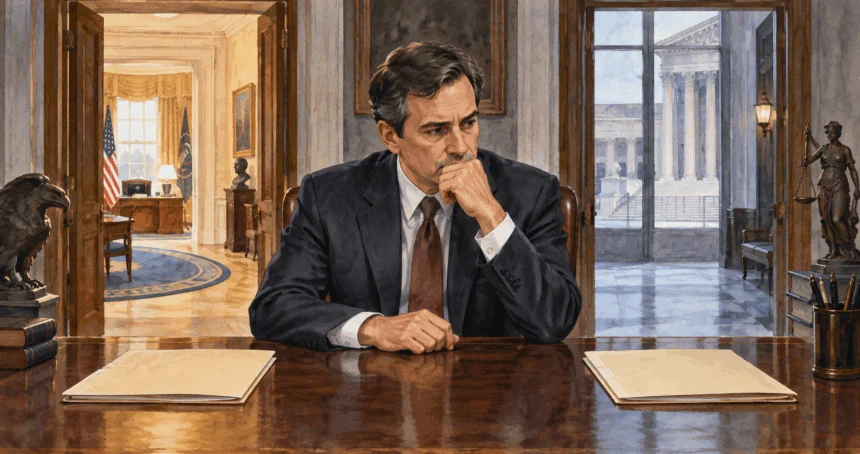
The Attorney General holds one of the most conflicted positions in American government. As a Cabinet member, they serve the President who appointed them. As the nation’s top law enforcement officer, they’re supposed to enforce laws fairly regardless of politics.
This tension became clear during Watergate when President Nixon fired Justice Department officials who wouldn’t stop investigating him. The “Saturday Night Massacre” created a crisis of public trust that shaped how every Attorney General since has approached the job.
- Understanding the Role
- Attorneys General of the United States (Reagan-Biden Administrations)
- The Reagan Years: Setting Conservative Priorities
- The Bush Sr. Years: Executive Power and Iran-Contra’s End
- The Clinton Era: Crisis Management and Independent Counsels
- The Bush Jr. Years: War on Terror and Executive Power
- The Obama Years: Restoring Independence and New Controversies
- The Trump Era: Testing the Breaking Point
- The Biden Era: Rebuilding in a Polarized Environment
- Lessons from Four Decades
The post-Watergate era established new norms: while administrations can set broad policy priorities, individual criminal and civil cases should be pursued based on facts and law, not partisan considerations. But as this history shows, those norms have been tested, bent, and sometimes broken by Attorneys General from both parties.
Understanding the Role
The Department of Justice serves two masters. The Attorney General advises the President on legal matters and implements administration policy. But they also oversee federal prosecutors, enforce civil rights laws, and investigate crimes — including those that might involve the administration itself.
This creates an inherent conflict between political loyalty and legal independence. Every Attorney General must decide where to draw the line between these competing demands.
The following analysis examines how Attorneys General from Reagan through Biden have navigated this challenge, distinguishing between “politicization” — using DOJ powers for political purposes– and “weaponization” — systematically misusing those powers to defy the rule of law.
Attorneys General of the United States (Reagan-Biden Administrations)
| President | Attorney General | Party Affiliation | Years of Service |
|---|---|---|---|
| Ronald Reagan | William French Smith | Republican | 1981–1985 |
| Ronald Reagan | Edwin Meese III | Republican | 1985–1988 |
| Ronald Reagan | Richard Thornburgh | Republican | 1988–1989 |
| George H.W. Bush | Richard Thornburgh | Republican | 1989–1991 |
| George H.W. Bush | William P. Barr | Republican | 1991–1993 |
| Bill Clinton | Janet Reno | Democratic | 1993–2001 |
| George W. Bush | John Ashcroft | Republican | 2001–2005 |
| George W. Bush | Alberto Gonzales | Republican | 2005–2007 |
| George W. Bush | Michael B. Mukasey | Republican | 2007–2009 |
| Barack Obama | Eric H. Holder, Jr. | Democratic | 2009–2015 |
| Barack Obama | Loretta E. Lynch | Democratic | 2015–2017 |
| Donald Trump | Jeff Sessions | Republican | 2017–2018 |
| Donald Trump | Matthew Whitaker (Acting) | Republican | 2018–2019 |
| Donald Trump | William P. Barr | Republican | 2019–2020 |
| Joe Biden | Merrick B. Garland | Democratic | 2021–Present |
The Reagan Years: Setting Conservative Priorities
William French Smith: The Policy Partner
Ronald Reagan appointed his longtime friend and advisor William French Smith as his first Attorney General in 1981. Smith’s tenure showed how an administration can reshape Justice Department priorities without crossing ethical lines.
Smith reoriented DOJ enforcement to match Reagan’s conservative agenda. The department took a more lenient view of corporate mergers, backing away from the aggressive antitrust enforcement of previous administrations. In civil rights, the DOJ reduced emphasis on affirmative action and mandatory school busing.
Critics argued the department filed fewer housing and education discrimination cases than its predecessors. But Smith’s approach stayed within legal bounds – he changed enforcement priorities rather than interfering with specific prosecutions.
Smith also championed Reagan’s anti-crime agenda. He successfully pushed for the Comprehensive Crime Control Act of 1984, which revised federal bail rules and established new sentencing guidelines. The DOJ’s law enforcement budget nearly doubled during his tenure.
He played a key role in selecting Sandra Day O’Connor as the first woman on the Supreme Court. Smith demonstrated that an Attorney General can advance an administration’s broad policy goals while maintaining prosecutorial integrity.
Edwin Meese III: The Presidential Shield
Edwin Meese III became Attorney General in 1985 just as the Iran-Contra scandal was developing. His handling of the affair became a cautionary tale about prioritizing presidential protection over law enforcement duties.
The Iran-Contra affair involved secretly selling arms to Iran and using the profits to fund Nicaraguan rebels, violating Congressional bans. When the scheme became public in November 1986, Meese launched what he called a “fact-finding” investigation.
Meese failed to secure National Security Council documents that were later altered and destroyed. He didn’t take notes during interviews with key officials, including President Reagan.
The Independent Counsel’s final report concluded Meese was acting as a “counselor” and “friend” to the President rather than the nation’s chief law enforcement officer.
When Meese’s team discovered the memo detailing funds diverted to the Contras, his first action wasn’t to secure evidence but to privately inform Reagan and his aides.
While Meese eventually requested an Independent Counsel, critics argued his initial actions compromised the investigation from the start. He established a troubling precedent of an Attorney General acting as presidential protector rather than independent law enforcer.
Richard Thornburgh: The Stabilizer
Richard Thornburgh took over in Reagan’s final months to restore the Justice Department’s credibility after the Iran-Contra scandal. He immediately pledged to “follow the evidence wherever it may lead” and refocused the department on traditional law enforcement.
The Bush Sr. Years: Executive Power and Iran-Contra’s End
Richard Thornburgh Continues: Federal Authority
Staying on under George H.W. Bush, Thornburgh oversaw major prosecutions including savings and loan cases, the BCCI money laundering scandal, and the Pan Am Flight 103 bombing. He also helped pass the Americans with Disabilities Act.
A defining moment was the “Thornburgh Memo” in 1989. This directive said federal prosecutors weren’t bound by state bar ethics rules prohibiting direct contact with represented individuals during investigations.
The memo asserted federal executive power under the Constitution’s Supremacy Clause. Critics, including the American Bar Association, argued it gave federal prosecutors unfair advantages. The policy was later reversed, and Congress ultimately required federal attorneys to follow state ethics rules through the McDade Amendment in 1998.
William Barr’s First Term: Unitary Executive Theory
William Barr brought strong views about presidential power to his first stint as Attorney General from 1991-1993. His belief in “unitary executive theory” — that the President has nearly unlimited authority over the executive branch — shaped his actions.
Barr’s most consequential decision involved President Bush’s Christmas Eve 1992 pardons of six Iran-Contra officials. Among those pardoned was former Defense Secretary Caspar Weinberger, who was awaiting trial on charges of lying to Congress.
Weinberger’s trial was expected to examine Bush’s own knowledge of Iran-Contra when he was Vice President. Barr had publicly criticized Independent Counsel Lawrence Walsh’s investigation as unconstitutional and fully supported the pardons.
The pardons effectively shut down the Iran-Contra investigation weeks before Bush left office.
This episode revealed how an Attorney General’s legal philosophy can directly impact investigations of the executive branch. Barr’s expansive view of presidential authority provided a framework for understanding his even more controversial second term decades later.
The Clinton Era: Crisis Management and Independent Counsels
Janet Reno: Independence Under Fire
As the first woman Attorney General, Janet Reno immediately faced crises that tested her independence throughout her eight-year tenure from 1993-2001.
Her first major challenge came at Waco, Texas, where she authorized the FBI’s plan to use tear gas against the Branch Davidian compound. The April 19, 1993, operation ended in tragedy when fire killed cult leader David Koresh and more than 75 followers, including children.
Reno took full responsibility, telling Congress: “It was my call, and I made it the best way I knew how.” While her candor was praised, her decision-making faced scrutiny. She initially justified the raid by citing ongoing child abuse reports, but FBI officials later said there was no contemporary evidence of abuse.
The Whitewater controversy created even greater pressure. Republicans demanded an investigation of Bill and Hillary Clinton’s failed Arkansas real estate investment. To demonstrate impartiality, President Clinton asked Reno to appoint a special counsel in January 1994.
She chose Robert Fiske Jr., a respected Republican former U.S. Attorney. But when the Independent Counsel Act was reauthorized, a three-judge panel replaced Fiske with Kenneth Starr.
Reno’s decision to allow Starr’s investigation to expand into President Clinton’s relationship with White House intern Monica Lewinsky showed remarkable independence from the White House. This ultimately led to Clinton’s impeachment, severely straining her relationship with the administration.
But, Republicans also questioned her independence when she refused in 1997 to appoint an independent counsel for alleged Clinton-Gore campaign fundraising violations. Reno argued the evidence didn’t meet the statute’s high legal threshold.
This created a paradox: the tool designed to ensure independence — the Independent Counsel statute — became an instrument of partisan warfare. The Starr investigation grew into a multi-year, multi-million dollar inquiry that consumed the Clinton presidency.
Reno later testified against renewing the statute, arguing it created prosecutors with unlimited time and budgets while failing to remove politics from sensitive investigations. Her experience showed that independence mechanisms, if not carefully constrained, could be weaponized to undermine rather than serve public trust.
The Bush Jr. Years: War on Terror and Executive Power
John Ashcroft: National Security Over Civil Liberties
The September 11, 2001 attacks on the World Trade Center immediately redefined John Ashcroft’s role as Attorney General from 2001-2005. He became the public face of the administration’s aggressive legal response to terrorism.
Ashcroft’s most lasting legacy was championing the USA PATRIOT Act. Rushed through Congress with little debate, the act granted vast new surveillance powers, often without traditional civil liberties safeguards and judicial oversight.
Civil liberties groups like the ACLU criticized the legislation as a “knee-jerk reaction” that allowed government intrusion into private lives without sufficient cause. Ashcroft defended the Act as essential for preventing future attacks and preserving American lives and liberty.
The debate highlighted deep alignment between the DOJ’s legal interpretations and the White House’s expansive view of executive power in national security matters, including controversial warrantless wiretapping programs.
Alberto Gonzales: The U.S. Attorney Firings
Alberto Gonzales, Bush’s close friend and former Texas counsel, faced controversy over anti-terrorism policies when he became Attorney General in 2005. As White House Counsel, he had authored memos dismissing Geneva Convention torture prohibitions as “quaint” and “obsolete.”
His tenure was ultimately defined by the 2006 dismissal of nine U.S. Attorneys. The administration initially claimed the firings were performance-based, but a Justice Department Inspector General investigation found the process “fundamentally flawed” with Gonzales “remarkably unengaged.”
The IG report uncovered “significant evidence that political partisan considerations were an important factor” in the firings. The most prominent case involved David Iglesias, the U.S. Attorney for New Mexico, who faced Republican pressure to bring voter fraud cases before the 2006 midterms but declined due to lack of evidence.
This exposed systematic efforts to ensure ideological alignment within DOJ prosecutorial ranks, moving beyond traditional presidential appointment prerogatives to using removal as a tool for influencing specific prosecutorial decisions.
In congressional testimony, Gonzales offered inconsistent explanations and claimed “extraordinary lack of recollection” about key meetings and decisions. The scandal eroded public trust and led to resignations of several top DOJ officials, including Gonzales himself in August 2007.
Michael Mukasey: The Torture Question
Michael Mukasey was appointed to restore Justice Department stability after the U.S. Attorney firing scandal. But his tenure was quickly dominated by controversy over the Bush administration’s interrogation program.
During confirmation hearings, Mukasey repeatedly refused to state whether waterboarding constituted illegal torture, calling it a “difficult question” where “people of equal intelligence and equal good faith” disagreed.
This equivocation avoided publicly contradicting secret Office of Legal Counsel memos that had authorized techniques widely considered torture. Later-released OLC memos revealed DOJ lawyers had used strained reasoning to conclude such techniques didn’t meet the “severe pain” threshold under federal law.
Mukasey defended the OLC lawyers as acting in “good faith” during national peril. Critics argued the memos showed DOJ had abandoned its role as guardian of the rule of law to become an enabler of illegal executive actions.
The Obama Years: Restoring Independence and New Controversies
Eric Holder: The Fast and Furious Backlash
As the first African American Attorney General, Eric Holder aimed to restore DOJ independence and reinvigorate the Civil Rights Division. But his long tenure from 2009-2015 became defined by intense political backlash over “Operation Fast and Furious.”
This Bureau of Alcohol, Tobacco, Firearms and Explosives operation used controversial “gunwalking” tactics, allowing firearms sales to straw purchasers to track them to high-level Mexican cartel members. The operation drew national outrage after two trafficked guns were found at the December 2010 murder scene of U.S. Border Patrol Agent Brian Terry.
The controversy escalated when Justice initially provided inaccurate information to Congress, denying ATF had knowingly allowed guns to “walk.” When evidence contradicted this claim, House Republicans launched an aggressive investigation accusing DOJ of a cover-up.
The dispute centered on DOJ’s refusal to provide internal documents about its congressional response. President Obama asserted executive privilege over the documents at Holder’s request, leading the Republican House to vote Holder in both criminal and civil contempt — the first time a sitting Cabinet member faced such citation.
A subsequent DOJ Inspector General report cleared Holder of prior knowledge of flawed gunwalking tactics but criticized other senior officials. The episode showed how an initial lack of transparency, combined with partisan oversight, could create confidence crises regardless of the AG’s direct involvement.
Loretta Lynch: The Tarmac Meeting
Loretta Lynch, the first African American woman Attorney General, took office in 2015 with the politically charged investigation into Hillary Clinton’s private email server already underway.
The defining moment occurred in June 2016 as the FBI investigation neared conclusion. Lynch had an unplanned meeting with former President Bill Clinton on the Phoenix airport tarmac. Both parties insisted their conversation was purely social and didn’t involve the investigation.
But the meeting created a political firestorm and perception of impropriety, undermining the Justice Department’s credibility in investigating Bill Clinton’s wife, the Democratic presidential nominee.
To mitigate damage, Lynch announced she would accept the “unanimous recommendation” of career prosecutors and FBI agents. While intended to signal impartiality, this effectively abdicated her decision-making authority as Attorney General.
The consequences were profound. FBI Director James Comey later testified the tarmac meeting was a key reason he decided to hold an unprecedented press conference announcing the FBI’s recommendation not to bring charges. Comey felt the meeting had “cast a shadow” over the investigation and that DOJ credibility was so compromised he needed to speak directly to the American people.
This break from DOJ protocol set the stage for Comey’s controversial decision to inform Congress of new developments in the FBI investigation of Hillary Clinton’s emails days before the 2016 election. The episode underscored that the appearance of politicization can damage DOJ mission and public trust as much as actual political interference.
The Trump Era: Testing the Breaking Point
The Trump presidency represented an unprecedented challenge to post-Watergate DOJ independence norms. The administration was characterized by presidential expectations of personal loyalty from the Attorney General, creating sustained public pressure and personnel turmoil.
Jeff Sessions: Recusal and Presidential Fury
As one of Trump’s first prominent endorsers, Senator Jeff Sessions was expected to be a loyal Attorney General. But his tenure was immediately defined by conflict between DOJ norms and presidential demands.
During confirmation hearings, Sessions testified he “did not have communications with the Russians” during the campaign. When it later emerged he had met twice with Russian ambassador Sergey Kislyak, he faced bipartisan pressure to recuse himself from any Russian interference investigation.
Following career ethics officials’ advice, Sessions announced his recusal in March 2017, stating: “I should not be involved in investigating a campaign I had a role in.” This adherence to departmental rules enraged Trump, who viewed recusal as personal disloyalty rather than ethical necessity.
For the remainder of Sessions’s tenure, Trump publicly and repeatedly attacked his own Attorney General, lamenting he would never have appointed Sessions had he known about the recusal. The President saw the recusal as directly leading to Deputy Attorney General Rod Rosenstein appointing Robert Mueller as Special Counsel. Mueller’s investigation was charged with examining potential Russian interference in the 2016 presidential election.
Despite constant criticism, Sessions aggressively implemented the administration’s conservative agenda. He rescinded Obama-era guidance limiting harsh mandatory minimums for non-violent drug offenses. He took hardline stances against “sanctuary cities” and played a key role in the controversial “zero tolerance” border policy resulting in family separations.
Sessions also severely limited DOJ use of consent decrees to oversee police departments accused of civil rights abuses. Trump fired Sessions on November 7, 2018, the day after midterm elections.
Matthew Whitaker: The Constitutional Question
Trump’s appointment of Matthew Whitaker, Sessions’s chief of staff, as Acting Attorney General immediately sparked legal and political controversy. Critics argued that because Whitaker hadn’t been Senate-confirmed for any position, his appointment violated the Constitution’s Appointments Clause.
The Justice Department defended the move under the Federal Vacancies Reform Act. But controversy was amplified by Whitaker’s past public statements criticizing the Mueller investigation which he was now in position to oversee.
This led to widespread concern that he had been installed specifically to curtail or shut down the Special Counsel probe.
William Barr’s Return: The Unitary Executive Unleashed
William Barr’s second tenure as Attorney General from 2019-2020 was among the most controversial in modern history. He was seen by Trump as the loyalist Sessions wasn’t, and his actions were marked by repeated interventions in politically-sensitive cases.
The most significant controversy was his handling of the Mueller Report. Upon receiving the Special Counsel’s 448-page report in March 2019, Barr didn’t release it immediately. Instead, he issued a four-page summary describing its “principal conclusions.”
Barr stated the investigation “did not establish that members of the Trump Campaign conspired or coordinated with the Russian government.” More contentiously, while noting Mueller hadn’t reached an obstruction conclusion, Barr announced he and Deputy AG Rosenstein concluded the evidence was “not sufficient to establish that the President committed an obstruction-of-justice offense.”
When the redacted report was released weeks later, it revealed Mueller’s team had explicitly stated: “while this report does not conclude that the President committed a crime, it also does not exonerate him.” Mueller later wrote to Barr complaining his summary “did not fully capture the context, nature, and substance” of the investigation’s findings.
Barr also intervened in high-profile cases involving Trump allies. He later told the House Judiciary Committee that the Stone and Flynn cases were ones where he “determined that some intervention was necessary to rectify the Rule of Law to make sure people are treated the same.” In February 2020, DOJ leadership overruled career prosecutors’ sentencing recommendation for Roger Stone, Trump’s longtime friend, who had been convicted of obstructing and lying to Congress and of witness tampering. All four line prosecutors on the case withdrew. One of them, Aaron Zelinsky, testified that he withdrew because he was “concerned over the political influence in the case.” Trump commuted Stone’s sentence on July 10, 2020, and pardoned him on December 23, 2020.
In May 2020, Justice moved to dismiss its case against Michael Flynn, Trump’s first National Security Advisor. Flynn had twice pleaded guilty to lying to the FBI, and in January 2020 he had moved to withdraw his guilty plea. Trump pardoned Flynn on November 25, 2020, and on December 8, 2020, the judge dismissed the case as moot because of the pardon.
The Biden Era: Rebuilding in a Polarized Environment
Merrick Garland: The Institutionalist’s Challenge
The Biden administration began with explicit goals of restoring DOJ independence and reaffirming its rule-of-law commitment. But Attorney General Merrick Garland quickly found that operating in a hyper-partisan, deeply distrustful environment posed unprecedented challenges.
Garland’s nomination signaled a return to traditional norms. A widely respected former federal judge, his confirmation was framed as a move to depoliticize Justice after the turbulent Trump years.
One of Garland’s first acts was issuing a memorandum strictly limiting White House-DOJ communications regarding ongoing investigations, directly repudiating previous administration practices.
The defining task of Garland’s tenure has been overseeing the January 6, 2021 Capitol attack investigation. He has described it as one of the largest, most complex investigations in DOJ history. The department has charged more than 1,500 individuals for their roles in the attack.
Despite efforts to project methodical, non-partisan approach, Garland has faced intense criticism from both sides. Many Democrats argued he moved too slowly investigating Trump’s role in election overturn efforts, expressing frustration that his institutionalist approach failed to meet the moment’s urgency.
Republicans and Trump supporters have accused Garland’s DOJ of “weaponization,” alleging investigations into Trump are politically motivated witch hunts against a political opponent.
To navigate this political landscape and insulate the department from bias accusations, Garland has relied heavily on the special counsel mechanism. In November 2022, he appointed Jack Smith to handle two federal Trump investigations: one related to January 6th and another concerning classified document mishandling.
In August 2023, he appointed David Weiss, the Delaware U.S. Attorney originally appointed by Trump, as special counsel to continue the Hunter Biden investigation.
The Hunter Biden investigation, which began under Trump, produced federal tax and gun-related charges. The case remained a political flashpoint, with Republican critics alleging lenient treatment and IRS whistleblowers claiming the probe was improperly delayed.
The dynamic shifted dramatically on December 1, 2024 when President Joe Biden issued a full pardon for his son, an extraordinary presidential intervention in an ongoing special counsel case. Biden claimed the prosecution was “selective” and “political,” while Special Counsel Weiss noted the pardon prevented him from making “additional charging decisions.”
Garland’s tenure demonstrates the profound difficulty of restoring public trust in a polarized era. His deliberate, institutionalist approach has been interpreted through partisan lenses by all sides. Heavy reliance on special counsels tacitly admits the Attorney General and DOJ are no longer viewed as credible, independent arbiters in politically sensitive cases.
This suggests the Justice Department institution has suffered lasting damage to its perceived legitimacy, one that may not be reparable simply through one individual’s commitment to traditional independence norms.
Lessons from Four Decades
The history of Attorneys General since Watergate reveals several clear patterns:
Political pressure is constant. Every Attorney General faces pressure to serve the President’s political interests over law enforcement duties. The source and intensity vary, but the tension is inherent to the role.
Independence comes at a cost. Attorneys General who maintain independence often face criticism from their own administration. Sessions’s recusal cost him his job. Reno’s decisions strained her relationship with Clinton. Lynch’s tarmac meeting compromised her credibility.
Perception matters as much as reality. The appearance of politicization can be as damaging as actual political interference. Lynch’s innocent airport conversation created lasting damage. Gonzales’s memory lapses suggested a cover-up even if none existed.
Crisis reveals character. Major scandals and investigations test Attorneys General’s independence most severely. Iran-Contra, Whitewater, 9/11, and January 6th all forced Attorneys General to choose between loyalty and law.
Norms can be rebuilt but easily broken. Post-Watergate independence expectations held for decades but proved fragile under sustained assault. Once broken, these norms are difficult to restore.
Special counsels create new problems. Mechanisms designed to ensure independence can become tools of partisan warfare. Independent counsels and special prosecutors can operate with unlimited budgets and time, sometimes pursuing cases beyond reasonable bounds.
The Attorney General’s tightrope walk between politics and independence grows more difficult in an increasingly polarized environment. Each administration’s approach shapes not just its own legacy but the institution’s long-term credibility.
The challenge for future Attorneys General will be maintaining public trust while serving in an inherently political role. History suggests this requires not just good intentions but sustained commitment to institutional norms, even when those norms conflict with immediate political interests.