Last Checked: August 1, 2026Next Check: August 1, 2030
Government and agencies 65 Research and academic 10 Industry and standards 2 News and analysis 13 Public commentary 9 Other sources 17
- postalmuseum.si.educited ×514 reviewed
- about.usps.comcited ×210 reviewed
- pe.usps.com6 reviewed
- congress.govcited ×14 reviewed
- facts.usps.comcited ×14 reviewed
- presidency.ucsb.edu4 reviewed
- uscode.house.gov4 reviewed
- si.edu3 reviewed
- uspsoig.govcited ×13 reviewed
- 21cpw.com
- archive.org
- docsteach.org
- everycrsreport.com
- gao.gov
- guides.loc.govcited ×1
- jfk.blogs.archives.govcited ×1
- jfklibrary.org
- planning.lacity.gov
- prc.gov
- princeton.educited ×1
- upload.wikimedia.org
- uspostalbulletins.com
- britannica.comcited ×13 reviewed
- pmc.ncbi.nlm.nih.govcited ×12 reviewed
- daily.jstor.orgcited ×1
- ethndis.orgcited ×1
- geoalliance.asu.edu
- muse.jhu.edu
- smithsonianmag.com
- policymap.comcited ×1
- zipinstant.com
- mentalfloss.com2 reviewed
- npr.org2 reviewed
- yahoo.com2 reviewed
- finance.yahoo.com
- history.com
- historyfacts.com
- latimes.comcited ×1
- newrepublic.comcited ×1
- nytimes.com
- sunjournal.com
- facebook.com9 reviewed
- govinfo.gov11 reviewed
- archives.gov6 reviewed
Last updated 3 months ago. Our resources are updated regularly but please keep in mind that links, programs, policies, and contact information do change.
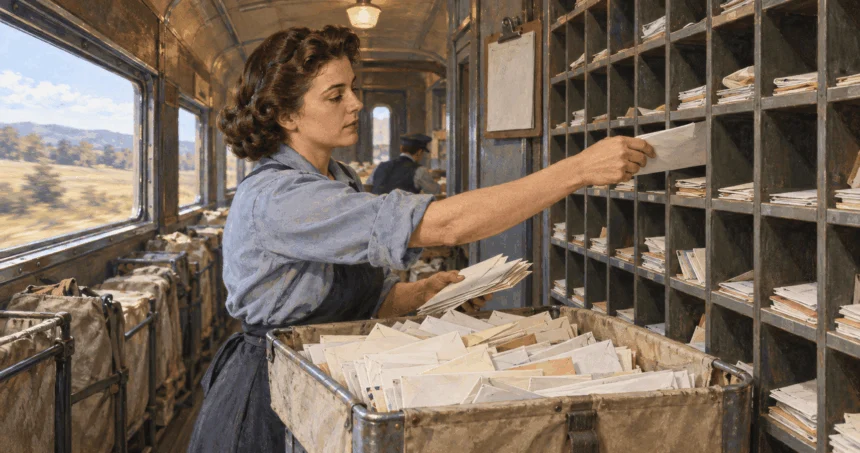
A postal clerk stands in front of a wall of pigeonholes. In his hands is a stack of letters he has to sort while the train moves, tossing each one into the right slot from memory: which town sits on which line, which bag drops at which station.
He was fast. The best clerks could sort faster than one piece of mail per second. But he was also the bottleneck, and by the early 1960s the bottleneck was cracking.
That is the problem the ZIP Code was built to solve. Not confusion about addresses. A shortage of human memory.
Mail volume had roughly doubled between 1943 and 1963, and the whole system still ran on clerks who knew which trains served which towns. The five-digit code, introduced nationwide on July 1, 1963, did one thing above all: it moved the knowledge of where a letter was going out of people’s heads and onto the envelope, in a form a machine could read. Everything else, faster sorting, fewer errors, eventual automation, followed from that single shift.
The Flood the Old System Could Not Hold
Start with the sheer weight of the mail, because that is where the pressure came from.
The Post Office Department, the cabinet-level agency that preceded today’s Postal Service, gained authority under an Act of February 28, 1925 to account annually for revenues and costs of each type of mail. By the 1950s those ledgers told an uncomfortable story.
First Class Mail alone climbed year after year, from roughly 24,500 million pieces in 1950 to 33,235 million by 1960. Total mail told an even starker version: from around 30 billion pieces a year during the Depression to, according to JSTOR Daily, more than 80 billion pieces a year.
Here is the volume that confronted the department, drawn from its own First Class series.
| Year | First Class Mail Pieces (millions) |
|---|---|
| 1950 | 24,500 |
| 1960 | 33,235 |
| 1963 | 35,833 |
| 1970 | 48,640 |
Source: USPS, First Class Mail Volume Since 1926. Figures come from annual reports of the Postmaster General and later USPS reports.
Every additional billion pieces meant more trays to fill, more bags to dispatch, and more chances to send a letter to the wrong city. The mid-century crisis was not about absolute size; by comparison, First Class volume still ran above 52,000 million pieces in 2020. It was about rapid growth pressing against a system that had never been redesigned for scale.
And that system had one soft spot everyone could see: it depended on people remembering things.
How Mail Actually Moved Before the Code
To understand the failure, you have to understand the railway car.
Clerks sorted and postmarked mail by hand in special railway cars fitted out as rolling post offices, dropping bags at stations as the train rolled, per the Smithsonian’s National Postal Museum.
Every routing decision happened in real time, in someone’s head. A clerk had to know which towns sat on which lines and which connecting routes served which regions.
Space was finite. Clerks were finite. Both put a ceiling on how many letters could move accurately per hour.
One of the people who saw that ceiling coming was Robert Aurand Moon, described by the Los Angeles Times as “the postal official who helped invent the ZIP Code system and later was director of delivery services for the U.S. Postal Service.” Reports suggest Moon believed as early as the 1940s that the railway system could not carry the volumes the postwar economy would generate.
He was reading the trend correctly. As transportation shifted toward highways and airplanes in the 1950s, the railway sorting infrastructure grew less central, but the sorting methods it had shaped stuck around. Postal officials, according to JSTOR Daily, even looked to emulate a West German coding system as they thought about how to move mail through trucks and planes rather than trains.
So by the late 1950s the department faced an awkward pileup. Volumes rising. Trains fading. Trucks and airplanes ascending.
And no national code that could tell any of them, machine or human, where a given letter needed to go.
The Half-Measure of City Zones
The department had already tried a smaller fix, and its limits are the clearest evidence of what a real solution would need.
During World War II, with experienced clerks off at war and replacements lacking their route knowledge, the Post Office Department reached for numbers. The Congressional Research Service describes it: “The U.S. Post Office Department, predecessor to USPS, developed a zoning address system in 1943 as a way to make sorting and delivery of mail easier. The first postal zones were one to two digits and used in large cities only.”
You wrote them right into the address, in a format like Chicago 5, Illinois, where the 5 pointed to a particular station within the city. It worked well enough that, per the Smithsonian’s National Postal Museum, numerous cities adopted zone codes, and most kept using the system for years afterward.
The wartime experiment proved something quietly radical: a code could stand in for a memory. A replacement clerk with a zone number could do work that used to require years of local knowledge.
But the zones had two fatal gaps.
The first was scope. Only large cities had them. Smaller towns and rural areas, most of the map, had nothing. A clerk still had to read textual place names and decide, from experience, which bag or dispatch a letter belonged in.
The second was direction. A two-digit zone helped sort mail once it had arrived in Chicago. It said nothing to a clerk in another state about how to get a letter to Chicago in the first place. Long-distance routing, the part groaning under the volume increase, was exactly the part zones could not touch.
The department drew the obvious conclusion. It needed a code that described a letter’s whole journey, not just its last mile.
Why the Number Had to Be Five Digits
The design that emerged was less a single invention than a two-decade argument inside a bureaucracy, and even the credit for it is contested.
Moon is often called the father of the concept. He began working on a modern delivery system in 1944, sketching an elementary three-digit code that pointed to the general region of the country a letter was bound for, later supplemented by two more digits for a smaller delivery area. The Postal Service credits Moon with those first three digits and says the final two were added by other postal workers.
Who added them is where the accounts diverge. The National Archives credits postal inspector H. Bentley Hahn as the man who invented the 5-digit ZIP Code.
That account records that “After spending six years evaluating the operations of the field postal service, Hahn submitted a report entitled, ‘Proposed Reorganization of the Field Postal Service’ (1953) to the Inspector in Charge, C. C. Garner, as a solution to the developing mail problem.” That report, the National Archives adds, “would later contribute to the, ‘Zone Improvement Plan,’ establishing the five-digit ZIP Code.”
Others split the difference. History.com hands Moon the first three digits and Hahn the last two. Britannica describes Moon’s idea as accepted and expanded upon by a committee inside the postal service. The disagreement itself is revealing: this was collective bureaucratic work, later simplified into neat origin stories.
Whatever the authorship, the finished structure is clever and simple, and it maps directly onto the routing problem it was solving. USPS explains the logic on its Decoding the ZIP Code page. The first digit marks a broad region of the country, running roughly east to west. The next two point to a regional area, and the last two identify specific Post Offices.
CRS adds the operational detail. Generally the first three numbers correspond to the USPS Sectional Center Facility that processes mail for a geographic area, and “the last two represent specific post offices or postal zones.” A Sectional Center Facility is the regional hub that gathers and redistributes mail for the towns around it.
Read that structure again and you can see the whole delivery network folded into five characters. Sort by the first digit and a letter heads toward the right part of the country.
Sort by the first three and it lands at the right regional hub. Sort by all five and it reaches the right local office. Each stage refines the last.
Why five? Because five digits give 100,000 possible combinations, comfortably more than the country needs. USPS reports 41,554 ZIP Codes currently in use, with room left for new offices and shifting boundaries. If you want the plain-language version of what the acronym means and how the pieces fit, our earlier guide to finding your ZIP code walks through it.
The genius was compactness. Short enough for a person to write, structured enough for a machine to read, detailed enough to route accurately.
Selling a Number Nobody Asked For
Designing the code was one thing. Getting 180 million Americans to use it was another, and this is the part the tidy histories skip.
According to the Postal Museum, July 1, 1963 marked the public introduction of a new way of processing mail by adding five numbers to each address.
Crucially, using the ZIP codes was optional. And a number you did not have to write is a number many people did not write.
According to Britannica, adoption of the new system was rocky. Within three months of the July 1963 rollout, ZIP codes appeared on only about 30% of mail. Britannica notes that only “after an extensive publicity campaign, the department finally succeeded in eliciting from the public a widespread acceptance of the ZIP code.”
That campaign had a face. Postmaster General J. Edward Day launched the code alongside a cartoon letter carrier drawn to look like speed in motion.
In July 1963, the Post Office Department introduced nationwide five digit ZIP codes and began a marketing and education campaign using a cartoon letter carrier, Mr. ZIP. His slogan, per an industry history, was “Mail Moves the Country, and ZIP Code Moves the Mail!”
Mr. ZIP turned out to be a genuine pop icon. The Postal Museum notes he appeared widely in American media, appearing in magazines, on delivery trucks, in post office lobbies, and on television. You do not commission a cartoon spokesman for a change you expect people to welcome.
Households got a mascot. Businesses got math. Large mailers were shown concrete savings, and when persuasion wasn’t enough, the department made it a rule: ZIP codes were made mandatory in 1967 for second- and third-class mail.
By 1969, roughly 83% of Americans were using them. Carrots, cartoons, and eventually compulsion. It took nearly 3 years for a significant share of the public to come around.
What the Five Digits Actually Fixed
Now to the payoff, the part that answers why any of this was worth a six-year publicity war.
Recall the ceiling: a top human clerk topped out around 3,600 pieces of mail per hour, achieved by an LSM key-in console operator typing ZIP codes rather than by memory and hands alone. Under the old routing, a letter went through about 17 sorting stops on its way to a doorstep, each one a manual handling and another chance to go astray.
The ZIP Code was the precondition for breaking that ceiling. The USPS Office of Inspector General states the intent directly in its white paper: “In 1963 the Post Office Department introduced the Zone Improvement Plan (ZIP) Code as a means to allow mail sorting methods to become faster and eventually be automated.”
The key word is automated. A machine cannot read and sort thousands of city names, abbreviations, and local conventions reliably. Give it a structured number, though, and it can scan an address, print a barcode, and route.
Early optical scanners built for ZIP-code sorting could process roughly 30,000 letters per hour; later USPS automation equipment pushed that figure to 36,000 pieces per hour, far outpacing manual sorting.
The code also let the labor move outside the Postal Service entirely. According to the Smithsonian’s National Postal Museum, ZIP codes let large-volume mailers presort mail by computer and deposit it already sorted by sectional center, cutting out multiple handlings and speeding delivery. Work that once sat inside a sorting room now happened upstream, in a company’s mailing software.
The trial evidence was concrete. In test areas, ZIP-based presorting produced annual savings of about $10,000 and delivery sped up by up to 48 hours, with no job losses. The JFK Library records that Hahn’s plan, tested in those areas, “led to a decrease in cost and delivery time.”
For a closer look at how those scanners and barcodes run today, see our tour of how a USPS sorting center works.
So the fix, in one line: the code turned routing from an act of recall into an act of reading, and reading is something machines do at scale.
The Four Digits That Finished the Job
The original five digits solved routing to the facility. They left one thing unsolved, and the answer arrived twenty years later.
Five digits could get a letter to the right post office. Inside a dense delivery zone, though, ambiguity remained.
Which side of the block? Which floor of the office tower? Which bank of PO boxes? A carrier still had to sort that out by hand.
Enter ZIP+4, introduced in 1983. The extra four digits add a delivery sector and a delivery segment, pinpointing a smaller area within a ZIP code. The Postal Museum describes what they bought: the additional digits “routed mail to one floor of an office building, one side of a block, or specific post office boxes, enabling letters to be automatically sorted to the correct carrier at the delivery office.”
This was not a cosmetic upgrade. It was the code catching up to what automation could finally do. A 1984 Office of Technology Assessment report to Congress spelled out the mechanics: ZIP+4 lets the Postal Service sort letters “down to the city block, building, or post office box,” where five digits reached only a broader post office zone.
According to the 1984 Office of Technology Assessment report, once an optical reader scans the address and prints a barcode, the letter can then be sorted automatically down to the level of carrier routes, with all intermediate manual sorting eliminated. The 17 sorting stops collapse toward zero human touches until final delivery.
The Postal Service even paid for the privilege. Under the 1984 pricing OTA documented, ZIP+4 presort First-Class mail earned a discount of half a cent per piece when the address was machine-readable and mailed in batches of 500 or more. A tiny sum per letter, but at billions of letters it is real money, and it nudged the entire flow of mail into machine-friendly form.
Two codes, two eras. The five-digit code was the automation project of 1963. The four-digit extension was the automation project of 1983. Each solved the ambiguity its own decade’s machines had left on the table.
The Number Grew a Second Life
Here is the twist the postal engineers never planned for. The ZIP Code stopped being only about mail.
The OIG white paper hints at it, noting the code created unimagined socio economic benefits as an organizing and enabling device. Put plainly, a standard number for every address became a handy way to sort and study people by where they live. Once every address in America carried a compact geographic key, that key became useful to anyone who wanted to organize information about where people live: insurers, retailers, credit agencies, political campaigns, and public health departments.
Consider one vivid case. When individual race and ethnicity data were often missing from case reports, researchers argued that area data like someone’s ZIP code could stand in as a rough substitute, letting health departments see disparities they would otherwise be blind to.
Research during the pandemic documented that ZIP codes with higher proportions of racial and ethnic minorities had significantly higher COVID-19 incidence than ZIP codes with fewer. A mail-routing number, built to spare railway clerks the burden of memory, had become an instrument for detecting who was getting sick and where.
That repurposing carries a tension worth sitting with. A ZIP Code is a rough stand-in for a person. It captures a neighborhood, not an individual, and using it to guess someone’s risk, income, or opportunity means treating geography as destiny. That is powerful when it surfaces a hidden inequity. It is troubling when it hardens into a judgment about who someone is.
The engineers of 1963 were solving a sorting bottleneck. They could not have known they were also building one of the most widely used geographic identifiers in American life, or that six decades later the open question would no longer be whether the code can move the mail. It plainly can. The question is how much we should let five digits tell us about the people who live inside them.