Last Checked: October 5, 2026Next Check: July 21, 2029
- pe.usps.comcited ×10
- legis.iowa.govcited ×9
- faq.usps.comcited ×8
- files.gao.govcited ×4
- facts.usps.comcited ×3
- uspsoig.govcited ×3
- about.usps.comcited ×1
- gao.govcited ×1
Last updated 2 weeks ago. Our resources are updated regularly but please keep in mind that links, programs, policies, and contact information do change.
Inside a mail sorting center, the address on an envelope becomes a set of instructions for the next leg of its trip. The United States Postal Service (USPS) scans the delivery address and prints a barcode that lets machines group the letter with mail headed toward the same destination.
If a machine cannot read that address, the letter does not necessarily leave the automated system. USPS sends an image to human readers at its Remote Encoding Center; their answer goes back to the plant so a barcode can be printed on the envelope. Mail with no postage, no return address or an address nobody can identify follows separate rules, and a sender can ask USPS to search for an item that goes missing.
From the Mailbox to the Processing Plant
A carrier empties a collection box, takes the mail to a post office and combines it with other carriers’ collected mail for transport by truck to a processing plant.
Regional Processing and Distribution Centers sort mail and packages for other regions as well as items that will be delivered within their own region. A processing plant therefore serves both the outgoing journey and the approach to delivery, rather than acting only as a stop near the sender.
The Sorting Process
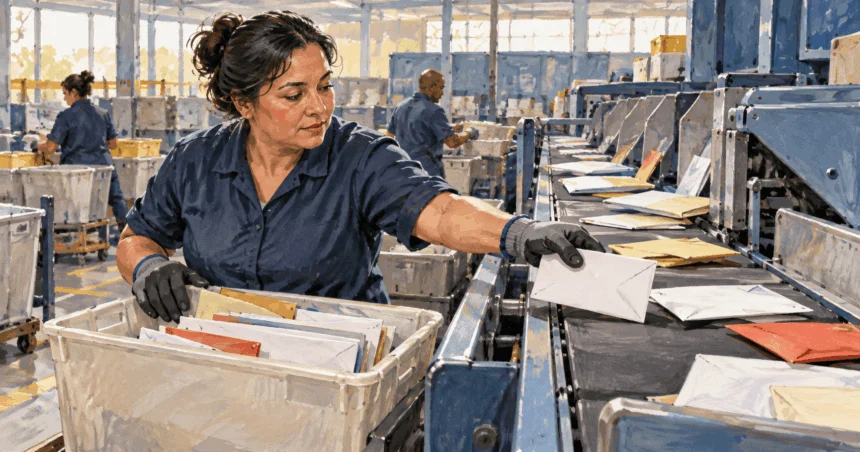
At the plant, a machine separates letters from large envelopes and packages by shape, a step called culling. It also turns letters so their addresses face the same way and are right side up. It then applies a postmark showing the date and place of sorting, along with cancellation lines so the stamp cannot be reused.
An optical character reader scans the delivery address, and a barcode representing that address is applied to the front of the letter. Optical character reading means software tries to interpret the written characters, turning the address into information a sorter can use. The barcode directs the letter into a machine bin for a range of ZIP Codes that identifies the next processing plant. The letter is placed in a tray with other mail for that ZIP Code range, and the tray travels to the destination processing plant.
At the destination plant, further sorting separates letters for a particular ZIP Code from other letters in that broader range. A delivery barcode sorter then groups letters for the carrier who will deliver them and puts that carrier’s letters into delivery order. The sorting becomes more specific as the letter approaches its recipient, moving from a region’s mail toward the sequence of addresses along a carrier’s route. The carrier’s mail then goes by truck to the delivery post office.
What Happens to Mail With No Postage or No Address
What USPS does with a problem letter depends on whether it has an address it can deliver to, an address it can return to, and the postage needed for the mailing.
Under the ordinary rule in USPS’s Domestic Mail Manual, mail received without postage is marked Returned for Postage and sent back to the sender without an attempt at delivery. If that unpaid mail has no return address, USPS treats it as dead mail, the category for mail that cannot be delivered or returned. Mail recovery centers seek a sender’s or recipient’s name and address so dead letters and parcels can be returned or delivered. The manual provides for opening dead letters at recovery centers and dead parcels at the Mail Recovery Center to find that identifying information.
Shortpaid mail, meaning some postage was paid but not enough, can be delivered with postage due, which the recipient must pay before receiving it. USPS says that if a shortpaid item cannot be delivered as addressed, including when the recipient refuses to pay and accept it, it is returned for additional postage. The sender can add the missing postage to the returned piece and leave the postage-due marking in place; a new envelope is not needed. So a letter with too little postage may still be delivered, while one with none ordinarily is not.
USPS describes a special December practice for domestic First-Class greeting cards without a return address: cards lacking postage or falling below minimum size are generally delivered with postage due instead of going to the Mail Recovery Center. That limited holiday exception should not be treated as a year-round promise to deliver unstamped mail.
USPS requires a return address for specified kinds of mail, rather than making it a universal requirement for every ordinary stamped letter. The required categories include Priority Mail, USPS Ground Advantage, Registered Mail and insured mail, as well as Certified Mail when a return receipt is requested. For ordinary mail that does not fall into a required category, omitting the return address is chiefly a problem when the delivery fails and the sender needs the item back.
USPS lists incomplete, illegible or incorrect addresses, an addressee who is no longer there, unclaimed mail and refused mail among the reasons an item may be undeliverable. If an undeliverable item also cannot be returned to its sender, it becomes dead mail, and USPS makes a reasonable effort to reunite loose articles with their envelopes or wrappers.
For mail that is undeliverable as addressed, the class of mail determines whether it is forwarded, returned to the sender or treated as dead mail. A mailer can request forwarding, return or address correction through an endorsement, with the authorized instructions varying by mail class.
Unendorsed means the mail lacks the mailer’s request for forwarding, return or address correction. USPS Marketing Mail is a mail class used for advertising, newsletters, catalogs and small parcels. The manual directs disposal of undeliverable unendorsed USPS Marketing Mail, printed matter and publications, along with unidentified articles that have no value. By contrast, undeliverable articles worth $25 or more are treated as dead mail. Someone searching for missing mail therefore cannot assume that every undeliverable item was kept.
When Machines Need a Human Reader
At the Remote Encoding Center, employees view the address image and type information that is matched with a valid address before being transmitted back to the plant. Once that information produces a usable barcode, the letter can rejoin the same automated stream rather than requiring someone to hand-sort its whole journey. This is why poor handwriting does not necessarily make a letter undeliverable, but a destination nobody can identify still creates a real limit.
Letters, Flats and Packages Take Different Paths
USPS uses the term flats for large envelopes, newsletters and magazines. The Postal Service processes them on fully automated machines called the Automated Flat Sorting Machine 100. A second kind of machine, the Flats Sequencing System, sorted flats into precise delivery order. USPS removed all 100 of those machines between April 2021 and August 2023 and planned to use the space they had occupied, its Office of Inspector General reported. The shape distinction helps explain why a magazine does not simply follow an ordinary envelope through every piece of letter-sorting equipment.
For packages, the Matrix Regional Sorter uses a scanning tunnel with lasers, mirrors, cameras and optical character recognition to read addresses or barcodes and route items to the correct location.
In its review of that sorter, the inspector general found that overloaded belts could stack packages on top of one another, preventing scanners from reading their barcodes and causing mail to be resorted manually or rerun.
What a Tracking Scan Can Tell You
USPS groups In Transit, Arrived at USPS Facility and Departed USPS Facility as updates meaning a package is being processed or transported toward its delivering post office. Those scans may appear more than once from the same facility or on different days during the journey. A repeated facility name therefore does not, by itself, explain which sorting operation the package is undergoing or establish that it has been lost.
Ordinary First-Class postcards, letters and flats are not eligible for USPS Tracking, although letters and flats can use services such as Certified Mail or Registered Mail that provide barcodes and tracking information. The barcode that helps route an ordinary envelope should not be confused with a customer-facing tracking service.
For missing mail, USPS’s online search process requires signing in or registering at MissingMail.USPS.com and submitting the required identifying information. The application allows a search request starting seven days after the original mailing date and no later than 365 days after that date. The search clock runs from mailing, not from the last moment a tracking page changed.
A search request needs the sender’s and recipient’s addresses, mailing date, packaging details and a detailed description of each missing item, with a tracking number and photographs if available. Keep the mailing information and describe the contents precisely when submitting a search, especially if the item might have separated from its packaging.
A Network Still Changing
USPS’s redesigned network includes large Regional Processing and Distribution Centers, Regional Transfer Hubs that aggregate mail and packages, and Local Processing Centers that sort mail and some packages as they enter the network, adding postmarks, and for delivery in their region. Sorting and Delivery Centers combine carrier operations from several smaller locations, while delivery units are where mail and packages leave for final delivery. The delivery post office in the walk-through is a delivery unit, a Post Office or similar facility with mail-delivery functions; in some areas, Sorting and Delivery Centers combine several locations’ carrier operations.
In a September 17, 2026, report, the Government Accountability Office found that USPS had lengthened expected delivery times by 1 to 2 days while largely failing to meet even its reduced service standards. A faster or more capable sorting machine is only one part of delivery performance; the useful outcome is whether the whole journey gets mail to its destination within the expected time.