Last Checked: October 9, 2026Next Check: October 9, 2027
- ncpc.govcited ×10
- parkplanning.nps.govcited ×9
- cfa.govcited ×5
- achp.govcited ×4
- apportionment-public.max.govcited ×3
- nps.govcited ×3
- king.senate.govcited ×2
- gao.gov
- law.cornell.educited ×6
- presidency.ucsb.educited ×2
- savingplaces.orgcited ×5
- citizen.orgcited ×3
- storage.courtlistener.comcited ×2
- wlrn.orgcited ×2
- democracyforward.orgcited ×1
- notus.orgcited ×1
- aol.comcited ×1
- thedailybeast.comcited ×1
Last updated 5 days ago. Our resources are updated regularly but please keep in mind that links, programs, policies, and contact information do change.
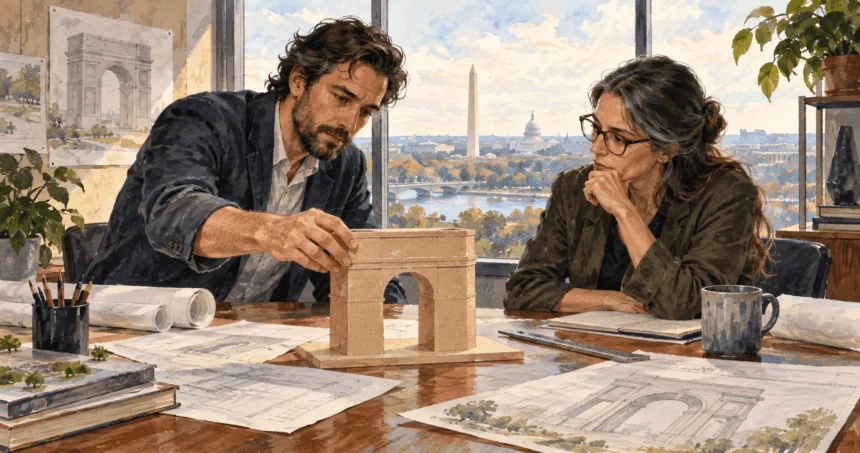
President Donald Trump’s proposed triumphal arch would rise approximately 250 feet at Memorial Circle in Washington, along the route from the Lincoln Memorial to Arlington National Cemetery.
That route already tells a story about the nation: Arlington Memorial Bridge links the Lincoln Memorial and Arlington House as a symbol of a reunited country. The Park Service has determined that the arch would adversely affect historic properties by changing significant views and their setting.
What Trump has proposed
The arch has not been built: a federal planning commission gave preliminary approval on July 9, 2026, with its final review still to come, and a lawsuit seeks to block construction, arguing that Congress has not authorized it.
The Daily Beast was using the nickname “Arc de Trump” by November 5, 2025.
The National Park Service calls the proposal the United States Triumphal Arch and describes it as a monument honoring the nation’s 250th anniversary and founding principles. The Department of the Interior, which includes the Park Service, submitted the project to the National Capital Planning Commission, the federal body reviewing its site and building plans.
Trump presented the idea at an October 15, 2025, dinner for White House ballroom donors in the East Room. Posters depicting the arch stood beside his lectern as he addressed the gathering.
NPR reported on September 21, 2026, that Trump said in a social media post that the arch would now be a military base for drones, snipers and ammunition. In the same broadcast, correspondent Franco Ordoñez said Trump claimed the military had called for the arch but had provided no details. That announcement is separate from the monument design the agencies have been reviewing.
Why the Arlington site matters
The proposed location is Memorial Circle on Columbia Island, at the western end of Arlington Memorial Bridge in Washington, D.C. Interior’s presentation to the Commission of Fine Arts, which reviews memorial designs, identifies the island, arch site and surrounding traffic circle as under Interior and National Park Service jurisdiction.
The Park Service explains that the bridge joins the Lincoln Memorial on the north side of the Potomac with Arlington House on the south, expressing the strength of a united nation. Memorial Bridge and Avenue also connect the capital with Arlington National Cemetery.
The National Trust for Historic Preservation argues that the arch’s scale, location and design would disrupt this visual and symbolic connection. In its July 9, 2026, statement, the preservation organization said the proposed design would overwhelm the cemetery’s solemn character.
The Park Service’s environmental assessment instead describes the project as a ceremonial gateway honoring founding principles, valor and sacrifice.
The design and its scale
The Park Service’s proposed-action description calls for a reinforced-concrete arch clad in granite, with a central winged figure and two eagles. Its principal architectural mass would be approximately 166 feet high, while the statuary would bring the total to approximately 250 feet. The approximate ground-level footprint would be 91 feet by 166 feet, with dimensions to be finalized in later design work.
For comparison, the Park Service lists the Lincoln Memorial as 99 feet tall. The official design presentation lists the Washington Monument at 555 feet.
Nicolas Charbonneau, a principal at Harrison Design, presented the revised concept to the Commission of Fine Arts. He described an enduring, grand gateway celebrating the anniversary of the nation’s founding.
The Park Service’s assessment invokes the Roman tradition of freestanding arches celebrating civic achievement.
Interior, the applicant, told the planning commission that it dismissed smaller arches because they fully obstructed the view between the Lincoln Memorial and Arlington National Cemetery and created no new viewing opportunities.
On May 21, 2026, the Commission of Fine Arts gave final approval to the arch’s structure and concept approval to the statue, requesting a return presentation of the sculptural program. That vote left the statue’s final approval for a later presentation.
Who would pay for the arch
A news report dated November 5, 2025, gave a $100 million estimate attributed to Axios’s unnamed White House sources.
Reporting on the financing says Trump floated using money left over from the White House ballroom project and told donors the archway was fully funded. Those statements describe a financing claim, not an itemized accounting of the arch’s construction costs.
The National Endowment for the Humanities’ fiscal 2026 spending plan reserved $2 million in Special Initiative funds for the arch. It separately reserved $13 million in matching funds for the arch. Together, those reservations show a public-funding component alongside the proposed use of leftover ballroom funds. They do not show that the entire construction bill has been paid or that every promised private dollar has arrived.
The spending plan says matching funding is obligated, or formally committed, as the required match is raised and certified by the endowment. Reserving money, committing it and paying it out are separate steps.
For projects it covers, the Commemorative Works Act, the federal law on permanent monuments on federal land in and around Washington, generally bars a construction permit unless the sponsor has donated 10 percent of the estimated construction cost for maintenance, in addition to having sufficient construction funding. The contribution requirement does not apply when a federal agency constructs the work and private sources provide less than half its funding. The funding mix can therefore affect obligations as well as the answer to who pays.
The approvals a proposal must clear
Three different issues sit behind the phrase “approved”: authority to establish the monument, approval of its design and site, and completion of the conditions for construction.
The Commemorative Works Act covers permanent monuments and other commemorative features on specified National Park Service and General Services Administration land in Washington and its environs. Its definition excludes structures primarily used for other purposes. Trump’s announced military role could bring that exclusion into play, though an announcement alone does not settle how the definition applies.
Under the act’s ordinary authorization rule, a commemorative work on covered federal land may be established only when specifically authorized by law. The approval process then calls for consultation with the National Capital Memorial Advisory Commission and submission of site and design proposals to the Commission of Fine Arts and National Capital Planning Commission.
The Congressional Research Service places Memorial Circle within Area I of the Commemorative Works Act map, one of the designated commemorative areas.
Area I has an additional requirement: the subject must be of preeminent historical and lasting significance, and the location recommendation must be approved by law within 150 calendar days of notification. For this location, congressional approval matters both to establishing a memorial and to choosing where it would stand.
The act sets a stricter rule for another zone, the Reserve. The Reserve is the Mall’s great cross-axis, generally extending from the Capitol to the Lincoln Memorial and from the White House to the Jefferson Memorial. There, the act bars new commemorative works and visitor centers. Memorial Circle is in Area I, not the Reserve, so the arch faces Area I’s requirements instead of that ban.
The question of authority is before a federal court in Lemmon v. Trump, a suit that Public Citizen filed for three Vietnam War veterans and an architectural historian to block construction. In their summary-judgment filing, the plaintiffs say the government claims to have found its authorization in a 1925 statute that directed the building of Arlington Memorial Bridge. The plaintiffs argue that its time limit, expenditure cap and completed bridge project cannot authorize a new massive arch. That is the plaintiffs’ legal argument, rather than a court ruling that has resolved the dispute.
Public Citizen’s case page, checked on October 9, 2026, reports that the government’s dismissal motion and the parties’ summary-judgment motions are awaiting a court decision.
The court has also set rules for work at the site. By Public Citizen’s account, after the Interior secretary posted on September 3 that excavation would begin within two weeks, the plaintiffs asked the court to block construction. The Park Service then said it was doing only archaeological excavation needed to comply with the National Historic Preservation Act and other laws.
Public Citizen says the judge then required 48 hours’ notice to the court before any other activity on Memorial Circle. The same account says construction before final Park Service authorization or without 14 days’ notice would violate the court’s orders.
The notice orders preserve a chance to challenge work before it happens; they do not decide the final meaning of the authorization statutes. Archaeological digging of the kind the Park Service described is not, by itself, proof that construction of the arch has begun.
In a June 2, 2026, motion, the government asked to pause briefing on the plaintiffs’ summary-judgment motion until the court ruled on its dismissal motion. A second motion filed that day asked for an expedited ruling on that request. Those motions concerned the briefing schedule, not a ruling on the arch’s legality.
The Height of Buildings Act of 1910 limits building height in Washington by street width, with maximums of 130 feet on commercial streets, 90 feet on residential streets and 160 feet on parts of Pennsylvania Avenue NW.
The design and site reviews are unfinished too. The planning commission is also considering whether the Height of Buildings Act binds the federal government and says it must decide that question before final action. It has requested a justification for the proposed height. Height review is only part of the remaining work: the commission also requested updated traffic, loading, aviation-lighting and granite-selection information.
Interior’s traffic study says the project could delay weekday-morning peak traffic for almost half a mile on Washington Boulevard and the George Washington Memorial Parkway. The study also says that, under the proposed design, visitors would no longer be able to reach Arlington National Cemetery from Washington Boulevard. The commission also records potential improvements to pedestrian and bicycle safety.
On October 8, 2026, the Arlington County Board filed a separate lawsuit in the Eastern District of Virginia. Its complaint argues that the Park Service’s environmental review was inadequate and seeks to stop construction until the required review is completed.
The Park Service has prepared a finding that the project would not cause significant environmental impacts, but expressly says this is not final project approval.
On September 24, 2026, the Advisory Council on Historic Preservation ended negotiations over an agreement under Section 106 of the National Historic Preservation Act, the federal process for reviewing effects on historic properties. The council said it would submit formal comments to the Interior secretary. The council says that review concludes when the secretary considers and responds to its comments.
The council’s notice says the Park Service determined that the arch would adversely affect historic properties by altering significant views, landscapes and their historic setting. A project can avoid the environmental threshold for significant impacts and still alter places valued for their history.
What to watch next
In its September 24, 2026, notice, the council said it intended to provide its advisory comments by October 7, 2026, and asked for public comments by September 29, 2026. The public comment deadline has passed. In an October 7, 2026, letter, the National Trust for Historic Preservation objected to the vice chairman’s draft comments, arguing that they understated the project’s effects on historic places. The Trust’s objection to the draft comments does not establish whether the council’s final comments have been transmitted to Interior. The final comments and the Interior secretary’s response remain the records to watch.
The Park Service’s environmental assessment anticipates two to three years of construction. That duration is not an opening date: final agency decisions and the unresolved court dispute still affect the project’s path.
Follow the planning commission’s project record, the Park Service’s planning record and the council’s project notice for new decisions.
For an item on its meeting agenda, the planning commission accepts written comments by noon the day before the meeting. Speaker registration deadlines vary with the item’s agenda classification, so check the commission’s published participation instructions before seeking to testify. These are standing participation rules, not an announcement of a new hearing on the arch.