Pony Express History and Its USPS Connection

GovFacts

Last updated 4 weeks ago ago. Our resources are updated regularly but please keep in mind that links, programs, policies, and contact information do change.

The image of a lone rider on a swift horse, racing across a vast and dangerous country to deliver mail, is part of the American identity.

The Pony Express played a key role in connecting a growing nation in the mid-19th century. While it ultimately went out of business, its legacy continues to resonate in the history and evolution of the United States Postal Service (USPS).

Origins of the Pony Express

The discovery of gold at Sutter’s Mill in California in 1848 sparked a massive westward migration, dramatically increasing the population on the Pacific coast. This influx of people, coupled with California’s admission to the Union in 1850, created an urgent need for reliable and faster communication between the newly established state and the rest of the country.

Existing mail delivery methods were woefully inadequate. Letters sent by steamship either had to travel the long journey around South America or take a route through Panama, involving transport by horseback or rail across the isthmus followed by another sea voyage to San Francisco. These routes often took weeks or even months for a single delivery.

Stagecoach lines offered an overland alternative, but these too were slow, with journeys frequently delayed for months due to weather or other challenges. The citizens of Los Angeles learned about California’s admission to the Union a full six weeks after it occurred, highlighting the need for improved communication.

Amid growing tensions between northern and southern states leading up to the Civil War, the need for a secure communication link with California, a state with significant resources and a stance against slavery, became critical.

Senator William M. Gwin of California championed the idea of a shorter, more direct “Central Route” for mail delivery. Gwin found a willing partner in William Russell, a principal in the established freighting firm of Russell, Majors and Waddell.

Russell envisioned securing a lucrative government mail contract by demonstrating the viability of a rapid express service over this central route, hoping to outcompete the existing Overland Mail Company. Despite initial opposition from his partners, Alexander Majors and William Waddell, the trio embarked on establishing the Pony Express.

The responsibility for the logistical planning fell largely to Alexander Majors, who arranged for the acquisition of hundreds of horses, the construction and staffing of numerous stations across desolate territories, and the recruitment of riders. This monumental undertaking was accomplished in about two months during the winter of 1860.

YearEvent
1848California Gold Rush begins
1850California admitted to the Union
1858Butterfield Overland Mail Company established
Apr 3, 1860Pony Express begins operation
Jun 16, 1860Congress authorizes transcontinental telegraph line
Jul 1, 1861Pony Express operates under contract as a U.S. Mail route
Oct 24, 1861Transcontinental telegraph line completed
Oct 26, 1861Pony Express officially terminates

Operations of the Pony Express

The Pony Express route spanned approximately 1,900 miles, connecting St. Joseph, Missouri, with Sacramento, California. For much of its length, the route followed established trails such as the Oregon Trail, the California Trail, and the Mormon Trail.

The route traversed the vast territories that would later become the states of Missouri, Kansas, Nebraska, Colorado, Wyoming, Utah, Nevada, and California. The final leg of the journey involved transferring the mail to steamboats for the trip down the Sacramento River to San Francisco.

The strategic selection of existing routes facilitated the rapid deployment of the service, though it also meant the riders faced the inherent dangers and challenges already present along these paths. Detailed maps of the Pony Express route were created, highlighting the meticulous planning involved in this complex operation.

Approximately 80 young men served as riders for the Pony Express. These riders were typically young, often teenagers, and had to be lean, expert horsemen weighing no more than 125 pounds.

The demanding nature of the job, which involved riding long distances across challenging terrain and facing potential dangers, was reflected in the relatively high wage of around $100 per month, a significant sum for the time.

Alexander Majors required each rider to swear an oath upon a Bible, promising to abstain from profanity, alcohol, gambling, and cruelty to animals. This emphasis on moral conduct aimed to project an image of reliability and trustworthiness for the fledgling enterprise.

To facilitate the rapid exchange of horses, approximately 150 to 200 relay stations were established along the route, typically spaced 10 to 15 miles apart. Every third station served as a “home station,” providing riders with rest and housing, as well as keeping extra horses and supplies.

Many of these stations were existing stagecoach stops or ranches, while others were constructed specifically for the Pony Express. The success of the Pony Express relied heavily on the often-overlooked station keepers and stock tenders who maintained the stations and cared for the horses in isolated and sometimes dangerous conditions.

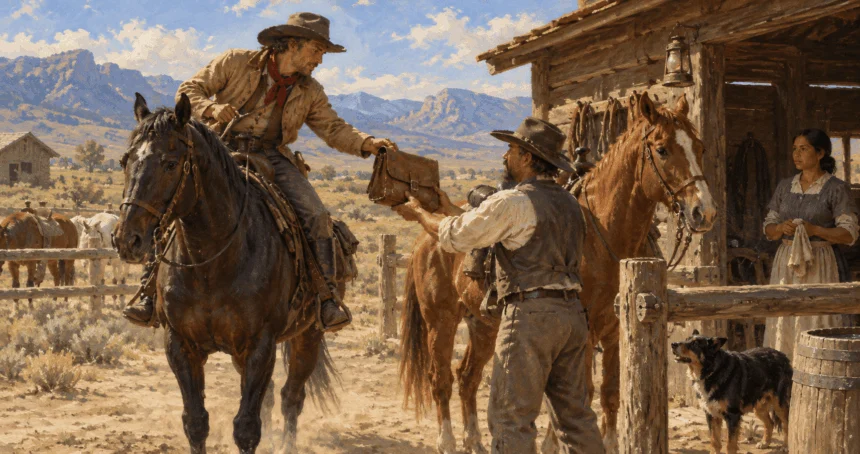
The mail was carried in a specially designed lightweight leather saddlebag called a “mochila.” This mochila featured four locked pockets, called cantinas, to secure the mail and was designed to be quickly transferred from a tired horse to a fresh one, ensuring minimal delay.

To protect the cargo from the elements, letters were carefully wrapped in oil silk. The initial cost to send a letter via the Pony Express was $5 per half-ounce, a price that was later reduced to $1 per half-ounce by July 1861. This high cost meant that the service was primarily utilized by businesses and newspapers for urgent communication.

Despite the meticulous planning, Pony Express riders faced numerous challenges. They had to contend with harsh weather conditions, including extreme heat in deserts and blizzards in mountains. The rugged terrain of the American West posed a constant physical demand on both riders and horses.

Perhaps the most significant danger was the threat of attacks by Native American tribes, particularly during the Pyramid Lake War in the spring of 1860, which led to the destruction of stations and loss of life.

StateNumber of StationsMiles of Trail
Missouri32
“Kansas”13151
“Nebraska”38565
“Colorado”227
“Wyoming”43489
“Utah”27263
“Nevada”47417
California2487
Total1971966

Note: Only Missouri and California were states at the time. The other territories were not yet formally organized as states.

Historical Context of the Pony Express

The Pony Express emerged as the fastest means of communication linking the East and West coasts of the United States in an era before electronic communication. This speed was particularly crucial during the escalating tensions leading up to the Civil War and in its early stages, as it provided a vital link between the Union government and the distant state of California.

The rapid delivery of news regarding President Abraham Lincoln’s election in 1860 and his inaugural address in March 1861 to California in record time underscored the Pony Express’s significance in disseminating critical political information across the continent.

Before the Pony Express, communication across the American continent was a slow and often unreliable process. The primary methods available were steamships, which followed lengthy routes, stagecoaches, known for their slow pace and susceptibility to dangers, and various private carriers.

The Pony Express represented a remarkable improvement in speed and efficiency, effectively shrinking the communication gap between the East and West.

The End of the Pony Express

Despite its undeniable speed and the romantic aura it quickly acquired, the Pony Express faced significant financial challenges. The costs associated with purchasing and maintaining a large number of horses, paying riders competitive wages, and operating numerous stations across vast distances were substantial.

The high postage rates, while necessary to offset these expenses, limited the service’s accessibility to a wider customer base. Furthermore, the parent company, Russell, Majors and Waddell, faced other financial setbacks, including significant losses due to severe winter weather and conflicts with Native American tribes.

Ultimately, the Pony Express never achieved its founders’ primary goal of securing an exclusive government mail contract.

The ultimate factor that sealed the fate of the Pony Express was the rapid advancement of technology. Just ten weeks after the Pony Express commenced operations, the United States Congress authorized the construction of a transcontinental telegraph line.

The telegraph offered a revolutionary means of communication, capable of transmitting messages almost instantaneously across vast distances. The completion of the transcontinental telegraph line on October 24, 1861, effectively rendered the horseback relay system of the Pony Express obsolete.

Just two days later, on October 26, 1861, the Pony Express officially ceased its operations.

Evolution of the United States Postal Service

The history of mail service in America predates the Pony Express by many decades, with its roots in the colonial era. A pivotal moment arrived in 1775 when the Continental Congress appointed Benjamin Franklin as the first American Postmaster General.

This act underscored the fundamental importance of a postal system for the welfare and unity of the nation. The U.S. Constitution, ratified in 1787, further solidified this by granting Congress the power to establish post offices and post roads.

This power was exercised with the passage of the Post Office Act of 1792, which formally established the Postal Service as a permanent fixture of the federal government.

Over the ensuing decades, the Postal Service grew in tandem with the nation’s westward expansion, establishing new routes and post offices to serve burgeoning communities. It embraced technological advancements to improve the speed and efficiency of mail delivery, transitioning from primarily relying on stagecoaches and horseback riders to incorporating railroads and, eventually, airmail.

The Postal Service’s mission evolved from primarily serving the needs of the military and government to becoming a universal service provider for all citizens. Significant legislative reforms, most notably the Postal Reorganization Act of 1970, transformed the Post Office Department into the independent United States Postal Service, striving to balance its public service mandate with financial self-sufficiency.

Connections Between the Pony Express and the USPS

Despite the shared purpose of delivering mail, the Pony Express was a private enterprise and was never formally a part of the U.S. Postal Service. However, for a brief period towards the end of its existence, from July 1, 1861, to its termination on October 26, 1861, the Pony Express operated under contract as an official U.S. Mail route.

This contractual agreement represents the most direct operational link between the Pony Express and the U.S. government’s mail delivery system. Following the discontinuation of the Pony Express, there is no substantial evidence to suggest a large-scale transfer of personnel or infrastructure to the USPS, likely due to the short operational period of the Pony Express and the rapid rise of the telegraph.

Nevertheless, the Pony Express exerted an indirect but significant influence on the development of postal services in the United States. It successfully demonstrated the feasibility of establishing a fast and reliable year-round transcontinental communication system along a central route, an idea that the government had initially deemed impractical.

This achievement likely played a role in shaping the government’s future approach to mail delivery and infrastructure development, including the crucial support for the transcontinental telegraph, which ultimately superseded the Pony Express.

The core principles of speed and reliability in reaching even the most remote areas, which were central to the Pony Express’s mission, remain enduring values for the modern USPS, even though these are now achieved through vastly different technological means. In this sense, the Pony Express can be viewed as an early precursor to the express mail services offered by the USPS today.

USPS Commemoration of the Pony Express

The United States Postal Service has consistently acknowledged and commemorated the historical significance of the Pony Express through various means. Several commemorative postage stamps have been issued over the years, including a 3-cent stamp in 1940 marking the 80th anniversary of its founding and a 4-cent stamp in 1960 celebrating its centennial.

In 1994, another commemorative stamp paid tribute to both the Overland Mail and the Pony Express. Most recently, in June 2024, the USPS dedicated a new series of “Horses” stamps at the kickoff of the annual Pony Express Re-Ride, highlighting the enduring connection between horses and mail delivery in American history.

Furthermore, the Pony Express National Historic Trail has been established to preserve the original route and numerous associated historical sites. Many historical markers along this trail and at the locations of former Pony Express stations serve as tangible reminders of this pivotal period in American history.

The Smithsonian National Postal Museum in Washington, D.C., dedicates significant exhibit space and resources to telling the story of the Pony Express, placing it within the broader context of American postal history. Commemorative coins featuring the Pony Express have also been produced, further demonstrating its lasting cultural and historical value.

Commemoration TypeYear(s)
Postage Stamps1940 (80th Anniversary), 1960 (Centennial), 1994 (Overland Mail & Pony Express), June 2024 (“Horses”)
National Historic TrailDesignated to preserve the route and sites
Historical MarkersLocated along the trail and at former stations
National Postal MuseumFeatures dedicated exhibits and resources
Commemorative CoinsIssued at various times

Legacy of the Pony Express

The Pony Express, despite its brief 18-month operational period, has become an enduring symbol of the Old West, embodying its romance, adventure, and the spirit of rugged individualism. Its daring riders and their incredible feats of endurance captured the national imagination and have been immortalized in countless stories, books, and films.

Beyond the romanticism, the Pony Express served as a powerful demonstration that a unified transcontinental communication system could be established and operated year-round, even across the challenging terrain of the American West. This proof of concept was crucial for the future development of both communication and transportation infrastructure in the United States.

The legacy of the Pony Express continues to hold relevance for the modern USPS. It embodies the core values of dedication, speed, and reliability in mail delivery, principles that the USPS strives to uphold in its daily operations.

The enduring image of the Pony Express rider serves as a powerful symbol of the commitment to delivering messages across vast distances and under challenging conditions, a mission that remains at the heart of the USPS.

The relay system employed by the Pony Express, with its strategic network of stations and the rapid transfer of mail between riders and horses, can be seen as a historical precursor to the sophisticated logistics and hub-and-spoke delivery networks that underpin modern postal operations.

Our articles make government information more accessible. Please consult a qualified professional for financial, legal, or health advice specific to your circumstances.

Follow:
Our articles are created and edited using a mix of AI and human review. Learn more about our article development and editing process.We appreciate feedback from readers like you. If you want to suggest new topics or if you spot something that needs fixing, please contact us.