Last Checked: August 12, 2026Next Check: August 12, 2028
Government and agencies 29 Research and academic 18 Organizations and advocacy 47 News and analysis 17 Other sources 7
- ohiohouse.gov5 reviewed
- congress.govcited ×13 reviewed
- justice.gov3 reviewed
- eac.govcited ×2
- legislature.ohio.govcited ×12 reviewed
- uscode.house.gov2 reviewed
- azsos.govcited ×1
- codes.findlaw.com
- docs.house.gov
- fjc.gov
- gao.govcited ×1
- govinfo.gov
- nist.gov
- riteusa.org
- search-prod.lis.state.oh.us
- sgp.fas.org
- usa.gov
- votetexas.gov
- cdce.umd.edu3 reviewed
- electionlab.mit.educited ×12 reviewed
- pmc.ncbi.nlm.nih.govcited ×12 reviewed
- digitalcommons.wcl.american.edu
- ebsco.com
- esra.wisc.edu
- ir.lawnet.fordham.edu
- journalistsresource.org
- journals.sagepub.com
- library.hbs.edu
- nber.orgcited ×1
- nyujlpp.org
- pnas.org
- scholarship.law.missouri.edu
- brennancenter.orgcited ×211 reviewed
- democracydocket.com4 reviewed
- aclu.org3 reviewed
- acluohio.org2 reviewed
- allvotingislocal.orgcited ×12 reviewed
- cato.org2 reviewed
- demos.org2 reviewed
- heritage.orgcited ×12 reviewed
- lwv.org2 reviewed
- vote.org2 reviewed
- voteriders.org2 reviewed
- ace-usa.org
- aclu-il.org
- aflcio.org
- americafirstpolicy.com
- assets.aclu.org
- carnegie.org
- everythingpolicy.org
- fairelectionscenter.org
- lawyersdemocracyfund.org
- mapresearch.orgcited ×1
- nass.org
- ncsl.orgcited ×1
- us.votecited ×1
- bbc.co.uk2 reviewed
- cnn.com2 reviewed
- apnews.com
- bylinetimes.com
- courthousenews.com
- latimes.com
- lifehacker.com
- nbcnews.com
- ohiocapitaljournal.com
- rte.iecited ×1
- telegraph.co.uk
- texastribune.orgcited ×1
- theguardian.comcited ×1
- washingtontimes.com
- wisconsinwatch.org
- ballotpedia.orgcited ×37 reviewed
Last updated 2 months ago. Our resources are updated regularly but please keep in mind that links, programs, policies, and contact information do change.
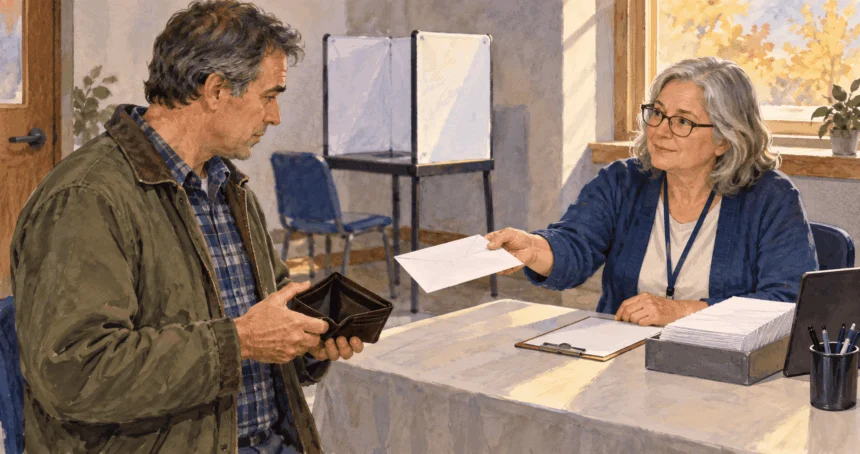
You get to the polling place, give your name, and reach for your wallet. It’s not there. It’s on the kitchen counter, next to the keys you also almost forgot.
Here’s the reassuring part: in most of the country, that moment is a delay, not a dead end.
- What a Poll Worker Actually Does When You Have No ID
- Your State’s Category Decides Almost Everything
- Why the Provisional Ballot Exists, and How Often It Works
- The Cure Process Is Where Votes Are Won or Lost
- When the System Works, and When People Slip Through
- The Debate Over Whether the Cure Is Enough
- The Laws Keep Moving, So Check Before Every Election
The honest answer to the title question comes in two parts. You probably will not be turned away outright. But in a state that requires ID, you will likely cast what’s called a provisional ballot, and it only counts if you follow through.
What a Poll Worker Actually Does When You Have No ID
Walk into any polling place and the first steps look the same. You state your name and address, and a poll worker looks you up in the registration book or on a tablet.
In a state with an ID requirement, that’s when they ask for your driver license, state ID card, or passport. No card, no problem in the sense that they will not tell you to go home for good.
Instead they reach for a provisional ballot. The Help America Vote Act of 2002, passed after the disputed 2000 election, requires states to offer “provisional voting”.
The law’s own text says it was written, among other things, “to establish minimum election administration standards for States and units of local government”. Provisional voting is one of those minimums.
The exact name varies by state. Arizona issues a “conditional provisional ballot” to a voter who lacks acceptable proof of identity, and it counts only if that voter brings ID to the county recorder by a deadline. New York hands certain voters an “affidavit ballot”, which needs extra verification before it’s tallied. If you want the fuller mechanics of how these differ from a regular ballot, our guide to provisional versus regular ballots walks through the basics.
In a state that does not require ID at all, showing up empty-handed usually changes nothing. You just vote. The provisional pathway only kicks in if there’s another red flag, like your name missing from the poll book.
Your State’s Category Decides Almost Everything
The single biggest factor in what happens to you is a category you’ve probably never heard of. According to the National Conference of State Legislatures, its tracker counts 36 states that request or require ID at the polls, while 14 states plus Washington, D.C., verify identity another way and ask for no documentation.
Among the states that do ask, the NCSL sorts them along two lines: photo versus non-photo, and “strict” versus “non-strict.” That second word is the one that matters most to you.
In a strict state, no acceptable ID means a provisional ballot plus a required follow-up step, or your vote doesn’t count. Non-strict states bend more: a poll worker can often verify you another way, by matching a signature or having you sign an affidavit, and you cast a regular ballot on the spot.
Here is how the NCSL groups the states that require ID.
| Category | Example states | What happens if you arrive without ID |
|---|---|---|
| Strict photo ID | Arkansas, Georgia, Indiana, Kansas, Mississippi, North Carolina, Ohio, Tennessee, Wisconsin | Provisional ballot; must return with ID by a deadline or it is rejected |
| Strict non-photo ID | Arizona, North Dakota, Wyoming | Provisional or conditional ballot; post-election verification required |
| Non-strict photo ID | Alabama, Florida, Kentucky, Michigan, Missouri, Rhode Island, South Carolina, Texas, West Virginia (after its recent change) | Often an affidavit or alternative document lets you vote a regular ballot |
| Non-strict non-photo ID | Alaska, Colorado, Connecticut, Delaware, Iowa, Oklahoma, Utah, Virginia, Washington | More flexible; signature or sworn statement often suffices |
Source: National Conference of State Legislatures voter ID tracker, which changes as states amend their laws.
Delaware shows the gentlest version. A voter without proof of identity can simply sign an affidavit affirming who they are, and there’s no later cure requirement. You attest, you vote, you’re done.
Arizona shows the strictest version of the fallback. Under Arizona’s election procedures manual, the conditional provisional ballot only counts if you bring ID to the county recorder by 5 p.m. on the fifth business day after a general election that includes a federal office, or the third business day after other elections. Arizona voters can find their county recorder’s contact information through the Arizona Secretary of State’s elections page.
The takeaway is unglamorous but important: before an election, find out which box your state sits in. You can check your state’s exact category using the NCSL’s voter ID tracker. It determines whether “I forgot my ID” is a shrug or a scramble.
Why the Provisional Ballot Exists, and How Often It Works
Provisional ballots get issued for all sorts of reasons, not just missing ID. Across the country, the most common reason has long been that a voter simply isn’t in the poll book.
That distinction changes your homework. When the problem is a registration record, officials can often fix it themselves by checking a statewide database, and you may not have to lift a finger. When the problem is ID, the ballot usually counts only if you take action.
The good news is that provisional ballots are not a black hole. The 2024 Election Administration and Voting Survey reported that 1,736,209 provisional ballots were cast among reporting states, about 0.9 percent of counted voters. Of those, 73.8 percent were counted partially or fully. A quarter, 25.1 percent, were rejected.
A quarter is not nothing. And the rejection rate varies wildly by state and by reason. In North Carolina in 2016, MIT found that 96 percent of the state’s 60,643 provisional ballots were cast by people who showed up on Election Day, and about 56 percent of those were rejected. Yet among voters flagged as previously removed from the rolls, 51.5 percent had their ballots accepted, a reminder that the later review can restore votes when records were simply out of date.
Which brings us to the step that decides your fate.
The Cure Process Is Where Votes Are Won or Lost
“Curing” is election-speak for fixing a fixable defect after you’ve already submitted a ballot, so it can still count. It shows up most often with mail ballots that have a missing or mismatched signature, but the same logic applies to an ID-related provisional ballot: you supply the missing piece by a deadline, or the ballot is set aside.
The deadlines are short, and they’re specific. Miss the deadline, and the ballot is rejected, because officials have no way to confirm you met the ID requirement.
Georgia ties its timing to the provisional review window. According to a summary of Georgia Code section 21-2-419, registrars must decide within three days after the election whether a provisional voter was registered and eligible, then notify the superintendent so the ballot can be counted.
Acceptable documents matter as much as timing. Kansas, a strict photo ID state, accepts a fairly broad list, according to the NCSL: a driver license or state ID from any state, a concealed carry license, a U.S. passport, a government employee badge, a military ID, a student ID from an accredited Kansas postsecondary institution, or a public assistance ID, among others.
It also reports that expired documents still work if you’re 65 or older, and that there are narrow exemptions for disability, military service, or a religious objection to being photographed.
Kentucky, a non-strict photo ID state, offers a softer landing. Kentucky election procedure, as tracked by NCSL, allows a voter who can’t produce photo ID to sign a voter affirmation form and supply an alternative like a county-issued ID, often avoiding a provisional ballot entirely; 2026 legislation has since removed the Social Security card as an accepted alternative under this provision.
When you cast a provisional ballot, ask the poll worker what reason is being recorded and what you must do next.
When the System Works, and When People Slip Through
The rules on paper and the experience at the counter don’t always match, and two real stories show the range.
Christopher Suprun was a Republican presidential elector from Texas in 2016, one of the people chosen to cast the state’s Electoral College votes. He was also just a guy trying to vote in the general election.
According to the Texas Tribune, a local election judge refused to let him cast any ballot, including a provisional one, because he lacked photo ID.
This was despite a federal court order that let Texas voters sign a reasonable-impediment declaration and use alternate ID. Suprun filed a formal complaint with then-Secretary of State Carlos Cascos.
His complaint is the cautionary one: the legal safeguard existed, and he said a local official did not apply it. The gap between what the law promises and what a single poll worker does is exactly where votes get lost.
Kathleen Unger works that gap for a living. She founded VoteRiders, a nonprofit that helps people obtain and understand voter ID, and now sits on its board while Lauren Kunis serves as CEO and executive director.
In guidance published through YES / US.VOTE, Unger explains that even without ID “you may be eligible to vote,” but that in many states voters will need to take additional steps: cast a provisional ballot and show ID later, sign an affidavit, or have your signature matched.
The core advice for voters challenged at the polls is simple. Don’t just leave. Ask for the provisional ballot, the affidavit, or the cure procedure.
Even outside the U.S. system, England’s recent experience shows how a hard ID rule plays out. When new photo-ID rules took effect, former Prime Minister Boris Johnson was turned away from his own polling station on May 2, 2024 for lacking ID, then returned later with valid documents and voted.
He praised the staff for enforcing the rule even against a former prime minister.
The American provisional ballot exists so that “come back with ID” isn’t the only option.
The Debate Over Whether the Cure Is Enough
Whether strict ID plus a cure process is a fair bargain or a hidden barrier is genuinely contested, and both sides argue from more than slogans.
Supporters frame it as a light-touch safeguard. Hans von Spakovsky has long argued that ID requirements deter impersonation, fictitious registrations, double voting across states, and noncitizen voting.
He also points to the Supreme Court’s willingness to uphold such laws.
A defense of voter ID laws on public-confidence grounds contends that the worry about identity theft weakens faith in elections, and that voting should be “at least as secure” as everyday tasks that require ID.
Proponents also lean on public opinion and turnout data. A Monmouth University poll reported by Ballotpedia found 80 percent of Americans support requiring photo ID to vote, including 62 percent of Democrats and 84 percent of minorities.
And a widely cited 2019 NBER working paper by Cantoni and Pons found that strict photo ID laws had no negative effect on registration or turnout overall or for any group defined by race, gender, age, or party affiliation. To supporters, that’s evidence the cure process works: if strict ID were mass disenfranchisement, the turnout numbers would show it.
Critics say the national average hides the burden.
The Brennan Center for Justice’s Voting Rights and Elections Program, directed by Sean Morales-Doyle, argues the core problem is that laws require forms of ID that many eligible Americans do not have.
Estimates relayed by the Brennan Center put the share as high as 10 percent of eligible adults, and the center argues the gaps are not random. A 2014 Brennan Center analysis found Americans earning under $35,000 a year are about twice as likely to lack valid photo ID, and that in Texas, Latino voters were found 2.4 times more likely than white voters to lack accepted ID.
A short cure window creates its own geographic burden. A peer-reviewed study published in PMC on North Dakota’s ID and address rules found they fall hardest on Native American voters on reservations, many of whom lack residential street addresses and face long drives to comply. A 2014 Government Accountability Office analysis found turnout in Kansas and Tennessee decreased from the 2008 to 2012 general elections to a greater extent than in comparison states Alabama, Arkansas, Delaware, and Maine.
Those two bodies of evidence, the finding of no national turnout effect and the documented local burdens, are hard to reconcile, and the disagreement is real, not just talking points. What both sides accept is the design fact at the center of this article: when you show up without ID, the cure process is the thing standing between you and a counted vote.
The Laws Keep Moving, So Check Before Every Election
Here’s the part that makes know your state’s category harder than it sounds: the categories change, and recently they’ve been changing fast.
Ohio is the sharpest example of tightening. House Bill 458, signed by Governor Mike DeWine on January 6, 2023, narrowed acceptable ID to a state driver license or ID card, a U.S. passport, or a military ID, dropping previously valid bank statements and utility bills. The bill’s stated purpose, in the legislature’s own words, was “to modify the law governing voter identification and absent voting” and to make related changes to state ID cards.
According to an analysis by All Voting Is Local, an advocacy group, rejected provisional ballots rose sharply afterward, with 28.4 percent rejected for lack of ID in the November 2023 election, more than 20 points higher than the year before.
Another state moved the same direction. West Virginia enacted HB 3016 in 2025, shifting from non-photo to photo ID.
California moved the opposite way. Governor Gavin Newsom signed SB 1174 on September 29, 2024, according to a summary of the legislation, barring any local government from requiring voters to show ID, locking in a state that does not require voters to present photo identification in most cases.
The legal backdrop hasn’t shifted the same way; the Supreme Court’s precedent still upholds state photo ID laws.
That precedent gives states wide room to require ID, which is why the action keeps happening in statehouses rather than courtrooms.
So the practical instruction that closes this out is less satisfying than a single national rule, and more useful. The category your state occupied two elections ago may not be the one it occupies now. Before you vote, confirm what your state currently accepts and what its cure deadline is. The difference between a delay and a thrown-out ballot is often just knowing you have until the fifth business day, and showing up with the right card in hand.