Last Checked: August 13, 2026Next Check: August 13, 2028
Government and agencies 50 Research and academic 15 Organizations and advocacy 33 News and analysis 3 Public commentary 1 Other sources 57
- justice.gov10 reviewed
- congress.govcited ×18 reviewed
- elections.ca5 reviewed
- ada.govcited ×24 reviewed
- cisa.gov3 reviewed
- usa.gov2 reviewed
- aec.gov.au
- archives.gov
- boe.cuyahogacounty.govcited ×1
- city.milwaukee.gov
- civilrights.justice.govcited ×1
- co.armstrong.pa.uscited ×1
- democrats-cha.house.gov
- gov.uk
- in.govcited ×1
- new.newcastle.gov.uk
- pa.gov
- scvotes.gov
- sos.state.tx.us
- uscode.house.govcited ×1
- vote.santaclaracounty.gov
- vote.sos.ri.gov
- voterready.iowa.gov
- votetexas.gov
- electionlab.mit.educited ×16 reviewed
- web.mit.edu2 reviewed
- circle.tufts.edu
- electoralintegrityproject.com
- lse.ac.uk
- politicalscience.stanford.edu
- stat.berkeley.educited ×1
- tandfonline.com
- uccs.ucdavis.edu
- brennancenter.orgcited ×17 reviewed
- aceproject.org3 reviewed
- bipartisanpolicy.org3 reviewed
- usvotefoundation.org3 reviewed
- electioninnovation.org2 reviewed
- everydaycivics.com2 reviewed
- lwv.org2 reviewed
- carnegie.org
- democracyfund.org
- dosomething.org
- globalcitizen.org
- govfacts.org
- makethefutureyours.uk
- nonprofitvote.org
- powerthepolls.org
- protectdemocracy.org
- rockthevote.org
- seventy.org
- theconversation.com
- vice.com
- wfyi.org
- thelandcle.orgcited ×1
Last updated 2 months ago. Our resources are updated regularly but please keep in mind that links, programs, policies, and contact information do change.
A poll worker at Clague Cabin, a modest building in Clague Park in the Cleveland suburb of Westlake that houses three precincts under one roof, worked the polls there. Writing a first-person essay for a local Cleveland outlet, that worker describes a 15-hour Election Day and comes away feeling, in their own words, “impressed with the process, exhausted and unsure” about signing up again.
That is the person who will greet you when you walk in to vote.
- The People Behind the Desk
- The Room Itself, and Getting Through the Door
- What to Bring, and Why It Depends on Your Zip Code
- Check-In: Where the System Confirms It Is You
- Marking and Casting: The Paper Almost Everyone Now Has
- Your Rights at the Booth: Help and Language
- The Debate Over How Much Verification Is Enough
- What Actually Shapes Your Day at the Polls
Here is the reassuring part. For all the anxiety that surrounds elections, the in-person experience is one of the most scripted encounters you will ever have with your government. You arrive, you prove you are who you say you are, you mark choices on paper or a screen, you cast the ballot, and you leave.
What follows is a walk through that process in order, from the parking lot to the ballot box. It focuses on the two things people most want to know: what actually happens at each step, and what your rights are if something goes wrong.
The People Behind the Desk
When you walk into a polling place, you are at the bottom of a system that connects up to your state’s chief election office, usually a Secretary of State or a state election board. Those offices write statewide rules, certify the voting equipment, and train the local officials who run your precinct.
These offices actually coordinate with each other. In February 2025, Pennsylvania Secretary of State Al Schmidt attended the National Association of Secretaries of State winter conference in Washington, an event heavy on election administration and cybersecurity, where officials swap notes on running secure and accessible elections.
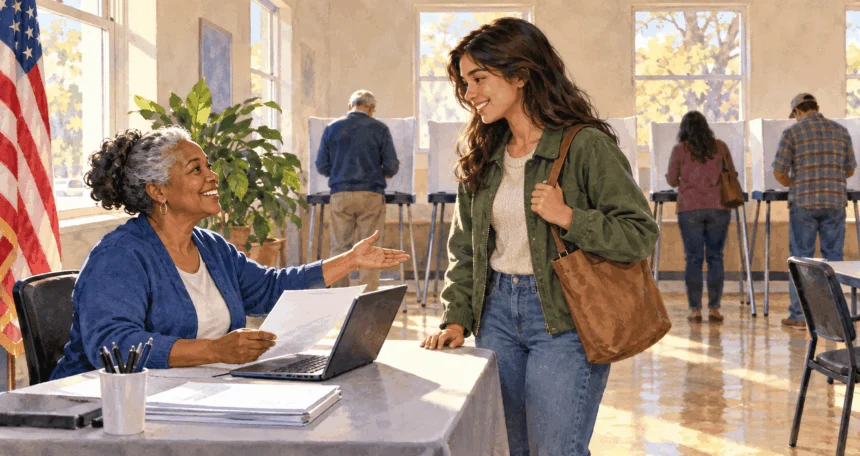
The people you meet, though, are mostly trained volunteers or short-term employees hired by a county, city, or township. The U.S. Election Assistance Commission, a federal body, describes their job plainly: poll workers set up the location, welcome voters, verify registrations, and issue ballots.
The reason your check-in feels scripted is that it is. Workers follow set procedures so every voter is handled the same way and the records hold up to scrutiny later.
That commission exists because of a single law. The Help America Vote Act of 2002, Public Law 107-252, was written, in its own opening words, “to establish a program to provide funds to States to replace punch card voting systems” and to set minimum election administration standards for federal elections. Nearly everything about the modern polling place traces back to that law’s response to the ballot-counting chaos of 2000 (when punch-card ballots left bits of paper, or “chads,” hanging).
The Room Itself, and Getting Through the Door
Polling places live in schools, churches, community centers, fire stations. The buildings vary wildly. The accessibility rules do not.
The Department of Justice’s checklist for polling places tells election officials to evaluate four things at any site: the parking and drop-off area, the routes inside and out, the entrance, and the voting area itself. Those rules come from the 2010 ADA Standards for Accessible Design, which the Justice Department published in the Federal Register on September 15, 2010 as the minimum standards state and local governments must meet.
Some of the specifics are oddly precise, and worth knowing. A polling place must have at least one accessible entrance with a door offering an opening at least 32 inches wide, enough for a wheelchair. The accessible route to that door must generally run at least 36 inches wide, though it may narrow at doorways or between obstacles for short stretches, and stairs are excluded from the accessible route entirely.
One detail I find quietly telling: the door hardware has to be usable with one hand, without tight grasping, pinching, or twisting of the wrist. Someone sat down and thought about the voter whose hands do not cooperate.
Where the ground rises, the slope has to be gentle. The ADA caps ramp slope on accessible routes at 1:12, one inch of rise for every foot of run. In practice, that can mean a temporary ramp or mat rolled out on Election Day at a building that would not otherwise comply.
Inside, expect a check-in area near the entrance, a bank of privacy booths, and at least one accessible voting machine. The National Conference of State Legislatures reports that 39 states plus several territories require accessible voting systems with audio input, tactile controls, and adjustable font sizes. So one machine with headphones and a keypad is usually available for voters who need it.
What to Bring, and Why It Depends on Your Zip Code
Before you go, confirm two things: that you are registered, and where your polling place is. The Justice Department points voters to usa.gov’s election office directory, which links out to state lookup tools. Enter your name and birth date, and you can see your assigned location and its hours.
Hours matter more than people expect. There is no national poll-closing time; each state sets its own.
One New York City voter, sharing tips in a Reddit thread on early voting, laid out the local rule cleanly: polls open at 6 a.m. and close at 9 p.m., and if you are in line by closing you can still vote. Arrive after 9 and then join the line, the same commenter warned, and “you will have missed your chance to cast a ballot.”
Then there is identification, the single biggest way Election Day differs from state to state. NCSL’s 2025 tally shows 36 states ask for or require some form of ID at the polls, while 14 states and Washington, D.C. do not require any documentation to vote at the polls. NCSL sorts these laws by two questions: photo or non-photo, and strict or non-strict.
Here is what that sorting looks like in practice.
| Category | What it means for you | Example states |
|---|---|---|
| Strict photo ID | You generally must show a listed photo document or you cannot cast a regular ballot | Arkansas, Georgia, Indiana, Kansas, Mississippi, New Hampshire, North Carolina, Ohio, Tennessee, Wisconsin |
| Strict non-photo ID | You must show a listed document, though it need not carry a photo | Arizona, North Dakota, Wyoming (per FindLaw’s compilation of NCSL’s framework) |
| Non-strict | Without ID you may vote provisionally or by affidavit; officials verify afterward | Alabama, Florida, Kentucky, Texas |
| No document required | No documentation required to vote at the polls | 14 states plus Washington, D.C. |
Source: National Conference of State Legislatures, voter ID laws (2025).
Delaware sits in an interesting middle spot. A voter without ID can sign an affidavit affirming they are the person listed on the record.
The rules keep moving, too. Alabama enacted a ban on digital IDs for voting effective October 1, 2026. Georgia in 2025 required IDs to be presented in physical form only, and Tennessee that same year prohibited digital IDs outright. West Virginia shifted from a non-photo to a photo requirement in 2025, and Wisconsin voters approved a constitutional amendment locking their photo ID rule into the state constitution.
Most strict-ID states carve out exceptions, for voters with religious objections to being photographed, indigent voters, those facing a reasonable impediment to getting an ID, and victims of recent disasters or of domestic abuse and stalking. Which is a long way of saying: the “right” ID to bring depends entirely on where you live.
Check-In: Where the System Confirms It Is You
At the desk, a poll worker asks your name, maybe your address, and finds you in the poll book. That book is either a printed list or an electronic version on a laptop or tablet, sometimes updated in real time. Both exist to do one thing: make sure each voter votes once, in the right place.
The space around that desk is deliberately quiet. Most states bar campaigners from the room and set a buffer zone outside. According to NCSL, these zones typically run 50 to 200 feet from the entrance, and 46 states plus D.C. prohibit campaign signs and literature inside them while 27 states ban campaign apparel like buttons and stickers.
Some statutes get granular. Alabama bars anyone other than voters, their assistants, the judge of probate, the sheriff or deputies, precinct officials, and accredited watchers from coming within thirty feet of the polling place door, according to a ncsl.org summary. The point is to let you state your name and take your ballot without a crowd leaning on you.
What happens next depends on your state’s ID rule. In a strict photo state, the worker compares the name and photo on your document to the poll book entry. In a non-strict state, a voter without ID may still cast a provisional ballot that officials verify later, sometimes with no further action needed from the voter at all. In no-document states, no documentation is required to vote at the polls.
When Your Name Is Not in the Book
This is the moment that spikes a voter’s blood pressure. Being told your name is not found does not mean you cannot vote.
Ask the worker to check alternate spellings and addresses, and to pull in a supervisor. If it still cannot be resolved, federal law and state statutes give most voters a fallback: the provisional ballot.
A provisional ballot is a real ballot sealed in a special envelope and set aside for review, not a brush-off. For how it gets counted or cured afterward, see our guide to provisional versus regular ballots, which walks through the verification step in detail.
If a worker tells you flatly that you cannot vote, you have the right to ask why and to seek help. The Justice Department’s civil rights portal takes complaints, though it stresses that threats or intimidation at a polling place “should be reported first to local police authorities by calling 911.”
Marking and Casting: The Paper Almost Everyone Now Has
Once you are checked in, you get a paper ballot or a machine. The technology has changed dramatically in two decades, and the direction is unmistakable: toward a paper record you can hold.
In 2016, 22.4 percent of registered voters lived in jurisdictions using paperless touchscreen machines that left no independent paper trail. By 2024, that figure had fallen to roughly 1.4 percent, and nearly 99 percent of voters would be in jurisdictions with a paper record, including all voters in battleground states, according to a brennancenter.org summary.
So today you will almost certainly do one of two things. You will mark a paper ballot by hand and feed it into an optical scanner. Or you will use a ballot-marking device, a touchscreen with visual and audio prompts that prints a paper ballot you review before casting.
Marking is where small mistakes happen, so read the instructions at the top of each contest. Two errors to avoid: an overvote, choosing more candidates than allowed, and an undervote, accidentally skipping a race. On a hand-marked ballot, a scanner can flag an overvote and let you fix it. On a ballot-marking device, the software usually blocks you from picking too many before you can advance.
If you botch a paper ballot, ask for a replacement. Most places let you “spoil” the bad one and start over. Because every ballot leaves a paper trail, officials can reconcile the number issued, spoiled, and cast against the number of voters checked in.
Then you cast. A hand-marked ballot goes into a precinct scanner or a secure box; the paper from a marking device does the same. It lets officials run audits and recounts that do not depend on trusting the electronics, and it means a jammed scanner does not stop voting: ballots drop into an auxiliary compartment and get scanned once the machine is fixed.
Your Rights at the Booth: Help and Language
Some voters need help reading or marking a ballot, and federal law gives them specific rights. The EAC states plainly that a voter with a disability has the right to vote privately and independently and to an accessible polling place with machines built for that purpose. The commission even offers a Braille card describing federal voting rights on request.
You can also bring someone to help you. Under federal law, that assistor can be almost anyone of your choosing, with one limit: not your employer or a union representative.
States pile on smaller accommodations too. Alabama, Arizona, Connecticut, Louisiana, and Nevada let voters with disabilities move to the front of the line. Minnesota requires a chair for a voter with a disability who has to wait. Twenty-seven states plus D.C., Guam, and American Samoa allow curbside voting, where a worker brings the ballot to your car.
Then there is language. If English is not your first language, a federal law may guarantee you a ballot you can actually read. Section 203 of the Voting Rights Act, codified at 52 U.S.C. section 10503, opens with a blunt finding: “citizens of language minorities have been effectively excluded from participation in the electoral process.”
The remedy is concrete. The statute declares that “before August 6, 2032, no covered State or political subdivision shall provide voting materials only in the English language.” Where the coverage formula applies, ballots, forms, and assistance must appear in the minority language alongside English.
The coverage formula is a threshold, not a nationwide rule. It reaches localities where more than 10,000, or over 5 percent, of voting-age citizens belong to a single language minority group, have depressed literacy rates, and are limited in English. In plain terms: a county crosses the line and the bilingual ballots kick in.
The Debate Over How Much Verification Is Enough
Everything above describes rules that are themselves contested. The disagreement is not really about whether you should be able to vote. It is about how much checking the system should do at the door, and who bears the cost of that checking.
Close margins raise the stakes, supporters of tighter verification argue, so preventive controls like ID checks, signature matching, and observer access are ordinary risk management, closer to a financial audit than an obstacle.
You can see this logic built into concrete rooms. The Cuyahoga County Board of Elections in Ohio describes safeguards it says are designed to safeguard voting systems, prevent voter fraud, and protect the integrity of election results: drop boxes bolted to the ground and monitored around the clock, checked at least once daily by one Republican and one Democratic member together.
Indiana’s polling-place guidelines forbid any one person from having unsupervised access to a voting machine. The recurring idea is no single point of failure.
This side of the debate points to an approach called “evidence-based elections,” which pairs auditable paper ballots with risk-limiting audits. Those check enough ballots by hand to be confident the result is right, catching any error big enough to change the outcome.
Critics counter that narrow ID lists and subjective signature matching fall hardest on low-income, elderly, minority, and disabled voters, who are likelier to lack a qualifying document or to have a signature that has drifted over time.
Whether that balance holds is genuinely unsettled, and it is being tested in real time as digital ID bans, citizenship-verification mandates, and audit requirements move through statehouses and federal agencies.
What Actually Shapes Your Day at the Polls
The averages are encouraging. The MIT Election Data and Science Lab found the share of voters waiting more than half an hour fell from 16 percent in 2008 to 9 percent in 2016, with an average wait around 10.4 minutes, before climbing back to 18 percent in 2020 amid pandemic precautions and record turnout.
But averages hide the worst cases. The Presidential Commission on Election Administration concluded no voter should wait more than 30 minutes.
In the worst-run precincts, often in urban and lower-income areas, that target gets blown past by hours, and the same MIT research suggests that seeing news coverage of long polling-place lines makes people less likely to vote in future elections.
The people absorbing that pressure are the poll workers. In a WFYI feature, Marion County, Indiana workers described forming a “team for that day” and calling the work really fun and really rewarding. One offered advice that doubles as a fair summary of the whole experience: a Marion County poll worker told WFYI that once voters come inside, they have a private, safe, secure way to vote for their candidates of choosing.
That is the reassuring version. The Westlake essay is the honest counterweight, the 15-hour day that leaves a person exhausted and unsure. Both are true at once, and both depend on the same thing: enough trained hands behind the desk.
The recruiting pitch is often a single name on a county document. Armstrong County, Pennsylvania, ends its poll worker guide by inviting residents to contact Jennifer at the Armstrong County Bureau of Elections.
The rules and the machines matter. The person who says your name and hands you a ballot matters more.