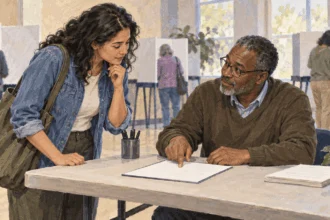
Accessibility for Voters with Disabilities
Your Right to an Accessible Ballot If You Have a Disability
Learn what federal law guarantees disabled voters: accessible polling places, voting machines, mail ballots, and help from a chosen assistant.

Learn what federal law guarantees disabled voters: accessible polling places, voting machines, mail ballots, and help from a chosen assistant.

A guide to researching judicial candidates on your ballot using voter guides, performance evaluations, bar ratings, and Ballotpedia.

See your ballot early using official state and county election sites, plus nonpartisan tools like Ballotpedia and Vote411 for candidates and measures.
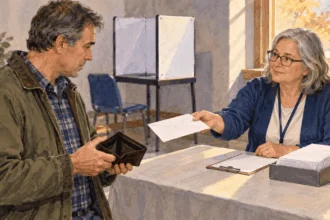
What really happens if you show up to vote without ID, from provisional ballots to state rules and the cure deadlines some voters must meet for…
Learn how voter ID rules differ by state, what documents count as valid ID, and what to do if you show up without one, based on federal law and NCSL data.
Voter ID rules differ by state, from strict photo-ID laws to none at all. See what your state requires and what to do if your ID does not match.
Learn how to track your mailed ballot through postal and election systems, decode status messages, and fix problems before deadlines pass.
Absentee and mail-in ballots differ by state: some require an excuse, others send ballots automatically. Learn the rules on deadlines and signatures.
Learn the five steps to vote by mail: check eligibility, request your ballot, fill out the envelope correctly, return it early, and track it to catch rejections.
Learn how to check your voter registration status online, what labels like inactive or pending mean, and what to do if your name is missing.
See how voter registration deadlines vary by state, from 30-day cutoffs to same-day registration, plus how North Dakota and military voters differ.
A step-by-step guide to registering to vote online, by mail, or in person, covering required ID, proof of address, and state rules on age and eligibility.
The order's provisions—specifically those requiring documented proof of citizenship for voter registration and prohibiting the counting of ballots that arrive after Election Day—exceeded presidential…
Primary elections select party nominees for the November ballot. Unlike general elections, participation rules vary dramatically by state. Some states allow any registered voter…