Last Checked: October 8, 2026Next Check: March 14, 2030
- govinfo.govcited ×44
- supremecourt.govcited ×5
- archives.govcited ×2
- id.uscourts.govcited ×1
- uscourts.govcited ×1
- law.cornell.educited ×1
Last updated 1 week ago. Our resources are updated regularly but please keep in mind that links, programs, policies, and contact information do change.
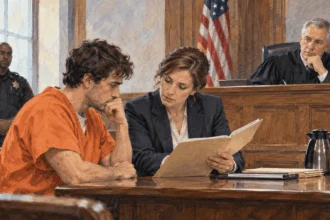
Police read a suspect his rights, then questioned him for nearly three hours while he stayed largely silent. Near the end, he answered yes to a question about praying for forgiveness for a shooting. His attempt to say little had not brought the questioning to a halt.
In its 2010 decision in his case, Berghuis v. Thompkins, the Supreme Court said Thompkins had not clearly claimed his right to end the questioning and had knowingly and voluntarily given up his right to remain silent by answering. The Fifth Amendment protects against being forced to give incriminating testimony, but ending an interview in police custody generally requires clearly saying that the questioning should stop.
- Why silence did not stop the questioning
- The Fifth Amendment protects more than defendants
- When police must give Miranda warnings
- How to invoke silence or ask for counsel
- Outside custody, silence follows different rules
- What a Miranda violation changes in court
- Testimony, physical evidence and the limits of silence
Why silence did not stop the questioning
Under Thompkins, a suspect can waive, or give up, the right to remain silent without saying so: when the prosecution shows that the warning was given and understood, an uncoerced statement establishes an implied waiver. Before the interview, a detective had Thompkins read one warning aloud and then read him the other four. Asked to sign the form to show that he understood his rights, Thompkins declined. Refusing a signature did not settle whether he understood the warning or later chose to answer.
The detective’s question about forgiveness came about two hours and 45 minutes into the interrogation. The suspect answered yes, looked away, and refused to make a written confession before questioning ended about 15 minutes later. The Court treated that spoken answer as the waiver; no signed confession was needed.
The majority explained that requiring a suspect to invoke the right unambiguously, that is, to claim it in clear words, gives officers an objective rule when a suspect’s intentions are unclear. Justice Sotomayor’s dissent, joined by three other justices, objected that a suspect had to speak precisely to preserve silence and that the waiver ruling weakened the protections of Miranda v. Arizona, the 1966 decision behind the warnings. The disagreement concerned how police should recognize the exercise of an existing right, not whether the Fifth Amendment contains that right.
The Fifth Amendment protects more than defendants
The Fifth Amendment’s Self-Incrimination Clause says no person shall be compelled in a criminal case to be a witness against himself. Self-incrimination means providing testimony that can help establish the speaker’s criminal liability. The protection targets compelled testimony, not every uncomfortable question or every kind of evidence.
The Supreme Court applies this protection to states through the Fourteenth Amendment and recognizes it in other official proceedings when answers could incriminate the speaker in a future criminal case. The constitutional text speaks of a person rather than making citizenship the test. In Ohio v. Reiner, the Supreme Court explained that even truthful answers from an innocent witness can supply incriminating evidence. Claiming the privilege is therefore not an admission of guilt.
The protection has old roots: in its Miranda opinion, the Supreme Court traced resistance to compelled self-accusation to John Lilburn, who in 1637 resisted an oath of England’s Court of Star Chamber that would have bound him to answer all questions put to him on any subject.
The Fifth Amendment holds other protections as well. One is the grand jury: no one may be made to stand trial in federal court on a felony charge until a grand jury returns an indictment, unless the accused waives that right. The grand jury evaluates whether evidence supports probable cause to believe the accused committed a crime, issuing the formal charge if it finds sufficient evidence. The constitutional clause contains an exception for specified military cases.
Double jeopardy protects against being put in jeopardy twice for the same offense. The amendment requires due process before government deprives a person of life, liberty or property, and just compensation when it takes private property for public use. For a criminal defendant, due process guarantees a fair and impartial trial.
When police must give Miranda warnings
The Supreme Court decided Miranda v. Arizona on June 13, 1966 after considering four cases involving isolated custodial questioning without full, effective warnings. Miranda requires safeguards before custodial interrogation because the Court saw the pressure of that setting as undermining a person’s freedom to choose whether to speak. Two conditions do the work: custody and interrogation. An arrest is not itself a promise that warnings must accompany every word an officer says.
The required warnings cover the right to remain silent, use of statements in court, a lawyer’s presence during questioning, and an appointed lawyer before questioning if the person cannot afford one and wants one. The Miranda opinion says a person must be warned that “he has the right to remain silent, that anything he says can be used against him in a court of law”. Hearing the warning does not automatically stop the interview; the next issue is whether the person invokes or waives the right.
Courts begin by asking whether a reasonable person could end the questioning and leave, considering the location, duration, statements and physical restraints. For Miranda custody, restricting freedom of movement is not enough by itself; the setting must also create the kind of coercive pressure addressed by Miranda. Ordinary temporary traffic stops generally do not count as Miranda custody under Berkemer v. McCarty. A child’s age belongs in the custody analysis when officers know it or it would be objectively apparent to a reasonable officer.
Under Rhode Island v. Innis, interrogation includes direct questions and other police words or actions they should know are reasonably likely to elicit an incriminating response, apart from ordinary arrest and custody practices. An officer need not phrase something as a question for it to have the legal effect of interrogation. Miranda does not bar freely volunteered statements.
New York v. Quarles recognizes a public-safety exception allowing certain unwarned answers to be admitted in evidence. There, an officer asked only the question needed to locate a missing gun before giving warnings, and continued with investigative questions only after securing the gun and giving the warnings. That exception does not turn an actually coerced statement into a voluntary one.
How to invoke silence or ask for counsel
The Thompkins majority said the suspect would have invoked his right by stating that he wanted to remain silent or did not want to talk with police. State the decision directly if the aim is to stop a custodial interview.
Justice Alito’s opinion in Salinas v. Texas, a case about a voluntary police interview, explained that invoking the privilege requires no ritualistic formula. No set phrase such as “on the advice of counsel” is needed: what counts is the clear refusal to answer. The rulings behind these rules were not unanimous; Thompkins and Salinas each drew dissents.
In Davis v. United States, after a knowing and voluntary waiver, the suspect’s statement “Maybe I should talk to a lawyer” did not require officers to stop questioning. The word maybe left the statement short of a clear request. Under Edwards v. Arizona, once a suspect in custody asks to deal with police only through a lawyer, police may not interrogate the suspect further until a lawyer has been made available, unless the suspect starts further communication with police.
Under Maryland v. Shatzer, that bar on renewed questioning ends once the suspect has been out of custody for 14 days. After that, police may question a suspect who makes a valid new waiver. A break in custody is essential to that rule; merely waiting while the suspect remains in uninterrupted Miranda custody is different.
A clear invocation of silence requires officers to honor the right to cut off questioning. Michigan v. Mosley permitted later questioning where officers immediately stopped the first interview, waited a significant interval, gave fresh warnings and asked about a different crime. Invoking silence does not create an absolute ban on every later interview. It also does not give officers permission to ignore the initial refusal and keep pressing for an answer.
A valid waiver must be voluntary and made with awareness of the right being abandoned and the consequences of abandoning it. Miranda allows a person who initially answers questions to invoke silence later.
The Miranda counsel safeguard comes from the Fifth Amendment, while the Sixth Amendment counsel right begins with formal criminal proceedings and applies to the charged offense.
Outside custody, silence follows different rules
Salinas involved a voluntary police interview without custody or Miranda warnings, during which the suspect answered questions but fell silent when asked about a possible ballistics match to his shotgun. Prosecutors used that silence as evidence of guilt at his murder trial, and the Supreme Court affirmed the judgment on June 17, 2013.
Justice Alito’s opinion, joined by Chief Justice Roberts and Justice Kennedy, rejected the Fifth Amendment claim because the suspect had not expressly invoked the privilege. Justices Thomas and Scalia concurred separately in the judgment, and four justices dissented. The result was an affirmed judgment, but Alito’s invocation reasoning had a plurality rather than a majority of the justices.
Alito’s opinion left undecided whether prosecutors could use a person’s expressly asserted privilege during a noncustodial interview. That question is still open, so a clear invocation does not guarantee that silence in a voluntary interview stays out of evidence. But Salinas is clear on the other half: simply falling quiet may leave the privilege unclaimed, so a person who wants its protection has to say so.
The Salinas plurality recognized that a criminal defendant need not take the stand to assert the privilege at his own trial and that governmental coercion can excuse a failure to invoke. Those exceptions are why the instruction to speak clearly cannot be turned into a rule that everyone must announce the privilege in every setting.
Hiibel v. Sixth Judicial District Court upheld application of Nevada’s stop-and-identify law, which requires a person detained by police under suspicious circumstances to identify himself, and noted that such laws vary among states. The Supreme Court found no reasonable danger that stating a name would incriminate the suspect in that case. The privilege is not a blanket exemption from identification requirements; the applicable law and a genuine risk of self-incrimination matter.
In federal matters, 18 U.S.C. § 1001 prohibits knowingly and willfully making materially false statements within federal government jurisdiction. A false statement is material if it has a natural tendency to influence, or is capable of influencing, the decision of the body receiving it. Declining to supply an incriminating answer and inventing an answer are legally different choices. That statute applies only to federal matters. Florida, for example, makes it a crime to knowingly give a law enforcement officer false information about an alleged crime.
What a Miranda violation changes in court
Miranda ordinarily prevents the prosecution from using statements obtained through custodial interrogation without the required safeguards. Excluding a statement concerns evidence in the case, rather than automatically canceling an arrest or dismissing every charge. Whether the prosecution can proceed depends on what admissible evidence remains.
Under Harris v. New York, a statement kept out of the prosecution’s case in chief for lack of Miranda safeguards may still be used to attack the credibility of the defendant’s trial testimony, if its trustworthiness satisfies legal standards. The case in chief is the prosecution’s presentation establishing the charge; impeachment challenges a witness’s credibility. United States v. Patane does not require exclusion of physical evidence derived from an unwarned but voluntary statement.
Doyle v. Ohio bars using a defendant’s post-arrest, post-Miranda silence to impeach a later explanation at trial. That protection follows warnings assuring a right to silence, a different setting from the unwarned voluntary interview in Salinas.
Vega v. Tekoh holds that violating Miranda rules does not itself support a federal civil-rights damages claim under section 1983.
On June 22, 2026, the Supreme Court decided McCarthy v. Hernandez summarily, in an unsigned opinion issued as it granted the state’s petition for review. Hernandez wanted an instruction explaining that a confession obtained through a deliberate sequence of questioning before Miranda warnings and then repeating the confession after them is inadmissible unless police take corrective steps to separate the two confessions. It held that no clearly established federal law required the Miranda-related jury instruction at issue and reversed the Second Circuit’s grant of federal habeas relief, returning the case for further proceedings. Justices Sotomayor, Kagan and Jackson would have denied the petition. The judgment issued on July 24, 2026. Federal habeas review is a challenge to a conviction in federal court; the ruling limited that remedy rather than removing the warning or invocation rules.
Testimony, physical evidence and the limits of silence
Schmerber v. California distinguishes compelled testimonial or communicative evidence from the blood sample involved in that case. The right concerns being made to communicate incriminating information; it does not make every physical examination a Fifth Amendment violation.
Under Hoffman v. United States, the privilege reaches answers that could supply a link in the chain of prosecution evidence when the witness reasonably fears incrimination. The court decides whether the asserted danger justifies refusing to answer. A witness need not wait for a question asking for a complete confession, but merely declaring that an answer is incriminating does not settle the issue.
Kastigar v. United States allows compelled testimony with immunity against using that testimony or evidence derived from it in a later prosecution. The prosecution must prove that evidence it later uses came from a legitimate source wholly independent of the compelled testimony. This immunity removes the incriminating use of the compelled answers; it is not a promise that the witness can never be prosecuted.
Baxter v. Palmigiano permits adverse inferences in civil cases when a party refuses to testify in response to probative evidence, while a criminal jury cannot be invited to treat a defendant’s silence as substantive evidence of guilt. An adverse inference means drawing an unfavorable conclusion, so silence can carry a consequence outside the criminal trial even when an answer risks incrimination.