Last Checked: June 17, 2026Next Check: June 17, 2028
- uspsoig.govcited ×1118 reviewed
- about.usps.comcited ×69 reviewed
- prc.govcited ×34 reviewed
- faq.usps.com
- federalregister.gov
- govinfo.gov
- home.treasury.gov
- hsgac.senate.gov
- brookings.educited ×1
- govinfo.library.unt.edu
- apwu.orgcited ×13 reviewed
- ips-dc.orgcited ×12 reviewed
- usmailnotforsale.orgcited ×1
- aei.org
- cardinalnews.org
- everycrsreport.com
- heritage.org
- hoptownchronicle.org
- inequality.org
- opb.org
- usafacts.org
- wsws.org
- facebook.comcited ×19 reviewed
- federalnewsnetwork.comcited ×2
- savethepostoffice.comcited ×12 reviewed
- 21cpw.com
- jacobin.com
Last updated 4 months ago. Our resources are updated regularly but please keep in mind that links, programs, policies, and contact information do change.
A stamp costs the same whether your letter goes to a brownstone in Brooklyn or a ranch at the end of a dirt road in rural Montana. That is not an accident of pricing. It is a legal requirement, a deliberate social contract baked into how the U.S. Postal Service operates.
And it means that every time someone in a dense city neighborhood drops a letter in a mailbox, a small fraction of what they paid is quietly covering the cost of reaching someone who lives much, much farther from the nearest postal facility.
- The Network That Has to Reach Everyone
- What “Rural” Actually Means on the Ground
- How Delivery Costs Are Built
- The Mode of Delivery Problem
- The Stamp as a Cross-Subsidy
- What Private Carriers Reveal
- Is Any of This Waste, or Is It Just Math?
- What Would Market Pricing Actually Look Like?
- Frequently Asked Questions
The gap is real and it is large. A USPS Office of Inspector General analysis of fiscal year 2019 data found that nearly two‑thirds of post offices in rural areas cost more to run than the revenue they bring in — while about 7 percent of urban post offices fall into the same category.
The same pattern holds for delivery routes: rural routes cover far more miles to reach fewer addresses, and the math of that geometry pushes up the cost of every stop. Long distances between homes, fewer pieces of mail per mile, more time spent driving with no delivery at the end of the road. None of that is waste. It is simply what rural geography looks like.
This is the story of why that gap exists, how it gets paid for, and what would happen if it didn’t.
The Network That Has to Reach Everyone
Start with scale. The USPS FY2025 Annual Report to Congress lists “Total delivery points” across three recent consecutive years: 166,577,596, then 168,578,718, then 170,389,351. The network is not shrinking. It keeps growing, even as the volume of traditional letter mail falls.
The OIG describes the basic unit of this network as a “delivery point,” essentially a unique address where mail can be deposited. In fiscal year 2021, there were about 163.1 million of them, and the OIG notes that “more addresses, or delivery points, [are] added every day.” That is not a metaphor. New housing developments, rural homesteads, small subdivisions appearing at the edge of existing communities: each one becomes a delivery obligation.
Here is the part that matters for cost. New delivery points are not evenly distributed. The OIG puts it plainly: a new urban development can add hundreds of delivery points with small changes to route length, while a new rural address may mean adding a single mailbox several miles beyond the previous end of the route.
Same headline number of new addresses, sharply different cost implications.
And USPS cannot decide which ones to skip. “Delivering to every address is part of the Postal Service’s Universal Service Obligation (USO),” the OIG states. For a fuller look at what that obligation entails legally and historically, our earlier explanation of the Universal Service Obligation covers the framework in detail. The short version: USPS is expected to serve every mailable address in the country, regardless of whether serving that address makes financial sense.
What “Rural” Actually Means on the Ground
In postal operations, “rural” is less a Census category than a description of route environment. Rural carriers handle the lower-density routes. City carriers handle urban and suburban ones. The distinction matters because the two groups work under different pay systems, drive different distances, and face fundamentally different operational conditions.
In 2013 congressional testimony, Jeanette Dwyer, then-president of the National Rural Letter Carriers’ Association, offered a number that anchors the whole discussion: the average mileage for a rural route is more than 48 miles. City routes often cover compact neighborhoods. Rural routes cover countryside.
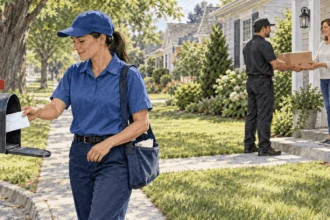
Picture two stylized routes. A city carrier in a dense neighborhood might serve several hundred addresses within a few square miles, with short drives between clusters of mailboxes. A rural carrier might serve a similar number of addresses spread across 50 or 60 miles of roads, including long stretches with no delivery at all. The actual routes are more complex, but the map already hints at the cost story: every extra mile driven without a delivery pushes up the average cost of serving each rural address.
The Postal Rate Commission’s paper “Rural Delivery and the Universal Service Obligation” opens with the observation that “It is widely believed that it costs more to provide rural areas with postal service than urban areas,” and sets out to test how much of that belief holds up under actual cost data.
The Postal Rate Commission’s paper examines “the relationship of rural delivery cost to population density” and the “profitability” of serving low-density areas. The findings confirm the intuition: density is the dominant driver of cost per stop, and rural routes have little of it.
How Delivery Costs Are Built
The cost of delivering mail is a sum of parts. Some are largely fixed: the processing plants, sorting equipment, and information technology systems that must exist regardless of how many letters move through them on a given day. Others vary more directly with route design and delivery volume: carrier wages and benefits, fuel, vehicle maintenance, and time spent at each stop.
City letter carriers are paid on an hourly basis, with overtime beyond a set threshold. Rural carriers work under an “evaluated” system: compensation is based on periodic measurements of route workload, expressed in evaluated hours, combined with a salary table.
The OIG’s audit of city carrier compensation found that city carrier compensation costs run higher than rural — in fiscal year 2015, city carriers were paid about 54 cents per delivery — reflecting their higher hourly pay and the labor intensity of dense door-to-door routes.
Rural carriers, by contrast, often use their own personal vehicles under reimbursement arrangements rather than Postal Service-owned trucks. Their pay is designed to account for route length, number of boxes served, and the volume and type of mail handled.
The newer Rural Route Evaluated Compensation System (RRECS) attempts to refine this by using detailed data on actual parcel scans, actual walking and driving distances, box locations, dismount requirements, and seasonal patterns. It has been controversial among carriers, in part because its implementation generated large swings in evaluated hours and pay, with some routes dropping sharply and others increasing.
That volatility is itself revealing: if a more precise measurement system produces such different results from the old one, the old system was not accurately capturing what rural routes cost to run.
The PRC’s 2024 Annual Compliance Determination noted that new “city and rural carrier cost models that attributed more costs to parcels and fewer to flats contributed to declines in delivery unit costs,” illustrating how sensitive cost-per-unit calculations are to assumptions about what work is being done for which mailpieces. Cost accounting in postal operations is genuinely complex, and small changes in methodology can shift millions of dollars between product categories.
The following table compares key operational characteristics between city and rural carrier environments, drawing on the research above.
| Characteristic | City Carriers | Rural Carriers |
|---|---|---|
| Pay structure | Hourly, with overtime | Evaluated system (periodic workload measurement) |
| Average route mileage | Compact neighborhood coverage | More than 48 miles on average |
| Vehicle ownership | Postal Service-owned trucks | Often personal vehicles under reimbursement |
| Deliveries per mile | High (dense neighborhoods) | Low (dispersed addresses) |
| Dominant delivery mode | Door-to-door and centralized | Curbside and roadside boxes |
| Pay measurement system | Time-based | RRECS (scan and activity data) |
Sources: NRLCA President Jeanette Dwyer, 2013 congressional testimony; USPS OIG city carrier compensation audit; RRECS implementation reporting.
The Mode of Delivery Problem
Where and how mail is handed over to the customer is another major cost driver, and it interacts with geography in ways that are easy to underestimate.
The OIG’s Modes of Delivery report (DR-AR-11-006) describes three primary modes: “door-to-door, curbside, and centralized.” Door delivery is the most labor-intensive: the carrier walks to each door, spending time in foot travel with small amounts of mail at each stop.
Curbside delivery, common in suburban and many rural areas, lets the carrier place mail in roadside boxes without leaving the vehicle. Centralized delivery, using cluster box units or apartment mailrooms, is the most efficient: many deliveries at a single point with minimal travel between boxes.
USPS policy now favors centralized delivery for new construction. The Postal Operations Manual states that “Centralized delivery is the preferred mode of delivery for all new residential and commercial developments.” and that “Curbside, sidewalk delivery, and door modes are generally not available for new delivery points.” That is a meaningful way to hold down costs for new suburban subdivisions, where cluster boxes can serve dozens of households at once.
In rural areas, the options are more constrained. Consolidating rural households into large cluster box units would often require customers to drive miles to collect their mail, which is not a realistic ask. The dominant mode remains curbside delivery to individual roadside boxes.
The time per stop, once the carrier arrives, can be fairly short. What drives up cost is the distance between stops. Moving a rural household from a box at the end of a long driveway to a cluster box at the road junction might save a minute or two per day. If that junction is still many miles from the previous stop, the driving time, fuel, and vehicle wear remain essentially unchanged.
The OIG notes that the “Mode of delivery is up to discretion of the Postal Service” within certain constraints. But in practice, the cost challenges of rural delivery are rooted in how spread out the addresses are, more than how mail is handed over. You cannot cluster-box your way out of a 50-mile route.
The Stamp as a Cross-Subsidy
USPS is legally required to charge uniform rates for certain mail classes. An OIG white paper states the rule plainly: “one class of mail must have uniform price,” meaning a First-Class stamp costs the same regardless of destination. At the same time, the USPS report on universal service acknowledges that “the Postal Service incurs costs associated with meeting its universal service obligation,” including serving high-cost rural addresses that a profit-seeking carrier might simply decline to reach.
Those two facts together produce a cross-subsidy. Delivery costs vary enormously by route density. Prices do not.
So revenue from cheap-to-serve urban and suburban routes helps cover the higher cost of rural route miles. USPS does not receive general tax revenue to fund this gap.
According to USPS strategic planning documents, Congress has authorized USPS to request up to $460 million per year for public service costs — the expense of maintaining a retail network in small and rural communities. USPS has not sought those funds since 1982. That is not because rural service became cheap. It is because the cost has been absorbed internally, embedded in the postage rates paid by everyone.
The Postal Regulatory Commission (successor to the Postal Rate Commission) has estimated the net cost of maintaining universal service at uniform rates, compared to what a purely commercial network would look like. Its estimate landed in the range of several billion dollars per year in the late 2000s, with rural delivery and rural post offices representing a major component.
That figure is not labeled rural cross-subsidy in any official document; it is an inference from the broader USO burden analysis. But the direction is clear: the $460 million congressional authorization, if it were ever used, would cover only a fraction of the hidden subsidy that currently flows from high-density routes to low-density ones.
Who pays? The answer is less romantic than city grandmothers subsidizing rural ranchers. The bulk of USPS volume consists of presorted advertising mail, marketing mail, and other commercial categories, not individual stamped letters.
Because bulk mail is concentrated in urban and suburban areas, and because its rates are designed to help cover shared costs, the cross-subsidy is mostly paid by high-volume commercial mailers. The PRC’s rural delivery paper documented that high-volume commercial mailers effectively subsidize the higher cost of serving rural routes. That is a structural feature of how postal rate design works, not an accident.
What Private Carriers Reveal
The clearest window into what rural delivery actually costs, absent the cross-subsidy, is what private carriers charge when they have to serve the same geography.
UPS and FedEx do not hide the math. They apply what they call “extended area surcharges” to rural ZIP codes. According to a 2025 Institute for Policy Studies analysis, UPS and FedEx extended area surcharges run about $8.30 per home delivery in rural ZIP codes where roughly 35 million Americans live.
Suburban and small-town ZIP codes where about 19 million people live face residential surcharges of a little over $6 per package. For Alaska, the surcharge is around $43 extra per shipment. For Hawaii and certain other remote areas, about $15 extra.
Altogether, according to the IPS report, UPS and FedEx area surcharges now apply to ZIP codes where 102 million Americans live.
For rural pickups, the numbers are higher still. According to a 2025 Institute for Policy Studies report, UPS fees for rural package pickups run more than $20 (about $21.30), while FedEx charges $4 per package on weekdays and $16 on Saturdays.
When even those surcharges are not enough to make a rural route profitable, private carriers take a different approach. Products like UPS SurePost and FedEx Ground Economy are built around this model: the private carrier handles the profitable urban and suburban legs, then hands the package to USPS for the final miles to the rural address.
The private carrier avoids the high-cost rural stop; USPS absorbs it as part of its universal service obligation.
The Brookings Institution, in its research on the postal network as economic infrastructure, finds that in many small towns there is no local UPS Store or FedEx Office, but there is a post office that serves as the community’s logistics hub. Rural small businesses rely heavily on USPS for both inbound and outbound parcels, in part because private carriers’ local presence is more limited. That dependence is not incidental. It reflects a basic fact: left to the market alone, no company would keep up affordable rural service.
USPS has begun to acknowledge this tension in its own competitive products. According to Save the Post Office, when the law allows deviation from strict uniform pricing, USPS does recognize and price the higher cost of rural service.
For market-dominant letter mail, where uniform rates still apply, the same cost differential exists but is not explicitly priced. It shows up instead as the cross-subsidy embedded in every stamp.
Is Any of This Waste, or Is It Just Math?
A fair question, and one that serious analysts disagree about.
The geographic argument is straightforward: low density raises cost per stop, and no amount of operational efficiency can fully overcome the physical reality that houses are far apart. The Postal Rate Commission’s rural delivery paper was designed to test exactly this, comparing rural and city delivery costs while controlling for density effects. The conclusion is that density explains a large share of the rural cost premium.
But some researchers and market-oriented critics argue that institutional constraints amplify the geographic premium in ways that are not inevitable. USPS faces political resistance to closing low-volume rural post offices, even when they operate at a loss. The law actually bars USPS from closing small post offices solely because they are unprofitable, a constraint Congress tied to ensuring effective postal services for residents of both urban and rural communities. Work rules and labor contracts limit management’s ability to redesign routes quickly as populations shift. And for decades, the evaluated pay system for rural carriers was based on outdated mail profiles rather than precise data, which is precisely why RRECS was developed: to measure actual workload with actual scan data rather than historical approximations.
The RRECS rollout is worth pausing on. It suggests the prior system was not measuring rural carriers’ workload accurately, a measurement problem rather than a question of geography. And a measurement problem is at least partly fixable.
The OIG’s white paper on package delivery in rural and dense urban areas identifies specific operational levers: installing parcel lockers, encouraging customers to use larger curbside boxes that can accept roughly 70 percent of parcels, using better route-level data to adjust workload. The paper even suggests USPS could consider applying extra fees to certain high-cost deliveries as one option to better align prices with costs. The fact that the OIG can identify concrete savings from relatively basic operational changes implies that the current cost structure is not purely dictated by geography.
The honest answer is probably both. Geometry sets the baseline. How USPS is run and regulated determines how much gets added on top.
The size of that institutional component, relative to the unavoidable geographic component, is a question the current data cannot fully answer. Separating the two would take detailed route-by-route measurement. RRECS is an attempt to provide it, and its troubled rollout is evidence of how much ground there is to cover.
What Would Market Pricing Actually Look Like?
Rep. Marie Gluesenkamp Perez, who represents a rural district in Washington state, has described rural mail delivery as a “lifeline” for her constituents. That framing captures something real: for rural communities, USPS is often the only carrier that will show up at all, and it shows up at the same price as everywhere else. The question of what would happen under market pricing is therefore not abstract.
Sarah Anderson, Global Economy Project Director at the Institute for Policy Studies and co-author of the IPS report on postal privatization, has documented what private-carrier pricing looks like in those same geographies. The surcharge numbers above are the answer: $8.30 per package in rural ZIP codes, $43 extra for Alaska, $20 or more for rural pickups. These are not projections. They are current rate-card prices that private carriers charge when they cannot hand the package to USPS.
Pricing that matched the real cost of rural delivery would mean materially higher prices for rural customers, or no service at all for the most remote addresses.
Supporters of market-oriented reform argue that this is more honest than the current system. The cross-subsidy is real but invisible, embedded in postage rates without any explicit democratic decision to impose it. Making the subsidy transparent, through a direct federal payment rather than a hidden rate cross-subsidy, would at least clarify what rural service costs and who is paying for it.
Congress has already authorized up to $460 million per year public service costs — the expense of maintaining a retail network in small and rural communities. The fact that USPS has not sought those funds since 1982 means the cost has been spread across postage prices instead, which is a policy choice, not a law of nature.
Critics of that framing respond that the cross-subsidy is a feature, not a bug. Rural Free Delivery, launched in the late 19th century as a deliberate public policy to extend urban-style mail service to rural areas, was controversial on several fronts: private express companies and town merchants feared lost business, postmasters feared losing jobs, and urban interests resisted subsidizing the higher cost of serving sparsely populated areas. That set of political choices was made then, and maintaining it is a political choice now. The question is whether to make that choice out in the open, through transparent subsidies, or hidden inside the price of a stamp.
Neither camp disputes the underlying cost reality. Rural delivery is expensive because rural geography is what it is: long distances, few stops per mile, high fixed costs spread over a small number of addresses. The Postal Regulatory Commission’s Report on Measuring the Benefits of Rural Postal Service finds that some rural areas generate losses exceeding $100 million per year, driven by the very high cost of delivery to rural ZIP codes, and those losses are openly covered by other users of the Postal Service.
That is the system working as designed. Whether the design is right is the argument that has not been settled, and as mail volumes continue to fall and the financial pressure on USPS’s cross-subsidy model grows, it is an argument that will become harder to defer.
Frequently Asked Questions
Why does a First-Class stamp cost the same everywhere in the country?
Federal law requires uniform pricing for certain mail classes, including First-Class Mail. The USPS OIG describes this as a requirement that “one class of mail must have uniform price,” regardless of where the letter is going. This is part of the Universal Service Obligation, which requires USPS to serve every address in the country at consistent rates. The result is that the stamp price reflects a national average cost, not the actual cost of any individual delivery.
How much more does it actually cost to deliver to a rural address?
USPS does not publish a single rural-versus-urban cost figure, because costs are tracked by product and cost driver rather than by geographic label. What regulators have documented is that, according to a USPS Office of Inspector General analysis of fiscal year 2019 data, nearly two-thirds of rural post offices cost more to run than the revenue they generate, compared to about 7 percent of urban post offices. According to a 2025 Institute for Policy Studies analysis, private carriers such as UPS and FedEx add extended area surcharges of about $8.30 per home delivery in rural ZIP codes as a market signal of the additional cost.
Who pays for the higher cost of rural delivery?
USPS funds its universal service obligation from its own revenues, not from general tax appropriations. That means the extra cost of rural delivery is absorbed internally, covered by revenue from cheaper-to-serve urban and suburban routes and from profitable competitive products like parcels. High-volume commercial mailers, including advertisers and large shippers concentrated in urban areas, contribute disproportionately to the common costs that cover rural service.
Why do UPS and FedEx charge extra for rural deliveries if USPS doesn’t?
Private carriers are not subject to a universal service obligation and must price every route to at least break even. When delivery density falls, the fixed cost per stop rises sharply, and private carriers pass that cost to customers through surcharges. When even surcharges are not enough, they hand the package to USPS for the final miles under products like UPS SurePost and FedEx Ground Economy. USPS absorbs those high-cost rural stops as part of its mandate.
Could USPS get federal money to cover rural delivery costs instead of using cross-subsidies?
Congress has authorized USPS to request up to $460 million per year for public service costs, of which rural service is the main driver. The current approach buries the rural cost premium in uniform postage rates rather than funding it through an explicit appropriation. Some reform advocates argue that making the subsidy transparent through direct federal payments would be more honest and more sustainable as mail volumes decline.