Last Checked: August 13, 2026Next Check: August 13, 2029
Government and agencies 75 Research and academic 7 Organizations and advocacy 13 Industry and standards 7 News and analysis 8
- leg.state.nv.us15 reviewed
- wicourts.gov7 reviewed
- eac.govcited ×14 reviewed
- justice.govcited ×14 reviewed
- codes.findlaw.com3 reviewed
- sos.ca.govcited ×13 reviewed
- supremecourt.gov3 reviewed
- elections.virginia.gov2 reviewed
- michigan.gov2 reviewed
- nycvotes.org2 reviewed
- scvotes.gov2 reviewed
- votetexas.gov2 reviewed
- acefiling.wicourts.gov
- atlanticcountynj.gov
- caselaw.findlaw.com
- cityofmadison.com
- codes.ohio.govcited ×1
- docs.legis.wisconsin.gov
- elections.maryland.gov
- elections.ny.gov
- fjc.gov
- georgia.govcited ×1
- governor.ny.gov
- law.lis.virginia.govcited ×1
- leg.state.fl.uscited ×1
- ncleg.govcited ×1
- nysenate.gov
- pa.gov
- rules.sos.ga.gov
- s3.amazonaws.com
- sos.ks.govcited ×1
- sos.mn.gov
- sos.mo.govcited ×1
- sos.state.tx.us
- sos.tn.gov
- tile.loc.govcited ×1
- vote.nyc
- vote.sos.ri.gov
- bipartisanpolicy.org2 reviewed
- electionlab.mit.educited ×2
- law.cornell.edu
- law.yale.edu
- scholarship.law.nd.edu
- ncsl.org3 reviewed
- 866ourvote.org2 reviewed
- statecourtreport.org2 reviewed
- vote.orgcited ×12 reviewed
- aclu-tn.orgcited ×1
- aclupa.org
- civilrights.orgcited ×1
- lwv.org
- law.justia.com4 reviewed
- nevada.public.law2 reviewed
- multistate.us
- cnet.com
- finance.yahoo.comcited ×1
- fox6now.com
- miamiherald.comcited ×1
- sacbee.com
- thehill.com
- vbnewsletters.votebeat.orgcited ×1
- yahoo.com
Last updated 2 months ago. Our resources are updated regularly but please keep in mind that links, programs, policies, and contact information do change.
A Reddit user recounting their own Election Day put it plainly: “It’s true, happened to me the second time I voted this year, they let all of us who were in line vote even though it took an hour after closing.”
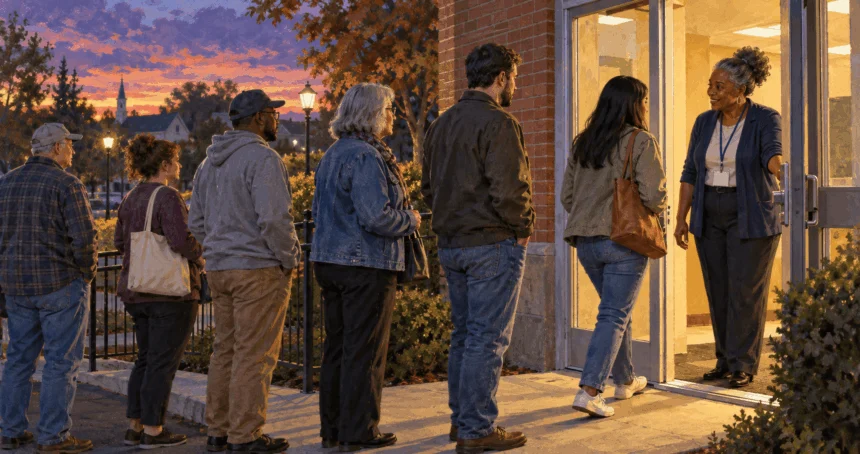
That is the whole question in one sentence. You show up before the polls close, the line is long, the clock runs out while you are still waiting. Do you get to vote?
State election guidance puts it about as directly as government prose ever gets: “Stay in line! All voters who are in line when polling locations close are allowed to vote.” A state voter portal says the same thing in a single line: “If you are in line by 7:00 p.m., you are allowed to cast your ballot.”
There is no single federal law guaranteeing the in-line rule. The protection lives in a patchwork of state statutes, administrative manuals, and poll worker training standards, and the way it gets enforced depends on who is running your precinct that night.
The Rule Comes From the States, Not Washington
This principle is one of the most basic in electoral democracy: if you arrive during voting hours as a registered, qualified voter, you are entitled to cast your ballot even if the line is so long that you must wait until after the scheduled time for the polls to close.
Congress never passed a statute guaranteeing the in-line rule. Instead, each state sets its own polling hours and writes its own procedure for what happens when the clock strikes closing time. The remarkable thing is how uniformly they landed in the same place.
A survey of state election laws compiled by MultiState notes that many states allow voters already inside the polling place or waiting in line at closing time to cast their ballots, describing the common pattern as individuals waiting in the polling place or waiting in line at the door at the time of closing are allowed to vote.
Closing hours themselves vary, which is the one detail you need to look up before Election Day.
| State | Polls Open | Polls Close | How the cutoff is marked |
|---|---|---|---|
| Virginia | 6:00 a.m. | 7:00 p.m. | Officers list names of everyone in line at 7:00 p.m. |
| California | 7:00 a.m. | 8:00 p.m. | Poll worker stands at back of line |
| Georgia | 7:00 a.m. | 7:00 p.m. | In line by 7:00 p.m. means you vote |
| Missouri | 6:00 a.m. | 7:00 p.m. | In line at 7:00 p.m. allowed to vote |
| North Carolina | 6:30 a.m. | 7:30 p.m. | Written list of voters in line |
| Wisconsin | 7:00 a.m. | 8:00 p.m. | Election worker stands at end of line |
Sources: Virginia Code §24.2-603, California Secretary of State, a 2026 Georgia.gov guide, Missouri Secretary of State, and North Carolina State Board of Elections.
State election guidance draws the boundary in two sentences: “those individuals in line at 7:00 p.m. will be allowed to vote.”
Closing time, in other words, is the deadline to join the line. It is not the deadline to finish voting.
How Poll Workers Actually Mark the Line
Think about the practical problem a poll worker faces at exactly 8:00 p.m. A line snakes out the door and around the building. Some of those people were here at 7:59. Others walked up at 8:01.
If everyone gets processed for the next hour, how does anyone remember who was where when the clock struck?
States solved this with a physical marker.
The U.S. Election Assistance Commission lays out a clean version in its “Closing the Polls” guide. At 6:30, announce that the polls will close in 30 minutes. At 7:00, announce that the polls are closed, bring in the flags, and “lock the polling place door to stop other voters from entering the polling place.” Then the line that matters: “voters in line at 7:00 pm, no matter how long the line, must be allowed to vote.”
California handles it with a person. California’s poll worker training directs a worker to stand at the back of the line at 8:00 p.m., so that anyone who arrives afterward is told, on the spot, that they are too late. Everyone ahead of that worker votes. That’s the whole system: one human body as a bookmark.
Virginia handles it with paper. State law directs officers of election to list the names of qualified voters in line before closing and permit only those voters to vote afterward. That defines a closed set: on the list, you vote; off the list, you don’t.
North Carolina builds a written record too, and even titles it. Just before 7:30, an official posts at the end of the check-in line. At closing, officials start from the back and move forward, creating a written list of everyone still in line. Only the people on that list may vote after the polls close.
Nevada goes further still. State law requires a board member to mark the last person waiting, either with a sticker or by physically standing behind them, so that no one can quietly slip into line after the cutoff. Indiana lets an official pick from a menu: write down each voter’s name, stamp their hand, or stand behind the last eligible voter. Under Indiana Code §3-11-8-11, when the polls close the precinct election board must determine the end of the line of voters waiting to vote and permit those voters, and no others, to cast a ballot. Texas gives its presiding judge the option of issuing numbered cards to everyone waiting.
Different props, same job. Each one turns a fuzzy human moment into a defensible record of who was there.
Dan Kulin, Manager of Election Administration for Clark County, Nevada, described what this looks like once the marker is set. “If there’s a line when the polls close, we continue processing voters until there are no more in line,” he said, adding that the county tries to accommodate voters so everyone can cast a ballot.
What Counts as “In Line”?
Do you have to be inside the building? At the check-in table? Or somewhere in the queue on the sidewalk?
The general answer is that being anywhere in the organized line counts, inside or outside, as long as you are clearly waiting to vote.
Virginia’s statute speaks of voters “in line before the polling place,” which plainly contemplates a line outside the entrance. California’s guidance covers any voter in line at 8:00 p.m. without limiting it to people indoors, which is why the worker gets sent to the back of the line, wherever the back happens to be.
Ohio’s election code offers a telling detail. It draws a campaign-free zone between the polling place and small U.S. flags placed on the walkways, and then adds that if the line of voters stretches past those flags, no campaigning may happen within ten feet of any voter in it. The law assumes lines run long and treats the whole line as a single protected thing.
What does not count: cutting across an adjacent area without joining the queue, or walking up a minute after closing and trying to merge in. That is exactly the boundary the sticker, the list, and the standing worker exist to police.
So the safe move is the one every voter guide repeats. Vote.org, a voter-advocacy organization, reduces its advice to four words on its Election Protection page: “Keep your place in line.”
The Integrity Question: Can Anyone Verify It Later?
The concern is not that in-line voters shouldn’t vote, but that the moment is hard to audit.
Consider the conditions. Closing time is often chaotic: long lines, tired volunteers, dim light, sometimes tension. The decision about who counts as in line gets made in real time, under pressure, by frontline workers, not by a court or a central official. If a sympathetic poll worker waves in one late arrival, or wrongly turns away someone who made it by a few seconds, there is frequently no timestamp, no photograph, and no electronic record to check afterward.
Virginia demands a name list, North Carolina titles a document, and Nevada requires a physical marker on the last voter. Lawmakers required extra paperwork exactly at the closing-time moment, which suggests they saw a real risk that the moment would be hard to prove later.
North Carolina goes one step further and treats after-hours voting under a court order as a category apart: those ballots must be provisional, separated, and held apart from other provisional ballots. Florida does something similar, setting aside court-ordered late voters for special handling while clarifying that the rule “shall not apply to voters in line at the poll-closing time” who simply finish voting afterward. Ordinary in-line voters are counted as regular voters. Late voters added by a judge are quarantined.
The weakness in this argument is that there is almost no hard data measuring actual misapplication of the in-line rule. The argument rests on how the system is set up and on the safeguards states chose, not on documented fraud. At its strongest, it is a claim about how well the process works and whether it can be checked afterward, not about keeping people from voting.
The Access Question: Who Ends Up Stuck in Those Lines?
Voting-rights advocates start from the opposite worry, and they support the in-line rule just as firmly. A voter-rights guide tells voters flatly that “If you’re in line, stay in line.” Their argument is that the rule is a necessary floor, not a full protection.
The reason is that long lines are not evenly distributed, and time is a cost that some voters can absorb and others cannot.
The MIT Election Data and Science Lab tracked the national trend. The share of voters waiting more than 30 minutes fell from 16 percent in 2008 to 9 percent in 2016, when the average wait was 10.4 minutes. Then it reversed. In 2020, pandemic precautions and record turnout pushed the average wait to 14.3 minutes, and 18 percent of voters waited longer than 30 minutes.
Those averages hide the disparities that advocates care about. Voters in urban precincts, communities of color, and lower-income areas are more likely to face the longest waits, often because there are fewer polling places or machines per voter.
Democracy-reform advocates have framed long lines and poll closures as obstacles to the ballot box and called for national wait-time standards. Civil-rights advocates have argued that polling-place closures in Black communities amount to a retreat from equal access.
For a voter who reaches the front only after closing, they contend, the in-line rule is not a convenience. It is the one thing standing between a three-hour wait and disenfranchisement.
Much of this traces back to a single 2013 Supreme Court decision. In Shelby County v. Holder, the Court held that a key coverage formula in the Voting Rights Act was unconstitutional and could no longer be used to decide which jurisdictions needed federal approval before changing their voting rules. The majority concluded that “our country has changed” and that Congress had to legislate for current conditions.
A voting-rights analysis documented widespread polling-place closures in formerly covered jurisdictions afterward, noting that courts had found “intentional discrimination in at least 10 voting rights decisions” since Shelby County. Fewer polling places funnel more voters into the ones that remain, which is exactly how you get lines that outlast closing time.
Both camps end up defending the same rule. One wants it documented more tightly; the other wants the lines that make it necessary to shrink. Neither wants to abolish it.
The Line Courts Won’t Let Judges Cross
There is a related question that trips people up, and a recent case draws the boundary sharply. If the in-line rule protects people already waiting, can a judge simply reopen the doors and let more people join a long line after closing?
In 2024, a Walworth County judge in Wisconsin did just that, allowing voters to enter the line after 8:00 p.m. at two Whitewater polling places where waits had run long. The judge ordered the two Whitewater sites to stay open until 10:30 p.m. or later for voters already in line.
A Wisconsin Court of Appeals panel later reversed it.
The reversal sums up the whole system. The rule protects the people who came on time and got stuck. It does not, on its own, extend the clock.
Which leaves an unresolved tension worth watching. When lines run hours past closing in a handful of precincts, and courts increasingly decline to extend hours, the in-line rule becomes the only remedy left for voters at the back. It protects you if you stay. So the practical advice is boring and correct: check your state’s closing time, get in line before it, and do not leave, no matter how long the wait looks.