Last Checked: October 9, 2026Next Check: April 4, 2028
- mod.gov.uacited ×1
- rusi.orgcited ×4
- gov.ukcited ×22
- nato.intcited ×16
- elysee.frcited ×6
- marketscreener.comcited ×2
- canada.cacited ×1
- eeas.europa.eucited ×1
- en.interfax.com.uacited ×1
Last updated 3 days ago. Our resources are updated regularly but please keep in mind that links, programs, policies, and contact information do change.
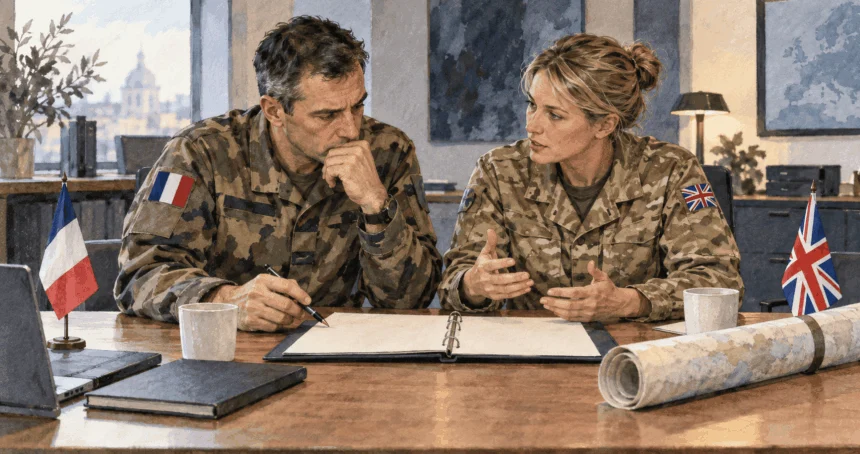
France and Britain are preparing a military force for Ukraine, but it is still a plan: the troops would deploy after a ceasefire to help deter renewed attacks. Ukraine’s president said in February 2026 that each country was ready to send one brigade, which he estimated at 5,000 service members.
Both countries belong to the North Atlantic Treaty Organization, or NATO. The force, though, is being prepared by the Coalition of the Willing, a group of countries working on security guarantees for Ukraine, and its mission would carry its own commitments. Ukraine is not a NATO member, and the alliance’s treaty guarantee does not cover it. What happens if the force is attacked would depend on which governments have promised to respond and what they could do.
What France and Britain have actually committed to
In January 2026, Britain and France led the coalition, whose meeting in Paris brought together 39 nations. Britain, France and Ukraine signed their declaration of intent in Paris on January 6, 2026.
The British, French and Ukrainian declaration of intent calls for national forces to deploy on Ukrainian territory to help deter further attacks. It recognizes the declaration itself as Ukraine’s request for military assistance. In other words, the document is Ukraine’s invitation and a statement of what the three countries intend, not a record of a completed deployment.
In a statement delivered January 7, 2026, the British defense secretary repeated the prime minister’s promise to bring any decision to deploy under the agreement signed the day before to the House of Commons, Britain’s elected parliamentary chamber, for a debate beforehand and a vote. That commitment covers this proposed deployment; the statement does not say that every British military deployment requires a vote.
On July 24, 2026, Britain announced that Lieutenant General Tom Bateman had taken command of the multinational force from his French counterpart at its operational headquarters in Paris. Britain’s defense ministry described the handover as a planned rotation between Britain and France. A headquarters and a commander can exist while the deployment they are preparing remains conditional.
The coalition’s co-chair statement was published on August 24, 2026, following a meeting in Kyiv and by video conference. It said preparations would continue for deployment once there was a credible end to the fighting, with security guarantees taking effect after a ceasefire.
What the force would do after a ceasefire
The coalition’s plans call for logistics, weapons and training specialists to help rebuild Ukraine’s land forces. Coalition aircraft would work alongside Ukraine’s air force to secure its skies and allow normal international air travel to resume. The plans also include support for safer maritime access and mine clearance.
The three-country declaration also envisages protected facilities for weapons, equipment and reserves, with logistical operations based on agreed operational needs. The multinational force’s joint operations staff would control deployments, movements and operations and would have to coordinate with Ukraine’s General Staff, Ukraine’s central military command body.
Under the declaration, Ukraine would give the contributing countries the right to use necessary means, including force, to fulfill the mission and to protect the personnel, equipment and infrastructure of both the force and Ukraine. They would act in line with international law and in coordination with Ukrainian forces. The force, in other words, would not be limited to observing: it could fight to carry out its mission and to protect itself.
The three-country declaration describes intentions for deploying forces; the Paris Declaration sets out the wider coalition’s proposed security guarantees. The Paris Declaration on security guarantees, published by the French presidency, keeps Ukraine’s own armed forces as the first line of defense and deterrence, backed by long-term assistance, weapons financing, supplies and fortification support. The foreign contingent is intended to strengthen that defense rather than replace the Ukrainian military.
Britain announced £200 million for deployment preparations on January 9, 2026, including equipping its armed forces for a possible multinational mission. Britain’s Treasury is also taking responsibility for further support costs for international objectives, including Ukraine security guarantees in the event of a ceasefire. Both announcements concern Britain’s own spending; neither is a total budget for running the multinational force.
Who else could join, and how large it could be
Canada’s defense department says its government is willing to contribute to the proposed force and is participating in the coalition’s military and political work. That makes Canada another NATO country that may contribute to the force, though its statement names no number of troops.
In a report published February 23, 2026, Interfax-Ukraine said President Volodymyr Zelenskyy described France and Britain as ready to provide one brigade each after the war, estimating a brigade at 5,000 service members. Those figures are Zelenskyy’s estimate for two countries, not a final total for the force or a count of troops already deployed.
The force is described in the Paris Declaration as contributions from willing nations within the coalition framework. That wording does not commit every coalition member to send ground troops.
Why allied troops would not make this a NATO mission
NATO says its member and partner countries voluntarily supply national forces for alliance operations, which operate under the NATO Command Structure. The alliance relies on those national militaries rather than possessing military forces of its own. A British or French uniform identifies the country supplying the soldier, but does not establish who authorized or commands a particular mission.
NATO decisions are made by consensus, expressing the collective will of all its member countries. The coalition’s plan, by contrast, commits willing countries through the coalition’s own framework; it is not an alliance decision simply because NATO members participate.
The European Union runs a separate operation: its Military Assistance Mission in support of Ukraine, known as EUMAM Ukraine, trains Ukrainian forces and says all its mission activities take place on EU soil. The coalition’s force, by contrast, would deploy inside Ukraine after a ceasefire.
What NATO is doing for Ukraine now
Ukraine is a NATO partner, not a member, and NATO says it is not covered by the security guarantee in the alliance’s founding treaty. To join under Article 10 of the North Atlantic Treaty, a country must be invited by unanimous agreement of the members and then deposit its accession document with the United States government. Neither military aid nor the presence of foreign troops substitutes for that membership process.
NATO Security Assistance and Training for Ukraine, or NSATU, coordinates equipment donations and training from its base in Wiesbaden, Germany, with three logistics hubs in the eastern part of the alliance.
NATO has also expanded the staff at its Representation to Ukraine, an office in Kyiv headed by a NATO Senior Representative. NATO says it is not sending combat troops or enforcing a no-fly zone in Ukraine because either step would bring its forces into direct conflict with Russia and escalate the war.
What an attack on the force could mean
Article 5 of the North Atlantic Treaty, the alliance’s mutual-defense pledge, treats an armed attack on one ally in Europe or North America as an attack on them all. Each ally must then assist by taking the action it considers necessary, including the use of armed force. The article does not prescribe the same military response from every member; each decides how to help.
Article 6 spells out where an attack counts for Article 5, including member territory in Europe or North America, Turkey, specified North Atlantic islands and waters, and the Mediterranean Sea. For forces in other parts of Europe, it refers specifically to areas where allied occupation forces were stationed when the treaty entered into force. It does not extend the guarantee to every place an ally chooses to deploy troops. Sending member-country troops into Ukraine would therefore not, by itself, give Ukraine NATO’s territorial protection.
Article 4 allows allies to consult whenever any member believes a member’s territorial integrity, political independence or security is threatened. An incident involving the coalition could become a serious alliance security question without automatically resolving whether Article 5 applies.
Reuters reported on July 15, 2026, that Russia called a post-peace-deal multinational force unacceptable and said it would regard the force as a threat and a legitimate military target. That is Russia’s stated position, not a legal determination that attacking the force would be lawful.
The Paris Declaration proposes US-led ceasefire monitoring, with a commission to address breaches, assign responsibility and determine remedies. It also says the coalition would finalize commitments for a future Russian armed attack, potentially involving military capabilities, intelligence, logistics, diplomacy and additional sanctions. The declaration says the steps taken at Ukraine’s request after a credible end to the fighting, called reassurance measures, would be European-led, with proposed US support. A proposed monitoring system or support arrangement should not be mistaken for a completed guarantee of US combat intervention.
A 2025 commentary published by the Royal United Services Institute, a defense and security think tank, argues for deterrence by denial: making a future attack impossible or overwhelmingly costly, rather than relying on punishment afterward. Its authors, Andriy Zogorodnyuk, Alina Frolova and Oleksandr Khara, argue that Ukraine needs sufficient ground-based air defense and advanced tactical aircraft to prevent Russia from gaining air superiority. Their point, made before the January 2026 declaration of intent, is that a renewed Russian offensive becomes much less likely if Ukraine controls the air over its own territory.
France is still a NATO member
NATO’s current membership list includes France and the United Kingdom, both founding members from 1949. In 1966, France withdrew from NATO’s integrated military structure while continuing to participate in its political structures. That was a change in military integration, not a departure from the alliance.
France announced full participation in NATO structures in April 2009, while remaining outside the Nuclear Planning Group.
The Nuclear Planning Group is NATO’s forum for consultation and decisions on nuclear deterrence, including nuclear policy and planning.
Related GovFacts reading: Alliances and Partnerships; Trump’s National Security Strategy.