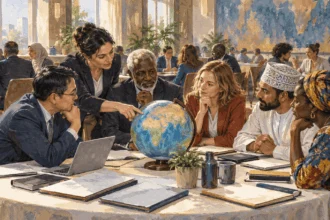
Multilateral organizations are the standing bodies that countries, including the United States, use to coordinate on problems no single nation can solve alone: war and peace, trade, disease, currency stability, and humanitarian crises. The United Nations is the best known of these, but it sits alongside a wider network of institutions that set rules, offer forums for negotiation, and sometimes deploy personnel into conflict zones.
How these bodies are structured matters as much as what they do. Each has its own membership rules, voting procedures, and funding formulas, which shape how much influence any single country, including the United States, can exert. A broad primer on how these institutions work and interact is a useful starting point: Understanding International Organizations: Your Guide to the UN, WTO, IMF, and More.
Security missions are one of the most visible and most misunderstood functions of these organizations. Blue-helmeted forces are often lumped together in public discussion, but the legal basis, rules of engagement, and goals of a mission can differ enormously depending on whether it is meant to monitor an existing peace or impose one. That distinction is explained in Understanding Peacekeeping vs. Peace Enforcement Operations.
Debates over relevance and reform follow these organizations constantly. Critics argue they move too slowly or answer to too few powerful members; defenders argue they remain the only venues where rival nations can still talk. Both views turn up in ongoing arguments about how institutions built after past conflicts should adapt to new ones.
The geopolitical map of Europe is being redrawn. Not by the shifting frontlines of the Donbas, but by the pen…
When blue-helmeted UN peacekeepers deployed to Cyprus in 1964, they entered with the consent of all parties to help monitor…
International Organizations like the United Nations, World Trade Organization, and International Monetary Fund are frequently in the news, shaping global…