- peacekeeping.un.org5 links
- un.org3 links
Last updated 11 months ago. Our resources are updated regularly but please keep in mind that links, programs, policies, and contact information do change.
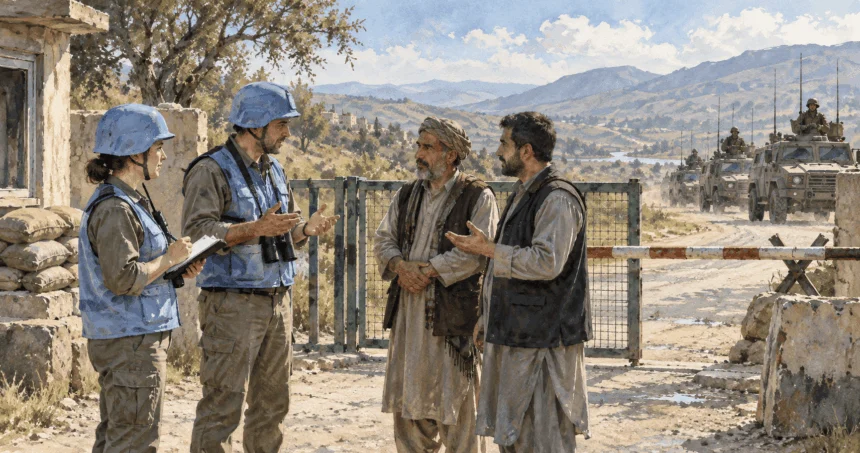
When blue-helmeted UN peacekeepers deployed to Cyprus in 1964, they entered with the consent of all parties to help monitor a ceasefire. When American-led coalition forces launched Operation Desert Storm in 1991 to liberate Kuwait, they operated under UN authorization but against Iraq’s will, using overwhelming military force to achieve their objectives.
These examples illustrate a crucial distinction in international peace operations that often confuses the public: the difference between peacekeeping and peace enforcement. Both aim to promote stability and security, but they work through fundamentally different approaches—one based on consent and cooperation, the other on coercion and force.
- UN Peacekeeping: Building Peace Through Consent
- Peace Enforcement: Imposing Peace Through Force
- Real-World Examples: Peacekeeping in Action
- Peace Enforcement in Practice
- Key Operational Differences
- Evolution of Peace Operations Doctrine
- Comparing Approaches: When to Use What
- Challenges and Limitations
- The U.S. Role and Perspective
- Looking Forward: Future Challenges
- Why Understanding These Distinctions Matters
Understanding this distinction matters more than you might think. It explains why some international interventions succeed while others fail spectacularly. It shows why the UN sometimes appears weak and ineffective while other times it authorizes devastating military action. It also helps explain America’s complex relationship with international peace operations and why U.S. policy toward these missions often seems inconsistent.
The stakes are enormous. Since the UN’s founding in 1945, peacekeeping operations have deployed to more than 70 conflicts worldwide, while peace enforcement actions have shaped major international crises from Korea to Kuwait to the Balkans. These operations affect global stability, cost billions of dollars, and involve hundreds of thousands of military and civilian personnel.
The United States is the largest financial contributor to UN peacekeeping, provides crucial military and logistical support, and often leads or participates in enforcement actions. How America approaches these missions—and how the public understands them—directly influences their effectiveness and the nation’s role as a global leader.
UN Peacekeeping: Building Peace Through Consent
What Peacekeeping Actually Does
United Nations peacekeeping has evolved far beyond the popular image of soldiers in blue helmets standing between hostile armies. Modern peacekeeping is a complex, multifaceted enterprise designed to help countries transition from conflict to lasting peace.
Today’s peacekeeping operations are “multidimensional,” meaning they combine military, police, and civilian components to address the root causes of conflict. Peacekeepers might monitor elections in a fragile democracy, train local police forces, protect civilians from violence, help former fighters reintegrate into society, or support the establishment of functioning courts and government institutions.
The U.S. Department of State views peacekeeping as a critical tool for promoting global stability and building other nations’ capacity to participate in peace operations. The Department of Defense recognizes that peacekeeping can involve American military personnel in maintaining ceasefires, implementing peace agreements, or assisting in humanitarian operations, often in challenging and dangerous environments.
This evolution reflects changing conflict patterns. During the Cold War, most peacekeeping addressed wars between countries. Today, most conflicts occur within states—civil wars, ethnic conflicts, and struggles for political control. These internal conflicts require more comprehensive responses addressing political, economic, and social factors alongside immediate security concerns.
The Three Pillars of Peacekeeping
UN peacekeeping operates according to three fundamental principles known as the “trinity of virtues.” These mutually reinforcing principles distinguish peacekeeping from other forms of international intervention:
Consent of the Parties
Peacekeeping operations deploy only with the consent of the main parties to conflict. This means the primary belligerents must agree to the UN’s presence and mandate. Consent provides peacekeepers with the political and physical freedom to carry out their tasks without being seen as invaders or occupiers.
However, consent can be fragile and complex. While main parties might agree to a peacekeeping mission, local commanders or spoiler groups may not. Consent must be actively maintained throughout a mission’s lifecycle, requiring constant political engagement and relationship-building.
Without genuine consent, peacekeeping operations risk becoming parties to the conflict themselves, fundamentally altering their nature and effectiveness. This is why the loss of consent often signals the need to either withdraw peacekeepers or transition to a different type of operation.
Impartiality
Peacekeepers must deal with all parties without favor or prejudice in implementing their mandate. This doesn’t mean neutrality or inactivity—peacekeepers should respond when parties violate agreements or international norms. Like a good referee who applies rules fairly but penalizes infractions, peacekeepers must uphold their mandate’s principles while treating all parties equitably.
Impartiality becomes challenging in missions with robust mandates, particularly those requiring civilian protection. When peacekeepers must act against specific groups to prevent atrocities, they may appear to be taking sides. This tension requires careful navigation to maintain overall mission legitimacy and effectiveness.
Non-Use of Force Except in Self-Defense and Defense of the Mandate
Peacekeepers are authorized to use force only in self-defense or to defend their mandate when others try to prevent them from carrying out authorized tasks. This principle emphasizes that peacekeeping is not an enforcement tool—force should be a last resort, used with restraint in a precise, proportional, and appropriate manner.
The scope of “defense of the mandate” has expanded significantly, particularly with robust peacekeeping mandates that explicitly authorize protecting civilians. However, even these expanded authorities maintain the principle that force should be defensive rather than offensive, aimed at deterrence and protection rather than defeating enemies.
Types of Peacekeeping Operations
Peacekeeping has evolved into several distinct types, each tailored to specific conflict situations:
Observation Missions
These typically involve small contingents of unarmed military or civilian observers who monitor ceasefires, troop withdrawals, or other peace agreement conditions. Examples include the UN Truce Supervision Organization (UNTSO) in the Middle East, established in 1948, and the UN Military Observer Group in India and Pakistan (UNMOGIP), also from 1948.
Observation missions provide objective reporting on compliance with agreements and can help build confidence between parties. Their presence alone often deters violations and provides early warning of potential escalations.
Traditional Peacekeeping (Interpositional Forces)
These operations deploy larger contingents of lightly armed troops to act as buffers between hostile forces after conflicts end. The first armed UN peacekeeping force was the UN Emergency Force (UNEF I) deployed during the 1956 Suez Crisis, which established the model of neutral forces separating adversaries.
Traditional peacekeeping works best in clear-cut situations where the main parties genuinely want peace but need help maintaining ceasefires and building confidence for political solutions.
Multidimensional Peacekeeping
Today’s most common peacekeeping operations are complex missions that combine military, police, and civilian components. These missions operate in volatile environments to implement comprehensive peace agreements covering everything from security arrangements to electoral processes.
Multidimensional operations might simultaneously monitor ceasefires, protect civilians, support elections, train police forces, facilitate former combatant reintegration, promote human rights, and help rebuild judicial systems. This comprehensive approach addresses conflict’s multiple dimensions but requires extensive resources and coordination.
Robust Peacekeeping
A recent evolution within multidimensional peacekeeping, “robust peacekeeping” authorizes the use of force at the tactical level to defend the mandate, particularly to protect civilians under imminent threat or deter spoilers who would disrupt peace processes.
Robust peacekeeping operates within the consent framework but pushes the boundaries of traditional peacekeeping principles. It requires Security Council authorization and host nation consent but permits more proactive force use than traditional peacekeeping. This evolution responds to criticism that peacekeepers have sometimes stood by helplessly while atrocities occurred.
How Peacekeeping Operations Are Created
Establishing a UN peacekeeping operation involves a complex, multi-stage process:
Initial Assessment: As conflicts develop or approach resolution, the UN consults with relevant actors—potential host governments, conflict parties, member states, and regional organizations—to determine appropriate international responses. The Secretary-General may initiate strategic assessments during this phase.
Technical Evaluation: If conditions permit, the UN deploys technical assessment missions to analyze security, political, military, humanitarian, and human rights situations. These missions determine whether peacekeeping is feasible and what requirements would be needed.
Security Council Authorization: Based on assessment reports and Secretary-General recommendations, the UN Security Council determines whether to authorize a peacekeeping operation. The Council adopts resolutions establishing missions, defining mandates and sizes, and detailing tasks.
Leadership Appointments: The Secretary-General appoints senior officials including the Head of Mission (often a Special Representative), Force Commander, Police Commissioner, and other civilian leaders.
Detailed Planning: Mission leadership, working with the Department of Peace Operations and Department of Operational Support, develops comprehensive operational plans.
Deployment: Since the UN has no standing army, military and police personnel are contributed by member states. Peacekeepers wear national uniforms but are identified by UN blue helmets or berets. Civilian staff are international civil servants recruited by the UN.
Funding: Mission budgets require UN General Assembly approval. All member states pay assessed shares of peacekeeping costs based on a special scale considering economic capacity, with permanent Security Council members paying larger shares. The United States is the largest financial contributor to UN peacekeeping.
Ongoing Oversight: The Security Council continuously monitors missions through Secretary-General reports and dedicated sessions, renewing or adjusting mandates as needed.
Peace Enforcement: Imposing Peace Through Force
What Peace Enforcement Means
Peace enforcement represents a fundamentally different approach to international peace and security. While peacekeeping works with consent to maintain existing peace, enforcement operations use military force or its threat to compel compliance with UN Security Council demands, typically against the will of one or more parties.
The U.S. Department of Defense defines peace enforcement as “military intervention in an ongoing conflict that uses military force to coerce one or more belligerents to comply with mandated restrictions.” The purpose is creating security conditions for other peace efforts through coercion rather than cooperation.
Peace enforcement operations are designed to create peace where none exists or restore peace that has been broken. They may involve defeating aggressors, protecting populations from atrocities, or compelling compliance with international law when diplomatic efforts have failed.
Unlike peacekeeping, enforcement missions explicitly permit offensive military action and require significantly more military capability, often involving heavily armed forces with sophisticated equipment and extensive logistical support.
Legal Authority: Chapter VII of the UN Charter
Peace enforcement operations derive their legal authority from Chapter VII of the UN Charter, which grants the Security Council power to determine threats to peace, breaches of peace, or acts of aggression and to take measures maintaining or restoring international peace and security.
Chapter VII measures can range from non-military actions like economic sanctions (Article 41) to military action (Article 42) if non-military measures prove inadequate. This framework allows flexible responses where the UN can authorize actions by those best equipped to carry them out while retaining ultimate political authority.
Security Council authorization is mandatory for peace enforcement actions. This authorization represents the international community’s collective will to address severe threats to peace and security, overriding normal prohibitions against using force in international relations.
How Enforcement Differs from Peacekeeping
Peace enforcement operations diverge fundamentally from peacekeeping in their relationship to the “trinity of virtues”:
Consent Not Required
Enforcement operations generally don’t require consent from all conflict parties, particularly those against whom enforcement action is directed. They’re often undertaken specifically against parties’ will to compel compliance with international demands.
This lack of consent from major parties fundamentally alters the operational environment and risks involved. Enforcement troops may face organized resistance and sustained combat rather than the cooperation or neutrality typically encountered in peacekeeping.
Partiality Is Inherent
While peacekeeping strives for impartiality, enforcement operations are often inherently partial. By identifying parties as aggressors or non-compliant with Security Council demands, enforcement operations take sides by definition.
The objective isn’t mediating between equals but enforcing international will against specific actors. This shift from impartiality to partiality significantly impacts mission legitimacy and acceptance among different actors.
Offensive Use of Force Authorized
The most striking difference lies in force authorization. Enforcement mandates explicitly authorize offensive military action beyond self-defense to achieve mission objectives. Security Council resolutions often use phrases like “all necessary means” or “all necessary measures” to grant broad authority for forceful action.
This contrasts sharply with peacekeeping’s principle of minimum force used only as a last resort in self-defense. The proactive and potentially large-scale use of force in enforcement operations carries significantly higher risks for both enforcement personnel and civilians.
Command and Control Differences
While UN peacekeeping operations are typically UN-led and UN-commanded, peace enforcement operations are often UN-authorized but carried out by member states acting individually, in coalitions, or through regional organizations like NATO or the African Union.
UN Authorization: The Security Council adopts resolutions under Chapter VII authorizing member states or regional bodies to take specific enforcement actions, including using “all necessary means.” These resolutions define broad objectives and legal basis for intervention.
Delegated Command: Unlike UN-led peacekeeping, operational command and control typically delegate to lead nations, coalition commanders, or regional organizations. The UN doesn’t directly command these combat-intensive operations.
UN Oversight: The Security Council retains overall political authority and oversight, typically requiring lead nations or organizations to submit regular progress reports. This reporting mechanism helps the Council monitor operations and make further decisions about mandate renewal or modification.
National Force Generation: Participating nations or regional organization members provide troops, equipment, and funding, differing from UN peacekeeping where funding comes from assessed contributions from all member states.
Real-World Examples: Peacekeeping in Action
Cyprus: A Frozen Conflict
The UN Peacekeeping Force in Cyprus (UNFICYP) exemplifies long-term traditional peacekeeping. Established in 1964 to prevent fighting between Greek Cypriot and Turkish Cypriot communities, its mandate expanded following 1974 hostilities.
UNFICYP supervises ceasefire lines, maintains a buffer zone (the “Green Line”), undertakes humanitarian activities, and supports the Secretary-General’s good offices mission to facilitate comprehensive settlement.
The mission has successfully maintained relative stability and prevented large-scale fighting recurrence since 1974. It facilitates essential humanitarian activities and intercommunal contacts. However, its primary goal—contributing to comprehensive political settlement—remains elusive, making it one of the longest-running UN peacekeeping missions.
This case illustrates both peacekeeping’s strengths and limitations. UNFICYP has effectively managed symptoms of conflict but cannot resolve underlying political disputes requiring the parties’ political will.
Lebanon: Operating in a Volatile Environment
The UN Interim Force in Lebanon (UNIFIL) demonstrates peacekeeping challenges in highly volatile environments. Originally established in 1978, its mandate was significantly enhanced after the 2006 Lebanon War.
UNIFIL’s current mandate includes monitoring cessation of hostilities, supporting Lebanese Armed Forces deployment, ensuring humanitarian access, helping establish areas free of unauthorized weapons, and assisting with border security.
The mission faces numerous challenges including movement restrictions, lack of full cooperation from all parties, personnel attacks, continued presence of unauthorized weapons, airspace violations, and ongoing Blue Line tensions.
UNIFIL has contributed to extended periods of relative stability and serves as crucial liaison between Lebanese and Israeli forces. However, it hasn’t fully achieved its mandate regarding unauthorized weapons or prevented all hostile activities, highlighting the limitations of peacekeeping when major parties don’t fully support mission objectives.
Mali: When Peacekeeping Meets Terrorism
The UN Multidimensional Integrated Stabilization Mission in Mali (MINUSMA) represented peacekeeping’s challenges in confronting asymmetric threats. Established in 2013 following Tuareg rebellion and Islamist extremist takeover in northern Mali, MINUSMA operated under robust rules of engagement.
The mission’s mandate included supporting political processes, carrying out security stabilization tasks, monitoring human rights, creating conditions for humanitarian aid, supporting state authority re-establishment, and assisting with elections and security sector reform.
MINUSMA became one of the UN’s deadliest missions, facing persistent terrorist threats, vast operational areas, inadequate resourcing, undeclared national caveats from troop contributors, and deteriorating political situations including two coups.
While credited with some successes like stabilizing key urban centers and supporting peace agreements, overall security in Mali deteriorated during MINUSMA’s tenure. In June 2023, Mali’s transitional government requested the mission’s withdrawal, citing perceived failure to address security crises. The mission officially closed in December 2023.
MINUSMA’s experience highlights critical lessons about sustained political will from host states, realistic mandates matched with adequate resources, and peacekeeping difficulties where stable peace doesn’t exist to maintain.
Peace Enforcement in Practice
Korean War: UN Collective Security
The Korean War (1950-1953) represented the UN’s first major collective security action. When North Korea invaded South Korea on June 25, 1950, the Security Council—with the Soviet Union boycotting—passed resolutions condemning the invasion and authorizing a unified command under U.S. leadership.
The UN Command included forces from 22 nations led by the United States. The operation successfully repelled North Korean aggression and preserved South Korea’s independence, demonstrating UN potential for collective security action, though at enormous human cost with millions of casualties.
The war ended in stalemate with the 1953 Armistice Agreement establishing the Demilitarized Zone roughly along the 38th parallel. A formal peace treaty was never signed, and the United Nations Command remains in Korea today to maintain the armistice.
Lessons included coalition warfare complexities, geopolitical rivalry impacts, and limited war challenges. The intervention showed both the potential and limitations of UN-authorized enforcement action.
Gulf War: Swift and Decisive Action
The 1991 Gulf War demonstrated effective UN-authorized peace enforcement. When Iraq invaded and annexed Kuwait in August 1990, the Security Council swiftly condemned the action and imposed comprehensive sanctions.
UN Security Council Resolution 678 authorized member states cooperating with Kuwait to use “all necessary means” to implement previous resolutions and restore international peace and security if Iraq didn’t withdraw by January 15, 1991.
The U.S.-led coalition of 34 nations launched Operation Desert Storm with massive air campaigns followed by swift ground offensive that liberated Kuwait in 100 hours. Iraq accepted ceasefire conditions, and the operation achieved its primary objective of Kuwait’s liberation.
The Gulf War highlighted the effectiveness of UN-authorized coalitions using overwhelming force for clearly defined objectives with broad international support. However, Saddam Hussein remained in power, leading to ongoing tensions and future conflicts.
Bosnia: From Peacekeeping Failure to Enforcement Success
The Bosnia experience illustrates the transition from failed peacekeeping to successful enforcement. The UN Protection Force (UNPROFOR) initially deployed to support humanitarian aid and protect designated “safe areas” but was stymied by restrictive rules of engagement, insufficient resources, and warring parties’ obstruction.
UNPROFOR’s failures, including the inability to prevent the Srebrenica massacre, highlighted the dangers of deploying peacekeepers into ongoing wars without clear mandates, sufficient resources, or political will to use force effectively.
After the 1995 Dayton Peace Agreement, NATO-led Implementation Force (IFOR) and later Stabilisation Force (SFOR) took over with robust Chapter VII mandates to enforce military aspects of the peace agreement. These forces successfully separated armed forces, oversaw territorial transfers, and maintained secure environments enabling reconstruction.
The Bosnia case demonstrates the critical difference between deploying peacekeepers where there’s no peace to keep versus deploying enforcement troops with clear mandates and adequate capabilities to impose and maintain peace.
Somalia: The Limits of Humanitarian Intervention
Somalia in the 1990s showcased both the potential and pitfalls of humanitarian intervention and peace enforcement. Following the Siad Barre regime’s collapse and devastating famine, multiple operations attempted to address the crisis.
The U.S.-led Unified Task Force (UNITAF), authorized under Chapter VII, successfully established secure environments for humanitarian relief through December 1992 to May 1993. However, UNITAF’s limited mandate didn’t include comprehensive disarmament or state-building.
The follow-on UNOSOM II expanded the mandate to include disarmament, national reconciliation, and rebuilding state institutions—the first UN mission authorized to use military force proactively beyond self-defense. However, the mission became embroiled in fighting with faction leaders, culminating in the October 1993 Battle of Mogadishu.
Somalia highlighted the challenges of “mission creep,” where limited humanitarian objectives expand into nation-building efforts without adequate resources or clear exit strategies. It also demonstrated the difficulty of conducting enforcement operations in failed states with no functioning government partners.
Key Operational Differences
Objectives and Strategy
Peacekeeping aims to create and maintain conditions for political settlements and lasting peace, typically where ceasefires or peace agreements exist. Strategic intent focuses on supporting parties in implementing commitments, building confidence, and preventing conflict relapse through monitoring, facilitation, protection, and capacity-building.
Peace Enforcement intends to compel compliance with UN Security Council demands or restore international peace and security, often when parties actively resist or violate agreements. Strategic intent is coercive—changing recalcitrant party behavior or defeating aggressors to achieve mandated objectives, potentially creating peace where none exists.
Rules of Engagement
Peacekeeping Rules of Engagement are generally restrictive, emphasizing minimum force use primarily for self-defense and mandate defense. Even robust peacekeeping mandates authorize force as last resort, carefully calibrated for de-escalation rather than escalation.
Peace Enforcement Rules of Engagement are inherently more permissive, authorizing offensive operations and proactive force use to achieve mission objectives. Security Council resolutions using phrases like “all necessary means” grant broad authority for engaging hostile forces, neutralizing threats, and enforcing compliance.
Force Capabilities
Peacekeeping Forces are typically multinational, drawn from diverse UN member states, traditionally lightly armed focusing on observation, patrolling, and presence. Modern multidimensional missions include military, police, and civilian components with equipment like armored personnel carriers, transport helicopters, and surveillance technology.
Peace Enforcement Forces are often led by single states or small coalitions with advanced military capabilities, heavily armed and equipped for combat operations including heavy armor, attack helicopters, close air support, sophisticated intelligence gathering, and offensive weaponry.
A significant challenge in UN peacekeeping is the “capability-expectations gap” where mandates often exceed actual military capabilities and logistical support that troop-contributing countries provide. Peace enforcement operations, typically conducted by advanced militaries, generally have capabilities better matched to their objectives.
Command Structures
UN Peacekeeping operations are typically UN-led with the Security Council providing political direction, the Secretary-General providing executive direction through the Department of Peace Operations, and Special Representatives heading missions with UN Force Commanders commanding military components.
Peace Enforcement operations are often UN-authorized but not UN-led in terms of command and control. The Security Council authorizes member states, coalitions, or regional organizations to conduct operations, with operational command resting with designated lead entities rather than UN Headquarters.
Evolution of Peace Operations Doctrine
Historical Development
UN peace operations have continuously evolved since their Cold War origins. Early missions focused on inter-state conflicts with primary tasks of monitoring ceasefires and supervising agreements between consenting states, often acting as buffer forces.
The post-Cold War era brought dramatic increases in peace operations numbers and scope, shifting toward intra-state conflicts and civil wars. Mandates became “multidimensional,” expanding beyond traditional military tasks to include complex peacebuilding activities.
The mid-1990s marked a challenging period with difficult missions in environments where often “no peace existed to keep,” such as Somalia, Rwanda, and former Yugoslavia. These missions faced immense difficulties and sometimes tragic failures, leading to widespread criticism and reassessment periods.
Landmark Doctrinal Documents
“An Agenda for Peace” (1992)
Boutros Boutros-Ghali’s seminal report introduced the concept of “peace-enforcement units”—more heavily armed forces that could be deployed under Chapter VII to respond to widespread violence or ceasefire breakdowns, potentially without all parties’ consent.
The report defined interconnected concepts: preventive diplomacy, peacemaking, peacekeeping, and post-conflict peacebuilding. While reaffirming traditional peacekeeping principles, it acknowledged limitations in increasingly complex post-Cold War conflicts.
The Brahimi Report (2000)
Responding to 1990s perceived failures, particularly in Rwanda, Bosnia, and Somalia, the Brahimi Report called for fundamental peacekeeping reforms. Key recommendations included clear, credible, and achievable mandates matched with adequate resources, robust rules of engagement when consent is fragile, rapid deployment capabilities, and strengthened Secretariat capacity.
The report emphasized that peacekeepers must be “able and willing to use force robustly” when spoilers threaten peace processes or civilians, while maintaining the distinction between peacekeeping and peace enforcement.
The Capstone Doctrine (2008)
The UN’s comprehensive peacekeeping guidelines reaffirmed the three core principles while explicitly addressing “robust peacekeeping”—using force at tactical levels with Security Council authorization and host nation consent to defend mandates, particularly protecting civilians under imminent threat.
The doctrine distinguishes robust peacekeeping from peace enforcement, stating enforcement doesn’t require consent and may involve force at strategic or international levels rather than tactical applications.
Comparing Approaches: When to Use What
| Feature | Peacekeeping | Peace Enforcement |
|---|---|---|
| Consent | Required from main parties | Not required from all parties |
| Impartiality | Maintains neutrality between parties | Inherently partial against aggressors |
| Force Use | Self-defense and mandate defense only | Offensive operations authorized |
| Command | UN-led and UN-controlled | UN-authorized, member state/coalition-led |
| Mandate Authority | Chapters VI and VII (limited) | Chapter VII (broad authorization) |
| Primary Objective | Maintain/build existing peace | Create/impose peace |
| Force Composition | Multinational, lightly armed | Coalition/national, heavily armed |
| Duration | Often long-term presence | Typically shorter, objective-focused |
| Success Factors | Sustained consent, political will | Clear objectives, adequate force |
| Typical Challenges | Mission creep, inadequate resources | Exit strategy, civilian casualties |
When Peacekeeping Works Best
Peacekeeping is most effective when:
- Main parties genuinely desire peace and have signed agreements
- Clear political processes exist for resolving underlying disputes
- Local populations support international presence
- Adequate resources match mandate expectations
- Regional actors support peace processes
When Enforcement Becomes Necessary
Peace enforcement may be required when:
- Parties actively violate international law or Security Council resolutions
- Humanitarian crises demand immediate intervention
- Aggressors threaten international peace and security
- Peacekeeping has failed or is inappropriate
- Political will exists for sustained military action
Challenges and Limitations
Peacekeeping Challenges
The Consent Dilemma: Modern conflicts often involve multiple actors, making genuine consent difficult to obtain and maintain. Spoiler groups may emerge to disrupt peace processes, while government consent may not extend to all state levels.
Capability-Expectations Gap: Mandates frequently exceed available resources and capabilities. Protection of civilians mandates, for example, may require capabilities that troop-contributing countries cannot or will not provide.
Impartiality vs. Protection: Robust mandates requiring civilian protection can conflict with impartiality when peacekeepers must act against specific groups to prevent atrocities.
Long-term Dependency: Successful peacekeeping may create dependency on international presence, potentially reducing incentives for parties to reach final political settlements.
Peace Enforcement Challenges
Political Sustainability: Enforcement operations require sustained political will from participating countries, which may erode as casualties mount or objectives prove elusive.
Exit Strategy Problems: Clear military objectives don’t automatically translate into sustainable political solutions, potentially leaving underlying conflicts unresolved.
Civilian Protection: Intensive military operations carry higher risks of civilian casualties, potentially undermining mission legitimacy and local support.
Coalition Cohesion: Maintaining unified command and shared objectives among diverse coalition partners presents constant challenges, particularly as situations evolve.
Shared Challenges
Cultural and Local Knowledge: Both types of operations often deploy with insufficient understanding of local dynamics, cultures, and languages, limiting their effectiveness.
Coordination with Civilian Actors: Military operations must coordinate with humanitarian organizations, development agencies, and political actors, requiring skills and procedures that military forces may lack.
Information Operations: Both peacekeepers and enforcement troops operate in complex information environments where perception management and strategic communication significantly affect mission success.
The U.S. Role and Perspective
American Contributions to Peacekeeping
The United States is the largest financial contributor to UN peacekeeping, funding roughly 27% of the total peacekeeping budget. This substantial investment reflects both American influence in setting peacekeeping policy and expectations for mission effectiveness.
The U.S. provides crucial enablers that many other countries cannot supply, including airlift capacity, intelligence and surveillance capabilities, logistics support, and specialized equipment. The Global Peace Operations Initiative trains and equips other nations’ peacekeeping forces.
However, the U.S. contributes relatively few troops to UN peacekeeping operations, preferring to provide financial support and specialized capabilities rather than large numbers of personnel. This approach allows America to influence peacekeeping while limiting direct military exposure.
American Leadership in Enforcement
The United States has historically led or significantly contributed to major peace enforcement operations, from Korea and the Gulf War to Bosnia and Libya. American military capabilities—particularly precision strike, airlift, intelligence, and command and control systems—are often essential for effective enforcement operations.
U.S. leadership in enforcement operations reflects both capability and strategic interest. America often has the military means to conduct complex operations that other countries cannot manage independently, while U.S. global interests frequently align with Security Council enforcement objectives.
Policy Considerations
American policy toward peace operations balances several competing considerations:
Strategic Interests: Operations that serve broader U.S. strategic objectives receive stronger support than those seen as peripheral to American interests.
Casualty Sensitivity: The American public and political system are often sensitive to casualties in operations with unclear objectives or limited national interest stakes.
Burden Sharing: The U.S. consistently pushes for greater burden sharing, wanting other countries to contribute more troops and resources to peacekeeping while America provides specialized capabilities.
Exit Strategies: U.S. policy emphasizes clear objectives and exit strategies, reflecting lessons learned from prolonged engagements without clear end states.
Looking Forward: Future Challenges
Changing Conflict Patterns
Modern conflicts increasingly involve non-state actors, terrorism, organized crime, and complex emergencies that blur traditional war and peace distinctions. These challenges may require new approaches that combine elements of peacekeeping and enforcement in innovative ways.
Climate change is likely to generate new types of conflicts and displacement, potentially requiring peace operations to address environmental security challenges alongside traditional security threats.
Technological Evolution
Advanced technologies—from drones and artificial intelligence to cyber capabilities and social media—are changing how conflicts unfold and how peace operations can respond. Future operations may require significantly different capabilities and approaches.
Information warfare and disinformation campaigns increasingly target peace operations, requiring enhanced strategic communication and information operation capabilities.
Political Constraints
Great power competition is making Security Council consensus more difficult to achieve, potentially limiting both peacekeeping authorizations and enforcement actions. Regional organizations may play increasingly important roles as global institutions face gridlock.
Public support for international interventions remains fragile in many contributing countries, influenced by operational outcomes, casualty levels, and perceived relevance to national interests.
Why Understanding These Distinctions Matters
For American citizens, understanding the difference between peacekeeping and peace enforcement illuminates crucial aspects of U.S. foreign policy and international relations:
Policy Debates: Many congressional and public debates about international interventions conflate peacekeeping and enforcement, leading to confused discussions about appropriate responses to international crises.
Resource Allocation: Understanding operational differences helps explain why the U.S. funds peacekeeping differently than it supports enforcement operations, and why capability requirements vary dramatically.
Risk Assessment: Different operations carry different risks for American personnel and interests, requiring informed public discourse about when and how the U.S. should engage internationally.
Alliance Relationships: American approaches to peace operations significantly affect relationships with allies and partners, who may prefer different types of international engagement.
Global Leadership: How America engages with peace operations—both peacekeeping and enforcement—directly affects its credibility and influence in international affairs.
The distinction between peacekeeping and peace enforcement represents more than academic categorization. It reflects fundamental questions about when and how the international community should intervene in conflicts, what methods are most likely to succeed, and how to balance sovereignty with responsibility to protect vulnerable populations.
As global challenges evolve, so too must approaches to peace and security. Understanding these operations—their strengths, limitations, and appropriate applications—is essential for informed citizenship in a world where local conflicts can have global consequences and where American leadership remains crucial for international peace and security.
The blue helmets of UN peacekeepers and the flags of multinational enforcement coalitions represent humanity’s ongoing struggle to build a more peaceful world. Whether they succeed often depends on whether the international community—and the American public that significantly supports them—understands what they’re trying to achieve and how they’re trying to achieve it.