Last Checked: October 5, 2026Next Check: March 23, 2030
- govinfo.govcited ×23 reviewed
- archives.govcited ×2
- le.utah.govcited ×2
- nps.govcited ×1
- law.cornell.educited ×13
- plato.stanford.educited ×5
- gateway.uncg.educited ×2
- hks.harvard.educited ×1
- kinginstitute.stanford.educited ×1
- assets.aclu.orgcited ×9
- journalofdemocracy.orgcited ×2
- aclu.orgcited ×1
- aclupa.orgcited ×1
- everycrsreport.comcited ×1
Last updated 1 week ago. Our resources are updated regularly but please keep in mind that links, programs, policies, and contact information do change.
Rosa Parks was riding home from work in Montgomery, Alabama, on December 1, 1955, when a bus driver instructed her to move back. She refused and was arrested under a city law requiring racial segregation on public buses.
Her refusal shows the difference between two kinds of dissent: civil disobedience deliberately breaks a law to seek political or moral change, while lawful protest uses protected rights within valid rules. That difference shapes what the First Amendment protects, when a permit is needed and what can happen if police step in. Neither a protester’s moral argument nor the fact that an arrest occurred settles whether a law is constitutional.
Peaceful is not the same as lawful
The conventional definition of civil disobedience is a public, nonviolent and conscientious breach of law intended to change a law or government policy. The breach is part of the message, rather than simply an obstacle to a private goal. That traditional account also includes willingness to accept the legal consequences.
Philosophers disagree about whether nonviolence and accepting punishment must always be part of the definition. Those disputes concern the boundaries of a political and moral concept, not a special exemption in a criminal code. Participants may instead be punished for specific offenses such as trespassing, damaging property or violating an injunction.
Direct civil disobedience breaks the law being opposed, while indirect civil disobedience breaks a different law to protest another policy. Refusing to obey a segregation rule is the direct kind. Entering a restricted building to oppose a war is the indirect kind: the law broken is not the policy being protested.
A permitted march or a lawful petition can challenge government without being civil disobedience at all, because neither requires breaking a law. Conversely, breaking a law does not automatically make an act civil disobedience: the conventional definition also asks about its conscientious, public purpose.
Where the First Amendment protects protest
The First Amendment protects freedom of speech, peaceful assembly and petitioning government for redress of grievances. In De Jonge v. Oregon in 1937, the Supreme Court applied the right of assembly to state governments and held that meeting peaceably for lawful discussion cannot be made a crime.
Public streets and parks are traditional public forums, places with a longstanding role in public expression. Government ownership alone does not make every property open to public demonstrations.
Government can also create a designated public forum by intentionally opening other property for public discourse. In a nonpublic forum, a space not opened by tradition or designation to public communication, rules restricting speech must be reasonable and cannot suppress a speaker’s view merely because officials oppose it.
In public forums, restrictions based on a speaker’s viewpoint are prohibited, while restrictions based on the content of speech must satisfy a demanding constitutional standard.
How permits and location change the rules
Content-neutral time, place and manner rules, those justified without reference to the content of speech, must be narrowly tailored to a significant government interest and leave ample alternative channels for communication. In ordinary language, government needs a practical reason for the restriction and must leave people meaningful ways to communicate. Narrow tailoring does not require officials to choose the least restrictive or least intrusive method, but a rule cannot be substantially broader than necessary.
The American Civil Liberties Union (ACLU) advocates for civil liberties through courts, legislatures and communities. The ACLU’s protest-rights guide identifies marches requiring street closures, large rallies using amplified sound and rallies at specified parks or plazas as events that commonly require permits. Check the relevant city or park’s permit rules before choosing a route, location or sound system.
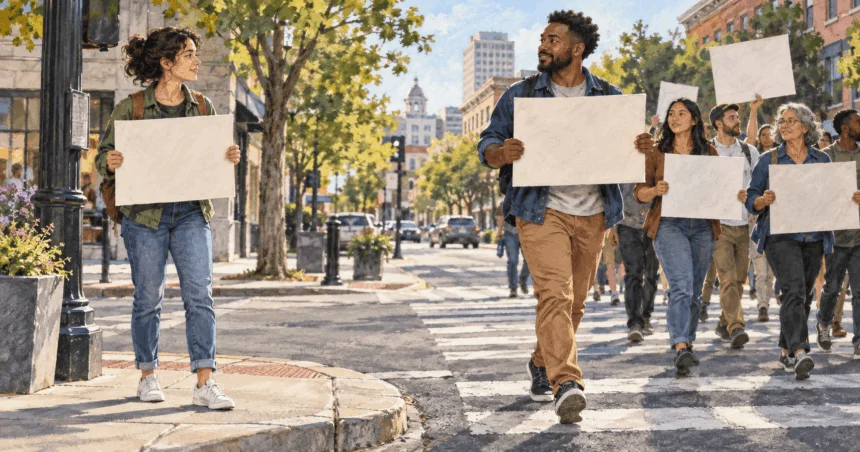
According to the ACLU guide, sidewalk marchers generally do not need a permit if they obey traffic and pedestrian signals and allow normal pedestrian passage. The guide also says building entrances must remain open and passersby must not be maliciously obstructed or detained. A right to deliver a message is not a right to force another person to stop and listen.
The ACLU explains that advance notice requirements cannot be used to prevent rapid-response demonstrations about unforeseeable recent events.
A permit system governing speech must contain narrow, objective and definite standards for the official deciding applications. A permit fee cannot be based on the content of the message or on how listeners may react to it: speech cannot be financially burdened simply because it might offend a hostile crowd. Otherwise, the people most opposed to a message could make it harder for the speaker to deliver it.
Private property owners generally may set speech rules and order people who disobey to leave; refusing to comply can expose them to trespass arrest, the ACLU guide explains. A business being open to customers does not give protesters the same access they have on a traditional public street.
The ACLU says counterprotesters also have speech rights and police should treat opposing groups equally. Police may separate antagonistic groups while allowing them to remain within sight and sound of one another.
When protest crosses into punishable conduct
When one act combines speech and conduct, a sufficiently important government interest in regulating the conduct can justify incidental limits on expression. What decides a case is the specific offense charged and the law that applies at that location; a philosophical definition does not supply an offense’s elements or its penalty.
The Brandenburg test is a two-part test for when advocacy of illegal action loses its constitutional protection. The Brandenburg test comes from the Supreme Court’s 1969 decision in Brandenburg v. Ohio. Advocacy can be punished as incitement only if it is directed to producing imminent lawless action and is likely to produce that action. Advocating illegal action at an indefinite future time does not meet that threshold. An angry message is therefore different from a call intended and likely to trigger unlawful action immediately. Nor may speech be punished or banned merely because it might offend hostile listeners.
Federal law defines a riot as a public disturbance involving an act of violence by one or more people in a group of three or more, where the violence causes, or creates a clear and present danger of, injury to another person or damage to another person’s property. The definition also covers threats of violence by people in such a group who are able to carry them out immediately, when the threatened acts would create that danger or cause that harm. A gathering does not meet those federal elements merely because it is large, loud or unpopular. That federal definition should not be treated as the wording of every state or local offense.
In National Association for the Advancement of Colored People (NAACP) v. Claiborne Hardware Co., decided in 1982, the Supreme Court held that a state may make people pay for the consequences of violent conduct but may not make them pay for the consequences of nonviolent, protected activity. The case concerned white Mississippi merchants who sued the NAACP and boycott participants over a boycott seeking racial equality. It also held that civil liability may not be imposed merely because a person belonged to a group, some of whose members committed acts of violence.
What civil disobedience has changed
After Parks’s 1955 arrest, a peaceful bus boycott in Montgomery lasted 381 days.
In a lawsuit separate from the boycott, Browder v. Gayle, four other women who had been mistreated on city buses because of their race challenged the segregation laws as a violation of the Fourteenth Amendment’s guarantee of equal protection. A three-judge federal district court ruled bus segregation unconstitutional on June 5, 1956, and the Supreme Court upheld that result on November 13, 1956. The boycott and the lawsuit were different instruments working on the same problem. The legal ruling supplied something moral opposition alone could not: a judicial answer about the segregation laws.
On February 1, 1960, four college freshmen in Greensboro, North Carolina, walked to Woolworth’s department store, where customers could buy goods but the lunch counter was segregated. Joseph McNeil, Franklin McCain, David Richmond and Ezell Blair Jr. bought items, kept their receipts, sat at the counter and asked for service. When service was denied, they asked why their money was accepted elsewhere in the store but not at its lunch counter. The receipts made the unequal treatment concrete: they were already paying customers of the same store.
The demonstrations expanded to the nearby S.H. Kress department store, and more than three hundred students were protesting in Greensboro by Friday of the first week. On July 25, 1960, Greensboro Woolworth’s integrated its counter by serving three Black employees. Kress also integrated that summer.
Federal public-accommodations law today guarantees full and equal enjoyment of covered establishments without discrimination or segregation based on race, color, religion or national origin. The federal public-accommodations law is Title II of the Civil Rights Act of 1964. The change at the Greensboro counters was local; the federal guarantee is an enforceable legal protection. They are related outcomes, but not the same thing.
Does nonviolent action work, and who judges its morality?
Erica Chenoweth is a Harvard Kennedy School professor who studies political violence and its alternatives. Erica Chenoweth’s essay The Future of Nonviolent Resistance, published in the Journal of Democracy in July 2020, draws on 628 mass campaigns from 1900 to 2019 that sought to remove a national leadership or win territorial independence. Of those, 303 involved organized armed resistance and 325 relied overwhelmingly on nonviolent civil resistance. In that historical comparison, nonviolent campaigns outperformed violent campaigns, including in the period after 2010. This is evidence about sustained struggles over national power or independence, not a forecast for an afternoon’s march in an American city.
The analysis also found declining success for nonviolent resistance during the 2010s, even as the method became more common. Relative effectiveness and assured success are different claims: a method can outperform another while still failing often. Whether peaceful protest is the best approach in a particular dispute depends on the goal and the kind of action being compared, rather than on a universal success rate.
In his Letter from Birmingham Jail, Martin Luther King Jr. defines a just law as a code that a majority compels a minority to follow and is willing to follow itself. An unjust law, he writes, is one inflicted upon a minority that had no part in enacting it because it lacked the unhampered right to vote. In explaining that distinction, King points to barriers preventing Black people from registering to vote under segregation.
King describes direct action as creating a crisis from which negotiation could emerge, following fact collection, negotiation and a preparatory stage called self-purification. That preparation involved nonviolence workshops in which participants asked whether they could accept blows without retaliation and endure jail. In King’s account, disruption is a way to bring about negotiation, not an end in itself.
Candice Delmas is an associate professor of philosophy and political science at Northeastern University. In her 2018 book A Duty to Resist: When Disobedience Should be Uncivil, Candice Delmas argues that justice, fairness and helping others can create duties to resist injustice through disobedience. Other philosophical accounts regard disobedience as presumptively wrong because it undermines the rule of law and democratic decision-making. A claim that dissent is a moral duty is about what people ought to do; it does not describe what the law excuses.
If police intervene: rights, risk and recourse
The ACLU advises people stopped by police to ask whether they are free to leave and, if the answer is yes, to walk away calmly. Police detention requires reasonable suspicion that a person has committed, is committing or is about to commit a crime. The question helps distinguish an encounter a person may leave from one in which police are restricting their movement.
If arrested, the ACLU advises saying that the person wishes to remain silent, asking for a lawyer and not saying or signing anything without a lawyer present. Its guide also advises keeping hands visible, remaining calm and never physically resisting an officer. A person need not consent to a search, but police may frisk clothing if they suspect a weapon and may conduct a search after arrest. Declining consent and physically preventing a search are different actions.
The ACLU describes shutting down a protest through a dispersal order as a last resort where there is an immediate threat to public safety, such as riot, disorder or traffic interference. Police must provide clear, detailed notice and a reasonable opportunity to comply, including sufficient time and an unobstructed exit path, its guide says. A person who stays after an order risks arrest even if the notice seemed inadequate; whether the order was lawful is argued afterward, not on the street. For that later argument, write down when and how a dispersal warning was given, what was audible and which exits were available.
When lawfully present in public, people may photograph what is in plain view, including police and federal buildings, according to the ACLU. Private property owners may set photography rules, and laws governing audio recording without consent can vary by state. A camera’s video function and its microphone therefore should not be treated as the same legal question.
The ACLU of Pennsylvania advises preserving officers’ badge or patrol-car numbers, written memories and witnesses’ names and phone numbers after a suspected violation. It also advises promptly photographing injuries without delaying medical care and invites people who believe their protest rights were violated in Pennsylvania to its complaint form. Elsewhere, seek advice from a lawyer or a civil-rights organization familiar with the applicable jurisdiction.
Deciding whether to take part in civil disobedience starts with identifying the rule an action would break and the legal risk attached to that conduct.