Last updated 10 months ago. Our resources are updated regularly but please keep in mind that links, programs, policies, and contact information do change.
The National Security Council sits at the heart of American foreign policy and national security decision-making.
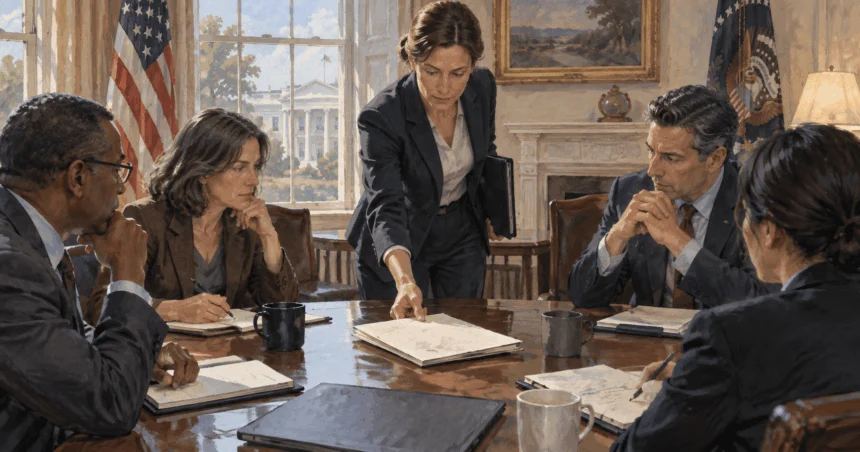
Part high-level committee of senior leaders, part sprawling expert staff within the White House, the NSC serves as the President’s main forum for deliberating critical decisions on war, peace, and international affairs.
This dual identity stems from its creation through the landmark National Security Act of 1947, legislation that fundamentally reshaped American government in the shadow of World War II and the Cold War’s dawn. The act aimed to create a “comprehensive program for the future security of the United States” by advising the President on integrating “domestic, foreign, and military policies relating to national security.”
The same legislation created the Department of Defense by merging War and Navy Departments and established the Central Intelligence Agency, cementing the NSC’s role as the central nervous system of an evolved national security establishment.
The Council and Its Captain: Who Sits at the Table
Understanding the NSC requires distinguishing between the formal Council—specific meetings of top officials—and the individual who directs the entire process daily: the National Security Advisor.
The Council: The Principals’ Forum
The National Security Council is formally a meeting chaired by the President of the United States. It represents the highest-level strategic forum where final decisions on pressing national security issues are debated and made. The composition is defined by law but shaped by each President’s personal style and priorities.
The core consists of Statutory Members required by law to participate. Under Title 50 of the U.S. Code, these include the President, Vice President, Secretary of State, Secretary of Defense, Secretary of Energy, and Secretary of the Treasury.
Beyond these members, the law designates two crucial Statutory Advisors who must attend NSC meetings. The Chairman of the Joint Chiefs of Staff serves as principal military advisor, offering uniformed armed forces perspective. The Director of National Intelligence serves as principal intelligence advisor, responsible for integrating analysis and information from the entire U.S. Intelligence Community.
A key NSC system feature is flexibility. Each President can invite other senior officials to attend meetings regularly, customizing the Council to reflect the administration’s specific security concerns. The Biden-Harris administration expanded regular attendees to include the Secretary of Homeland Security, U.N. Ambassador, Attorney General, and White House Chief of Staff, among others.
This expansion reflects broader, modern national security understanding encompassing homeland security, global public health, climate change, and international economics, requiring wider expertise at the table.
The National Security Advisor: Daily Operations Leader
While the Council meets only when the President convenes it, daily national security system work is managed by one of Washington’s most powerful figures: the Assistant to the President for National Security Affairs, commonly known as the National Security Advisor (NSA).
The NSA is personally appointed by the President and crucially doesn’t require Senate confirmation, ensuring the occupant serves the President’s interests alone. The role has evolved dramatically from modest beginnings.
The 1947 Act created an “Executive Secretary” position to manage Council staff and paperwork, a largely administrative function. Over time, Presidents began relying on this individual for substantive advice and direct policy implementation.
The NSA’s power flows from proximity to the President. With an office steps from the Oval Office, the advisor often has more daily contact with the President on foreign policy matters than Secretaries of State or Defense. This access allows the NSA to shape information flow to the President, set high-level meeting agendas, ensure policy paper preparation, and communicate presidential decisions back to the sprawling bureaucracy for implementation.
Two Models of National Security Leadership
The choice between leadership approaches represents one of the most critical decisions new presidents make, defining their administration’s foreign policy decision-making character.
The “Honest Broker” Model: This approach, epitomized by Brent Scowcroft serving Presidents Gerald Ford and George H.W. Bush, prioritizes process over policy advocacy. The Honest Broker’s primary goal is managing fair, transparent, and inclusive systems ensuring the President hears all competing viewpoints from relevant departments.
The NSA works to be perceived by Cabinet colleagues as neutral facilitator accurately representing their positions to the President, even if conflicting with the NSA’s personal views. Scowcroft was famously low-key, meticulous about process, and wielded influence through quiet competence and trust built among principals.
The “Advocate” Model: In contrast, the Advocate model sees the NSA as primary policy engine, actively developing and promoting specific agendas on behalf of the President. Figures like Henry Kissinger under Richard Nixon and Zbigniew Brzezinski under Jimmy Carter embodied this approach.
Kissinger centralized policy-making to such extent that he controlled all information flow to Nixon, effectively sidelining the State Department and conducting secret diplomacy. An advocate NSA often maintains high public profile and acts as chief spokesperson for administration foreign policy.
| Feature | “Honest Broker” Model | “Advocate” Model |
|---|---|---|
| Core Philosophy | Process paramount – ensure President hears all viable options | Policy outcome paramount – ensure President’s agenda enacted |
| Primary Function | Process manager, facilitator, coordinator | Policy entrepreneur, chief strategist, public spokesperson |
| Relationship with Cabinet | Collegial – aims to be fair representative of all viewpoints | Often competitive, especially with Secretary of State |
| Public Profile | Low profile, works behind scenes | High profile, engages in public diplomacy and media |
| Key Examples | Brent Scowcroft, Stephen Hadley | Henry Kissinger, Zbigniew Brzezinski |
The Engine Room: How National Security Policy Gets Made
The abstract goal of integrating domestic, foreign, and military policy is achieved through highly structured, hierarchical processes of meetings and paperwork. This “interagency process” represents the engine room of national security decision-making, designed to ensure issues are thoroughly vetted at lower levels before reaching the President.
The Three-Tiered Coordination System
Since the George H.W. Bush administration, the NSC system has largely relied on three-tiered committee structure. This vertical system allows policy options to flow up from working-level experts to the President, while decisions and directives flow back down to departments and agencies for implementation.
Policy Coordination Committees
At the pyramid’s base are Policy Coordination Committees (PCCs), the “main day-to-day fora for interagency coordination” where foundational policy-making work occurs. Dozens of PCCs operate simultaneously, each focused on specific regions (Near East and North Africa) or functional topics (Counter-Terrorism, Arms Control).
These committees are chaired by Senior Directors from NSC staff and composed of Assistant Secretary-level officials from relevant government departments and agencies. In these meetings, policy papers are drafted, intelligence analyzed, interagency disagreements first identified, and policy option ranges developed for senior official consideration.
The Deputies Committee
When PCCs cannot reach consensus or issues are too significant for working-level resolution, they’re elevated to the Deputies Committee (DC). The DC represents the “senior sub-Cabinet interagency forum” and serves as the system’s critical management hub.
Chaired by the Deputy National Security Advisor, the DC includes second-in-command from key national security departments—Deputy Secretary of State, Deputy Secretary of Defense, and Deputy Director of National Intelligence. The DC reviews PCC work, resolves escalated interagency disputes, prepares issues and options for the Principals Committee, and critically serves as the primary crisis management body.
In many cases, the DC finalizes the vast majority of policy coordination, allowing the Principals Committee and President to focus only on the most difficult or consequential decisions.
The Principals Committee
At the committee structure’s top, just below full NSC meetings with the President, sits the Principals Committee (PC). The PC represents the “Cabinet-level senior interagency forum for considering policy issues that affect United States national security interests.”
Chaired by the National Security Advisor, the PC includes Cabinet Secretaries themselves—Secretary of State, Secretary of Defense, Secretary of the Treasury, and heads of other relevant agencies. This committee represents the last stop for most policy debates before presidential presentation. Its purpose involves framing options, clarifying remaining disagreements, and forging final recommendations for presidential consideration.
Crisis Management: The Cuban Missile Crisis and ExComm
The Cuban Missile Crisis of October 1962 provides a seminal case study of how the NSC process can be adapted to manage situations bringing the world to nuclear war’s brink.
When U-2 reconnaissance flights returned with photographic proof that the Soviet Union was secretly installing nuclear-capable ballistic missiles in Cuba, President John F. Kennedy needed a forum for rapid, secret, and intense deliberation.
Instead of relying on the full, formal National Security Council, he assembled a hand-picked group of trusted advisors. This ad hoc body was formally constituted on October 22, 1962, as the Executive Committee of the National Security Council, or “ExComm.”
ExComm’s creation and operation reveal that the NSC system isn’t rigid, unchangeable bureaucracy but flexible presidential management tool. The statutory NSC is relatively large, ill-suited for the fast-moving, top-secret missile crisis nature where leaks could have been catastrophic.
Kennedy, still distrustful of formal bureaucracy after the Bay of Pigs fiasco, wanted more intimate settings where ideas could be debated fiercely and creatively, free from normal rank and protocol constraints. He populated ExComm with core NSC members like Secretary of State Dean Rusk and Secretary of Defense Robert McNamara, but also included his brother Attorney General Robert Kennedy, speechwriter Theodore Sorensen, and other trusted advisors who weren’t formal NSC members.
The ExComm meetings, which Kennedy secretly tape-recorded, provide unparalleled windows into the interagency process under duress. Over thirteen days, the group debated wide spectrums of possible responses, ranging from immediate military action—air strikes to destroy missile sites, favored initially by Joint Chiefs of Staff—to purely diplomatic solutions, such as trading U.S. missiles in Turkey for Soviet missile removal in Cuba.
Through this rigorous, often contentious deliberation process, consensus gradually formed around middle course: naval “quarantine” of Cuba. This option, strongly advocated by Robert McNamara and Robert Kennedy, demonstrated American resolve and halted additional missile delivery without initiating immediate, irreversible acts of war.
The successful crisis resolution stands as testament to structured yet flexible advisory process value, allowing presidents to hear full option ranges before making monumental decisions.
The Staff: 400 Experts Supporting the President
The Council and its committees’ work would be impossible without NSC staff support. This group of several hundred experts, working within the White House complex, forms the intellectual and administrative backbone of the entire national security enterprise.
Staff Composition
The NSC staff represents unique hybrid organization, blending deep institutional knowledge with political responsiveness. The vast majority of policy staff, typically 80% to 90%, are “detailees”—career civil servants, foreign service officers, military officers, and intelligence analysts on temporary assignment to the NSC from home agencies like State, Defense, Treasury, and Homeland Security Departments, plus Intelligence Community components.
These detailees typically serve one to two years, bringing invaluable subject-matter expertise and intricate understanding of how their home bureaucracies operate. The remaining 10% to 20% are political appointees selected directly by administrations, typically filling senior leadership roles including the National Security Advisor, Deputy National Security Advisors, and Senior Directors heading various policy directorates.
This blend ensures the NSC process is both well-informed by deep governmental experience and responsive to the President’s specific policy agenda.
Organization and Function
The NSC staff is organized into directorates—small teams of typically 5 to 12 people, each led by Senior Director. These directorates represent primary policy management units and fall into two categories:
Regional Directorates: Responsible for managing U.S. policy toward specific geographic world areas, including African Affairs, Asian Affairs, European Affairs, and Near East and South Asian Affairs.
Functional Directorates: Handle transnational issues cutting across geographic boundaries. Numbers and focus change between administrations to reflect evolving security priorities, including Defense Policy and Arms Control, Counterterrorism, Nonproliferation and Export Controls, International Economic Affairs, Cybersecurity, and Global Health Security and Biodefense.
The core function involves managing the three-tiered interagency process. NSC staffers organize and chair PCC meetings, draft background papers and policy option memos framing debates for Deputies and Principals, and prepare daily briefing materials for the President and National Security Advisor. After decisions are made, NSC staff monitor implementation by various departments and agencies, ensuring presidential directives are carried out.
The Growth Question: Why Did the NSC Staff Become So Large
The most significant and controversial trend in NSC history has been dramatic staff growth. What began as small secretariat has expanded into formidable organization of several hundred people, leading to vigorous debates about proper size and role.
History of Growth: From Handful to Hundreds
The NSC staff’s growth trajectory tells stories about changing American power nature and evolving security challenges.
Early Years (1947-1960s): For its first decade and a half, the NSC staff was very small. During Truman and Eisenhower administrations, it consisted of only about 20 policy professionals, focused primarily on facilitating advice flow from major departments to the President. Kennedy famously slashed this structure to even leaner team of about 10-12 activist staffers serving him directly.
Cold War Expansion (1970s-1980s): As the National Security Advisor’s role became more central to policy-making under figures like Henry Kissinger, staff began growing. During the Nixon administration, staff expanded to around 35-40 substantive officials supporting more White House-centric foreign policy processes.
Post-Cold War (1990s): The Cold War’s end didn’t lead to smaller staff. Instead, “national security” definition began broadening. Under George H.W. Bush, staff numbered around 50 professionals. Under Bill Clinton, it doubled to approximately 100, as new directorates were created handling emerging transnational threats like international crime, environmental issues, and global health.
Post-9/11 Explosion (2000s-2010s): The September 11, 2001 terrorist attacks were the single greatest catalyst for NSC staff growth. Staff doubled again to around 200 under George W. Bush as “War on Terror” became government’s central organizing principle. It reached its peak of roughly 400 during the Obama administration, surge driven largely by the 2009 merger of NSC staff with newly created Homeland Security Council staff, plus needs to address intensifying challenges in cyberspace and public health emergencies like Ebola outbreak.
| Administration | Approx. Policy Staff Size | Key Events & Drivers |
|---|---|---|
| Eisenhower (1953-61) | ~20 | Formalized processes, “honest broker” model |
| Kennedy (1961-63) | ~10-12 | Shift to smaller, activist staff; NSA empowerment |
| Nixon (1969-74) | ~35-40 | Centralization under “advocate” NSA Henry Kissinger |
| G.H.W. Bush (1989-93) | ~50 | “Scowcroft Model” refines interagency process |
| Clinton (1993-2001) | ~100 | Post-Cold War expansion into new functional areas |
| G.W. Bush (2001-09) | ~200 | Post-9/11 expansion; Homeland Security Council creation |
| Obama (2009-17) | ~400 (peak) | NSC and HSC staffs merger; cyber, health emergencies expansion |
| Trump/Biden (2017-) | ~250-350 | “Rightsizing” efforts; Congressional 200 policy staff cap |
The Case for Large Staff: Complex World Requirements
Proponents of large, robust NSC staff argue that size represents necessary adaptation to unprecedented complexity world.
First, national security definition has expanded dramatically. During the Cold War, primary focus was single, overarching threat: the Soviet Union. Today, the United States faces dizzying arrays of diverse, interconnected challenges requiring specialized expertise. Modern NSC must have staff dedicated not only to great power competition with China and Russia but also to transnational threats such as global terrorism, cyber warfare, pandemics, climate change, and international financial crises.
Second, this threat and actor proliferation makes effective coordination more critical than ever. Strong central White House staff is needed to orchestrate “whole-of-government” responses, ensuring various departments aren’t working at cross-purposes or pursuing parochial interests.
Third, the relentless 24-hour global news cycle pace and modern crisis speed demand highly responsive teams at the President’s side. Larger, more deliberative State or Defense Department bureaucracies cannot always move at required speed. Large, agile NSC staff allows the White House to coordinate rapid responses and manage crises in real time.
Finally, capable staff is essential for Presidents to effectively drive their own policy agendas and ensure priorities are translated into action by vast federal government machinery.
The Case Against Large Staff: Imperial White House
Critics argue that NSC growth has created dysfunctional, overbearing “imperial White House,” undermining the very officials and departments it’s meant to support.
The most persistent criticism, voiced by former Secretaries of Defense Robert Gates and Leon Panetta, is that large NSC staff inevitably leads to micromanagement. Instead of focusing on high-level strategy and coordination, oversized staff gets drawn into operational and tactical details properly the departments’ responsibility. Gates famously complained about “micromanagement by 35-year-old PhDs who love to talk,” second-guessing seasoned generals’ and ambassadors’ decisions from White House offices.
This leads to second major problem: the NSC has strayed from its intended coordinating staff role and become more like operating agency. With its own press, legislative, and speechwriting offices, large NSC can begin conducting parallel foreign policy, often competing with State and Defense Departments, creating confusion for domestic and foreign audiences.
Third, this White House power centralization inevitably sidelines Cabinet Secretaries. Secretaries of State and Defense are appointed by the President and confirmed by the Senate to be the nation’s chief diplomat and chief defense policy official, respectively. When their authority is usurped by large, unelected White House staff, it can disrupt constitutional balance and deprive the President of full Cabinet advice and expertise benefit.
Finally, this power concentration comes with significant accountability lack. The National Security Advisor and NSC staff aren’t subject to Senate confirmation and are protected by executive privilege from substantive congressional testimony. This means immensely powerful official groups operate with very little direct public or congressional oversight, a situation critics argue is unhealthy in democracy.
Case Study: The 9/11 Transformation
The NSC’s explosive 21st-century growth cannot be understood without examining the cataclysmic event that precipitated it: the September 11, 2001 terrorist attacks. In many ways, 9/11 represented catastrophic failure of the very interagency coordination and policy integration the National Security Act of 1947 was designed to achieve.
The 9/11 Commission Report identified deep “fault lines” within the U.S. government and collective “failure of imagination” to grasp threat nature. The plot, conceived by foreign terrorist group overseas but carried out by operatives living inside the United States, fell squarely into institutional “void between foreign and domestic threats.” The CIA focused on threats abroad, while the FBI focused on crimes at home; no single agency was effectively positioned to connect dots and see full pictures.
The government’s immediate response to this coordination failure was structural. Just weeks after attacks, on October 8, 2001, President George W. Bush issued executive order creating Homeland Security Council and Office of Homeland Security within the White House.
The HSC was explicitly modeled on the NSC and designed to do for domestic security what the NSC did for foreign and military policy: coordinate many disparate agencies’ activities, from FBI and Coast Guard to newly created Transportation Security Administration.
This created parallel White House staff structure, with one group focused on foreign threats and another on domestic ones. To eliminate this new seam and improve integration, President Barack Obama in 2009 merged NSC and HSC staffs into single, unified “National Security Staff.” This merger was primary driver of staff growth to peak size of around 400 people.
NSC staff growth wasn’t simply bureaucratic bloat. It was direct response to perceived failures of larger departments and agencies to adapt to new, complex post-9/11 era threats. The 1947 national security architecture, designed for state-on-state Cold War conflict, proved ill-equipped to handle transnational threats blurring lines between foreign intelligence and domestic law enforcement.
Rather than undertaking monumental, politically fraught tasks of fundamentally reorganizing the entire executive branch, more immediate solution for Presidents Bush and Obama was building larger, more powerful White House coordinating body. NSC staff expansion can thus be seen as “patch” applied to existing bureaucracy.
The ongoing debate about NSC proper size is, at its core, debate about entire U.S. national security apparatus effectiveness. Leaner NSC would require major departments to become more integrated and effective in their own right. As long as Presidents perceive gaps in bureaucracy’s ability to handle the nation’s most pressing threats, they will likely continue relying on large, powerful National Security Council staff as their primary tool for safeguarding the nation.
The NSC represents both the promise and the challenge of modern American governance: the need for coordination and presidential control in an increasingly complex world, balanced against the risk of concentrating too much power in unelected White House staff. Its evolution reflects broader questions about how democratic institutions adapt to 21st-century security challenges while maintaining accountability and effectiveness.