Last updated 9 months ago. Our resources are updated regularly but please keep in mind that links, programs, policies, and contact information do change.
Six Republicans voted against their own party’s labor reform bill Tuesday afternoon. The defeat was more than embarrassing. It was a public demonstration that the Speaker has lost control of the House floor at the worst possible moment—with a majority so small that even one sick member could block votes.
The bill failed 215-209. Leadership immediately canceled two more scheduled votes that same afternoon. Bills reach the floor and can’t make it through the full chamber. Injured members show up in neck braces because leadership cannot afford their absence. The machinery of governance grinds to a halt not because of philosophical disagreement, but because the basic math of having enough votes has become impossible.
The Math That Makes Governing Impossible
House Republicans began 2025 with 220 seats. Representative Doug LaMalfa of California died last week. Representative Marjorie Taylor Greene of Georgia resigned earlier in January. Special elections take months to organize and hold. These departures have shrunk the majority—and that’s before accounting for the normal human reality that members get sick, attend funerals, deal with family emergencies, or recover from car crashes.
In practical terms, Johnson cannot lose more than a handful of votes on any vote where Republicans vote as a bloc. On Tuesday, he lost six GOP members on a bill. They represented districts where overtime pay matters to many voters.
The 45-Minute Scramble
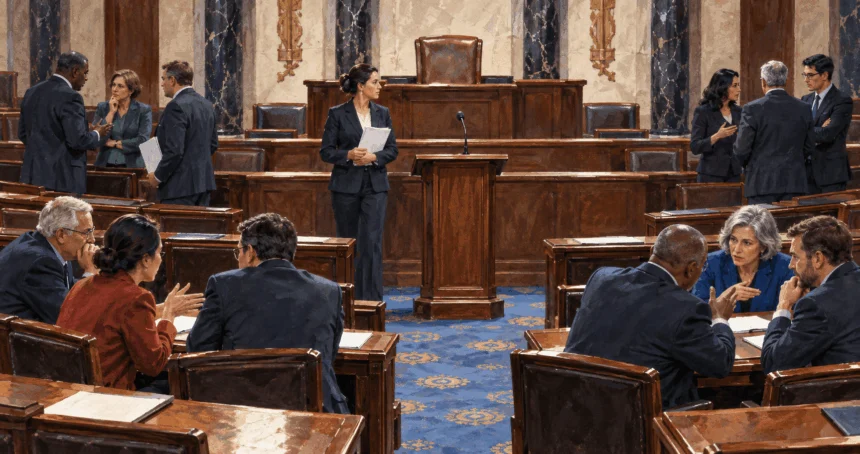
Johnson ordered the vote kept open well past the standard fifteen minutes. The Speaker, Majority Leader Steve Scalise, and other senior GOP leaders physically moved around the chamber, approaching wavering members one by one. Arguments about party loyalty. Discussions of constituent concerns. They couldn’t flip a single vote.
The frustration wasn’t about the labor bill itself. It was about leadership bringing legislation to the floor without knowing it had the votes.
What Control Means
The Speaker of the House, constitutionally speaking, presides over chamber proceedings. But the modern speakership—particularly since the 1990s—has evolved into something closer to legislative executive. The Speaker controls which bills get voted on through the Rules Committee. Controls access to floor time, committee assignments, campaign support. When these tools work in concert with a cohesive party and comfortable majority, the Speaker functions as the most powerful position in Congress.
When the majority shrinks to Johnson’s current numbers, these tools stop working. You can’t punish members by removing committee jobs when both parties would want them anyway. Campaign support means nothing to representatives in competitive districts who’ll face well-funded challenges regardless. Leadership can’t pressure members when every vote matters. And controlling which bills get voted on only matters if you can pass them once they get there.
The floor collapse Tuesday afternoon suggested control has slipped, even with the GOP controlling the House and the presidency.
The Absences That Break Everything
When your majority is thin, normal human life becomes a governing crisis. Someone gets the flu, and suddenly you can’t pass appropriations bills. Someone attends a family funeral, and your legislative agenda stalls. Someone gets in a car accident, and you’re asking them to show up in a neck brace because you cannot afford their absence.
Nancy Pelosi faced similar tight margins in 2021-2022 when Democrats held a 220-213 majority. She canceled controversial bills rather than letting them fail, and she accepted that Democratic unanimity wouldn’t always exist and worked with the GOP when feasible. Johnson’s approach has been different: he has demanded party-line votes on legislation. That strategy requires more votes than he has.
The DHS Funding Crisis
Congress must pass funding bills or the government shuts down. The most contentious involves the Department of Homeland Security.
Republicans say oversight rules would tie the hands of law enforcement. Some GOP members agree there should be some oversight, creating potential for bipartisan compromise. But Trump administration pressure on the party to block any limitations on immigration enforcement makes compromise politically dangerous for members.
Neither side will budge. Neither party wants a temporary funding bill that keeps spending at today’s levels. The GOP would fund DHS without Trump’s preferred enforcement capabilities. Democrats would fund DHS without new oversight protections.
In a slightly more comfortable majority, Johnson could bring forward a compromise bill that satisfies neither extreme but commands support from the center of both parties. With his current majority, any bill with Democratic oversight rules would lose Republican votes. Any bill without those provisions faces Democratic blocking. The math doesn’t work. And unlike the labor bill, this one has a hard deadline with shutdown consequences.
The Six Who Said No
Brian Fitzpatrick represents Pennsylvania’s first congressional district, which Biden won by 5 percentage points in 2020 (52%-47%). Fitzpatrick often votes with Democrats on labor and social issues. For him, voting against a bill that would reduce overtime pay made sense politically—necessary, even—to keep the trust of union members in his district.
Rob Bresnahan represents Pennsylvania’s 7th district, which Biden won by 2 points. One of the most competitive House seats in the nation. Union members have a lot of voting power there. Many voters work jobs where overtime pay makes a meaningful difference in household economics.
The same calculation applied to Nick LaLota in New York’s first district, Jeff Van Drew and Chris Smith in New Jersey’s second and fourth districts, and Riley Moore in West Virginia. What they all had in common: voting with their party on this bill would hurt them politically at home. They voted for what their constituents wanted instead of what their party wanted.
What Happens Next
This failure means more than one lost vote. It suggests Congress is having trouble doing basic work, dependent on putting together temporary alliances, vulnerable to disruption from unexpected events like member deaths or illnesses that affect vote counts.
The funding deadline looms as the immediate test of whether Johnson can maintain sufficient control to prevent shutdown. The threat of a shutdown helps him—both sides want to avoid the blame for a shutdown. But even that pressure may prove insufficient to bridge the gap between GOP demands for full immigration enforcement authority and Democratic demands for oversight protections.
Losing control of the House floor isn’t a single dramatic moment. It’s a series of small losses. Eventually everyone realizes the Speaker can’t pass bills his own party wants. Tuesday’s 45-minute scramble for votes that didn’t come wasn’t when Johnson lost control—it was when everyone else noticed he’d already lost it.
Congress struggling to pass bills along party lines. Congress can still pass bills that both parties agree on. Routine votes that only need one party can happen. Emergencies might force both sides to work together. But the big bills Johnson and Trump wanted to pass—labor reform, tax changes, regulatory reforms—look less likely to pass.
As the 2026 midterm elections approach, Congress may pass fewer laws and spend more time on partisan arguments, with the President’s agencies making more decisions instead of new congressional mandates. The Speaker’s power has always come from controlling a united party with enough votes. That power disappears when there aren’t enough votes and party members disagree based on where they’re from and what they believe.
Bills keep failing and votes keep being canceled. The defections continue. That’s what losing control looks like: not a dramatic coup, but a slow breakdown where votes stop working. Where injured members have to show up to vote because the Speaker needs every single vote. Where six lost votes cancel the whole week’s plans. Where the Speaker spends 45 minutes trying to find votes that don’t exist.
The Deeper Pattern
The Tuesday defeat exposes how fragile the entire legislative process has become when margins shrink this far. Every absence becomes a crisis. Every dissenting vote becomes a potential catastrophe. Every bill becomes a high-stakes gamble.
Committee hearings still happen. Debates still occur. Bills still get marked up and sent to the floor. But the final step—passing legislation—has become unreliable. Leadership can no longer confidently predict outcomes even on bills their own committees approved unanimously.
This uncertainty cascades through the entire legislative calendar. Which bills are safe to bring to the floor? Which members might defect on which issues? How do you schedule votes when you can’t guarantee the votes exist? The result is paralysis.
Johnson faces a choice between two bad options. He can continue bringing bills to the floor and risk more public defeats that further erode his authority. Or he can pull back, schedule fewer votes, and accept that his speakership will be defined by what didn’t happen rather than what did.
With limited votes and multiple members representing competitive districts, Johnson cannot pass partisan legislation that puts those members at electoral risk. He cannot punish defectors without making his majority even smaller. He cannot promise rewards that matter more than political survival.
The Funding Fight Ahead
The Department of Homeland Security funding battle will test whether Johnson has learned anything from Tuesday’s defeat. The dynamics are even more challenging than the labor bill. Democrats have more leverage because they can simply refuse to provide votes, forcing a shutdown that polls suggest would hurt the GOP more than Democrats.
Democrats want comprehensive oversight of immigration enforcement, including body cameras, prohibition on masks during arrests, and reporting requirements for use of force. Democrats say these demands are about accountability, particularly after high-profile use-of-force incidents.
The GOP views these provisions as handcuffing law enforcement during what they consider a border crisis requiring aggressive action. Trump has made immigration enforcement a centerpiece of his agenda. Any Republican who votes for restrictions on ICE operations risks primary challenges and Trump’s public criticism.
Perhaps body cameras without real-time oversight requirements. Maybe reporting mandates that don’t create immediate legal liability. Possibly sunset provisions that allow review after a trial period. But finding language that satisfies enough Democrats to pass while not losing GOP votes requires negotiating skill and political capital Johnson may no longer possess.
The shutdown threat creates urgency but not necessarily clarity. Both parties have incentives to avoid shutdown, but they also have incentives to blame the other side if shutdown occurs. Johnson needs Democratic votes but cannot be seen as capitulating to Democratic demands. Democrats need to fund the government but cannot abandon oversight principles after demanding them publicly.
Every concession to Democrats costs him GOP votes he cannot afford to lose. Every concession to his right flank makes Democratic support impossible. The math that doesn’t work on labor bills doesn’t work on appropriations either.
The Precedent Being Set
If Johnson cannot pass basic funding bills with a narrow majority, future Speakers will know that anything less than a 10-seat cushion makes governance nearly impossible.
That reality will reshape how parties approach congressional elections. Winning the House won’t be enough—parties will need to win the House by margins large enough to absorb defections, absences, and unexpected departures. The current situation demonstrates that narrow majorities, once considered sufficient for governance, have become recipes for paralysis.
It will reshape how members think about party loyalty versus constituent representation. The six Republicans who voted against the labor bill showed that electoral survival trumps party discipline when margins are this thin. Future members in competitive districts will note that defection carried no immediate consequences—Johnson couldn’t punish them even if he wanted to.
As members learn that defection is safe, more members will defect. As more members defect, leadership loses more votes. As leadership loses more votes, their ability to reward loyalty or punish defection diminishes further.
The result is a House that functions less like a legislative body with majority control and more like a coalition parliament where every vote requires fresh negotiation. That might produce better policy through forcing compromise. Or it might produce no policy at all through making compromise impossible.
What This Means for Trump’s Agenda
The Trump administration came into 2025 with ambitious legislative goals: tax reform, regulatory rollbacks, immigration restrictions, labor law changes. All of these require House passage. All of these face the same mathematical problem Johnson confronted Tuesday.
Tax reform will split Republicans between deficit hawks and those willing to increase debt for tax cuts. Immigration restrictions will split them between border-district members facing constituent pressure and members representing immigrant communities. Labor law changes will split them between pro-business conservatives and members representing working-class districts where unions matter.
Each split costs votes Johnson doesn’t have. The Trump administration can pressure members through primary threats and public criticism, but that pressure only works if members fear it more than they fear losing general elections. In competitive districts, losing a general election is the greater threat.
Trump’s legislative agenda may need to be accomplished through executive action rather than congressional legislation. Executive actions are faster and don’t require Johnson to find votes he doesn’t have. But they’re also more vulnerable to legal challenges and can be reversed by future administrations.
The alternative is bipartisan legislation that attracts Democratic support to offset GOP defections. That path requires accepting Democratic priorities in exchange for Republican priorities, and it requires patience and negotiation rather than demands and deadlines.
Johnson is caught between these realities. He cannot pass partisan legislation with his current majority. He cannot negotiate bipartisan compromises without angering Trump. He cannot expand his majority until special elections occur months from now. He cannot prevent absences due to illness or emergency.
Johnson’s job has become less about advancing an agenda and more about preventing complete collapse.