Last Checked: September 18, 2026Next Check: September 18, 2029
- congress.govcited ×16
- justice.govcited ×9
- govinfo.govcited ×4
- tile.loc.govcited ×34 reviewed
- constitution.congress.govcited ×2
- fordlibrarymuseum.govcited ×2
- schiff.senate.govcited ×2
- supremecourt.govcited ×2
- law.cornell.educited ×2
- brennancenter.orgcited ×3
- floridalawreview.comcited ×1
Last updated 4 weeks ago. Our resources are updated regularly but please keep in mind that links, programs, policies, and contact information do change.
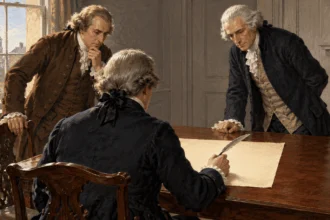
In 1795, George Washington pardoned rebels who promised to obey federal law. In 1974, Gerald Ford gave Richard Nixon a full pardon before prosecutors charged him. The same constitutional power made both decisions possible, but Americans remember them very differently.
The pardon power is broad because mercy sometimes must bypass ordinary process, and dangerous because the same design leaves few legal checks on abuse. It can stop federal punishment with a president’s signature. It can also stop a prosecution before a jury ever hears the case.
A constitutional exception to the ordinary process
Article II gives the president power to grant reprieves and pardons for federal offenses, except in impeachment cases. That short clause creates several kinds of relief. A pardon forgives an individual, an amnesty generally covers a group, and a commutation reduces the punishment without canceling the conviction.
Clemency is not another appeal. A court decides whether a conviction and sentence follow the law. The president decides whether the federal government should continue imposing some or all of the punishment. The Justice Department has an application and review process, but its recommendation does not control the president.
That independence is the point. If every act of mercy had to survive the same institutions that produced the sentence, clemency would be less able to correct an exceptional result. Independence also creates the central risk: the president can act for reasons that a court would never accept as legal grounds for changing a judgment.
Mercy and fear entered together
The American power grew from the English king’s prerogative of mercy. English abuses included selling pardons and using them to recruit soldiers, and Parliament responded with limits. The Constitution kept a strong executive power but placed it in an elected presidency and excluded impeachment.
Alexander Hamilton argued in The Federalist No. 74 that criminal law was necessarily general and severe. He wanted easy access to exceptions for unfortunate guilt. He also thought one responsible decision-maker could weigh mercy more carefully than a large body whose members might harden one another.
Others saw the danger just as clearly. At the Constitutional Convention, Edmund Randolph warned that a president might be involved in treason and that the traitors might be his instruments. George Mason later feared a president could pardon crimes he had advised, stopping inquiry and preventing detection.
The argument was never mercy against accountability. Both sides understood that mercy needs room to depart from ordinary rules. They disagreed about whether one president could be trusted with that room.
What clemency changes
Presidential Pardon Explorer
Pick whose law the offense is under and, for a federal case, where it stands. The results explain the parts that apply: the kinds of clemency, the Justice Department’s petition rules and waiting periods, what a pardon does and doesn’t do, and the limits on the power. They give the general rules and name key exceptions.
How to answer this
Just learning how clemency works, with no particular case? Choose federal, then the last answer on the next screen.
Choose federal if the U.S. government brought the case, such as in a U.S. district court. Choose state if a state, county or city brought it in a state or local court. Who brought the case decides the answer, even if the program involved gets federal money.
Convicted in both federal and state court? Answer for the federal case. The state conviction is outside the president’s power, as the lines below explain.
A court-martial has its own answer. For criminal contempt of a federal court, choose the fifth answer.
This tool doesn’t cover D.C. Superior Court cases. Choose the last answer, and ask a lawyer.
The Constitution gives the president “Power to grant Reprieves and Pardons for Offences against the United States, except in Cases of Impeachment.” U.S. Constitution
Whatever the kind of clemency, the president’s power reaches only “offences against the United States”: federal crimes, not state or civil wrongs. Constitution Annotated
| Kind | What it does | Justice Department petition rule (28 CFR Part 1) |
|---|---|---|
| Pardon | A full or absolute pardon removes any punishment for the crime and restores the person’s civil rights, if any were lost. Constitution Annotated | Under the Justice Department’s rules, no pardon petition should be filed until at least five years after the person’s release from confinement or, if no prison sentence was imposed, at least five years after the conviction. Generally, no pardon petition should be submitted by someone on probation, parole or supervised release. 28 CFR 1.2 |
| Commutation | A commutation replaces the punishment a federal court imposed with a less severe one, such as a shorter prison sentence. A pardon or amnesty, by contrast, may do away with the punishment entirely. Constitution Annotated | A petition for commutation of sentence, including remission of a fine, shouldn’t be filed if other forms of judicial or administrative relief are available, except on a showing of exceptional circumstances. 28 CFR 1.3 |
| Remission of a fine | Remission reduces or cancels criminal fines, penalties and forfeitures arising under federal law. Money already paid into the Treasury, and property in which a third party’s rights have vested, are beyond the president’s reach. Constitution Annotated | A petition for commutation of sentence, including remission of a fine, shouldn’t be filed if other forms of judicial or administrative relief are available, except on a showing of exceptional circumstances. 28 CFR 1.3 |
| Reprieve | A reprieve temporarily delays a criminal sentence. In Ex parte Wells, the Supreme Court described it in passing as a delay of “a judicial sentence when the President shall think the merits of the case, or some cause connected with the offender, may require it.” Constitution Annotated | The Justice Department’s rules require anyone seeking a pardon, reprieve, commutation of sentence or remission of a fine to file a formal petition addressed to the president. Except for military offenses, the petition goes to the Pardon Attorney at the Justice Department. 28 CFR 1.1 |
| Amnesty | Amnesty has essentially the same effect as a pardon, but it is typically extended to whole groups or communities instead of individuals. Constitution Annotated | Not addressed in 28 CFR Part 1 |
- A pardon must be accepted to take effect, and the person offered one may refuse it. The Supreme Court has indicated that a commutation or remission doesn’t require the person’s consent. Constitution Annotated
- The Justice Department’s clemency rules are advisory only. They create no enforceable rights for people applying for clemency and don’t restrict the president’s power under the Constitution. 28 CFR 1.11
A president may act after a federal offense has occurred but before charges, during a case or after judgment. The power cannot license a future crime. It reaches federal criminal offenses, not state crimes, and it cannot undo impeachment.
A full pardon removes the punitive legal consequences of the pardoned conviction. It does not rewrite history. The Justice Department says the conviction and pardon both remain on the record, so a pardon is not expungement or sealing.
The same boundary explains why state prosecution and civil claims can survive. Article II reaches only federal criminal offenses. A governor or state clemency board controls relief under state law, and a private party’s civil claim is not federal criminal punishment.
Commutation is narrower. It reduces a sentence already being served but does not forgive the offense or erase the conviction. For a person in prison, the immediate difference can be enormous even though the legal record stays in place.
A pardon offered and refused
In 1915, New York Tribune editor George Burdick refused to identify his sources to a federal grand jury. He said his answers could incriminate him. A pardon was handed to him. Burdick rejected it and continued to assert his constitutional right not to testify.
The Supreme Court held that a full pardon may be rejected. The Court also wrote that a pardon carried an imputation of guilt. Modern federal cases draw a narrower line: a pardon removes punishment, but the underlying conduct may still be considered in later proceedings.
The rule is different for a commutation. In Biddle v. Perovich, the Supreme Court held in 1927 that a prisoner’s consent was not required to replace a death sentence with life imprisonment. The reduced sentence remained valid and enforceable.
Other cases protected breadth while drawing edges. In Schick v. Reed, the Court held in 1974 that clemency flows from the Constitution rather than Congress, allowing a lawful condition on a commutation. In Ex parte Grossman, the Court held in 1925 that criminal contempt of federal court could be pardoned. The Court said an extreme campaign of pardons designed to disable a court would point toward impeachment, not a cramped interpretation of the power.
These decisions do not make clemency part of the judicial process. They explain how courts recognize a presidential act once its legal effect matters in a case.
Mercy after national rupture
Presidents have repeatedly used clemency for conflicts larger than one prosecution. Washington’s 1795 proclamation tied pardons after the Whiskey Rebellion to assurances of obedience. The bargain offered mercy after force had restored federal authority.
On December 8, 1863, Abraham Lincoln offered a conditional pardon to many participants in the rebellion. They had to swear allegiance, and the policy was linked to restoring loyal state governments. On December 25, 1868, Andrew Johnson went further, granting an unconditional pardon and amnesty for treason and adherence to U.S. enemies during the Civil War.
Ford’s Nixon pardon forced the same purpose into a single, extraordinary case. The September 8, 1974 proclamation covered all federal offenses Nixon may have committed from January 20, 1969, through August 9, 1974. Because a pardon may come before charges, it ended Nixon’s federal criminal exposure arising from that period without a trial.
Ford said Watergate was an American tragedy that someone had to end. That is the reconciliation case at its strongest: continued prosecution could prolong a national crisis after the president at its center had resigned. The objection is equally strong: ending the case also denied the public an ordinary legal accounting.
On January 21, 1977, Jimmy Carter used group clemency for Vietnam-era Selective Service Act violations committed from August 4, 1964, through March 28, 1973. The proclamation restored political, civil and other rights, but excluded offenses involving force or violence and misconduct by Selective Service employees.
Amnesty can close a political conflict by treating a group alike. A personal pardon can close one case. Neither choice proves that mercy was wise; each transfers that judgment from the ordinary legal system to the president.
The danger follows from the design
A 2025 Brennan Center report was written by Hernandez D. Stroud and Rosemary Nidiry. They called for relief for people serving obsolete enhancements and unusually long drug sentences. They also proposed an independent clemency board outside the Justice Department, arguing that prosecutors have an institutional conflict when reviewing punishment from cases their department brought.
That case does not require a weaker pardon power. It asks for a fairer way to identify people who merit its use. Regular review could make mercy less dependent on wealth, celebrity or access while leaving the final constitutional decision with the president.
In 2025, University of Oklahoma law professor Stephen E. Henderson defended pardons as an important lever of mercy, even while acknowledging the danger of giving one powerful person the final word. His case rests on the limits of ordinary criminal justice. Rules written for everyone can still produce punishment that deserves an exception.
Anti-corruption advocates focus on the opposite problem. Senators Adam Schiff, Chuck Schumer and Richard Blumenthal and Representative Joe Morelle introduced the No Payoffs for Pardons Act in August 2026. The bill would require disclosure of significant gifts tied to clemency and state that federal bribery laws apply to the president and vice president. Their argument is not that every controversial pardon is corrupt. It is that private payment or self-dealing should remain punishable even when the pardon itself cannot be undone.
The Senate status record updated August 13, 2026, showed S. 5212 in the Senate Judiciary Committee. The House record updated September 17, 2026, showed the identical H.R. 10032 in the House Judiciary Committee.
Congress cannot simply pass a law shrinking Article II. It can use oversight, impeachment or a constitutional amendment. Those tools can expose abuse or remove a president more readily than they can reverse clemency already granted.
The unresolved self-pardon
In 1974, the Justice Department’s Office of Legal Counsel concluded that a president cannot pardon himself because no one may be a judge in his own case. The same opinion described a different route: a president could temporarily transfer authority under the Twenty-Fifth Amendment, allowing the acting president to grant a pardon.
The 2024 supplement to Constitution Annotated described the self-pardon question as unresolved. It reported no presidential example and no direct federal court decision. That means decided law supplies no yes-or-no answer.
A self-pardon presses the founding tension to its limit. The text grants sweeping power, while the basic objection says a person cannot supply mercy to himself and then bind the courts to it.
How an application reaches the president
The Office of the Pardon Attorney provides separate applications for pardon and commutation. A person who has completed a federal sentence uses the pardon form. A person serving a federal prison or supervision sentence uses the commutation form.
The commutation form checked in September 2026 generally requires a federal sentence with no pending court challenge, except in capital cases. For a pardon recommendation, Justice Department guidance considers post-conviction conduct, character and reputation. The department describes a pardon as forgiveness that may recognize acceptance of responsibility and sustained good conduct after conviction.
To seek clemency, choose the form for the relief requested and submit it to the Office of the Pardon Attorney. The office reviews petitions, directs investigations and prepares recommendations. The president makes the final decision.
No applicant has an enforceable right to a recommendation or a grant. Federal regulations say the process is advisory and does not restrict the president. The forms can organize mercy, but they cannot turn it into an ordinary claim with a predictable legal result.
That returns the power to the choice visible in Washington’s pardon and Ford’s. A president can use clemency to end punishment when the ordinary system cannot see beyond its own judgment. The Constitution also leaves the public to decide whether that judgment was mercy, favoritism or escape from accountability.