Last updated 4 months ago. Our resources are updated regularly but please keep in mind that links, programs, policies, and contact information do change.
- The Executive Power Debate
- Who Can Be President
- The Original Electoral System
- Presidential Succession and Compensation
- Commander in Chief Powers
- Cabinet Powers and Pardons
- Shared Powers: Treaties and Appointments
- Legislative Duties and Responsibilities
- Additional Presidential Duties
- The Take Care Clause
- Impeachment: The Ultimate Check
- Constitutional Amendments and Presidential Evolution
- The 12th Amendment: Fixing Elections
- The 20th Amendment: Ending Lame Duck Periods
- The 22nd Amendment: Presidential Term Limits
- The 25th Amendment: Handling Disability and Vacancy
- Modern Presidential Power and Constitutional Evolution
Few Americans fully understand the constitutional foundation that defines presidential power. Article II of the Constitution serves as the executive branch’s blueprint, establishing not just what the president can do, but what they must do.
The Founding Fathers faced a fundamental challenge: create an executive strong enough to govern effectively while preventing the tyranny they had fought to escape. Their solution was Article II – a careful balance of power and restraint that has shaped American governance.
This constitutional framework has evolved through amendments and interpretation, responding to crises from the Civil War to Watergate. Understanding Article II means understanding the presidency itself: its origins, its limits, and its ongoing role in American democracy.
The Executive Power Debate
The Constitution’s opening line for Article II sparks immediate controversy: “The executive Power shall be vested in a President of the United States of America.” These twelve words have fueled constitutional debates for centuries.
Two competing interpretations dominate legal scholarship. The “Unitary Executive Theory” treats this as a sweeping grant of authority. Under this view, the president possesses not just the powers explicitly listed but also inherent executive authority, particularly in foreign affairs and national security.
Proponents of this theory argue that the phrase “executive Power” in Article II differs significantly from the more limited grants in Articles I and III, which vest only “legislative Powers herein granted” and “judicial Power.” They contend this difference signals the founders’ intent to grant broader, inherent authority to the executive.
The opposing interpretation sees this merely as a title, establishing the office without expanding its powers beyond those specifically enumerated. Advocates of this view argue that the Constitution’s structure suggests the founders intended to limit all governmental power, and that broad, undefined executive authority would contradict this principle.
This debate isn’t academic – it influences real presidential decisions on everything from firing cabinet members to launching military operations. Presidents have invoked broad executive power to justify controversial actions, such as warrantless surveillance, military interventions without congressional approval, and sweeping claims of executive privilege.
The Supreme Court has never definitively resolved this tension. Different justices and different eras have embraced varying interpretations, often influenced by the political context of specific cases. This fundamental ambiguity in Article II’s opening clause continues to shape modern governance and constitutional law.
Historical examples illuminate this debate’s practical significance. When President Harry Truman seized steel mills during the Korean War, he claimed inherent executive authority to protect national security. The Supreme Court rejected this claim in Youngstown Sheet & Tube Co. v. Sawyer, establishing important limits on presidential power. Yet presidents continue to test these boundaries, particularly in national security contexts.
Who Can Be President
The Constitution sets three nonnegotiable requirements for the presidency: natural-born citizenship, age 35 or older, and 14 years of U.S. residency. These qualifications reflect specific fears and values of the founding era.
The natural-born citizen requirement stems directly from foreign influence concerns. John Jay wrote to George Washington during the Constitutional Convention, urging “a strong check to the admission of Foreigners into the administration of our national Government.” The founders worried that foreign powers might install loyalists in America’s highest office.
This concern wasn’t theoretical. European politics of the era featured frequent foreign interference in domestic affairs. The founders knew that ambitious foreign princes or their agents might seek the American presidency to advance their own nations’ interests. The natural-born citizen requirement served as a safeguard against such interference.
The Constitution doesn’t define “natural-born citizen,” but it generally means someone who is a citizen at birth – either born on U.S. soil or abroad to U.S. citizen parents. Legal scholars have debated edge cases, such as children born to American citizens in foreign countries or those born on American military bases abroad, but the basic principle remains clear.
The founders included an exception for those who were citizens when the Constitution was adopted, ensuring that foreign-born revolutionary leaders like Alexander Hamilton remained eligible. This grandfather clause recognized the practical reality that many prominent Americans of the founding generation had been born as British subjects.
Modern controversies over this requirement have occasionally surfaced, most notably during discussions of Ted Cruz’s eligibility despite his Canadian birth to an American mother. These debates highlight the ongoing relevance of the founders’ concerns about foreign influence and national loyalty.
The age requirement of 35 was set to ensure presidential maturity and experience. This wasn’t arbitrary – it reflected Enlightenment beliefs about human development and the accumulation of wisdom. The founders believed that effective leadership required not just intelligence but also judgment that came from life experience.
Interestingly, 35 was older than many of the founders themselves when they signed the Constitution. James Madison was 36, Alexander Hamilton was 30, and Thomas Jefferson was 33 when he wrote the Declaration of Independence. Yet they believed the presidency demanded greater maturity than even these other crucial roles.
The 14-year residency requirement guarantees familiarity with American laws, culture, and interests. This provision ensures that even natural-born citizens who spent significant time abroad would need to reestablish deep connections to American society before seeking the presidency.
Together, these qualifications aimed to produce presidents with deep roots in and loyalty to the United States. They reflect the founders’ belief that the presidency required not just legal eligibility but also cultural and emotional investment in American success.
The Original Electoral System
The Electoral College system outlined in Article II was one of the Constitutional Convention’s most complex compromises. The original system worked far differently than today’s process, reflecting the founders’ attempt to balance competing interests and concerns.
The convention considered several alternatives for presidential selection. Direct popular election appealed to democratic principles but faced practical obstacles in an era of poor communication and transportation. Many founders doubted that voters in Georgia could meaningfully evaluate candidates from New Hampshire.
Selection by Congress offered administrative simplicity but raised concerns about executive independence. If Congress chose the president, would the executive become subservient to the legislature? This option seemed to violate the separation of powers principle.
The Electoral College emerged as a compromise that addressed these concerns while accommodating the federal system. Each state legislature decided how to appoint electors equal to their total congressional representation – a formula that balanced population (House seats) with state equality (Senate seats).
These electors met in their respective states and cast two votes for president – with at least one vote going to someone from outside their state. This requirement was designed to prevent pure sectionalism and encourage candidates with national appeal.
The candidate with the most electoral votes became president, provided they received a majority. The runner-up became vice president. This system assumed elections would occur without organized political parties, with electors exercising independent judgment to choose the two most qualified individuals nationwide.
The founders envisioned electors as knowledgeable intermediaries who could make informed choices on behalf of their constituents. Alexander Hamilton described the Electoral College in Federalist 68 as likely to produce good presidents because electors would be “men most capable of analyzing the qualities adapted to the station.”
Political parties immediately exposed this system’s fatal flaw. The 1796 election produced a president (John Adams) and vice president (Thomas Jefferson) from opposing parties, creating inherent conflict within the executive branch. Adams and Jefferson, once close friends, found themselves heading an administration divided against itself.
The crisis peaked in 1800 when Thomas Jefferson and his running mate Aaron Burr tied in electoral votes, throwing the election to the House of Representatives. Each state delegation received one vote, and it took 36 ballots before Jefferson prevailed. This constitutional crisis demonstrated that the original system couldn’t function in a partisan political environment.
The 1800 election also revealed another flaw: the possibility that electors might vote strategically rather than for the most qualified candidates. Some Republican electors considered switching their votes from Burr to ensure Jefferson’s victory, highlighting how party politics had already corrupted the founders’ vision of independent electoral judgment.
Presidential Succession and Compensation
Article II establishes basic rules for presidential succession, compensation, and the oath of office. These provisions reflect careful attention to the practical challenges of executive governance and the need to maintain presidential independence.
The original succession clause was straightforward: if the president dies, resigns, is removed, or becomes unable to serve, “the Same shall devolve on the Vice President.” This language established a clear line of succession but left critical ambiguities about what constituted presidential “inability” – questions later addressed by the 25th Amendment.
Early interpretations of succession varied. When William Henry Harrison died in 1841, Vice President John Tyler claimed the full presidency rather than merely acting as president. This precedent, initially controversial, established the principle that vice presidents become president in their own right rather than temporary caretakers.
The compensation clause serves multiple purposes in maintaining presidential independence. By prohibiting Congress from changing presidential salaries during their terms, it prevents legislative branches from using financial pressure to influence presidential decisions. A Congress angry with presidential policies cannot punish the president by cutting their pay.
The prohibition on receiving other payments from federal or state governments prevents potential corruption and conflicts of interest. Presidents cannot accept additional compensation that might compromise their independence or create competing loyalties.
These financial protections proved prescient. Throughout American history, various interests have attempted to influence presidents through financial incentives. The constitutional prohibition provides a clear barrier against such corruption, though modern presidents face complex questions about business interests, speaking fees, and book deals.
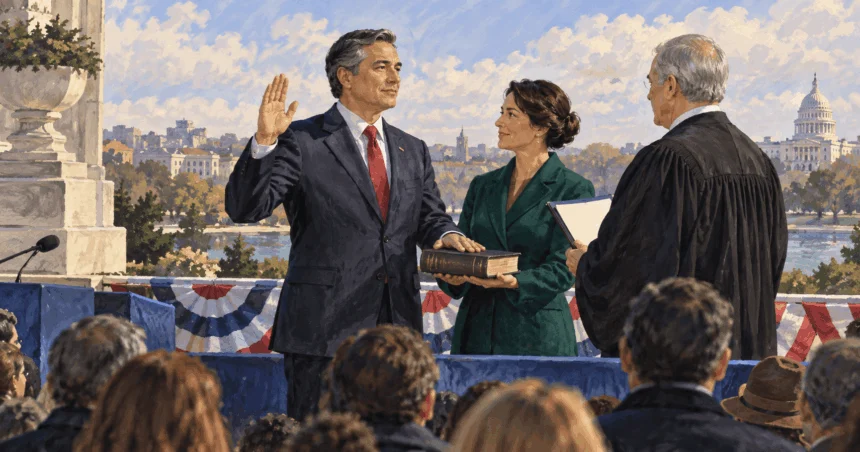
The presidential oath creates more than ceremonial obligation – it establishes a constitutional duty that has been invoked by presidents to justify extraordinary actions. The oath’s specific language appears nowhere else in the Constitution, highlighting its unique significance.
“I do solemnly swear (or affirm) that I will faithfully execute the Office of President of the United States, and will to the best of my Ability, preserve, protect and defend the Constitution of the United States.”
The inclusion of “or affirm” accommodates religious minorities, particularly Quakers, who objected to oath-taking on religious grounds. This small detail reflects the founders’ commitment to religious liberty and inclusion.
The oath’s two-part structure creates dual obligations: faithfully executing the office and defending the Constitution. Presidents have sometimes found these duties in tension, particularly during national emergencies when constitutional limitations might conflict with perceived necessities.
Abraham Lincoln cited his oath when justifying controversial wartime measures like suspending habeas corpus and issuing the Emancipation Proclamation. He argued that his duty to preserve the Constitution and the Union superseded strict adherence to particular constitutional provisions.
Modern presidents have similarly invoked their oath when defending expansive interpretations of executive power, particularly in national security contexts. This highlights the oath’s ongoing relevance in constitutional debates about presidential authority.
Commander in Chief Powers
Article II designates the president as “Commander in Chief of the Army and Navy of the United States, and of the Militia of the several States, when called into the actual Service of the United States.” This establishes civilian control over the military – a direct response to British grievances about making the military “independent of and superior to the Civil Power.”
The principle of civilian control reflected hard-learned lessons from English history, where military leaders had sometimes challenged civilian authority. The founders were also influenced by classical republican theory, which viewed standing armies as threats to liberty and insisted on civilian control as a safeguard.
This power exists in careful balance with legislative authority. While the president commands armed forces, Congress alone can declare war, raise armies, and maintain navies. The founders intended war declarations to be collective decisions by the people’s representatives, while war execution would be handled by a single, decisive commander.
James Madison explained this division in a letter to Thomas Jefferson: “The constitution supposes, what the History of all Governments demonstrates, that the Executive is the branch of power most interested in war, and most prone to it. It has accordingly with studied care vested the question of war in the Legislature.”
The Commander in Chief clause grants presidents several specific authorities. They can direct military strategy and tactics, appoint and remove military officers (subject to Senate confirmation for higher ranks), and make operational decisions about troop deployment and engagement.
However, the scope of these powers has expanded dramatically since the founding. Early presidents commanded small military forces with limited global reach. Modern presidents oversee vast military establishments with worldwide commitments and weapons of unprecedented destructive power.
Modern practice has blurred the distinction between congressional war powers and presidential command authority. Presidents increasingly rely on Commander in Chief authority to deploy troops and engage in extended military conflicts without formal congressional war declarations.
This evolution began early in American history. Thomas Jefferson sent naval forces against Barbary pirates without congressional authorization, justifying this as defensive action that didn’t require a formal war declaration. Subsequent presidents expanded this precedent, particularly in conflicts with Native American tribes and during westward expansion.
The twentieth century saw dramatic expansion of presidential war-making. Both World Wars began with congressional declarations, but subsequent conflicts in Korea, Vietnam, Iraq, and Afghanistan involved varying degrees of congressional authorization that fell short of formal war declarations.
The tension between presidential military command and congressional war powers reflects the Constitution’s broader struggle between energy and accountability in government. Presidents argue they need flexibility to respond to threats quickly, while Congress insists on its constitutional role in war decisions.
Courts have generally avoided resolving these disputes, viewing them as “political questions” best left to the elected branches. This judicial restraint has allowed the expansion of presidential war powers through practice and precedent rather than formal constitutional interpretation.
The War Powers Resolution of 1973 attempted to reassert congressional authority by requiring presidents to notify Congress of military deployments and withdraw forces after 60 days without congressional approval. However, presidents of both parties have questioned its constitutionality and frequently ignored its requirements.
Cabinet Powers and Pardons
Article II grants presidents two significant exclusive powers related to government administration and law enforcement that have proven crucial to presidential effectiveness.
The “Opinion Clause” allows presidents to “require the Opinion, in writing, of the principal Officer in each of the executive Departments.” This seemingly modest provision provides the constitutional foundation for the cabinet system and presidential control over executive branch operations.
The Constitution doesn’t create executive departments, but it anticipates them and establishes presidential authority over department heads. This language emerged from the founders’ recognition that the executive branch would need specialized departments to handle different governmental functions.
Early congresses created the first executive departments – State, Treasury, and War – with their secretaries serving at presidential pleasure. This established the principle that cabinet officials are presidential appointees accountable to the chief executive rather than independent administrators.
The Opinion Clause has been interpreted to support broad presidential authority over executive branch officials. Presidents can demand reports, issue directions, and remove officials who fail to implement presidential policies effectively.
This power has grown in significance as the executive branch has expanded. Modern presidents oversee millions of federal employees across dozens of departments and agencies. The Opinion Clause provides constitutional foundation for this vast administrative authority.
However, the extent of presidential control over executive officials remains contested. Some officials, particularly those in independent agencies, enjoy statutory protections against removal without cause. The Supreme Court has struggled to define the boundaries of presidential removal power, producing inconsistent precedents that leave important questions unresolved.
The pardon power grants presidents authority to “grant Reprieves and Pardons for Offenses against the United States, except in Cases of Impeachment.” This represents one of the presidency’s most absolute powers, rooted in English traditions of royal mercy but adapted to American republican principles.
Presidential clemency includes several distinct forms. Full pardons forgive crimes entirely, as if they never occurred. Commutations reduce sentences without erasing the underlying conviction. Reprieves temporarily postpone punishment. Amnesty extends pardons to entire groups of people.
The Supreme Court has described this power as “plenary” – broad and largely immune to checks from Congress or courts. In Ex parte Garland (1866), the Court declared the pardon power “unlimited” except for the explicit constitutional restrictions.
The only explicit constitutional limits are that pardons apply only to federal crimes and cannot nullify impeachments. Presidents cannot pardon state crimes or use pardons to prevent their own removal from office through impeachment.
Presidents have used clemency power in various ways throughout American history. George Washington pardoned participants in the Whiskey Rebellion to demonstrate federal authority while showing mercy to repentant rebels. Andrew Johnson’s pardons for Confederate leaders helped reconstruct the Union after the Civil War.
Modern presidents have used pardons to advance various policy goals. Some have granted amnesty to war resisters, seeking national reconciliation. Others have pardoned administration officials involved in controversial programs. Pardons for political allies remain controversial when they appear to circumvent the judicial process.
Pardons can prove highly controversial, especially when granted to political allies or when they appear to circumvent the judicial process. Gerald Ford’s preemptive pardon of Richard Nixon remains one of the most debated uses of this power, praised by some as necessary for national healing and criticized by others as an abuse of presidential authority.
The timing of pardons often generates controversy. Presidents frequently issue controversial pardons during their final days in office, when political consequences are minimal. Bill Clinton’s last-minute pardon of financier Marc Rich sparked ethics investigations and damaged Clinton’s post-presidential reputation.
Donald Trump’s extensive use of pardons for political associates raised new questions about the power’s limits and appropriate use. Critics argued that pardons for campaign associates threatened the rule of law, while supporters contended presidents have broad discretion in clemency decisions.
Shared Powers: Treaties and Appointments
Two of the presidency’s most important functions – foreign policy and government staffing – are deliberately designed as shared responsibilities with the Senate, creating constitutional friction points that force compromise and deliberation.
The treaty power allows presidents to negotiate international agreements, but treaties cannot become binding U.S. law until the Senate provides “advice and consent” with a two-thirds supermajority vote. This division reflects the founders’ recognition that foreign policy requires both executive expertise and legislative deliberation.
The treaty clause emerged from lengthy convention debates about foreign policy authority. Some delegates favored giving Congress complete control over treaties, while others supported exclusive presidential authority. The compromise divided treaty-making between negotiation (executive) and approval (legislative).
The high two-thirds threshold ensures that significant international commitments have broad, bipartisan support. Unlike simple legislation, which can pass with narrow majorities, treaties require substantial consensus that transcends partisan divisions.
This supermajority requirement has proven both blessing and curse for American foreign policy. It prevents presidents from making international commitments that lack domestic support, but it also makes it difficult to conclude treaties on controversial subjects even when they might serve national interests.
The nature of “advice and consent” has evolved significantly since the founding. Early presidents, particularly George Washington, attempted to consult with the Senate during treaty negotiations. Washington’s frustrating experience seeking Senate advice on an Indian treaty led him to conclude that consultation during negotiations was impractical.
Modern practice focuses Senate involvement on approving final treaty texts rather than participating in negotiations. This evolution has strengthened presidential control over foreign policy while maintaining Senate authority over final commitments.
Presidents have increasingly used “executive agreements” that don’t require Senate ratification to conduct foreign policy. These agreements, based on presidential constitutional authority or existing statutory authorization, have become far more numerous than formal treaties.
Executive agreements represent a major shift from the original constitutional framework. The founders clearly intended the Senate to play a significant role in international commitments, but modern presidents have found ways to make binding agreements without Senate involvement.
Some executive agreements rest on clear constitutional authority, such as presidential recognition power or Commander in Chief authority. Others derive from congressional delegation, such as trade agreements negotiated under fast-track authority. Still others push the boundaries of presidential power in ways the founders might not have anticipated.
The appointments power gives presidents authority to “nominate, and by and with the Advice and Consent of the Senate” ambassadors, federal judges, and other high-ranking officials. This shared power allows presidents to staff the entire federal government’s leadership while requiring Senate confirmation by simple majority vote.
The appointments clause reflects another carefully crafted compromise. Exclusive presidential appointment power might have created opportunities for corruption or incompetence, while exclusive legislative appointment power might have undermined executive authority and efficiency.
The founders debated extensively about which offices should require Senate confirmation. They settled on “Ambassadors, other public Ministers and Consuls, Judges of the supreme Court, and all other Officers of the United States” whose appointments are not otherwise provided for in the Constitution.
This language creates several categories of federal officials. “Officers of the United States” require Senate confirmation, while “inferior Officers” can be appointed by the President alone, courts, or department heads, as Congress directs. The distinction between officers and employees affects thousands of federal positions.
Senate confirmation serves multiple purposes beyond checking presidential power. It allows public scrutiny of nominees’ qualifications and views. It forces presidents to consider Senate preferences when making nominations. It provides opportunities for senators to extract policy commitments from nominees.
The confirmation process has become increasingly contentious and politicized over time. Senate minorities have used various tactics to delay or block nominees they oppose. Majority parties have responded by changing Senate rules to limit minority obstruction, escalating confirmation battles.
To prevent government paralysis, the Constitution grants presidents power to make temporary “recess appointments” when the Senate is not in session. These appointments expire at the end of the next Senate session unless confirmed through normal processes.
Recess appointments have generated modern controversy as presidents and Senate have sparred over what constitutes a true “recess.” The Supreme Court’s decision in NLRB v. Noel Canning (2014) limited recess appointment power by requiring recesses of at least ten days and restricting appointments to vacancies that arise during recesses.
| Constitutional Power | Classification | Key Details |
|---|---|---|
| Commander in Chief | Exclusive Presidential Power | Ultimate civilian authority over armed forces; checked by congressional war powers and military funding |
| Require Written Opinions | Exclusive Presidential Power | Constitutional basis for cabinet system and presidential control over executive branch |
| Grant Pardons & Reprieves | Exclusive Presidential Power | Broad clemency power for federal crimes; cannot be used in impeachment cases |
| Make Treaties | Shared Power (with Senate) | President negotiates; Senate approves with two-thirds vote |
| Appoint Federal Officers | Shared Power (with Senate) | President nominates; Senate confirms with majority vote |
| Recess Appointments | Exclusive Presidential Power (Conditional) | Temporary appointments only when Senate is in recess |
Legislative Duties and Responsibilities
Article II casts presidents in multiple roles: chief legislator, head of state, and chief law enforcement officer. These responsibilities connect the executive branch directly to Congress and the broader American public in ways that have evolved far beyond the founders’ original conception.
The State of the Union requirement mandates that presidents “shall from time to time give to the Congress Information of the State of the Union.” This creates a formal constitutional duty, not an option, though it leaves presidents considerable flexibility in timing and format.
The phrase “from time to time” was deliberately vague, allowing presidents to determine how frequently to report to Congress. The founders rejected more specific requirements, such as annual reports, preferring to give presidents discretion based on circumstances and need.
The practice has evolved dramatically since George Washington delivered the first State of the Union address in person to a joint session of Congress in 1790. Washington’s precedent of personal delivery continued through John Adams’s presidency but faced strong opposition from Thomas Jefferson.
Jefferson viewed in-person addresses as too reminiscent of the British monarch’s speech from the throne. He began the practice of sending written messages to Congress, which continued for over a century until Woodrow Wilson revived personal addresses in 1913.
Wilson’s revival transformed the State of the Union from a routine administrative report into a major presidential platform for setting national agenda and communicating directly with the American people. The advent of radio and television further amplified the address’s significance.
Modern State of the Union addresses have become elaborate productions involving extensive preparation, strategic timing, and careful staging. Presidents use these occasions to highlight achievements, propose new initiatives, and frame national debates on their preferred terms.
The constitutional requirement has also expanded beyond the annual address. Presidents now regularly communicate with Congress through special messages, budget submissions, legislative proposals, and other formal communications that fulfill their duty to provide information about the state of the union.
The “Recommendation Clause” grants presidents power to “recommend to their Consideration such Measures as he shall judge necessary and expedient.” This establishes the president’s most direct constitutional role in the legislative process, allowing them to propose new laws and submit annual budgets to Congress.
This power emerged from the founders’ recognition that effective government required executive initiative in legislative matters. The weak Confederation government had suffered from lack of coordinated policy direction, and the founders wanted to ensure the new government could develop coherent legislative programs.
While Congress isn’t constitutionally obligated to act on presidential recommendations, this power, combined with the State of the Union platform, establishes presidents as the nation’s “chief legislator.” This role has expanded dramatically since the founding as the federal government has grown in size and scope.
Early presidents used recommendation power sparingly, typically suggesting broad policy directions rather than detailed legislative proposals. Alexander Hamilton’s financial plans, submitted through Washington, represented early examples of comprehensive presidential legislative programs.
The modern presidency involves extensive legislative involvement far beyond what the founders envisioned. Presidential staffs draft detailed bills, lobby Congress for passage, and coordinate with party leaders to advance administration priorities. This evolution reflects both the growth of government and changing expectations about presidential leadership.
From Franklin Roosevelt’s New Deal to modern budget proposals, presidents have used recommendation authority to shape national political debate and drive legislative agendas. The president’s ability to command media attention gives recommendations influence far beyond their constitutional status.
Presidents’ true legislative influence often comes less from formal recommendation power than from informal “bully pulpit” authority – the ability to command public attention and pressure Congress to act. This concept, popularized by Theodore Roosevelt, recognizes that presidential communications can mobilize public opinion in support of particular policies.
The modern president’s legislative role creates tensions with constitutional separation of powers. Critics argue that extensive presidential involvement in lawmaking violates the principle that Congress should be the primary legislative branch. Defenders contend that modern governance requires presidential leadership to coordinate complex policy initiatives.
Additional Presidential Duties
Article II grants presidents several other important responsibilities that define their role as head of state and chief executive, many of which have acquired significance beyond their original conception.
Presidents can convene Congress for “extraordinary Occasions,” such as considering war declarations or emergency legislation. This power addresses situations where normal congressional schedules might prevent timely action on urgent matters.
The founders included this provision because Congress wasn’t expected to remain in continuous session. In an era when travel was difficult and legislators needed to return to their home states for extended periods, presidential authority to recall Congress ensured the government could respond to crises.
Modern Congress remains in session nearly year-round, making this power less practically significant than originally intended. However, presidents have occasionally used it to demonstrate urgency about particular issues or to pressure Congress to act on stalled legislation.
Presidents can also adjourn Congress if the House and Senate cannot agree on an adjournment date – a power that has never been used. This provision reflects the founders’ concern that congressional disputes might paralyze government operations, requiring presidential intervention to break deadlocks.
The duty to “receive Ambassadors and other public Ministers” serves as a cornerstone of presidential authority as head of state. This seemingly ceremonial function carries substantial foreign policy implications that have grown in importance over time.
The reception power is widely interpreted as granting presidents authority to formally recognize foreign governments’ legitimacy – a significant diplomatic tool. When presidents receive ambassadors from particular governments, they implicitly acknowledge those governments’ legitimacy and right to represent their nations.
This recognition power allows presidents to make crucial diplomatic decisions unilaterally, such as recognizing new nations or withdrawing recognition from hostile governments. The power to receive foreign representatives thus becomes a power to shape America’s international relationships in fundamental ways.
Historical examples demonstrate this power’s significance. Presidents have used recognition authority to support democratic movements, pressure authoritarian regimes, and advance various foreign policy objectives. The decision whether to receive particular ambassadors can signal American approval or disapproval of foreign governments.
The recognition power has generated constitutional controversies when it conflicts with congressional preferences. Congress sometimes passes legislation directing particular recognition decisions, creating tensions between legislative and executive foreign policy authorities.
Presidents also have implicit ceremonial duties as head of state that aren’t explicitly mentioned in the Constitution but flow from the office’s nature. These include hosting foreign dignitaries, representing the nation at international events, and serving as a unifying symbol during national celebrations or tragedies.
These ceremonial functions have acquired greater significance in the modern media age, when presidential actions receive extensive coverage and symbolic gestures can have substantial political impact. Presidents must balance their roles as partisan political leaders with their duties as nonpartisan heads of state.
The Take Care Clause
Perhaps the most significant presidential duty appears in Article II’s command that presidents “shall take Care that the Laws be faithfully executed.” This “Take Care Clause” sits at the center of ongoing constitutional struggles between presidential discretion and obligation, generating more litigation and political controversy than almost any other constitutional provision.
The clause embodies both a profound duty and substantial power, reflecting the enduring tension between democratic accountability and executive efficiency in American constitutional design.
As duty, the Take Care Clause requires presidents to enforce laws passed by Congress, regardless of personal agreement with those laws. This obligation reflects the principle that presidents serve as agents of the law rather than sources of law, bound to implement Congress’s will even when they disagree with particular policies.
The inclusion of the word “faithfully” suggests more than mechanical enforcement – it implies commitment to laws’ intent and purpose, not just their literal text. Presidents must attempt to implement laws in ways that achieve congressional objectives rather than undermining them through deliberate misimplementation.
This duty has proven challenging when presidents inherit laws they campaigned against or when new circumstances make existing laws seem inappropriate. The constitutional system expects presidents to seek legislative changes through proper channels rather than simply refusing to enforce laws they dislike.
However, the Take Care Clause also grants presidents substantial power and discretion in law enforcement. Since it’s impossible to enforce every law with equal vigor given limited resources and competing priorities, presidents must make choices about enforcement emphasis, resource allocation, and prosecutorial priorities.
This prosecutorial discretion represents a significant source of presidential power that has expanded dramatically as federal law has grown more comprehensive and complex. Modern presidents oversee enforcement of thousands of statutes covering everything from immigration to environmental protection to financial regulation.
The inherent ambiguity in the clause – the line between “faithfully” executing laws and effectively nullifying them through nonenforcement – creates constant political and legal conflict. Presidential decisions to defer deportation for certain immigrant groups, selectively enforce drug laws, or prioritize particular types of financial crime have all generated controversy.
Some argue that selective enforcement can become a form of executive lawmaking that violates separation of powers. When presidents systematically decline to enforce certain laws, they effectively repeal congressional enactments without going through proper legislative processes.
Others respond that prosecutorial discretion is inherent in executive power and necessary for effective governance. They argue that rigid, mechanical law enforcement would be both impractical and potentially unjust, requiring presidential judgment about priorities and circumstances.
Courts have generally given presidents broad deference in making enforcement decisions, viewing most prosecutorial choices as unreviewable executive judgments. However, some cases of systematic nonenforcement have prompted judicial intervention, particularly when presidential policies appear to contradict clear congressional directives.
The Supreme Court has linked the Take Care Clause to presidents’ implied power to supervise and remove executive officers. The logic holds that presidents cannot “take Care” that laws are faithfully executed without controlling the officials responsible for that execution.
This connection between the Take Care duty and removal power has generated ongoing constitutional controversies. Congress has sometimes tried to insulate certain officials from presidential removal, creating independent agencies and officers with tenure protections.
The Court has struggled to define boundaries between presidential control and congressional protection of administrative independence. Different cases have produced varying results, leaving important questions about presidential removal power unresolved.
Recent controversies over presidential control of independent agencies, special prosecutors, and law enforcement officials all trace back to tensions inherent in the Take Care Clause. The clause simultaneously requires presidential responsibility for law enforcement while limiting presidential authority to ignore or undermine laws they dislike.
Impeachment: The Ultimate Check
Article II concludes with the ultimate check on executive power: impeachment. This mechanism allows for removal of presidents, vice presidents, and all civil officers for grave misconduct, representing the founders’ most important safeguard against executive abuse.
The impeachment process reflects the founders’ careful study of English constitutional history and their determination to adapt parliamentary practices to American republican principles. English impeachment had been used against royal ministers who abused their authority, and the founders saw similar potential in America.
However, American impeachment differs significantly from its English predecessor. English impeachment could result in criminal punishment, while American impeachment is limited to removal from office and disqualification from future office-holding. Criminal prosecution must follow through separate judicial processes.
The Constitution specifies three impeachable offense categories: “Treason, Bribery, or other high Crimes and Misdemeanors.” The first two terms have relatively clear legal definitions established through law and precedent, but “high Crimes and Misdemeanors” remains deliberately ambiguous.
“High Crimes and Misdemeanors” is not a standard legal term but rather a political concept inherited from English parliamentary practice. It refers not necessarily to indictable crimes but to severe power abuses, public trust violations, or conduct that brings office into disrepute.
The phrase “high Crimes” suggests offenses against the state or public order rather than ordinary criminal law violations. “Misdemeanors” in this context doesn’t mean minor infractions but rather misconduct or misbehavior in office, regardless of criminal law implications.
The founders rejected more expansive grounds for removal, such as “maladministration,” which Edmund Randolph initially proposed. James Madison objected that such broad language would make presidential tenure subject to legislative pleasure, effectively creating a parliamentary system rather than separation of powers.
This rejection indicates the founders intended impeachment for grave offenses that threatened constitutional government rather than mere policy disagreements or administrative incompetence. Impeachment was meant to address extraordinary circumstances where other checks had failed.
The impeachment process divides responsibility between the two congressional houses, turning the legislature into a forum for both accusation and trial. This division reflects the founders’ recognition that removal decisions required both investigative capability and judicial deliberation.
The House of Representatives holds “sole Power of Impeachment,” functioning as a grand jury to investigate allegations and formally charge officials through “articles of impeachment.” This investigative role allows the House to examine evidence, hear testimony, and determine whether charges are warranted.
House impeachment requires only simple majority vote, making it relatively easy to bring charges against executive officials. However, impeachment itself doesn’t remove anyone from office – it merely initiates the process by formally accusing officials of misconduct.
The Senate holds “sole Power to try all Impeachments,” sitting as a court to evaluate evidence and determine guilt or innocence. Senators take special oaths to do “impartial justice,” distinguishing their role from ordinary legislative business.
In presidential impeachment trials, the Chief Justice presides rather than the usual Senate president. This provision recognizes the conflict of interest that would arise if the Vice President, who would benefit from presidential removal, presided over the proceedings.
Senate conviction requires a two-thirds supermajority vote and results in automatic removal from office. The Senate may also vote separately to disqualify convicted officials from holding future federal office, though this requires only simple majority.
The high two-thirds threshold ensures presidents cannot be removed by narrow, partisan majorities. This protection requires broad consensus that presidential misconduct threatens the nation’s welfare, preventing impeachment from becoming a routine political weapon.
Impeachment is fundamentally political rather than legal, despite its judicial trappings. Congress determines what constitutes impeachable offenses based on political judgment rather than legal precedent. There is no appeal from congressional impeachment decisions to federal courts.
This political character explains why impeachment cases have often centered on broader conflicts over presidential power and policy rather than clear legal violations. Andrew Johnson’s impeachment grew from bitter disputes over Reconstruction policy, while Bill Clinton’s focused on whether perjury about private conduct constituted public abuse of power.
Historical impeachment cases illustrate the process’s political dimensions and practical difficulties. Johnson escaped conviction by a single Senate vote, despite clearly violating the Tenure of Office Act, because some senators concluded that removal would damage constitutional government.
President Bill Clinton was impeached by the House of Representatives in 1998 on charges of perjury and obstruction of justice, with votes largely following party lines. The Senate acquitted him, as a majority – including some Republicans – determined that while his conduct was serious, it did not meet the threshold for removal from office. The case underscored the complex interplay between legal standards and political judgment in impeachment proceedings.
President Donald Trump was impeached twice by the House of Representatives. The first impeachment in 2019 involved allegations that he pressured Ukraine to investigate political opponents; the second in 2021 charged him with incitement of insurrection following the January 6 Capitol attack. Both proceedings saw significant partisan division, though the second impeachment received support from ten House Republicans. In both cases, the Senate acquitted Trump. These events highlighted impeachment’s inherently political nature and the differing interpretations of constitutional standards.President Donald Trump was impeached twice by the House of Representatives. The first impeachment in 2019 involved allegations that he pressured Ukraine to investigate political opponents; the second in 2021 charged him with incitement of insurrection following the January 6 Capitol attack. Both proceedings saw significant partisan division, though the second impeachment received support from ten House Republicans. In both cases, the Senate acquitted Trump. These events highlighted impeachment’s inherently political nature and the differing interpretations of constitutional standards.
Three presidents have been impeached by the House – Johnson, Clinton, and Trump (twice) – but all were acquitted by the Senate. Richard Nixon resigned in 1974 when his impeachment by the House and conviction by the Senate appeared certain following Watergate revelations.
Nixon’s resignation established an important precedent that presidents might choose to leave office rather than face certain impeachment and conviction. This possibility adds another dimension to impeachment’s role as a check on presidential power, since the mere threat of impeachment can influence presidential behavior.
Constitutional Amendments and Presidential Evolution
Article II has been formally amended four times, each responding to historical crises or exposed flaws in the original design. This pattern demonstrates that presidential job descriptions have been refined by practical necessity rather than abstract constitutional theory.
The amendment process itself reflects the founders’ recognition that constitutional design might require adjustment as experience revealed unforeseen problems. However, the difficulty of amending the Constitution has meant that only the most pressing issues have generated successful reform efforts.
The 12th Amendment: Fixing Elections
The presidential election of 1800 revealed critical flaws in the original Electoral College system, prompting significant changes to how presidents and vice presidents are selected.
The crisis emerged from the founders’ failure to anticipate organized political parties. The original system assumed electors would exercise independent judgment in choosing the two most qualified individuals for president and vice president, but partisan politics immediately corrupted this vision.
Thomas Jefferson and Aaron Burr, running as Republicans against Federalists John Adams and Charles Pinckney, each received 73 electoral votes when Republican electors faithfully cast ballots for both men on their party’s ticket. This tie threw the election to the House of Representatives, where each state delegation received one vote.
Federalists in the House faced a challenging decision between Jefferson, whom they viewed as a political adversary, and Burr, whom they considered unpredictable and self-serving.
The House required 36 ballots before Jefferson prevailed, creating a dangerous interregnum during which the nation’s leadership remained uncertain. Alexander Hamilton played a crucial role in breaking the deadlock by urging Federalists to support Jefferson, whom he viewed as having more integrity than Burr despite their policy differences.
The crisis demonstrated that the original Electoral College system couldn’t function in a partisan environment where organized parties nominated tickets rather than allowing electors to choose freely among all qualified candidates.
Ratified in 1804, the 12th Amendment redesigned the Electoral College process by requiring electors to cast separate, distinct ballots for president and vice president. This change eliminated the possibility of ties between running mates while preserving the federal structure of presidential selection.
The amendment fundamentally altered the vice presidency by making it a position explicitly chosen in conjunction with the presidency rather than awarded to the presidential runner-up. This change recognized political reality while eliminating the administrative conflicts that had plagued the Adams-Jefferson relationship.
The 12th Amendment represented a rare example of constitutional adaptation to unforeseen political developments. Rather than abolishing the Electoral College, which might have required more extensive constitutional revision, the founders chose targeted reform that preserved the system’s federal character while accommodating partisan politics.
The 20th Amendment: Ending Lame Duck Periods
The original Constitution set March 4 as Inauguration Day, creating a four-month “lame duck” period after November elections during which defeated presidents and Congress members remained in office with diminished authority and legitimacy.
This extended transition period was practical in the eighteenth century, when travel and communication were slow. Newly elected officials needed time to journey to the capital, and the outgoing administration required time to transfer responsibilities and prepare successors.
However, industrial development and improved transportation made such long transitions unnecessary and potentially harmful by the twentieth century. Defeated presidents and congressmen retained power for months after voters had rejected them, hindering government’s ability to respond effectively to pressing national problems.
The Great Depression highlighted these problems dramatically. Herbert Hoover lost the 1932 election decisively to Franklin Roosevelt, but Hoover remained president until March 1933 while the economic crisis deepened. Roosevelt couldn’t implement his recovery programs, while Hoover lacked the political authority to pursue major new initiatives.
This four-month interregnum proved particularly dangerous because the banking system was collapsing and unemployment was soaring. The nation needed decisive leadership, but the lengthy lame duck period prevented either president from acting effectively.
Ratified in 1933, the 20th Amendment moved presidential terms to January 20 and congressional terms to January 3, significantly shortening transition periods. These new dates balanced the need for orderly transitions with the requirement for timely leadership changes.
The amendment also clarified succession lines if presidents-elect died before taking office, addressing scenarios that the original Constitution had not anticipated. These provisions became relevant when assassination attempts against presidents-elect became a concern in the modern era.
Section 3 of the amendment addresses the possibility that neither presidential candidate receives the required Electoral College majority and the House election extends past Inauguration Day. In such cases, the Vice President-elect serves as Acting President until the House resolves the presidential election.
This change proved crucial for modern governance, enabling more rapid policy transitions and reducing the instability that accompanied lengthy lame duck periods. Modern presidents can begin implementing their programs much sooner after election victories, improving government responsiveness to electoral mandates.
The 22nd Amendment: Presidential Term Limits
George Washington established an informal two-term tradition that held for over 150 years, creating one of American democracy’s most important precedents through personal example rather than constitutional requirement.
Washington’s decision to retire after two terms reflected both personal inclinations and principled commitment to republican government. He was weary after eight years of intense partisan conflict and eager to return to private life at Mount Vernon, but he also believed that voluntary retirement would establish important precedent against unlimited tenure.
Washington’s Farewell Address explicitly warned against the dangers of unlimited presidential terms, arguing that long tenure might encourage presidents to view office as personal property rather than public trust. He worried that permanent presidency would gradually transform American republicanism into monarchy.
Subsequent presidents respected Washington’s precedent until Franklin Roosevelt’s unprecedented four terms broke the tradition during the Great Depression and World War II. Roosevelt’s extended tenure raised fundamental questions about democratic governance and the concentration of power in single individuals.
Roosevelt initially planned to retire after two terms but decided to seek a third amid growing international crisis and economic uncertainty. He justified this decision by arguing that extraordinary circumstances required experienced leadership, though critics accused him of power-grabbing.
Roosevelt’s death early in his fourth term intensified concerns about unlimited presidential tenure. His lengthy presidency had concentrated enormous power in the executive branch while creating unprecedented federal programs and international commitments that outlasted his administration.
Ratified in 1951, the 22nd Amendment codified Washington’s two-term tradition into constitutional law: “No person shall be elected to the office of the President more than twice.” This limitation applied to all future presidents, though Harry Truman was exempted as the incumbent.
The amendment also addresses vice presidents who succeed to the presidency, specifying that those who serve more than two years of predecessors’ terms may only be elected once more. This provision prevents circumvention of term limits through vice presidential succession.
The 22nd Amendment represents the only constitutional restriction on presidential power rather than expansion or clarification of existing authority. It reflects post-World War II concerns about concentrated executive power and the importance of democratic turnover in leadership.
Critics argue that term limits weaken presidents in their second terms by making them “lame ducks” unable to seek reelection. They contend that voters should decide presidential tenure through elections rather than constitutional restrictions.
Supporters respond that term limits prevent excessive power concentration while ensuring regular leadership renewal. They argue that unlimited tenure might encourage authoritarian tendencies and reduce democratic accountability over time.
The 25th Amendment: Handling Disability and Vacancy
President Kennedy’s assassination in 1963, combined with Cold War anxieties about nuclear weapons and constant leadership needs, exposed dangerous gaps in constitutional provisions for handling presidential disability and vice presidential vacancies.
The original Constitution provided that presidential powers and duties would “devolve” on the Vice President in cases of presidential death, resignation, removal, or inability, but it left crucial questions unanswered. Did the Vice President become President or merely Acting President? What constituted presidential “inability,” and who determined when it existed?
Vice President Lyndon Johnson’s immediate assumption of the presidency after John F. Kennedy’s assassination followed the precedent set by John Tyler in 1841. However, this practice was not explicitly defined in the Constitution at the time.
Concerns about presidential succession became more urgent during the Cold War, as the presence of nuclear weapons underscored the need for clear leadership structures in case of national emergencies or attacks on government officials.
Medical advances also complicated disability questions by making it possible for presidents to survive serious illnesses or injuries that might impair their ability to function effectively. Presidents could survive serious medical conditions but be unable to perform their duties, raising constitutional questions about who should exercise executive authority.
Dwight Eisenhower’s heart attacks and other health problems in the 1950s highlighted these issues practically. President Dwight Eisenhower experienced multiple health issues in the 1950s, including heart attacks and a stroke. He made informal agreements with Vice President Richard Nixon to temporarily delegate authority if needed, but these arrangements had no legal basis under the Constitution.
Ratified in 1967, the 25th Amendment provided comprehensive procedures to ensure governmental continuity during presidential transitions and disability crises.
Section 1 formally clarifies that Vice Presidents become President, not just Acting President, upon predecessors’ death, resignation, or removal. This codified existing practice while eliminating legal uncertainty about succession.
Section 2 creates processes for filling vice presidential vacancies through presidential nomination and congressional confirmation by majority votes in both houses. This ensures continuous succession while maintaining democratic accountability through legislative approval.
Gerald Ford became the first person appointed Vice President under this provision when Spiro Agnew resigned in 1973. Ford then became President when Nixon resigned, making him the only President never elected to national office.
Sections 3 and 4 establish detailed procedures for handling presidential disability, both voluntary and involuntary. These provisions address the most complex constitutional questions about presidential incapacity.
Section 3 allows presidents to voluntarily transfer power to Vice Presidents by written declaration to congressional leadership. Presidents can reclaim power by declaring their ability restored, making this procedure entirely under presidential control.
This provision has been used during medical procedures requiring anesthesia. President Ronald Reagan informally invoked it in 1985, while Presidents George W. Bush (in 2002 and 2007) and Joe Biden (in 2021) formally transferred power to their vice presidents during surgeries
Section 4 provides mechanisms for involuntary power transfers when presidents cannot or will not acknowledge their disability. The Vice President and majority of cabinet officers can declare presidential inability, making the Vice President Acting President.
Presidents can contest such declarations by asserting their ability to discharge duties. If the Vice President and cabinet majority disagree, Congress has 21 days to resolve the dispute by two-thirds vote in both houses. Failure to achieve this supermajority restores presidential power.
This involuntary procedure has never been used, though it has been discussed during various presidential health crises. The high threshold for congressional override reflects concern that disability determinations could be influenced by political considerations, especially during times of controversy or crisis.
The 25th Amendment has proven crucial for modern governance by providing clear, legally enforceable procedures for handling succession and disability issues that the original Constitution left ambiguous. It ensures governmental continuity even during constitutional crises involving presidential capacity.
Modern Presidential Power and Constitutional Evolution
These constitutional amendments have collectively strengthened the presidency by making it more stable, efficient, and responsive to democratic accountability. They fixed fundamental flaws in the original design while preserving the office’s essential character and authority.
The presidency today operates within a constitutional framework that combines eighteenth-century foundations with twentieth-century refinements responding to practical governance needs. This evolution demonstrates the Constitution’s adaptability to changing circumstances while maintaining core principles.
Modern presidents wield power far beyond what the founders envisioned, commanding vast bureaucracies, global military forces, and unprecedented technological capabilities. Yet they remain constrained by the same basic constitutional structure of checks and balances established in 1787.
The ongoing tension between presidential power and democratic accountability continues to generate constitutional controversies in areas ranging from war powers to executive privilege to regulatory authority. Each generation must rebalance these competing values based on contemporary challenges and constitutional understanding.
Presidential power has expanded through several mechanisms beyond formal constitutional amendment. Congressional delegation has granted presidents broad discretionary authority over complex regulatory and foreign policy matters that didn’t exist in the founding era.
Supreme Court interpretation has generally supported expansive presidential authority, particularly in foreign affairs and national security contexts. Cases like United States v. Curtiss-Wright Export Corp. (1936) have recognized broad inherent presidential powers that supplement specific constitutional grants.
Historical precedent has established presidential prerogatives through consistent practice over time. When presidents repeatedly exercise certain powers without congressional objection or judicial intervention, those practices acquire constitutional legitimacy through accepted usage.
National crisis has repeatedly expanded presidential authority as presidents claim emergency powers to address threats to national security or public welfare. While these expansions often face later challenges, they frequently establish new baseline levels of presidential power.
Public expectations have created informal presidential responsibilities that extend far beyond constitutional text. Americans expect presidents to manage the economy, provide moral leadership, respond to natural disasters, and address social problems regardless of specific constitutional authority.
The modern presidency thus represents both continuity and change – maintaining the essential constitutional structure while adapting to governance needs that the founders could not have anticipated. Understanding this evolution requires appreciating both Article II’s enduring framework and the historical forces that have shaped its interpretation.
Contemporary debates over presidential power continue to invoke foundational constitutional principles while grappling with modern governance challenges. Whether the issue is immigration enforcement, military intervention, trade policy, or regulatory oversight, the underlying questions remain those the founders addressed: How much power does effective governance require, and how can that power be constrained by democratic accountability?
Article II’s job description for the presidency continues to provide the fundamental framework for these debates, even as its interpretation evolves with changing circumstances and constitutional understanding. The presidency remains a work in progress, its powers and limits constantly tested by new challenges while remaining grounded in constitutional principles established more than two centuries ago.
Our articles make government information more accessible. Please consult a qualified professional for financial, legal, or health advice specific to your circumstances.