

Last Checked: October 6, 2026Next Check: August 22, 2030
- uscourts.govcited ×12
- govinfo.govcited ×7
- cdn.ca9.uscourts.govcited ×5
- supremecourt.govcited ×3
- ca4.uscourts.govcited ×1
- law.cornell.educited ×23
Last updated 4 weeks ago. Our resources are updated regularly but please keep in mind that links, programs, policies, and contact information do change.
An appellate decision uses a few set words to say what happens to the ruling under review. Affirm means the appeals court found the lower court’s decision correct, so it stands. Reverse means the appeals court decided the lower court’s judgment was incorrect. Remand means it sent the case back for further proceedings. “Reversed and remanded” means both happened: the appeals court reversed the judgment and returned the case to the lower court.
Winning an appeal does not always end the case. A criminal defendant can have a conviction overturned and still face another trial. The appeals court’s instructions determine whether the lower court must carry out a settled result or decide something the appeal left open. The rules described here are those of the federal courts.
What the words change, and what they leave open
Appellate describes a court’s power to review a lower court or tribunal’s judgment. Federal law gives appellate courts authority to affirm, modify, vacate, set aside or reverse a judgment and to order further proceedings. To vacate a judgment is to set it aside or annul it. Affirm, reverse and vacate say what happens to the existing judgment; remand says where the case goes next.
A reversal can apply to the entire judgment or only part of it, leaving other parts valid. The appellate court may direct a different judgment or reconsideration of a particular issue without ordering a new trial. That is why a decision can be both reversed and remanded without contradiction: the first word addresses the ruling, and the second returns the case for further action.
A decision can also affirm one part of a judgment and reverse another. The affirmed portion survives even when another issue returns to the lower court, so a party that lost on one question has not necessarily lost on every question. Read the appeals court’s ruling and instructions before treating a remand as a complete victory or a complete defeat.
Why the appeal is not another trial
Federal courts of appeals do not retry cases, hear new evidence or hear witnesses testify, and they do not have juries. The record is the documented account of the case’s proceedings, including pleadings, evidence and exhibits. The appeal is decided on that record; it is not an opportunity to present the whole dispute to a new jury.
The appellant, the party challenging the decision, presents written legal arguments in a brief seeking reversal. The appellee, the party defending against the appeal, argues that the decision was correct or that any error did not affect the result. Oral argument is a structured discussion between lawyers and appellate judges about the disputed legal principles.
How closely the appeals court looks depends on what is being challenged. For facts found by a judge in a nonjury trial, federal civil rules tell the reviewing court to leave the findings intact unless they are clearly erroneous, giving due regard to the trial court’s opportunity to judge witness credibility. A review guide by the Ninth Circuit, one of the regional federal appeals courts, describes the standards for other questions. Questions of law get de novo review: appellate judges consider the matter independently, without deferring to the lower court’s decision.
Under abuse-of-discretion review, the appeals court upholds a decision that falls within a broad range of permissible conclusions. It can correct a decision when the lower court applied the wrong law or relied on a clearly erroneous finding of a material fact. Disagreement with a trial judge’s choice is not, by itself, the same as showing that the choice fell outside the allowed range.
The Ninth Circuit’s review guide says a district court’s decision may be affirmed on a ground supported by the record even if the district court did not rely on it. An affirmance therefore need not endorse the lower court’s explanation word for word.
Why finding an error may not change the result
The federal harmless-error statute directs reviewing courts to disregard errors that do not affect the parties’ substantial rights. Substantial-rights review focuses on harm to a fair trial, not technical perfection; in most criminal cases, that means asking whether the error affected the outcome. Rule 61 of the Federal Rules of Civil Procedure says the same and limits when an error justifies disturbing a judgment or granting a new trial. An appeal must connect a mistake to the kind of harm the governing rule recognizes, rather than simply collect imperfections in the proceedings.
For criminal cases, Rule 52 of the Federal Rules of Criminal Procedure also requires courts to disregard errors that do not affect substantial rights. The same rule permits a court to consider a plain error affecting substantial rights even if the error was not brought to the court’s attention. Plain error is a clear or obvious legal mistake under current law; even if it affects substantial rights, correction is discretionary and reserved for errors that seriously harm the proceedings’ fairness, integrity or public reputation. Not raising an issue in time is one problem; an error that did no real harm is another. Either can matter to the appeal. An affirmance answers whether the challenged result should stand; it does not certify that every step was flawless.
What happens in the lower court after remand
An appellate court can direct entry of an appropriate judgment or require further proceedings that are just under the circumstances. The lower court receives the appellate court’s mandate, which ordinarily consists of the certified appellate judgment, the opinion if any, and directions about costs. The lower court must adhere to the appellate decision and cannot take actions that contradict its mandate. A remand is therefore a return with boundaries, not a blank invitation to start the case over. The lower court may still decide issues the appellate court did not decide; the Ninth Circuit has said a trial court may decide anything the mandate does not foreclose.
A remand can be the route to closing a case as well as the route to more litigation. Moot describes a controversy that no longer calls for a court ruling because it has ended. A civil case that becomes moot during appellate review can be returned with instructions to dismiss it.
Remand has another meaning that does not involve an appeal: a return from federal court to state court. Removal moves an eligible civil case from state court to federal district court, subject to the statutory requirements. If the federal district court finds before final judgment that it lacks jurisdiction over the subject matter, meaning the legal authority to hear and decide that type of case, it must remand the removed case, and the state court may then proceed.
In Social Security judicial review, federal law permits a court to affirm, modify or reverse the agency decision, with or without sending it back for a rehearing. So check where a case is being sent: a remand to an agency is not the same procedural step as a remand to a trial court.
A criminal reversal does not always bar another trial
A criminal defendant may appeal a guilty verdict, while the government may not appeal a not-guilty verdict. Either side may appeal the sentence imposed after a guilty verdict. The conviction and the punishment are distinct targets of review, so success on one does not necessarily reopen the other.
Reversal for trial error is not a decision that the government failed to prove its case, and it implies nothing about the defendant’s guilt or innocence. It means the process was defective, and a retrial is allowed to correct the error.
When a reviewing court finds the trial evidence legally insufficient to sustain the guilty verdict, the Double Jeopardy Clause bars a second trial and the remedy is a judgment of acquittal. The Supreme Court explained that the prosecution had already received one fair opportunity to assemble its proof. The reason for reversal therefore determines whether the government gets another chance to try the charge.
Federal sentencing law directs a remand for further sentencing proceedings when the appeals court finds a sentence imposed in violation of law or through an incorrect application of the sentencing guidelines. The district court must follow the appellate court’s instructions when resentencing under that statutory remand procedure. A sentencing remand can require a new decision about punishment without requiring a new trial on guilt.
Release from custody is a separate question. Under federal appellate Rule 9, a party entitled to do so can obtain review of a release order after conviction by filing a notice of appeal from that order in district court or, when the party has already appealed the conviction, a motion in the court of appeals. The court must decide release under the applicable federal release and detention statutes. A remand alone is therefore not an order to release a prisoner; what follows depends on the relief granted on the conviction or sentence and on the separate custody decision.
The ruling, the mandate and the next deadline
The mandate is effective when it is issued. The written decision and the mandate are issued separately; reading the decision does not establish that the mandate has issued. Ordinarily, the mandate issues seven days after the time for rehearing expires, or seven days after denial of a timely rehearing petition or motion to stay the mandate, whichever is later. The appeals court may shorten or extend that time by order. Check the court’s order and docket entry, because the ordinary timetable can be changed.
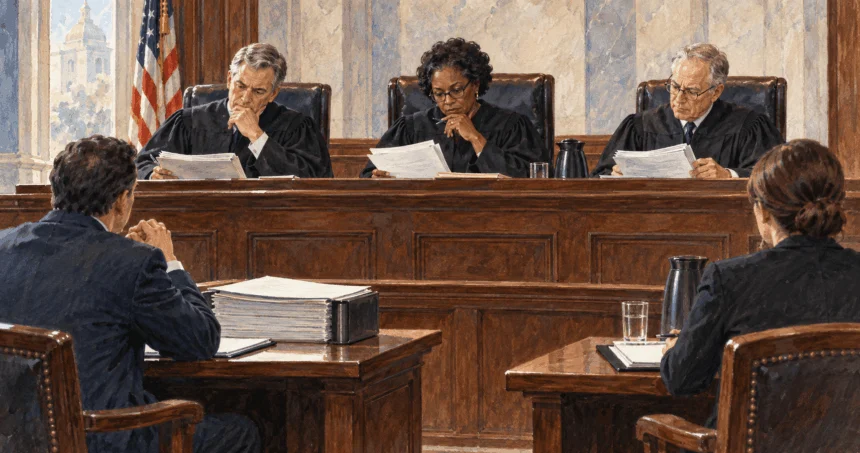
Federal appeals are usually decided by panels of three judges. En banc refers to the full court taking part, though the largest appeals courts may divide their full membership into en banc panels. Under federal appellate rules, a party may petition for panel rehearing, rehearing en banc, or both. Panel rehearing is the ordinary route to reconsideration, and en banc rehearing is not favored.
The ordinary federal rehearing deadline is fourteen days after judgment or an amended decision, subject to changes by order or local rule. Unless an order changes the time, the rehearing deadline in a civil case is forty-five days when a party is the United States, a federal agency, or a federal officer or employee sued in an official capacity. That civil exception also covers current or former federal officers or employees sued individually for acts or omissions connected with their federal duties. File a federal rehearing petition with the clerk of the court of appeals under its filing rules. These are federal deadlines; do not apply them to a case in a different court system.
Supreme Court review through a writ of certiorari, an order agreeing to review a lower court’s decision, is discretionary and requires compelling reasons, including important conflicts between appellate courts. Filing a petition does not mean the Court will take the case.
Ordinarily, a certiorari petition seeking review of a judgment of a United States court of appeals or a state court of last resort is due within ninety days after entry of judgment, unless law provides otherwise. File the certiorari petition with the Supreme Court’s Clerk under the Court’s filing rules. If any party files a timely rehearing petition in the lower court, the certiorari period for all parties runs from the denial of rehearing or, if rehearing is granted, from the later judgment. The same reset applies when the lower court appropriately considers an untimely rehearing petition or considers rehearing on its own initiative.
The certiorari period runs from the relevant judgment or order, not the mandate’s issuance date. Waiting for the mandate before considering Supreme Court review can therefore confuse two different clocks. A party seeking to stay the mandate while pursuing certiorari must move for a stay and show a substantial question and good cause. Further review and a pause in the mandate are separate requests.
For the next step in a particular case, read the appeals court’s ruling together with its instructions, the mandate and any order affecting timing.