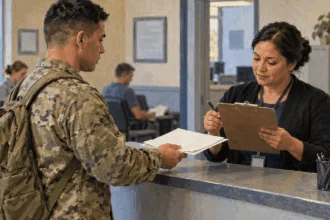
Military bases are more than fences and barracks. They are self-contained communities that house troops and families, store equipment, and project American power both at home and abroad. Each installation operates under its own security rules, environmental obligations, and support systems, all shaped by federal law and military regulation rather than the state or city that surrounds it.
Security and access set military installations apart from ordinary public property. Entry is controlled, guarded by dedicated law enforcement personnel described in The Guardians at the Gate: Inside America’s Military Police Force, and governed by threat-level systems explained in FPCON Decoded: What Those Signs at Military Gates Mean. Civilians who need to enter for work, visits, or deliveries follow specific procedures, covered in Visiting Military Bases: Rules and Access for Civilians, and firearm rules on base differ sharply from state law, as detailed in Guns on Base: A Guide to Military Installation Weapons Policies.
Land, environment, and infrastructure present a separate set of challenges. Decades of military activity have left contamination at many sites, a legacy addressed in America’s Toxic Military Legacy: Cleaning Up Contaminated Bases, while the Pentagon also manages vast tracts of land for training and conservation, as described in Inside the Pentagon’s Massive Environmental Effort. Periodically, the Department of Defense reshapes its footprint entirely, a process outlined in Military Base Realignment and Closure (BRAC) Process Explained.
Life on base revolves around services families rely on daily, including housing choices covered in Military Family Housing Options: On-Base vs. Off-Base Living and identification requirements explained in Your Guide to Getting a Military ID Card (CAC and USID): Process and Locations.
Articles are now written and checked by the GovFacts Engine, an AI system. No government agency has any input into what it produces. Learn more about our article development and editing process.
We appreciate feedback from readers like you. If you want to suggest new topics or if you spot something that needs fixing, please contact us.
The United States Department of Defense (DoD) undertakes a significant process known as Military Base Realignment and Closure (BRAC) to…
The United States maintains a significant military presence across the globe, necessary for international relations and national security objectives. Status…
The military exchange system offers significant worldwide retail benefits to the U.S. military community. Operated by distinct organizations serving different…
The Department of Defense (DoD) provides a vital network of support programs known collectively as Morale, Welfare, and Recreation (MWR).…
The Department of Defense (DoD) offers a valuable resource known as military lodging. These facilities, located on or near military…
For members of the U.S. military community, the commissary represents more than just a grocery store; it's a significant benefit…
Receiving Permanent Change of Station (PCS) orders means making important decisions about housing at your new duty station. This guide…
This guide simplifies the steps for obtaining Department of Defense (DoD) identification cards: the Common Access Card (CAC) and the…