Last updated 10 months ago. Our resources are updated regularly but please keep in mind that links, programs, policies, and contact information do change.
Every day, millions of Americans commute on roads, ride buses and trains, turn on water taps, and work in jobs that exist because of decisions made by government bodies they’ve probably never heard of.
These regional organizations control billions in public spending and shape how entire metropolitan areas develop, yet they operate largely in the shadows of public awareness.
- What Makes Regional Governance Necessary
- Metropolitan Planning Organizations: The Federal Transportation Planners
- Regional Authorities: The Service Providers
- Key Differences That Matter
- How They Work Together (And Sometimes Clash)
- Federal Legislation That Shaped MPOs
- Types of Regional Authorities
- Common Collaboration Mechanisms
- Case Studies in Regional Collaboration
- Real-World Impact on Your Daily Life
- Finding and Engaging Your Regional Players
- The Evolving Landscape of Regional Governance
Two types of regional entities wield enormous influence over American communities: Metropolitan Planning Organizations (MPOs) and Regional Authorities. While both operate beyond traditional city and county boundaries, they serve fundamentally different purposes and derive their power from entirely different sources.
What Makes Regional Governance Necessary
Modern challenges don’t respect political boundaries. Traffic jams that start in one city create gridlock across an entire region. Water supplies cross multiple counties. Economic development in one area affects job markets everywhere nearby. Air pollution drifts wherever the wind blows.
These regional realities demand regional solutions. Individual cities and counties simply can’t tackle issues that span their borders effectively on their own. A small suburb can’t build a regional airport. A single county can’t manage an entire watershed. One city can’t create an integrated public transportation network serving millions of commuters.
This need for coordination has spawned hundreds of specialized regional organizations across the United States, each with different powers, funding sources, and areas of responsibility. Some focus narrowly on specific services like water supply or port operations. Others coordinate broadly across multiple issues affecting entire metropolitan areas.
The proliferation of regional entities reflects a fundamental tension in American governance: balancing local control with the practical necessity for region-wide solutions. Communities want to maintain autonomy over their affairs, but they also need to address shared challenges that no single jurisdiction can handle alone.
Metropolitan Planning Organizations: The Federal Transportation Planners
What MPOs Actually Do
Metropolitan Planning Organizations exist for one primary reason: the federal government requires them. Created by the Federal-Aid Highway Act of 1962, MPOs are mandated for every urbanized area with more than 50,000 people. Their job is to ensure federal transportation dollars get spent wisely through what’s called the “3-C” process: continuing, cooperative, and comprehensive planning.
This means transportation planning must be ongoing, involve collaboration among different government levels, and consider all transportation modes—not just highways. The federal requirement emerged from recognition that transportation systems cross jurisdictional boundaries and their impacts ripple throughout entire regions.
Before MPOs existed, states and localities often pursued transportation projects in isolation, creating inefficient networks and missing opportunities for coordination. Highway projects might proceed without considering transit needs. Airport expansions could ignore ground transportation access. The 3-C process was designed to force collaborative, region-wide thinking.
The Evolution of MPO Power
MPOs started as relatively weak advisory bodies with limited influence. The 1962 law required their creation but gave them little actual authority. That changed dramatically with the Intermodal Surface Transportation Efficiency Act of 1991 (ISTEA), which significantly increased MPO funding and decision-making power.
ISTEA marked a watershed moment in American transportation policy. It shifted substantial authority from state transportation departments to regional MPOs, recognizing that local officials often better understood regional transportation needs than distant state capitals. MPOs gained the power to select which projects received federal funding, subject to state approval.
Subsequent federal laws continued expanding MPO responsibilities and influence. The Transportation Equity Act for the 21st Century (TEA-21) in 1998 increased funding levels and emphasized multimodal planning. The 2005 SAFETEA-LU Act added safety and environmental requirements. More recently, the 2021 Bipartisan Infrastructure Law introduced housing coordination requirements and emphasized equity considerations.
This evolution reflects growing federal recognition that transportation planning must consider broader regional goals beyond simply moving vehicles efficiently. Modern MPOs are expected to address air quality, economic development, housing accessibility, environmental justice, and climate change—a far cry from their original narrow focus on highway planning.
The Paper Trail That Moves Billions
MPOs produce several key documents that control how transportation money flows:
Long-Range Transportation Plan: This 20-year vision document identifies future transportation needs and major projects. The plan must consider demographic projections, land use patterns, economic development goals, and environmental impacts. Crucially, it must be “fiscally constrained”—meaning it can only include projects for which funding is reasonably expected. No wish lists allowed.
The fiscal constraint requirement forces difficult prioritization decisions. MPOs can’t simply include every project that might be beneficial; they must make tough choices about which investments will provide the greatest regional benefit within available resources. This often creates intense political pressure as different communities compete for limited federal dollars.
Transportation Improvement Program (TIP): This shorter-term document lists specific projects that will receive federal funding over the next four to six years. If a project isn’t in an MPO-approved TIP, it can’t get federal transportation money. This gives MPOs enormous leverage over transportation investments throughout their regions.
The TIP serves as the critical link between long-range planning and actual implementation. Projects can sit in long-range plans for years, but inclusion in the TIP means funding is committed and construction can proceed. Competition for TIP inclusion is often fierce, with local officials lobbying intensively for their priority projects.
Unified Planning Work Program: This outlines the MPO’s annual work plan and budget for planning activities. It identifies all transportation planning studies and tasks to be undertaken, specifies who will perform the work, establishes timeframes, and identifies funding sources.
Public Participation Plan: Federal law requires MPOs to actively encourage public involvement throughout their planning processes. These plans outline how MPOs will engage citizens, provide information, and incorporate public input into decision-making.
These documents collectively control how billions in federal transportation dollars get spent in urban areas. The Metropolitan Transportation Plan and TIP together determine whether regions invest in highway capacity, public transit, bicycle and pedestrian infrastructure, freight improvements, or some combination of all these modes.
Who’s in Charge
MPO policy boards typically include elected officials from member cities and counties, state transportation department representatives, and officials from public transit agencies. The exact composition varies by region, but federal law requires that local elected officials constitute a majority of the voting members.
This structure creates inherent tensions between different communities and transportation modes. Urban representatives often favor transit investments and complete streets approaches that accommodate pedestrians and cyclists. Suburban members frequently prioritize highway improvements and parking availability. Rural representatives may focus on maintaining existing infrastructure rather than expanding capacity.
Some critics argue that suburban and rural representatives often outnumber urban ones on MPO boards, leading to transportation investments that favor highways over transit. The Center for American Progress has documented this pattern in several major metropolitan areas, noting that board composition often doesn’t reflect regional population distribution.
This geographical imbalance can have profound policy implications. Suburban-dominated boards may prioritize highway expansion projects that primarily benefit their constituents while underinvesting in urban transit systems that serve different populations. The result can be transportation networks that reinforce existing patterns of development and mobility rather than promoting more sustainable alternatives.
Federal Money, Federal Rules
MPOs get their operational funding primarily from federal transportation planning grants—specifically FHWA PL funds and FTA Section 5305 funds. These require state or local matching money, typically 20% of the total cost. The federal share covers activities like staff salaries, consultant contracts, data collection, travel demand modeling, and public outreach.
The Bipartisan Infrastructure Law increased MPO funding significantly and added new requirements. MPOs must now spend at least 2.5% of their planning funds on projects that increase safe transportation options for all users, including pedestrians and cyclists. This requirement reflects growing federal emphasis on “Complete Streets” design that accommodates multiple travel modes.
The law also requires MPOs to coordinate transportation planning with housing patterns and consider projects that promote consistency between transportation improvements and local housing policies. This reflects recognition that transportation and housing costs are closely linked—regions with better transit access often have more affordable overall transportation costs even if housing prices are higher.
Importantly, MPOs don’t actually build roads or operate transit systems. They plan and program federal money for others to implement. State departments of transportation typically handle highway construction. Local governments manage city streets. Regional transit authorities operate bus and rail systems. MPOs coordinate all these actors but don’t directly control implementation.
Geographic Scope and Boundaries
The geographic area over which an MPO exercises planning authority is carefully defined. MPOs must cover entire urbanized areas as defined by the U.S. Census Bureau, plus contiguous areas expected to become urbanized within 20 years. This forward-looking approach ensures that MPO planning considers future growth patterns, not just current development.
Metropolitan planning areas often extend well beyond the central city that gives a region its name. The Boston MPO covers 101 municipalities across multiple counties. The Atlanta region MPO includes 20 counties spanning nearly 8,000 square miles. These large planning areas reflect the reality that economic and social connections extend far beyond traditional city boundaries.
The size and complexity of MPO planning areas create both opportunities and challenges. Larger areas allow for more comprehensive regional planning but make consensus-building more difficult. MPOs must balance the interests of central cities, inner suburbs, outer suburbs, and small towns—communities that may have very different transportation needs and priorities.
Some regions have multiple MPOs covering different parts of the same extended metropolitan area. The San Francisco Bay Area has three separate MPOs, while the New York metropolitan area spans parts of four states with multiple MPO jurisdictions. This fragmentation can complicate coordination on truly regional issues but may allow for more locally responsive planning.
Regional Authorities: The Service Providers
A Diverse Landscape
Unlike MPOs, which have standardized federal roles, Regional Authorities come in many forms and serve varied purposes. Most are created under state law to provide specific services or manage particular resources across multiple jurisdictions. This diversity reflects the varied ways that states and localities have responded to regional challenges.
Regional Authorities typically emerge when local governments recognize that certain services or functions are better provided at a regional scale. Water supply might be more efficient when managed across an entire watershed. Public transportation often requires coordination across multiple cities and counties. Economic development initiatives may need regional scope to compete effectively for business investment.
The creation of Regional Authorities often involves complex negotiations among existing local governments. Communities must agree to cede some authority to a regional entity while ensuring their interests remain protected. This tension between regional efficiency and local control shapes how Regional Authorities are structured and governed.
Regional Transportation Authorities
These entities actually operate public transportation systems—the buses, trains, and ferries that MPOs plan for but don’t run. They represent one of the most common and visible types of Regional Authority, directly touching millions of Americans’ daily lives.
Sound Transit in Washington state operates light rail, express buses, and commuter trains across three counties in the Seattle area. Created by state legislation and approved by regional voters, Sound Transit has embarked on one of the largest transit expansion programs in U.S. history. Its $54 billion Sound Transit 3 program, approved by voters in 2016, will triple the regional light rail system by 2041.
Sound Transit’s funding comes from voter-approved sales taxes, property taxes, and motor vehicle fees collected throughout its service district. This dedicated regional tax base gives Sound Transit predictable revenue for both operations and capital expansion, unlike many transit agencies that depend on annual government appropriations.
The agency’s governance structure includes representatives from the cities and counties it serves, plus state transportation officials. Board members are elected officials from member jurisdictions, creating direct accountability to local voters while maintaining a regional perspective.
Chicago’s Regional Transportation Authority provides oversight and funding for the city’s three transit operators: the Chicago Transit Authority (buses and rapid transit), Metra (commuter rail), and Pace (suburban buses). Rather than operating services directly, the RTA coordinates planning and distributes funding among the three operating agencies.
This model allows for regional coordination while preserving specialized expertise in different transportation modes. The CTA focuses on urban transit serving Chicago and inner suburbs. Metra operates commuter rail lines extending far into surrounding counties. Pace provides suburban bus service and specialized transportation for seniors and people with disabilities.
Bay Area Rapid Transit (BART) in California operates heavy rail service connecting San Francisco with cities throughout the region. BART’s 131-mile system carries over 400,000 passengers daily and represents one of the few examples of regional rail transit built primarily with local funding rather than federal grants.
BART demonstrates both the potential and challenges of regional transit authorities. The system has been enormously successful in providing fast, frequent service connecting major employment centers with residential areas throughout the region. However, it has also faced the challenge of maintaining aging infrastructure.
Port Authorities
These powerful entities manage seaports, airports, and related infrastructure that drives regional economies. Port authorities often rank among their region’s largest public agencies, with budgets exceeding many state departments and influence extending far beyond transportation.
The Port Authority of New York and New Jersey operates major airports (including JFK, LaGuardia, and Newark), seaports, bridges, tunnels, and transit facilities. It generates revenue through tolls, fees, and facility charges rather than taxes, making it financially independent from the governments that created it.
The Port Authority’s independence gives it enormous flexibility but also raises accountability questions. The agency can pursue long-term capital investments without annual budget approval from state or local governments. However, this independence also means less direct democratic oversight of its decisions.
Created by an interstate compact in 1921, the Port Authority demonstrates how regional authorities can transcend state boundaries when economic or geographic logic demands it. The New York harbor naturally functions as a single economic unit despite spanning two states, making joint management sensible.
The Port Authority has expanded far beyond its original port operations to become a major regional infrastructure developer. It operates three major airports, multiple seaport terminals, six tunnels and bridges, and the PATH rapid transit system connecting New York and New Jersey. This expansion reflects the authority’s substantial revenue-generating capacity and political influence.
Port of Los Angeles and Port of Long Beach operate as separate authorities but coordinate closely on shared infrastructure and environmental initiatives. Together, they handle about 40% of all U.S. container imports, making them critical to the national economy.
These ports have invested billions in infrastructure improvements, including expanding capacity for larger container ships and implementing environmental measures to reduce air pollution impacts on surrounding communities. Their economic importance gives them significant political influence in regional transportation planning.
Water Management Authorities
These regional bodies manage water supply, quality, and flood control across watershed boundaries. Water management authorities often have some of the most extensive geographic jurisdictions and regulatory powers among regional entities.
Florida’s Water Management Districts cover the entire state, with governing boards appointed by the governor. The five districts—Northwest Florida, Suwannee River, St. Johns River, Southwest Florida, and South Florida—are funded primarily through property taxes and have authority over water use permits and environmental protection.
The South Florida Water Management District manages water resources for 8.1 million residents across 16 counties. Its responsibilities include operating an extensive system of canals, levees, and pump stations that provide flood protection, maintaining water supplies for urban and agricultural users, and protecting environmental resources like the Everglades.
These districts wield enormous regulatory authority over land development and water use throughout their regions. Property developers must obtain permits for projects that affect wetlands or water flows. Agricultural and municipal users need permits for water withdrawals. This regulatory power makes water management districts major players in regional growth management.
Metropolitan Water District of Southern California serves 26 member agencies providing water to 19 million residents across six counties. The district imports water from the Colorado River and Northern California through massive aqueduct systems, then distributes it to local water utilities throughout the region.
This regional approach to water supply reflects the geographic reality that Southern California’s population centers are located far from major water sources. No single county or city could develop the infrastructure needed to import water from hundreds of miles away, making regional cooperation essential.
Economic Development Agencies
These organizations work to attract businesses, create jobs, and promote regional economic growth. They operate at the intersection of public policy and private markets, using government resources to influence business location and investment decisions.
Invest Atlanta serves as the official economic development authority for Georgia’s capital city, offering financing programs, site selection assistance, and business incentives. Unlike many regional bodies, it operates as a public-private partnership with funding from both government sources and private contributions.
Invest Atlanta’s tools include tax increment financing districts, development loans, infrastructure investments, and workforce development programs. The agency has played key roles in major developments like the Atlanta BeltLine and the redevelopment of former Olympic venues.
Regional economic development agencies often compete with each other to attract business investment, sometimes leading to “beggar-thy-neighbor” policies where regions offer excessive incentives to lure businesses from other areas. More sophisticated approaches focus on building genuine competitive advantages through infrastructure, workforce development, and quality of life improvements.
Virginia’s Regional Economic Development Organizations include entities like Onward New River Valley, which serves a seven-locality region in southwestern Virginia. These organizations coordinate economic development marketing, provide business assistance, and develop regional strategies for industry attraction and retention.
Many regional economic development agencies also administer federal and state grant programs. The U.S. Economic Development Administration provides funding to designated Economic Development Districts, which often align with regional economic development organizations.
Councils of Governments
Often called COGs or Regional Councils, these voluntary associations of local governments coordinate on multiple regional issues. Many house their region’s MPO, creating natural linkages between transportation planning and other regional concerns.
The Atlanta Regional Commission serves as both the MPO and Council of Governments for its region, plus functions as an Economic Development District and Area Agency on Aging—demonstrating how some entities wear multiple hats. This integration allows for coordination across different policy areas that might otherwise operate in isolation.
ARC’s multiple roles give it unusual influence in regional planning. As the MPO, it controls federal transportation funding. As the Council of Governments, it coordinates among local governments on land use and environmental issues. As the Economic Development District, it develops regional economic strategies. This combination allows for more integrated regional planning than would be possible with separate organizations handling each function.
Metropolitan Washington Council of Governments serves the D.C. metropolitan area, including jurisdictions in Maryland, Virginia, and the District of Columbia. MWCOG coordinates on issues ranging from transportation and environmental protection to public safety and emergency management.
The cross-state nature of the Washington region requires extensive intergovernmental cooperation. MWCOG provides a forum for local officials from three different state systems to work together on shared challenges. The organization also houses the National Capital Region Transportation Planning Board, which serves as the area’s MPO.
Denver Regional Council of Governments combines COG and MPO functions for the Denver metropolitan area. DRCOG’s work includes regional transportation planning, growth management, aging services, and regional data collection and analysis.
Denver’s regional approach to growth management includes the Urban Growth Boundary/Area, a regional policy tool designed to encourage compact development and preserve open space. This demonstrates how COGs can coordinate on land use planning that complements transportation investments.
Key Differences That Matter
Origins and Legal Authority
MPOs exist because federal law requires them. Every aspect of their core mission—from the 3-C planning process to fiscal constraint requirements—is mandated by federal statute. This uniform federal framework creates consistency in MPO operations across the country, although implementation varies significantly based on local political dynamics and state transportation policies.
The federal mandate gives MPOs legitimacy but can also limit their flexibility. MPOs must follow federal planning requirements regardless of local preferences. They must include specified stakeholders in their planning processes. They must produce required documents on federally mandated schedules.
Regional Authorities are creatures of state and local action. They’re established under state enabling legislation, through agreements between local governments, or sometimes by direct voter approval. This gives them much more varied structures and powers, tailored to specific regional needs and state legal frameworks.
Some Regional Authorities are created by special acts of state legislatures, giving them customized powers and structures. Others operate under general state laws governing special districts or authorities. Still others emerge from interlocal agreements where existing local governments agree to create shared institutions.
This diverse genesis means Regional Authorities can be highly adaptive to local circumstances but also creates confusion about their roles and accountability. Citizens may find it difficult to understand how different regional entities relate to each other and to traditional local governments.
Funding and Financial Power
MPOs are primarily funded through federal planning grants with state/local matching requirements. They program much larger amounts of federal transportation money but generally can’t raise their own revenue. This creates an unusual dynamic where MPOs control billions in spending power while having relatively modest operating budgets.
The federal funding structure gives MPOs significant leverage over transportation investments while limiting their institutional independence. MPOs depend on continued federal appropriations for their planning activities. They must satisfy federal oversight requirements to maintain their funding eligibility.
Regional Authorities often have independent revenue sources. They can levy dedicated taxes (approved by voters), charge user fees, issue bonds, and generate income from their operations. This financial independence gives them more autonomy than MPOs and allows them to pursue long-term capital investments.
Transit authorities commonly rely on voter-approved sales or property taxes that provide predictable revenue streams. Port authorities generate income from facility charges and operations. Water authorities collect user fees and special assessments. Economic development agencies may use tax increment financing or receive private contributions.
This financial independence allows Regional Authorities to make long-term commitments and investments without annual budget approval from other governments. However, it also means they may be less directly accountable to elected officials than agencies that depend on annual appropriations.
What They Actually Do
MPOs are planners and programmers. They decide which transportation projects get federal funding but don’t build or operate infrastructure themselves. Their influence comes from controlling access to federal transportation dollars and convening stakeholders around regional transportation issues.
MPO planning influence extends beyond project selection. Their long-range plans shape regional development patterns by identifying future transportation investments. Their air quality conformity analyses can determine whether projects can proceed in non-attainment areas. Their public involvement processes provide forums for regional transportation debates.
Regional Authorities are implementers and operators. They build facilities, run services, and manage day-to-day operations. Their influence comes from directly providing services that citizens use and managing infrastructure that shapes regional development.
Regional Authorities often have more visible public presence than MPOs because citizens interact directly with their services. People ride transit systems, use airports and seaports, receive water from regional utilities, and see economic development projects in their communities.
Geographic Scope and Service Areas
MPO boundaries are based on urbanized areas as defined by the U.S. Census Bureau, plus areas expected to urbanize within 20 years. This creates planning areas that may not align with existing political boundaries or economic regions.
Some MPO boundaries seem artificial because they’re based on population density rather than economic or social connections. Rural areas just outside urbanized boundaries may be excluded from MPO planning despite being economically integrated with urban areas.
Regional Authority boundaries are typically defined by their specific function and enabling legislation. Transit authority service areas may be determined by voter approval of funding measures. Water district boundaries often follow watershed lines. Port authority jurisdictions may be based on geographic features like harbors.
This functional approach to boundary-setting can create more logical service areas but also leads to overlapping jurisdictions with different boundaries for different regional functions. Citizens may live within multiple regional authority service areas that don’t align with each other or with MPO boundaries.
How They Work Together (And Sometimes Clash)
Natural Partnerships
MPO transportation plans often depend on Regional Authorities to implement them. An MPO might program federal funding for a new light rail line, but the regional transit authority actually builds and operates it. This interdependence requires extensive coordination despite different organizational structures and funding sources.
Many regions formalize these relationships through Memoranda of Understanding that spell out roles, responsibilities, and coordination procedures. The Puget Sound Regional Council (Seattle’s MPO) has detailed agreements with Sound Transit covering everything from long-range planning to public outreach.
These partnerships can be highly effective when organizations share compatible goals and have established working relationships. MPO staff often have technical expertise in transportation modeling and planning that benefits Regional Authorities. Regional Authorities bring operational experience and implementation capacity that MPOs lack.
Data sharing represents a crucial area of MPO-Regional Authority cooperation. MPOs often maintain regional databases and transportation models that Regional Authorities need for their own planning. Regional Authorities provide operational data about ridership, facility usage, and service performance that MPOs need for accurate planning.
Joint planning studies allow MPOs and Regional Authorities to pool resources and expertise on issues of mutual interest. Freight mobility studies might involve MPOs, port authorities, and economic development agencies. Transit-oriented development initiatives could include MPOs, transit authorities, and local planning departments.
Inevitable Tensions
Different missions can create conflicts. An MPO focused on air quality might prioritize transit investments, while a port authority needs highway capacity for freight movement. Suburban-dominated MPO boards might favor road projects over the transit systems that regional transportation authorities operate.
These conflicts often reflect deeper disagreements about regional development priorities. Should transportation investments promote compact, transit-oriented development or maintain the mobility of existing suburban development patterns? Should freight movement take priority over passenger travel, or vice versa? Different regional entities may have different answers to these questions.
Competition for limited funding creates additional friction. While federal transportation money flows through MPOs, state and local matching funds are scarce. Regional Authorities compete with each other and with MPO-programmed projects for these limited resources.
Political dynamics can exacerbate these tensions. MPO board members may face pressure from their local constituents to support projects that benefit their specific communities, even if other regional priorities might provide greater overall benefits. Regional Authority board members may similarly advocate for their organizations’ interests rather than broader regional needs.
Integration Strategies
Some regions address coordination challenges by housing multiple functions under one organizational roof. The Atlanta Regional Commission combines MPO, COG, economic development, and aging services functions. The Greater Nashville Regional Council incorporated the area’s MPO to better align transportation planning with economic development.
This structural integration can reduce conflicts and improve coordination, though it may also concentrate significant power in single regional entities. Integrated organizations can more easily coordinate across different policy areas and avoid duplicative activities.
Other regions maintain separate organizations but create formal coordination mechanisms. Joint boards or committees bring together representatives from different regional entities. Shared staff positions allow expertise to flow between organizations. Regular planning coordination meetings provide opportunities to identify and resolve conflicts before they become major problems.
Some states mandate coordination among regional entities. Florida requires collaboration between contiguous MPOs and incentivizes joint regional transportation planning through programs like the Transportation Regional Incentive Program (TRIP). California requires regional transportation plans to be consistent with land use plans developed by regional planning agencies.
Federal funding programs increasingly encourage regional collaboration. The Infrastructure Investment and Jobs Act includes provisions that favor multi-jurisdictional applications for major grant programs. This creates incentives for MPOs and Regional Authorities to work together on large-scale projects.
Federal Legislation That Shaped MPOs
The evolution of federal transportation policy has fundamentally shaped MPO roles and responsibilities over six decades:
| Act Name | Year | Key Provisions for MPOs |
|---|---|---|
| Federal-Aid Highway Act | 1962 | Mandated MPO formation in urbanized areas over 50,000 population; established 3-C planning process |
| Federal-Aid Highway Act | 1973 | Reinforced MPO requirement for federal highway funds; detailed 3-C planning procedures |
| Intermodal Surface Transportation Efficiency Act (ISTEA) | 1991 | Significantly increased MPO funding and decision-making authority; required fiscally constrained plans |
| Transportation Equity Act for the 21st Century (TEA-21) | 1998 | Continued ISTEA principles; increased funding; emphasized safety and environmental protection |
| Safe, Accountable, Flexible, Efficient Transportation Equity Act (SAFETEA-LU) | 2005 | Introduced new safety programs; emphasized system management and operations |
| Moving Ahead for Progress in the 21st Century Act (MAP-21) | 2012 | Established performance-based approach; created national freight policy |
| Fixing America’s Surface Transportation (FAST) Act | 2015 | Continued performance framework; increased focus on roadway and pedestrian safety |
| Bipartisan Infrastructure Law (BIL) | 2021 | Significantly increased funding; emphasized multimodal options and housing coordination |
Each legislative milestone reflected changing national priorities and growing recognition of the connections between transportation and broader social goals. The shift from ISTEA’s emphasis on local flexibility to MAP-21’s performance-based approach demonstrates evolving federal expectations for accountability and results.
Types of Regional Authorities
| Entity Type | Primary Function | Funding Sources | Governance | Example |
|---|---|---|---|---|
| Regional Transportation Authority | Transit system operation | Dedicated taxes, fares, federal/state grants | Appointed or elected board from member jurisdictions | Sound Transit (Seattle) |
| Port Authority | Port/airport management and operation | User fees, tolls, facility charges, bonds | Appointed board (often by governors) | Port Authority of NY & NJ |
| Water Management Authority | Water supply, quality, flood control | Property taxes, user fees, state/federal grants | Appointed or elected board with state oversight | South Florida Water Management District |
| Economic Development Agency | Business attraction, job creation, investment promotion | Government funds, grants, bonds, TIF, private contributions | Public agency, public-private partnership, or nonprofit | Invest Atlanta |
| Council of Governments | Multi-issue regional coordination and planning | Federal/state grants, membership dues, service fees | Elected officials from member governments | Atlanta Regional Commission |
| Special District (General) | Specific limited-purpose services (fire, parks, libraries, etc.) | Property taxes, user fees, special assessments, bonds | Elected or appointed board | Varies widely by function and state |
Common Collaboration Mechanisms
Successful regional governance requires extensive coordination among different entities. Common mechanisms include:
| Mechanism | Description | Example |
|---|---|---|
| MOUs/Interlocal Agreements | Formal agreements defining roles and coordination processes | PSRC-Sound Transit comprehensive planning coordination agreement |
| Joint Planning/Studies | Collaborative development of specific plans or analytical studies | MPOs and Port Authorities developing freight mobility plans |
| Board Representation | Officials from one entity serving on governing bodies of another | Transit operator officials serving as voting members on MPO policy boards |
| Shared/Co-located Staff | Staff housed within broader regional organizations for resource sharing | Nashville MPO integrated into Greater Nashville Regional Council |
| Regular Joint Meetings | Scheduled meetings for ongoing communication and coordination | MAP Forum bringing together NY-NJ-CT-PA MPOs for information sharing |
| Data Sharing Protocols | Agreements for exchanging technical data and analytical tools | DMAMPO providing travel demand model support to DART |
| Coordinated Public Outreach | Joint efforts to engage citizens on regional plans and projects | PSRC-Transit Agencies coordinating public information campaigns |
These collaboration mechanisms work best when they’re supported by strong personal relationships among staff and board members from different organizations. Trust and mutual understanding often matter more than formal agreements in achieving effective coordination.
Case Studies in Regional Collaboration
Seattle: Integrated Planning and Implementation
The Puget Sound region demonstrates sophisticated coordination between the Puget Sound Regional Council (PSRC) as MPO and Sound Transit as the regional transit authority. Their collaboration spans multiple areas:
Joint Long-Range Planning: PSRC’s regional transportation plan incorporates Sound Transit’s long-term expansion plans, ensuring that regional transportation investments support transit-oriented development patterns. Sound Transit’s major capital projects receive priority in PSRC’s federal funding programming.
Coordinated Growth Management: Both organizations support the region’s VISION 2050 growth strategy, which directs most new development to transit-accessible locations. This coordination helps ensure that transportation investments and land use patterns reinforce each other.
Shared Technical Resources: PSRC provides regional demographic and employment forecasts that Sound Transit uses for ridership projections and service planning. Sound Transit provides detailed transit network data that PSRC incorporates into regional transportation models.
This collaboration has helped the region secure billions in federal funding for transit expansion while maintaining broad political support for regional growth management policies.
San Francisco Bay Area: Complex Multi-Agency Coordination
The San Francisco Bay Area’s regional governance involves multiple overlapping entities with different geographic boundaries and functional responsibilities:
Three MPOs: The Metropolitan Transportation Commission covers nine counties, while the Association of Bay Area Governments handles regional planning for the same area. Santa Barbara County and the Monterey Peninsula have separate, smaller MPO jurisdictions.
Multiple Transit Operators: BART provides regional rail service, while numerous local operators serve individual counties and cities. AC Transit serves the East Bay, Muni serves San Francisco, VTA serves Santa Clara County, and many others operate in their respective areas.
Regional Coordination: The Bay Area’s multiple agencies coordinate through various mechanisms including joint planning studies, shared funding programs, and integrated fare payment systems. The region has developed sophisticated coordination despite its fragmented governance structure.
The Bay Area demonstrates both the challenges and opportunities of complex regional governance. Multiple agencies can provide specialized expertise and local responsiveness, but coordination requires extensive ongoing effort.
Atlanta: Consolidated Regional Authority
The Atlanta Regional Commission represents a different approach, consolidating multiple regional functions under a single organization. ARC serves as:
- The MPO for the 20-county Atlanta region
- The Council of Governments coordinating among local jurisdictions
- The Economic Development District administering federal economic development programs
- The Area Agency on Aging providing services for older adults
This consolidation allows for integrated planning across transportation, land use, economic development, and social services. ARC can coordinate transportation investments with economic development initiatives and ensure that aging services connect with regional transportation planning.
However, consolidation also creates challenges. ARC must balance different federal requirements for its various functions. Board representation must account for the different geographic areas and interests served by each function.
Real-World Impact on Your Daily Life
Transportation Choices and Mobility
Every aspect of how you travel reflects decisions made by MPOs and Regional Authorities. Your commute options result from decades of MPO planning decisions about which transportation projects received federal funding. Whether your region has extensive transit systems, well-maintained highways, safe bike lanes, or walkable neighborhoods directly reflects these entities’ priorities.
Consider the difference between regions with strong regional transit authorities and those without. Seattle’s Sound Transit has created an integrated regional rail system that allows residents to live in one county and work in another without driving. Atlanta’s MARTA provides more limited regional coverage, making car ownership more necessary for many residents.
These transportation choices affect household budgets significantly. Families in transit-rich areas may be able to reduce car ownership, saving thousands of dollars annually on vehicle purchase, insurance, maintenance, and fuel costs. Regions with limited transit options may force residents into car dependency regardless of their preferences.
MPO decisions about bicycle and pedestrian infrastructure affect daily safety and mobility options. Regions that have invested in complete streets and trail networks provide residents with healthy, low-cost transportation alternatives. Areas that focus primarily on automobile infrastructure may offer few safe options for walking or cycling.
Economic Opportunities and Regional Competitiveness
Regional economic development authorities work to attract employers and create jobs, directly affecting residents’ employment opportunities. Their success in recruiting businesses and supporting existing employers determines the local job market’s strength and diversity.
Port authorities facilitate the trade that supports many regional economies. The Port of Los Angeles and Port of Long Beach together support hundreds of thousands of jobs throughout Southern California. Their efficiency in moving cargo affects the cost of goods for consumers nationwide.
MPO transportation investments connect workers to jobs and businesses to markets. Regions with good transportation connectivity often have stronger economies because businesses can access larger labor markets and customers can reach more employment opportunities.
Airport investments managed by port authorities or regional airport authorities affect business attraction and tourism development. Regions with major airports can compete for businesses that require frequent travel and benefit from tourism spending.
Environmental Quality and Public Health
MPOs in many urban areas play a crucial role in air quality by ensuring transportation plans conform to federal clean air standards. Their project selection decisions directly affect regional air pollution levels and related public health outcomes.
Transportation choices promoted by MPOs and Regional Authorities affect greenhouse gas emissions and climate change. Regions that invest heavily in transit and encourage compact development typically have lower per-capita emissions than those focused on highway expansion and suburban sprawl.
Water management authorities protect drinking water supplies and natural systems. Their regulatory decisions about development permits and water use affect environmental quality throughout their regions. Poor water management can lead to supply shortages, water quality problems, or environmental degradation.
Regional Authorities’ infrastructure investments can have significant environmental justice implications. Highway projects that divide low-income communities or transit investments that primarily serve affluent areas can exacerbate existing inequalities.
Housing Affordability and Community Development
MPO planning increasingly considers housing affordability and access to services. The Infrastructure Investment and Jobs Act requires MPOs to coordinate transportation planning with housing patterns and consider projects that promote consistency between transportation improvements and local housing policies.
Transportation costs represent the second-largest household expense for most families after housing. Regions with good transit access often allow families to reduce transportation costs even if housing prices are higher. This connection between transportation and housing affordability makes MPO decisions crucial for overall cost of living.
Regional authorities’ infrastructure investments shape development patterns and neighborhood character for decades. Transit investments can spur transit-oriented development that provides more housing choices. Highway investments may encourage sprawling development patterns that require car ownership.
Economic development initiatives can affect housing markets significantly. Successful business attraction efforts may increase job opportunities but also drive up housing costs if supply doesn’t increase accordingly. Regional coordination between economic development and housing policies becomes crucial for maintaining affordability.
Finding and Engaging Your Regional Players
Identifying Key Entities
The first step in effective regional civic engagement is understanding which entities serve your area and what they do:
Finding Your MPO: The Federal Highway Administration maintains a directory of all MPOs. Your state department of transportation website also typically lists MPOs operating within the state. MPO names often include geographic identifiers, but boundaries may extend beyond what the name suggests.
Mapping Regional Authorities: Regional Authority identification is more complex because they vary by state and function. Start with your state government website, which should list major authorities and special districts. Your county or city website may link to regional organizations they participate in.
Check for:
- Regional transit authorities or districts
- Water and sewer authorities or districts
- Port authorities (if near major ports or airports)
- Regional economic development organizations
- Councils of governments or regional planning commissions
- Special districts providing specific services
Using Online Resources: GovFacts.org provides information about government transparency and civic engagement. The National Association of Regional Councils website includes directories and resources about regional organizations nationwide.
Understanding Roles and Responsibilities
Once you’ve identified relevant regional entities, learn about their specific roles:
MPO Responsibilities: Review your MPO’s most recent Metropolitan Transportation Plan and Transportation Improvement Program to understand regional transportation priorities. These documents show which projects are planned and funded over the coming years.
Regional Authority Functions: Check each authority’s website for information about services provided, current projects, and future plans. Many authorities publish annual reports that summarize activities and financial performance.
Board Composition: Understanding who serves on governing boards helps identify decision-makers and potential advocates for your interests. MPO board members are typically local elected officials, while Regional Authority boards may include appointed or elected members.
Participation Opportunities
MPO Engagement: Federal law requires MPOs to provide meaningful public participation opportunities:
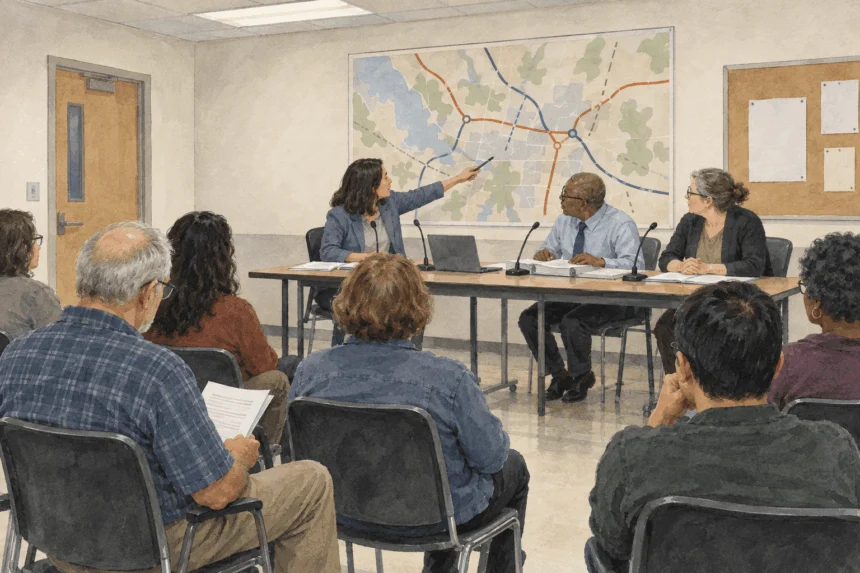
- Public Meetings: MPOs hold regular policy board meetings and special meetings on major planning documents. Most meetings include public comment periods.
- Advisory Committees: Many MPOs maintain citizen advisory committees, technical advisory committees, or special interest group committees (such as bicycle/pedestrian advisory committees).
- Formal Comment Periods: MPOs must provide public comment opportunities on major plans like the Metropolitan Transportation Plan and Transportation Improvement Program.
- Online Engagement: Many MPOs now use online surveys, social media, and virtual meetings to expand participation opportunities.
Regional Authority Input: Public participation varies by entity type and state law:
- Transit Authorities often hold public hearings on fare changes, service modifications, and major capital projects.
- Water Authorities may seek public input on rate changes, infrastructure projects, or regulatory policies.
- Port Authorities typically hold public meetings on major facility expansions or policy changes.
- Economic Development Agencies sometimes involve communities in strategic planning processes or specific development projects.
Making Your Voice Heard
Effective engagement requires understanding each entity’s specific role and decision-making process:
Match Issues to Entities: Direct transportation planning concerns to your MPO. Address transit service issues to the regional transit authority. Raise water quality concerns with the appropriate water management authority.
Timing Matters: Public input is most effective during formal planning processes. MPOs update their long-range plans every four years and their improvement programs every two years. Regional Authorities often have specific timelines for budget adoption, service planning, or major project decisions.
Build Relationships: Developing ongoing relationships with staff and board members increases your influence over time. Attend multiple meetings, volunteer for advisory committees, and maintain regular communication on issues you care about.
Coalition Building: Regional entities respond more to organized community input than individual comments. Work with neighborhood groups, advocacy organizations, or business associations to amplify your voice.
Use Multiple Channels: Combine meeting attendance with written comments, social media engagement, and meetings with individual board members or staff.
Staying Informed
Regular Information Sources:
- Subscribe to newsletters and email updates from relevant regional entities
- Follow social media accounts for meeting announcements and project updates
- Check websites regularly for new plans, studies, and public comment opportunities
- Attend regional forums or conferences where multiple entities present information
Media Coverage: Regional transportation and development issues often receive local news coverage. Following regional newspapers and news websites helps track important decisions and controversies.
Civic Organizations: Many regions have civic organizations focused on transportation, environment, or government accountability that monitor regional entities and provide analysis of their decisions.
The Evolving Landscape of Regional Governance
Current Trends and Challenges
Regional governance continues evolving in response to changing demographics, technology, environmental challenges, and federal policy priorities:
Equity and Environmental Justice: There’s growing recognition that past transportation and infrastructure investments may have exacerbated racial and economic inequalities. Many MPOs and Regional Authorities are now explicitly considering equity in their planning and investment decisions.
Climate Change Adaptation: Regional entities increasingly must consider climate change impacts in their long-term planning. This includes preparing infrastructure for extreme weather events and reducing greenhouse gas emissions from regional transportation systems.
Technology Integration: New technologies like electric vehicles, autonomous vehicles, and shared mobility services are changing transportation patterns and requiring updated planning approaches.
Housing-Transportation Coordination: Federal policy increasingly recognizes the connections between housing and transportation costs. Regional entities must coordinate more closely on development patterns that affect both housing affordability and transportation efficiency.
Federal Policy Influence
Recent federal legislation continues shaping regional governance:
Infrastructure Investment and Jobs Act: This 2021 law significantly increased funding for regional transportation planning and infrastructure while adding new requirements for coordination with housing planning and emphasis on equity considerations.
Performance-Based Planning: Federal requirements for performance measurement and target-setting are pushing MPOs and transit authorities toward more data-driven decision-making and accountability for results.
Resilience Focus: Federal grant programs increasingly prioritize projects that enhance regional resilience to climate change, economic disruptions, and other challenges.
Future Directions
Several trends are likely to shape the future of regional governance:
Regional Consolidation: Some regions may move toward more consolidated regional authorities to improve coordination and reduce fragmentation. This could involve expanding the roles of existing entities or creating new multi-functional regional governments.
Cross-Regional Coordination: As issues like climate change and economic competitiveness operate at larger scales, coordination among multiple regional entities may become more important. Megaregional approaches covering multiple metropolitan areas are emerging in some parts of the country.
Enhanced Public Engagement: Technology and changing expectations for government transparency may lead to more extensive and sophisticated public engagement processes for regional planning.
Equity-Centered Planning: Growing awareness of historical inequities in regional planning may lead to fundamental changes in how regional entities make decisions and set priorities.
Understanding MPOs and Regional Authorities is crucial for effective civic engagement in an era when many of the most important decisions affecting communities are made at the regional level. These entities control billions in public spending and make decisions with decades-long consequences for regional development, environmental quality, economic opportunity, and quality of life.
While regional governance can seem complex and distant, these entities ultimately exist to serve public purposes and are accountable to the communities they serve. Informed and engaged citizens can play vital roles in ensuring that regional entities are responsive, effective, and equitable in pursuing their missions.
The next time you sit in traffic, ride public transit, worry about water quality, or consider your region’s economic future, remember that MPOs and Regional Authorities are making decisions that directly affect these concerns. They may operate with less public attention than city councils or county commissions, but their influence on your daily life is substantial and growing. Regional Authorities are making decisions that directly affect these concerns. They may operate in the shadows, but their influence on your daily life is anything but hidden.