Last updated 2 weeks ago. Our resources are updated regularly but please keep in mind that links, programs, policies, and contact information do change.
Across the United States, city streets are undergoing a transformation.
One of the most visible and debated elements of this change is the protected bike lane. It represents a modern approach to transportation planning, viewing the public right-of-way as a shared space for people – whether they are driving, walking, or cycling.
- What Makes a Bike Lane “Protected”
- Safety Benefits: Protecting Everyone on the Street
- Boosting Bicycle Ridership and Equity
- Economic Impact: Business and Real Estate Effects
- Environmental and Health Benefits
- Challenges and Criticisms
- Design Guidelines: Engineering for Success
- Real-World Case Studies
- Implementation Challenges and Solutions
The key feature of these lanes is physical separation from motor vehicle traffic, a distinction that makes them more inviting and accessible to a wider range of people than a traditional bike lane.
What Makes a Bike Lane “Protected”
To understand the role and impact of protected bike lanes, it’s essential to first define what they are and what they are not. The evolution from a simple painted line to a physically separated facility reflects a significant shift in transportation philosophy – from merely acknowledging a cyclist’s right to the road to proactively ensuring their safety.
Physical Separation: The Core Concept
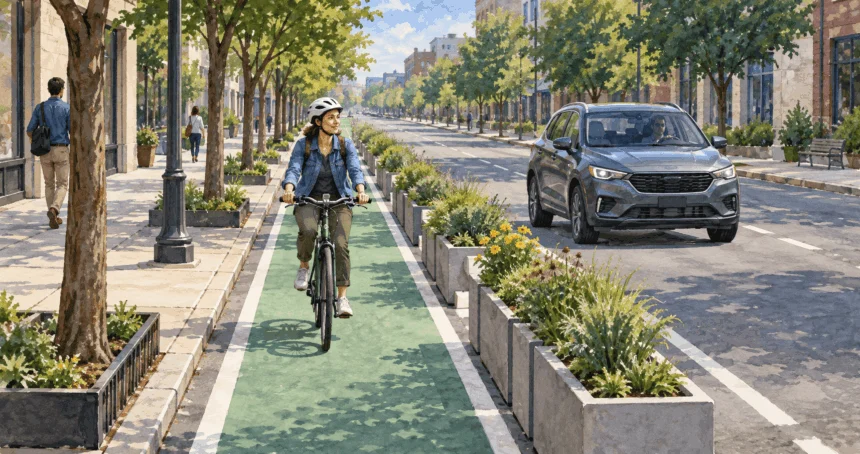
A protected bike lane, also known as a separated bike lane or cycle track, is an exclusive space for bicyclists that is physically separated from both motor vehicle traffic and the sidewalk.
This physical separation is the core concept that distinguishes them from other types of bikeways. According to guidance from the Seattle Department of Transportation and the National Association of City Transportation Officials, protected bike lanes differ from standard bike lanes in two fundamental ways:
Lateral Separation: There is a horizontal buffer zone, often marked with paint, between the bike lane and the adjacent vehicle travel or parking lane.
Vertical Separation: There is a physical, vertical feature within that buffer zone intended to prevent cars from encroaching into the cycling space.
This design philosophy aligns with the “Safe System Approach” promoted by the Federal Highway Administration, which recognizes human vulnerability and seeks to create a transportation system where crashes do not result in death or serious injury.
By separating users of different sizes and speeds – like a 2-ton SUV and a 20-pound bicycle – the design itself mitigates the potential for the most severe types of collisions.
Types of Physical Barriers
The vertical separation that defines a protected bike lane can be created using a variety of materials and configurations, each with different levels of cost, permanence, and perceived safety.
Object-Separated Lanes: These lanes are built at the same level as the street and use a combination of a painted buffer and physical objects to create the barrier. Common objects include:
Flexible delineator posts: White or brightly colored plastic posts, sometimes called bollards, that are bolted to the pavement. They provide a strong visual cue to drivers and can withstand minor impacts, but do not offer robust protection from an errant vehicle.
Concrete barriers or curbs: More permanent and solid options, such as pre-cast concrete curbs or poured-in-place medians, offer a higher level of protection and clearly define the edge of the vehicle travel lane.
Planters: Landscaped planters can serve as an aesthetic and effective barrier, adding greenery to the streetscape while protecting cyclists.
Parking-Protected Lanes: This is one of the most common and cost-effective designs. A lane of on-street parking is shifted away from the curb, and the bike lane is placed between the sidewalk and the parked cars.
The row of parked vehicles itself becomes the primary physical barrier protecting cyclists from moving traffic. A critical component of this design is a painted buffer zone between the parking spaces and the bike lane to provide space for car doors to open without obstructing the bike lane – dangerous event known as “dooring.”
Curb-Separated / Raised Lanes: In this high-quality configuration, the bike lane is vertically raised from the street level. It can be at an intermediate height between the roadway and the sidewalk, or at the same level as the sidewalk itself.
This design provides a very high degree of safety and comfort, as it makes encroachment by vehicles nearly impossible and clearly delineates the spaces for pedestrians, cyclists, and drivers.
Lane Configurations and Flow
Protected bike lanes can be designed to accommodate traffic in one or both directions, depending on the street context and network goals.
One-Way Protected Lanes: These lanes carry bicycle traffic in the same direction as the adjacent motor vehicle lane. On a typical two-way street, this would mean a one-way protected lane on each side of the street.
Two-Way Protected Lanes (Cycle Tracks): This design consolidates bicycle traffic onto one side of the street, with one lane for each direction of travel. This is often used on one-way streets to allow cyclists to travel in the opposite direction of cars (contra-flow) or on very wide two-way streets to consolidate infrastructure and minimize conflicts on one side.
Contra-Flow Lanes: A specific type of lane on a one-way street that allows cyclists to travel against the flow of motor vehicle traffic. This is a critical tool for creating a connected and logical bike network, as it prevents cyclists from having to take long detours around one-way street grids.
How Protected Lanes Differ from Other Bike Infrastructure
The physical barrier is the key feature that separates protected bike lanes from other, more common types of bike infrastructure.
Conventional Bike Lanes: These are simply a portion of the roadway designated for cyclists with painted lines and bicycle symbols. They offer no physical protection from traffic.
Buffered Bike Lanes: An enhancement of a conventional lane, a buffered lane includes an extra striped area of paint to create more space between the bike lane and either moving traffic or the “door zone” of parked cars. It still lacks a vertical, physical barrier.
Marked Shared Lanes (“Sharrows”): These are not bike lanes at all. They are pavement markings –typically a bicycle symbol with two chevrons above it – placed in a regular vehicle travel lane. They serve only as a reminder to drivers that cyclists are legally entitled to use the full lane; they do not provide a dedicated or protected space.
Safety Benefits: Protecting Everyone on the Street
Cities across the country are investing in protected bike lanes as part of broader strategies to achieve public policy goals related to safety, transportation equity, economic development, and public health.
An extensive body of research has documented the wide-ranging positive impacts of this infrastructure.
Dramatic Crash Reduction for Cyclists
Research has consistently documented improved safety outcomes on streets with protected bike lanes. By creating a more organized and predictable roadway where all users have their own dedicated space, these designs can reduce the conflicts that lead to crashes.
The physical separation addresses common types of car-bike collisions. A Federal Highway Administration analysis found that converting a conventional bike lane to a protected one can be expected to reduce motor vehicle-bike crashes by over 50%.
Multiple academic studies have found that streets with protected bike lanes see reductions in injuries per mile compared to similar streets with no bike infrastructure, with findings ranging from 28% to 90% fewer injuries depending on the study and context.
Pedestrian Safety Improvements
The benefits can extend to those on foot. Protected bike lanes, especially those that are parking-protected or raised, effectively widen the sidewalk buffer, placing moving traffic further away from pedestrians.
They also often shorten the crossing distance at intersections and create pedestrian refuge islands, which can make it safer to cross the street.
Data from New York City shows that these designs reduced injury rates for people walking by 12% to 52% on treated corridors. The protected bike lane on 9th Avenue, for example, led to a 29% reduction in injuries to pedestrians.
Benefits for Drivers
Streets with more organized traffic patterns can be safer for drivers as well. With cyclists in their own protected space, drivers do not need to navigate around them, which can reduce complexity and uncertainty.
Data from New York City shows that when protected bike lanes are installed, injury crashes for all road users – drivers included – typically drop by 40% to 50%.
A multi-year study that looked at 12 cities concluded that protected bike lanes reduced traffic deaths and serious injuries by nearly half for everyone on the road.
Boosting Bicycle Ridership and Equity
A simple painted bike lane on a busy street may not make most people feel safe enough to cycle. Protected bike lanes can address a major barrier to wider cycling adoption: concern about being hit by a car.
Unlocking ‘Interested but Concerned’ Riders
Research consistently shows that a large majority of the American public – around 60% – falls into a category of being “interested but concerned” about bicycling.
These are people who would like to ride more often for transportation or recreation but report being deterred by safety concerns. Protected bike lanes can help address these concerns.
Studies show that as many as 81% of this “interested but concerned” group would be willing to ride if they had access to facilities with physical separation from traffic.
Quantifying the Increase
When cities build high-quality protected infrastructure, ridership often increases. Studies from across North America show that adding protected bike lanes to a street significantly increases bike ridership, with documented increases ranging from 21% to as high as 171%.
After New York City installed a protected lane on Columbus Avenue, weekday bicycling increased by 56%. In Philadelphia, the city saw a 96% increase in the number of bikes counted where parking-protected bike lanes had been installed.
This phenomenon suggests that building safe infrastructure can encourage more cycling, rather than waiting for more cyclists to appear on existing streets before building infrastructure. Increased ridership can enhance the “safety in numbers” effect, where more riders may lead to safer streets for everyone as drivers become more accustomed to their presence.
Transportation Equity
Safe cycling infrastructure relates to transportation equity concerns. Bicycling is an affordable mode of transportation for many households across income levels.
Data shows that 49% of people who bike to work in the U.S. earn less than $25,000 per year. Yet, these same communities often suffer from a historic lack of investment in safe street infrastructure.
Consequently, Black and Hispanic bicyclists face fatality rates that are 30% and 23% higher, respectively, than those of white bicyclists.
Building extensive networks of protected bike lanes is therefore one strategy for improving safety for the most at-risk and transportation-vulnerable road users.
Economic Impact: Business and Real Estate Effects
The debate over protected bike lanes often centers on their economic impact, particularly the concern that removing on-street parking will harm local businesses. Research on this question has produced varied results across different contexts.
Local Business Impact
The data reveals a complex picture. Studies from cities across North America have produced varied findings on the economic impact of bike lanes on local retail.
In New York City, after a protected bike lane was installed on 9th Avenue, local businesses saw retail sales increase by up to 49%, compared to just a 3% increase across the rest of Manhattan during the same period.
A pilot project on Toronto’s Bloor Street removed 136 on-street parking spaces for a new bike lane. A rigorous before-and-after study found that businesses in the pilot area performed as well as or better than those in a control area, with transaction values growing by 4.45%.
While people who arrive by bike may spend less on a single trip, they tend to visit more frequently and spend more money overall per month than customers who arrive by car, according to some studies.
It is worth noting that a few studies have found that bike lanes might have a negative impact on specifically auto-centric businesses, such as gas stations or car repair shops.
Property Values
The relationship between bike lanes and property values is complex, with mixed results depending on the type of facility and the urban context. The research shows that there are varied impacts across different settings.
Studies focused on off-street trails and greenways consistently show a positive impact, with proximity increasing home values by anywhere from 3% to 11%. One study in Minneapolis-St. Paul found that for every quarter-mile a home was nearer to an off-street bicycle trail, its value increased by $510.
Research on on-street lanes is less consistent. Some studies have found a negative correlation, particularly in suburban areas, which may be attributable to factors like loss of privacy or proximity to a busy road that now also has a bike lane.
For instance, one analysis of New York City census tracts found that the addition of bike lane meters was correlated with a decrease in median rent values by about $30.
Real estate developers have increasingly marketed proximity to bike networks as a selling point in some urban markets, suggesting that access to active transportation infrastructure is viewed as a desirable feature by some homebuyers.
Environmental and Health Benefits
Beyond safety and economics, protected bike lanes represent an investment in community well-being, with potential environmental sustainability and public health benefits.
Climate and Air Quality
Bicycling is a zero-emissions mode of transportation. Encouraging more people to shift short trips from cars to bikes can reduce greenhouse gas emissions, help address climate change, and improve local air quality by cutting down on pollutants like particulate matter and nitrogen oxides.
A study by the Institute for Transportation and Development Policy of bike networks in Bogotá, Colombia, and Guangzhou, China, found that they prevent the emission of approximately 22,000 and 16,000 tonnes of CO2-equivalent per year, respectively.
The same report concluded that, on a dollar-for-dollar basis, investing in protected bike lanes is about ten times more effective at reducing greenhouse gas emissions than investing in new metro rail systems.
Public Health Tool
The health benefits of regular physical activity are well-documented, and protected bike lanes can make it easier and safer for people to incorporate exercise into their daily routines. Cycling is linked to a lower risk of heart disease, cancer, obesity, and diabetes.
A 2016 study in New York City calculated the public health value of its bike lane investments. It concluded that the 45.5 miles of bike lanes the city built in 2015 would yield benefits equivalent to an extra year of life at full health over the lifetime of all city residents, calling it an “exceptionally good value” compared to most other preventive health measures.
When accounting for the combined economic benefits of transportation cost savings and improved public health outcomes, some protected bike lane networks can pay for their initial construction costs in less than a year, according to some analyses.
Challenges and Criticisms
The implementation of protected bike lanes is often controversial and presents real-world challenges. Understanding different perspectives requires acknowledging the concerns of opponents, the practical drawbacks of some designs, and the importance of high-quality engineering.
The Battle for Street Space
Most opposition to protected bike lanes stems from the reallocation of finite street space, which often means removing something that drivers and businesses have come to rely on.
Parking Removal: The loss of on-street parking is a common source of opposition from local business owners and residents, who express concern that it will reduce customer access and make their neighborhoods less convenient.
While some economic studies have found neutral or positive business impacts, others have found negative impacts in specific contexts. The perception of potential harm remains a significant factor in public debates. This is sometimes compounded by business owners overestimating the percentage of their customers who arrive by car, as documented in several studies.
Traffic Congestion: An argument from opponents is that removing a vehicle travel lane to create a bike lane – a process often called a “road diet” – will lead to increased traffic congestion and longer commute times for drivers.
Some projects have resulted in measured increases in motor vehicle travel times, while other studies show that traffic flow remains stable or even improves. Traffic flow can be influenced by better organization of the remaining lanes (e.g., adding a dedicated left-turn lane) or because some people switch from driving to biking, reducing the number of cars on the road.
For example, the Prospect Park West project in New York City saw no increase in vehicle travel times after a travel lane was removed.
Construction Costs: Building protected infrastructure requires financial investment. While less expensive than major highway projects, protected bike lanes represent a expenditure for cities. Construction costs can range from around $133,000 per mile to more than $536,000 per mile, depending on the complexity of the design and the materials used.
Design Failures and Safety Concerns
The term “protected” can create expectations if the lane is poorly designed. While physical separation can be effective along straight, mid-block sections, the safety performance of a protected bike lane is determined by how it handles conflict points like intersections, driveways, and alleys.
Poor design of these areas can lead to problematic outcomes.
Intersection and Driveway Conflicts: This is a significant safety challenge for protected bike lanes. The protection offered by a physical barrier often ends at intersections where cars are turning.
These conflict zones are where a majority of crashes in protected bike lane corridors occur.
The Danger of Two-Way Street-Level Lanes: A study by the Insurance Institute for Highway Safety found that two-way protected bike lanes located at street level had a significantly higher risk of crashes and falls than a major road with no bike infrastructure at all.
The study suggested that drivers turning across the bike lane are often looking only for one-way car traffic and are not conditioned to look both ways for oncoming bicycle traffic. This creates a highly dangerous and unexpected conflict.
In contrast, the same study found that protected lanes that were physically raised or located on bridges and in greenways – away from frequent intersections – were the safest of all facility types.
Cambridge Case Study: The complexity of evaluating safety outcomes is illustrated by an analysis of police accident data from Cambridge, Massachusetts.
The analysis, cited by opponents of the city’s bike lane network, reported that after separated bike lanes were installed, cyclist injuries on those street segments were 2.5 times higher and motorist injuries were 3.5 times higher.
These findings have been disputed and stand in contrast to research from other cities. This underscores that the safety benefits of protected bike lanes depend on design quality and context.
Conflicts with Pedestrians: Protected bike lanes can create conflict points with pedestrians if not designed thoughtfully. This can occur near bus stops, where people waiting for the bus may stand in the bike lane, or at crosswalks where pedestrians looking only for cars may step into the path of a cyclist.
User Experience Issues
The political and social challenges of implementing protected bike lanes are often as significant as the technical ones.
Drawbacks for Experienced Cyclists: While protected lanes are designed to appeal to less-confident riders, they can sometimes be frustrating for faster, more experienced cyclists.
Common complaints include that the lanes are too narrow to pass slower riders, that it’s difficult to maneuver around obstacles like debris or double-parked delivery trucks, and that making a left turn can become a cumbersome, two-step process (requiring crossing one street, stopping, and then waiting for the next signal) instead of merging into a vehicle turn lane.
Status Quo Bias: Opposition that greets new bike lane proposals can be partly explained by “status quo bias” – a documented psychological phenomenon describing a human preference for keeping things as they are.
The immediate, tangible “costs” of a project, such as the loss of a familiar parking space, are felt directly and personally. The benefits, such as a statistical reduction in crashes or a slight improvement in regional air quality, are more diffuse, long-term, and harder for an individual to perceive.
This asymmetry may help explain opposition to some projects. Studies also show that public opinion can shift in favor of a project after it has been built and people have had a chance to experience the outcomes firsthand.
This highlights the value of pilot projects and clear communication. A lack of meaningful public consultation can increase opposition and make it more difficult to build consensus.
Design Guidelines: Engineering for Success
The difference between a safe, successful protected bike lane and a problematic one lies in the details of its design. In the United States, the standards for bikeway design are primarily set by the National Association of City Transportation Officials and the Federal Highway Administration.
These guidelines provide a blueprint for creating facilities that are safe for users of all ages and abilities.
National Standards
NACTO Urban Bikeway Design Guide: Developed by and for city transportation departments, the NACTO guide is the leading resource for street design in North America.
NACTO’s guidance provides a threshold for when protected bike lanes should be considered. They are the recommended facility type for streets with high motor vehicle volumes (more than 6,000 vehicles per day), speeds greater than 25 mph, or a multi-lane configuration (more than one travel lane in each direction).
FHWA Guidance: The Federal Highway Administration provides national-level guidance through documents like its Separated Bike Lane Planning and Design Guide.
The FHWA outlines a four-step design process for planners:
- Establish directional and width criteria
- Select forms of separation
- Identify midblock design challenges
- Develop intersection design
All signs, signals, and pavement markings used in a project must comply with the federal Manual on Uniform Traffic Control Devices, which ensures consistency and predictability for all road users nationwide.
Key Design Dimensions
NACTO provides specific dimensional guidance to ensure that protected bike lanes are functional. Narrow design can discourage use and make it difficult for cyclists to pass one another or ride side-by-side.
Lane and Buffer Widths: The total “rideable width” of a bike lane includes both the marked lane and any adjacent, at-grade buffer space.
| Design Element | Minimum Width | Preferred Width |
|---|---|---|
| Total Rideable Width | 6.5 – 7 ft | 8 – 12.5 ft |
| Bike Lane | 5 ft | 6 – 9 ft |
| Buffer (General) | 2 ft | 2 – 5+ ft |
| Buffer (Adjacent to Parking) | 3 ft | 3 – 5 ft |
One-Way Lanes: The preferred rideable width is 8 to 12.5 feet, with a minimum of 6.5 to 7 feet. This space is typically composed of a bike lane (preferred 6-9 feet, minimum 5 feet) and a buffer (preferred 2-5+ feet, minimum 2 feet).
Parking-Protected Buffer: The buffer zone next to a parking lane is a special case. To prevent “dooring,” this buffer must be at least 3 feet wide, with a preferred width of 3 to 5 feet.
Two-Way Lanes: A two-way protected bike lane should be at least 13 feet wide to comfortably accommodate riders traveling in both directions, including passing and side-by-side riding.
Separation Elements: The design of the physical barrier itself requires careful consideration. For example, flexible delineator posts should be spaced closely enough to deter vehicle entry (typically 10-40 feet apart), and concrete curbs must be designed with gaps to allow for proper street drainage.
Designing Safer Intersections
The intersection is a critical area for design. NACTO’s guidance emphasizes several key strategies to reduce conflicts and improve safety where bikes and cars cross paths.
Protected Intersections: This is a design, common in the Netherlands, that uses concrete corner refuge islands to slow turning vehicles and align them at a 90-degree angle to the bike lane, improving visibility.
It also uses a forward stop bar for cyclists and dedicated signal timing to keep bikes physically separated from turning cars throughout the entire intersection.
Bike-Specific Signals: The use of dedicated traffic signals for cyclists, often smaller and featuring a bicycle symbol, is a tool. These signals can provide cyclists with a “leading pedestrian interval” (a few seconds head start before cars get a green light) or a fully protected phase where all conflicting car traffic has a red light.
Markings and Color: The Manual on Uniform Traffic Control Devices allows for the use of green-colored pavement to enhance the visibility of bike lanes, particularly in areas of potential conflict like intersections, driveways, and bus stops.
Real-World Case Studies
The principles, benefits, and challenges of protected bike lanes can be understood through real-world examples. Case studies from cities across the U.S. demonstrate how this infrastructure is being implemented in different contexts and how evaluation has become a tool for assessing performance.
New York City: Prospect Park West
The bike lane project on Prospect Park West in Brooklyn has been extensively studied and debated, illustrating how data can inform public discussion.
Context: Prospect Park West is a wide, one-way street running alongside Brooklyn’s premier park. For years, its three broad travel lanes encouraged speeding, creating challenges for pedestrians and cyclists trying to access the park.
The Conflict: In 2010, in response to community requests, the NYC Department of Transportation removed one travel lane to install a two-way, parking-protected bike lane.
The project was met with opposition from a group of residents who filed a lawsuit to have it removed, turning the project into a notable example in debates over bike infrastructure.
Outcomes: The DOT conducted before-and-after studies of the project. The results showed:
Speeding dropped: The percentage of vehicles exceeding the speed limit dropped from 74% to 20%.
Crashes fell: Total crashes declined by 16%, and crashes causing injuries fell by a remarkable 63%.
Ridership soared: Weekday cycling tripled and weekend cycling more than doubled.
Sidewalk riding dropped: The number of cyclists illegally riding on the sidewalk dropped from 46% to just 3%.
Traffic flow was maintained: Despite removing a travel lane, vehicle travel times remained stable.
The lawsuit was eventually dropped. The project became a reference point for street redesign discussions in New York City and elsewhere.
Cambridge: Ordinance-Driven Approach
The city of Cambridge, Massachusetts, has taken an aggressive policy-driven approach to building a bike network.
Context: In 2019, the Cambridge City Council passed a Cycling Safety Ordinance. This law requires the city to build a network of approximately 25 miles of separated bike lanes by a set deadline, often using “quick-build” methods (flexible posts and paint) to accelerate implementation on streets not scheduled for full reconstruction.
Outcomes: Ridership increased substantially following installation. A study of a new separated bike lane on Garden Street, which replaced a conventional painted lane, found that within four months, the bike mode share on nearby residential streets increased by 300%, and total bike volumes on the corridor increased by more than 500%.
The Conflict: This rapid, mandate-driven rollout has been contentious. The city has faced lawsuits from resident groups concerned about the loss of parking and the perceived negative impacts on traffic and business.
The debate has been further fueled by conflicting data, with one analysis claiming that injuries for both cyclists and drivers have increased since the lanes were installed.
Cambridge serves as a complex case study, demonstrating how a political commitment can rapidly expand a network and boost ridership, while also highlighting the intense and ongoing conflicts that can arise over implementation and contested safety outcomes.
Seattle: Innovation in Complex Downtown
Seattle’s implementation of a protected bike lane on 2nd Avenue shows how engineering can address challenges in complex urban corridors.
Context: In 2014, Seattle installed a two-way protected bike lane on 2nd Avenue, a busy one-way street in the heart of downtown, as a demonstration project. A two-way lane on a one-way street presents significant design challenges, particularly at intersections.
Design Innovations: The project incorporated several design elements. To manage conflicts, the city installed dedicated bicycle traffic signals at seven intersections, giving cyclists a protected phase to move through separately from turning cars..
It also included protected left-turn pockets for vehicles, green pavement markings in conflict zones, and careful management of parking and loading zones.
Outcomes: The demonstration project showed positive results. Bicycle volume on the street increased by nearly 300% after the lane was installed.
The safety data showed improvement: the overall bicycle collision rate on the corridor decreased by 79%, and the rate of collisions resulting in a fatality or serious injury dropped by 75%.
The Seattle case study demonstrates that thoughtful design can help make complex street configurations safer for various users.
Safety Results Across Cities
Safety improvements have been documented across multiple American cities with protected bike lanes.
| City/Project | Metric | Outcome |
|---|---|---|
| New York City (Citywide) | All Injury Crashes | -40% to -50% |
| New York City (Prospect Park West) | All Crashes | -16% |
| New York City (Prospect Park West) | Injury Crashes | -63% |
| New York City (9th Avenue) | Injuries to All Street Users | -56% |
| Seattle (2nd Avenue) | Bicycle Collision Rate | -79% |
| Seattle (2nd Avenue) | Fatal/Serious Injury Collision Rate | -75% |
| Multiple Cities (12-City Study) | Traffic Deaths & Serious Injuries | ~ -50% |
Implementation Challenges and Solutions
Protected bike lanes represent more than a simple infrastructure upgrade. They require cities to rethink how street space is allocated and how different modes of transportation interact.
The success of these projects depends on engineering, public engagement, phased implementation strategies, and ongoing maintenance and evaluation.
Understanding both the benefits and challenges of protected bike lanes is important for cities considering this infrastructure investment. Research indicates support for their safety benefits, though successful implementation requires careful design, community engagement, and long-term commitment to maintenance and evaluation.
The implementation of protected bike lanes in American cities continues to evolve, with each project contributing to understanding of how to create safer and more diverse transportation systems.