Last updated 10 months ago. Our resources are updated regularly but please keep in mind that links, programs, policies, and contact information do change.
In secure conference rooms deep within the White House complex, the nation’s most senior officials gather to confront catastrophic scenarios.
The Secretary of State, Secretary of Defense, Director of National Intelligence, and Chairman of the Joint Chiefs face crises spiraling out of control: a deadly virus spreading from far away, a devastating cyberattack on the financial system, or nuclear-armed adversaries stumbling toward war.
These are meticulously designed rehearsals. This is the world of National Security Council “war games,” high-stakes simulations that prepare America’s leaders for the nation’s darkest hours.
Established under President Truman in 1947, the NSC serves as the President’s principal forum for national security and foreign policy decisions. While its daily work involves managing ongoing policy, its most critical function may be preparing for crises that haven’t happened yet.
Beyond Military Battles
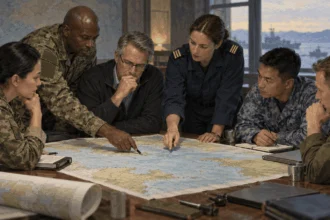
The term “war game” conjures images of generals moving miniature armies across maps, but modern NSC exercises focus more on policy and decision-making than battlefield tactics. These are typically “tabletop exercises”—structured, discussion-based simulations where senior leaders grapple with developing crises in conference room settings.
The goal isn’t to simulate physical combat but to pressure-test strategic thinking, interagency coordination, and legal authorities that would govern real-world responses.
Evolution of Threats
The practice of using games to simulate conflict dates back to the 1824 Prussian Kriegsspiel (“wargame”), which used detailed maps and complex rules to let officers practice tactical decisions. The U.S. Naval War College adopted similar methods in the 1920s and 1930s, conducting “chart maneuvers” to game out potential war with Japan.
Over time, this military tool has adapted to broader challenges. The evolution of topics addressed in these simulations mirrors the expanding definition of “national security” itself. Where Cold War exercises focused almost exclusively on military and nuclear confrontation, today’s NSC-level simulations are equally likely to involve global pandemics, climate-driven humanitarian crises, or sophisticated disinformation campaigns.
This shift reflects a fundamental change in how the U.S. government perceives threats. The Biden-Harris administration’s NSC explicitly states that today’s challenges demand coordination across “traditional national security, economic security, health security, and environmental security.”
The transition from gaming out fleet battles to simulating viral outbreaks illustrates how the concept of what can fundamentally harm the United States has broadened in the 21st century.
Types of Crisis Simulations
To understand how the government prepares for different emergencies, it’s essential to distinguish between various kinds of exercises.
| Exercise Type | Description | Primary Focus | Example |
|---|---|---|---|
| Tabletop Exercise (TTX) | Discussion-based session where key personnel deliberate simulated emergencies in an informal, classroom-like setting | Validating plans, policies, and interagency decision-making processes | An NSC meeting to debate policy options in response to a hypothetical pandemic |
| Functional Exercise | Hands-on simulation of a single function or capability in a realistic, time-pressured environment | Coordination, command and control, and specific operational procedures | A cyber mission force responding to a simulated network intrusion on a virtual range |
| Full-Scale Exercise | Multi-agency, “boots-on-the-ground” deployment of real personnel and equipment in response to a simulated event | Total response capability, logistics, and real-world operational execution | A city-wide disaster drill involving FEMA, local first responders, and the National Guard |
The tabletop exercise is the NSC’s preferred tool because its primary responsibility isn’t to execute responses but to advise the President and coordinate agencies that will. These sessions question fundamental assumptions underpinning national strategy and hammer out the complex, often conflicting responsibilities of different government departments under simulated pressure.
Anatomy of a High-Stakes Exercise
A successful high-level tabletop exercise isn’t improvised discussion—it’s a carefully choreographed event designed to elicit specific insights and test particular aspects of government response plans.
Step 1: Defining Objectives
Before any scenario is written, exercise designers must answer: What are we trying to learn? Objectives drive every other aspect of the simulation. Planners might aim to test legal authorities for responding to domestic bioterrorism, assess communication plans for major cyberattacks, or evaluate coordination between the Department of Health and Human Services and FEMA during a pandemic.
Step 2: Assembling the Players
For an NSC-level exercise to be effective, it must involve people who would actually make decisions in a real crisis. Participants aren’t actors—they’re the key decision-makers themselves. A typical exercise gathers members of the NSC Principals Committee (department heads) or Deputies Committee (their second-in-command).
Bringing actual officials into the room ensures the simulation reflects real-world dynamics, personalities, and institutional perspectives that would shape crisis responses.
Step 3: Crafting the Scenario
The scenario is the disaster narrative. It must be plausible enough to command serious attention from senior leaders but stressful enough to challenge their assumptions. Typical scenarios unfold over several “moves” or phases, with situations escalating over time.
The first move might present intelligence of a potential threat; the second might describe the initial attack or outbreak; the third might introduce cascading consequences like economic collapse or civil unrest.
To make simulations more dynamic, facilitators use “injects”—unexpected developments that complicate matters. An inject could be a disinformation news report, a key ally’s sudden refusal to cooperate, or critical infrastructure failure. These twists prevent participants from falling back on rote plans and force real-time adaptation.
Step 4: The “No-Fault Zone”
High-level exercises occur in a “no-fault zone”—a crucial ground rule establishing the exercise as a safe space to make mistakes, ask difficult questions, and challenge established procedures without professional penalty. This environment is essential for encouraging honest, often contentious debate needed to uncover hidden weaknesses.
A skilled facilitator guides the entire process. This individual, often an experienced former official or outside expert, introduces scenarios, presents injects, and asks probing questions to push participants beyond talking points. The facilitator keeps discussion focused on exercise objectives and ensures the most difficult, uncomfortable issues are confronted directly.
Step 5: The After-Action Report
The tangible output is the After-Action Report (AAR). This document formally records the simulation, but its most important function is analytical. The AAR captures what happened, identifies key gaps or weaknesses in existing plans and capabilities, and provides actionable recommendations for improvement.
This report translates lessons from simulated crises into concrete changes in policy, procedure, and resource allocation.
Real-World Case Studies
The power and sometimes prescience of high-level wargaming are best understood through specific examples across different threat types.
Pandemic Prophecy: Crimson Contagion
In August 2019, several months before the world heard of COVID-19, U.S. government agencies concluded a massive pandemic simulation codenamed “Crimson Contagion.” The exercise, run by the Department of Health and Human Services, tested the nation’s ability to respond to a severe influenza pandemic.
The scenario was eerily specific: a novel respiratory virus originates in China and spreads internationally through tourists. The first U.S. case is a 52-year-old man returning to Chicago. The simulation projected catastrophic outcomes: 110 million infected Americans, 7.7 million hospitalizations, and 586,000 deaths.
The official After-Action Report, finalized in October 2019, outlined systemic failures across government:
Insufficient Funding: The federal government lacked dedicated funding sources to respond to severe pandemics, with the Public Health Emergency Fund being woefully inadequate.
Conflicting Authorities: Existing laws and policies were “insufficient and often in conflict with one another,” creating confusion over which federal agency—HHS or DHS/FEMA—was truly in the lead.
No Manufacturing Capacity: The report stated bluntly that the United States “lacks sufficient domestic manufacturing capacity and/or raw materials for almost all pandemic influenza medical countermeasures,” including vaccines, personal protective equipment, and ventilators.
Interstate Confusion: States struggled to request resources from the federal government “due to a lack of standardized, well-understood, and properly executed resource request processes.”
When the COVID-19 pandemic began months later, the unheeded warnings of Crimson Contagion became reality. The shortages of masks and ventilators, confusion over federal leadership, funding battles, and chaotic supply distribution weren’t unforeseen problems—they were exact vulnerabilities the simulation had identified.
This highlights a crucial point about simulation value: they’re not valuable because they’re prophetic but because they provide accurate diagnoses of present-day weaknesses. The failure wasn’t in the simulation’s ability to identify risks but in political and bureaucratic inertia that prevented acting on findings before it was too late.
Nuclear Nightmares: Guardian Tiger Exercises
The “Guardian Tiger I and II” tabletop exercises, conducted by the Atlantic Council, forced senior U.S. officials and experts to confront the challenge of multi-front conflict in East Asia in 2030.
Guardian Tiger I began with a limited North Korean attack on South Korea, quickly escalating to chemical and then tactical nuclear weapons use, while China began limited military intervention in North Korea.
Guardian Tiger II simulated a Chinese invasion of Taiwan, expanding to include Chinese missile strikes on U.S. bases in Japan and a secondary crisis instigated by North Korea to exploit the situation.
These exercises forced U.S. players, organized into cells representing the NSC, Pentagon, and U.S. Indo-Pacific Command, to grapple with excruciating dilemmas:
The Two-Front War: The simulations revealed that if the U.S. engages in major conflict with either China or North Korea, it may not be able to deter the other from escalating or starting new conflicts. Resources, from munitions to high-level attention, would be stretched to breaking points.
Alliance Management: The games highlighted alliance cohesion fragility under extreme pressure. In the Taiwan scenario, South Korea refused to allow U.S. forces on its territory to be used in the conflict, prioritizing North Korea deterrence.
The Nuclear Response Problem: When North Korea used a low-yield nuclear weapon in Guardian Tiger I, the U.S. team was paralyzed. The official U.S. policy of threatening the “end of that regime” for any nuclear use was seen as potentially lacking credibility by 2030, as it could lead to uncontrollable escalation.
The key takeaway was that the U.S. is underprepared for limited nuclear conflict and for managing simultaneous Indo-Pacific crises. The exercises recommended urgent updates to U.S. command-and-control structures and deeper, more realistic planning with allies before crises erupt.
New Frontiers of Conflict
As conflict nature evolves, so do wargamed scenarios. Today’s exercises increasingly focus on non-physical domains where engagement rules are still being written.
Cyber Warfare
Simulations like the Council on Foreign Relations’ “Cyber Clash with China” place participants in the NSC Situation Room after a devastating hack on the Nasdaq stock market, attributed to a Chinese state-sponsored group. Players debate costs and benefits of responding with cyber counterattacks, economic sanctions, or military posturing, exploring how to establish deterrence in a domain where attribution can be murky and escalation pathways dangerously unclear.
Information Warfare
A new and challenging field is “influence wargaming,” which attempts to simulate disinformation campaign effects. These exercises model how adversaries use social media and other channels to spread false narratives designed to sow social division, weaken alliances, and undermine trust in democratic institutions.
Simulating these “non-kinetic” attacks is incredibly complex, requiring modeling human psychology and societal resilience, not just weapons system performance. A 2022 Brussels exercise organized by the European Center of Excellence for Countering Hybrid Threats had a “Red Team” producing fake news and hate speech, while a “Blue Team” recognized and countered the campaign in a simulated social media environment.
Climate Security
Recognizing climate change’s profound security implications, the U.S. military and partners now wargame its effects. The 2022 exercise “Ho’okele Mua” (“Navigating the Future”) helped U.S. Indo-Pacific Command prepare for climate impacts in its region.
Scenarios set 5 to 15 years in the future challenged participants to plan for how rising sea levels, extreme weather, and resource scarcity could create instability, drive mass migration, damage critical military infrastructure, and create new openings for geopolitical rivals.
These games integrate climate considerations directly into strategic planning, treating environmental change not as a separate issue but as a core driver of future conflict.
Benefits and Dangers
Despite their proven value, wargames aren’t a panacea. They’re tools created and run by humans, subject to the same biases, assumptions, and institutional pressures as any other government process.
The Safe-to-Fail Environment
When executed properly, strategic wargaming benefits are immense. They provide structured, “safe-to-fail” environments where decision-makers can explore choice consequences without real-world costs in blood or treasure. These exercises identify gaps in plans, policies, and resources before crises expose them.
By bringing together leaders from different agencies who may not regularly interact, they build personal relationships and collaborative “muscle memory” essential for effective interagency coordination during high-stress events. Most importantly, they force senior officials to confront messy decision-making reality under uncertainty, challenging core assumptions and compelling difficult trade-offs absent from polished policy papers.
The Millennium Challenge Warning
The most famous and controversial wargame in recent history is Millennium Challenge 2002 (MC02), a massive $250 million exercise designed to test the Pentagon’s vision of high-tech, “network-centric” future warfare.
The exercise pitted a technologically superior U.S. “Blue Force” against an inferior “Red Force” representing a rogue Middle Eastern state, commanded by retired Marine Lieutenant General Paul Van Riper.
On the second day, Van Riper refused to play by the Blue Force’s high-tech rules, using brilliant, low-tech, asymmetric tactics. He used motorcycle couriers and light signals to transmit orders, rendering sophisticated signals intelligence useless. Facing a U.S. naval fleet in the Persian Gulf, he launched a preemptive, coordinated swarm attack using small boats and low-flying aircraft to fire massive cruise missile volleys, overwhelming advanced Aegis defense systems.
The result was simulated catastrophe: 19 U.S. ships, including an aircraft carrier, were sunk, and the Blue Force suffered an estimated 20,000 casualties.
Commanders then “refloated” the sunken fleet and reset the exercise. In the next phase, they imposed artificial constraints on Van Riper. He was ordered not to shoot down certain aircraft carrying Blue Force troops and to turn on anti-aircraft radars so they could be easily destroyed.
Outraged that the game was being “rigged,” Van Riper quit his role, and the exercise continued along a scripted path to U.S. victory.
The controversy sparked competing narratives that persist today. Van Riper and supporters argue MC02 was never a true experiment but an exercise scripted to validate the Pentagon’s expensive new warfighting concepts. In their account, when his adaptive enemy demonstrated that low-tech, clever adversaries could defeat this warfare vision, organizers cheated to ensure their preferred outcome.
The counter-argument from military observers is that Van Riper exploited unrealistic “loopholes”—his motorcycle couriers were credited with transmitting complex orders instantly, a physical impossibility—and the massive exercise had to continue to meet training objectives for 13,500 service members participating in live-fire drills.
Regardless of which side is more accurate, MC02’s ultimate lesson is cautionary. The exercise revealed, with stunning clarity, vulnerabilities to asymmetric, insurgent-style warfare that the U.S. would face with devastating consequences in Iraq and Afghanistan just years later. By prioritizing scripted victory over painful lessons of simulated defeat, the Pentagon may have squandered one of its most valuable learning opportunities.
The AI Revolution
Just as technology has transformed battlefields, it’s now beginning to transform wargames designed to simulate them. The rise of artificial intelligence, particularly generative AI and Large Language Models, promises to revolutionize strategic simulation, potentially overcoming persistent limitations.
AI as the Ultimate Red Team
One exciting application is creating more sophisticated and unpredictable adversaries. Instead of having human players role-play foreign leaders or terrorist groups, AI models can be trained on vast datasets—including a leader’s speeches, writings, and historical decisions—to emulate their strategic culture and decision-making with high degrees of nuance.
This allows creation of dynamic “AI Red Teams” that can react to events in unexpected but plausible ways, free from inherent biases and assumptions of human players.
Democratizing Wargaming
Traditionally, complex wargames like Millennium Challenge 2002 have been enormously expensive and time-consuming, making them rare events reserved for power’s highest echelons. AI has potential to “democratize” this practice. By automating scenario design, data analysis, and even role-playing different actors, AI can dramatically reduce costs and manpower required to run simulations.
This could allow more frequent, varied, and iterative wargaming at all government and military levels, turning it from special events into routine planning and training tools.
Overcoming Human Bias
AI can be a powerful tool for overcoming cognitive biases that often plague strategic planning. Human planners can fall victim to “confirmation bias,” designing scenarios that reinforce existing beliefs, or “failure of imagination,” overlooking low-probability, high-impact events.
AI can be tasked with generating hundreds or thousands of alternative scenarios and “roads to war,” forcing planners to consider much wider ranges of possibilities and stress-test strategies against more diverse futures.
This technological shift isn’t without challenges. The “black box” problem—where it’s difficult to understand reasoning behind AI decisions—is a significant concern, requiring robust human oversight. Furthermore, AI systems themselves, along with training data, must be secured against adversary manipulation.
Breaking the Bias Cycle
AI integration may offer solutions to institutional bias problems so starkly illustrated by Millennium Challenge 2002. A truly independent and unpredictable AI adversary cannot be easily scripted, constrained, or overruled by human facilitators who desire particular outcomes.
By providing genuinely objective and relentlessly adaptive opponents, AI could force organizations to confront uncomfortable truths in ways that human-controlled Red Teams—often subordinate to Blue Team leadership—sometimes cannot. This could fundamentally increase honesty, and therefore ultimate value, of practicing for the worst day imaginable.
The future of wargaming lies not in predicting specific crises but in building the institutional reflexes, decision-making processes, and coordination mechanisms that will be essential when the unthinkable becomes reality.