- whitehousehistory.org7 links
- whca.press5 links
- en.wikipedia.org2 links
- millercenter.org
Last updated 11 months ago. Our resources are updated regularly but please keep in mind that links, programs, policies, and contact information do change.
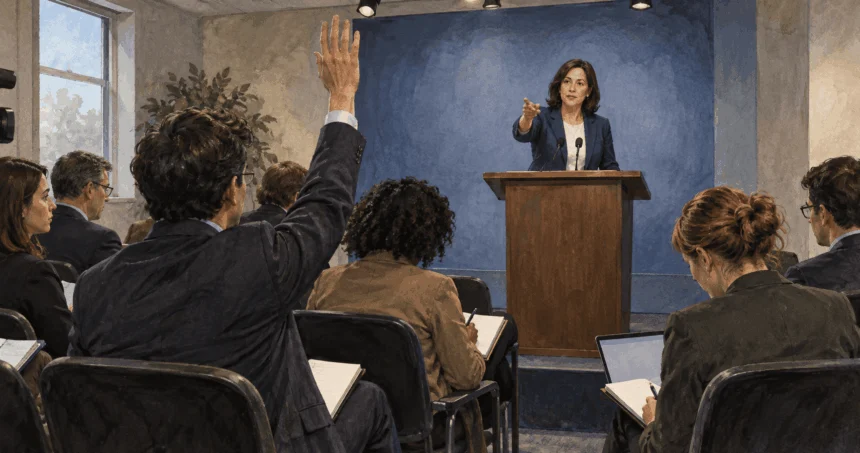
Cable news thrives on clips of “fiery confrontations” and “explosive exchanges” that make the daily briefing look like a verbal boxing match.
But is the White House press briefing truly as combative as it appears on television? The answer reveals how a century-old government function became compelling TV drama through cameras, editing, and the relentless demands of the 24-hour news cycle.
- Why Press Briefings Exist
- Television Changes Everything: From Information to Performance
- The 24-Hour Monster: Feeding the News Beast
- Behind the Drama: What Reporters Actually Do
- The Editor’s Hand: How Production Creates Drama
- The Reporter Reality: Professional Demands Behind the Questions
- The New Media Landscape: Partisanship and Digital Disruption
- Case Studies in Confrontation: When Drama Becomes News
- Direct Communication: Bypassing the Press
- The Reality Check: Performance vs. Substance
Why Press Briefings Exist
The confrontational nature of modern briefings didn’t emerge from political polarization or social media. It stems from a fundamental tension between the executive branch’s desire for message control and the press’s democratic mandate for accountability – a conflict built into the institution from the beginning.
From Backdoor Gossip to Public Forum
Before formal briefings existed, White House press coverage was haphazard. In the 1800s, reporters waited outside Abraham Lincoln’s second-floor offices, hoping to catch news snippets from visitors or staff. The relationship was informal and largely unstructured.
The pivotal moment came on March 15, 1913, when Woodrow Wilson held the first formal presidential press conference. This transformed the dynamic, creating a structured forum where press could systematically question the chief executive.
The purpose was clear: in a representative government, citizens expect to see leaders respond to questions, with reporters acting as “surrogates for the public.” President Calvin Coolidge explained in 1926 that these sessions were essential for the republic’s functioning: “I regard it as rather necessary to the carrying on of our republican institution that the people should have a fairly accurate report of what the president is trying to do.”
The Power Struggle Begins
Creating formal press conferences immediately triggered a foundational power struggle over access and control. This tension led to institutionalization on both sides.
The White House Correspondents’ Association was founded in 1914 as a defensive measure. Reporters covering the White House grew alarmed by rumors that Wilson might allow a congressional committee to select which journalists could attend conferences. Eleven reporters banded together to form the WHCA to protect “the interests of those reporters and correspondents assigned to cover the White House.”
The inherent conflict was clear from the start. Wilson, who pioneered press conferences, quickly soured on them. He complained about reporters quoting remarks he considered off-the-record and found questions “tiresome,” with one early 1914 question being about his thoughts on Groundhog Day. By June 1915, he had effectively ended regularly scheduled press conferences.
The WHCA’s existence demonstrates the relationship was never purely cooperative – it was a power negotiation. The president held access power, and the press organized to collectively demand it.
This dynamic was formalized in 1929 when Herbert Hoover established the Press Secretary position, hiring George Akerson. This created a single, official point of contact for administration messaging, centralizing communication strategy.
With these two institutions – the WHCA and Press Secretary – the modern framework was established. The core tension between a press corps seeking information and an administration managing its message was now built into their daily interactions’ structure.
Television Changes Everything: From Information to Performance
While the foundational tension is over a century old, its transformation into public spectacle resulted directly from television. Cameras fundamentally altered the event’s audience, purpose, and performance, turning behind-the-scenes exchanges into high-stakes public drama.
Eisenhower’s “Experiment”
The first step toward televised presidencies came with Harry Truman’s live televised speech on October 5, 1947, urging food conservation for Europe. While a media milestone, its impact was limited – most Americans didn’t own televisions.
The truly pivotal moment came in January 1955, when Dwight Eisenhower held the first televised presidential press conference in the Indian Treaty Room. Eisenhower acknowledged the novelty, opening by saying, “Well, I see we’re trying a new experiment this morning.”
This experiment came with crucial caveats: the White House maintained complete narrative control. Conferences were filmed, but Press Secretary James Hagerty edited footage, selecting the most newsworthy portions for public release. This allowed the administration to present polished, curated versions of presidential performance, mitigating unscripted moment risks.
Kennedy’s Live Revolution
The briefing was permanently transformed into live performance on January 25, 1961, when John F. Kennedy held the first live, uncut televised news conference. By 1960, 87% of American households owned televisions, and Kennedy’s decision to go live brought the presidency directly into living rooms in unprecedented ways.
Unlike Eisenhower’s edited broadcasts, these sessions were raw and unscripted. The public could now see presidents think on their feet, showcasing command of facts, sense of humor, and leadership style in real time.
This shift had profound consequences. Press conferences were no longer just news-gathering events for reporters – they became high-stakes national performances for presidents. This new reality necessitated massive preparation increases, with staff compiling extensive briefing books and conducting practice sessions to prepare for any possible question.
The introduction of live television fundamentally redefined the briefing’s primary audience. Before cameras, the audience was reporters in the room who would interpret and convey administration messages through articles. With live television, the primary audience became the American public watching from home.
The Performance Dynamic
This transformation created situations where both reporters and press secretaries perform for multiple audiences simultaneously. A journalist’s sharp, probing question isn’t just for the official at the podium – it’s also performance for editors, network viewers, and their professional brand, signaling credibility as tough, independent watchdogs.
Likewise, press secretaries’ firm, sometimes combative pushback isn’t just responses to reporters – it’s direct messaging to administration political bases, signaling strength, loyalty, and control. In this environment, on-camera conflict itself often becomes the message.
The 24-Hour Monster: Feeding the News Beast
The televised briefing’s intensity was magnified exponentially with the 24-hour news cycle advent. CNN’s 1980 launch, followed by other cable networks, created what one Clinton aide described as “a giant monster that has to be continually fed.”
This insatiable content demand elevated daily press briefings from routine administrative functions to primary sources of political drama, soundbites, and punditry for endless news loops.
The final evolution step came in 1995 when Bill Clinton’s Press Secretary Mike McCurry allowed television cameras to broadcast daily briefings live. This cemented the briefing’s status as daytime political television staple.
McCurry later expressed regret over this decision, telling Politico that televised daily briefings “have become less than helpful” and “should not be” televised events. His concern reflected growing recognition that constant camera presence had irrevocably changed exchange nature, prioritizing performance and conflict over substantive dialogue.
Behind the Drama: What Reporters Actually Do
The 45-minute televised briefing represents only a fraction of White House press corps work. Understanding correspondents’ full scope reveals that on-camera aggression is often strategic adaptation to complex, demanding media environments driven largely by shifting presidential access patterns.
The Full Beat: More Than Soundbites
A typical White House correspondent day is a grueling marathon beginning long before cameras turn on. Days often start around 7 AM with reviews of White House “daily guidance” – public schedules for presidents and senior officials – to plan coverage.
Throughout days, constant information streams flow from press offices, including official statements, fact sheets, transcripts, and announcements. Reporters’ work involves much more than attending single televised briefings – it’s continuous information gathering through various channels.
The Press Pool System
One of the most critical yet least visible press corps functions is the “press pool.” Because key locations like the Oval Office, Cabinet Room, or Air Force One are too small for every journalist, small, rotating groups of reporters, photographers, and technicians cover presidents on behalf of entire press corps.
The print pooler on duty files detailed “pool reports” – factual, real-time accounts of presidential comments and activities – distributed by email to hundreds of other journalists. This system, in place for nearly a century, is essential for creating public presidential records.
Pool reporters were present during John F. Kennedy’s assassination, Ronald Reagan’s assassination attempt, and George W. Bush’s September 11 evacuation. In crisis moments, pool reporting provides solid, dependable information vital for national security and global stability, helping prevent conspiracy theory spread.
Off-Camera “Gaggles”
Another key interaction occurring away from main briefing room cameras is the “gaggle” – informal, often impromptu briefings with press secretaries or other officials. Historically, gaggles were off-the-record exchanges sharing scheduling information and getting background on developing stories.
Today, they’re typically on-the-record but disallow video recording. These sessions can occur in press secretaries’ offices, on Air Force One, or even in hallways. While they can provide more candid questioning forums, access to gaggles has at times been limited to selected outlets, with others left out.
The Shouted Question Strategy
The practice often appearing most aggressive to television viewers is the “shouted question.” At presidential event endings, as presidents leave rooms, question clamors erupt from press corps. This isn’t random noise – it’s a long-used journalistic tool born of necessity.
The tactic was famously perfected by ABC News correspondent Sam Donaldson during the Reagan administration. A 1980s New York Times piece observed these “chaotic exchanges have become the primary way that Mr. Reagan communicates with the press corps.”
The shouted question rise correlates directly with declining presidential willingness to engage in formal, solo press conferences. When presidents limit accessibility, reporters are forced to use any available opportunity seeking answers on the public’s behalf.
Presidential press conference data provides clear evidence for this trend:
| President | Years in Office | Total Solo Press Conferences | Average per Year |
|---|---|---|---|
| Franklin D. Roosevelt | 12.1 | 881 | 72.7 |
| Harry S. Truman | 7.7 | 334 | 43.4 |
| Dwight D. Eisenhower | 8.0 | 193 | 24.1 |
| John F. Kennedy | 2.8 | 64 | 22.9 |
| Ronald Reagan | 8.0 | 46 | 5.8 |
| George H.W. Bush | 4.0 | 143 | 35.8 |
| Bill Clinton | 8.0 | 194 | 24.3 |
| George W. Bush | 8.0 | 89 | 11.1 |
| Barack Obama | 8.0 | 164 | 20.5 |
| Donald J. Trump | 4.0 | 91 | 22.75 |
| Joseph R. Biden | 4.0 | 37 | 9.25 |
This decline in formal, extended question-and-answer sessions forces journalistic adaptation. The shouted question, while appearing unruly, is rational response to diminished access media environments.
The Editor’s Hand: How Production Creates Drama
The White House press briefing most Americans see isn’t the raw, unmediated event as it unfolds. It’s a highly constructed media product shaped by technical and editorial decisions – from camera angles to soundbites – designed to create compelling television narratives. This production process inherently selects for and amplifies conflict moments, creating aggression perceptions often more intense than full briefing reality.
Camera Angles and Power Dynamics
How briefings are filmed has profound, subconscious impacts on viewer participant perception. Academic visual communication studies have long established that camera techniques aren’t neutral – they carry rhetorical weight.
Vertical camera angles influence power perceptions. Low-angle shots looking up at speakers can make them appear more dominant, while high-angle shots looking down can diminish stature and make them seem vulnerable. Standard eye-level shots are considered most neutral, fostering speaker-viewer parity sense.
Shot selection and framing direct viewer attention and frame emotional context. During tense exchanges, directors might cut from medium press secretary shots to close-ups of reporters’ incredulous expressions, then back to press secretaries’ stern faces. This rapid reaction cutting heightens drama and conflict sense.
The Soundbite Economy
What happens after briefings, in editing suites, is equally important in constructing aggression narratives. A “soundbite” is a short, memorable speech clip extracted from longer statements. The average politician’s soundbite on network news has shrunk dramatically, from over 40 seconds in the 1960s to less than 10 seconds today.
This severe time constraint forces complex policy discussions into brief, often simplistic and confrontational exchanges. Nuanced, two-minute policy explanations are unlikely to make evening news, but sharp, 10-second retorts to pointed questions are perfect for news packages.
Even more prevalent are “image bites” – video segments where political figures are shown but not heard while journalists provide voice-over narration. Research shows image bites are now more common than soundbites in campaign coverage and can be more potent in shaping voter perceptions.
Image bites of press secretaries sighing, rolling eyes, or looking flustered, played under reporters’ critical narration, can powerfully convey incompetence or frustration narratives regardless of actual spoken answer content.
The Highlight Reel Effect
The public rarely sees entire press briefing processes. Full briefings can last over an hour, covering wide topic ranges, many receiving calm, detailed answers. Cable news segments on same briefings might only last three minutes.
To create compelling segments, producers inevitably select the most “newsworthy” moments. In modern media environments, “newsworthy” often means conflict, drama, and sensationalism. Single 30-second heated exchanges are far more likely to be excerpted, analyzed by pundits, and replayed throughout days than 20 minutes of civil, substantive policy discussion.
Public perception is therefore formed not by raw events but by “highlight reels” of most aggressive moments, leading to skewed understanding of typical briefing tone and function.
The Reporter Reality: Professional Demands Behind the Questions
Understanding why briefings appear aggressive requires examining the professional pressures facing White House correspondents. What looks like grandstanding or hostility often reflects rational responses to challenging media environment demands.
Access Scarcity Creates Urgency
The decline in formal presidential press conferences has forced reporters to maximize every available opportunity. When presidents rarely hold solo news conferences, the daily briefing becomes one of few regular chances to ask administration officials substantive questions on the record.
This access scarcity creates natural urgency. Reporters covering complex, fast-moving stories have limited time to get answers. If a press secretary deflects or provides non-responsive answers, follow-up questions become more pointed and persistent – behavior that can appear aggressive but is actually standard journalistic practice.
Multiple Audience Performance
White House correspondents face unique professional pressures. They’re simultaneously performing for their editors (who want exclusive stories), their audiences (who expect tough questioning), and their peers (who judge professional credibility).
A reporter who consistently asks softball questions risks being seen as co-opted by the administration. One who asks tough, persistent questions demonstrates independence and accountability focus. This professional incentive structure naturally pushes toward more confrontational questioning styles.
The Professional Reputation Stakes
For many correspondents, the White House beat represents a career pinnacle. Their performance in the briefing room is visible to the entire industry and can make or break professional reputations. This creates additional pressure to ask memorable, substantive questions that demonstrate journalistic skill.
The most successful White House correspondents – from Sam Donaldson to Jim Acosta to Peter Doocy – are often those who’ve developed reputations for persistent, sometimes confrontational questioning. This professional dynamic rewards assertiveness over deference.
The New Media Landscape: Partisanship and Digital Disruption
Historical tensions and technological transformations now collide with two powerful modern forces: deeply polarized media landscapes and social media rise. These developments are reshaping briefing room internal dynamics, press corps composition, and fundamental questions about the institution’s digital age relevance.
Ideological Echo Chambers with Assigned Seats
Partisan media outlet rise has fundamentally altered briefing room chemistry. Where press corps were once dominated by legacy organizations with shared, if sometimes debated, objectivity commitments, rooms now contain reporters from distinct, often conflicting ideological ecosystems.
This creates dynamics where questions can be designed not merely to elicit information but to signal allegiance to particular political viewpoints and satisfy specific, partisan home audiences. Reporters from conservative outlets might ask questions reinforcing narratives popular on the right, while mainstream or left-leaning outlet reporters might challenge those same narratives.
Press secretaries, in turn, may respond differently based on perceived outlet friendliness. This can lead to administration accusations of favoring outlets providing more positive coverage, undermining traditional adversarial relationships.
The Creator Economy Invasion
The most recent and perhaps most profound briefing room shift is formal inclusion of social media influencers, podcasters, and independent content creators. The Trump administration announced initiatives to welcome “new media voices” into briefing rooms and provide them credentials, arguing this adaptation was necessary for changing media landscapes where millions, especially young people, get news from non-traditional sources.
This development has met both support and significant criticism. Proponents argue it democratizes access and reflects modern news consumption habits. Critics warn it risks undermining journalism professions by blurring lines between independent reporting and partisan activism.
A related concern is that influencer content can reach administration supporters directly, without passing through the scrutiny professional journalists apply.
Case Studies in Confrontation: When Drama Becomes News
Televised aggression perceptions are fueled by specific, high-profile clashes between certain reporters and administrations. These individual episodes, while not representative of every interaction, are disproportionately highlighted by news outlets, reinforcing perpetually combative environment narratives.
The Acosta Affair
During the Trump administration, CNN’s Jim Acosta became known for persistent, often confrontational questioning, ultimately leading to temporary White House press pass revocation. The incident occurred after a heated exchange about immigration where Acosta refused to surrender the microphone to a White House intern attempting to take it.
The administration argued Acosta’s behavior was inappropriate and disruptive. CNN and press freedom advocates argued the revocation was retaliation for tough questioning and represented dangerous precedent for press access restriction.
The Doocy Dynamic
In the Biden administration, Fox News’ Peter Doocy has frequently engaged in pointed exchanges with both the president and press secretary. These interactions often go viral on social media, with clips showing tense back-and-forth exchanges over immigration, inflation, and other contentious topics.
Doocy’s persistent follow-ups on uncomfortable topics for the administration serve his professional role while creating television moments that reinforce conflict narratives.
Disruption and Order
More recently, disruptions by reporters like Simon Ateba of Today News Africa, who has repeatedly shouted out of turn to protest what he calls lack of access, have led to open rebukes from both press secretaries and fellow journalists. These incidents highlight ongoing tensions about access equity and briefing room decorum.
Direct Communication: Bypassing the Press
The final challenge to modern press briefings comes from presidents’ ever-increasing ability to communicate directly with the public. This isn’t a new ambition – Franklin Roosevelt used radio “fireside chats” to bypass newspaper filters of his day.
In the 21st century, social media platforms like Twitter and Facebook have given presidents unprecedented ability to shape news cycles and speak directly to millions of followers instantly. This has led some to question briefings’ continued relevance.
Administrations have, at times, suspended daily briefings altogether, arguing they can communicate more effectively through other channels. This raises fundamental digital age questions: Does the televised press briefing – with all its inherent theatricality, structural tensions, and perceived aggression – still serve its original purpose of holding power accountable?
Or has it become a political relic, compelling television that generates more heat than light, while real presidential communication work happens elsewhere?
The Reality Check: Performance vs. Substance
The answer to whether White House press briefings are as aggressive as they look is both yes and no. The confrontational dynamic is real and rooted in legitimate democratic tension between transparency and message control. However, the perception of constant warfare is amplified by television production techniques, soundbite economics, and social media clip culture.
The institutional tension is necessary and healthy in a democracy. The public benefits when reporters ask tough questions and hold administrations accountable. The problem arises when this accountability function becomes secondary to entertainment value, and when production techniques emphasize conflict over content.
The briefing room remains an important democratic institution, but understanding its reality requires looking beyond the TV drama to see the complex professional, technological, and political forces that shape what appears on screen. The spectacle serves democracy best when viewers understand they’re watching both genuine accountability efforts and carefully constructed political theater.