Last updated 5 months ago. Our resources are updated regularly but please keep in mind that links, programs, policies, and contact information do change.
- Understanding Basic Military Training
- Army Basic Combat Training (BCT)
- Navy Recruit Training Command (RTC)
- Air Force & Space Force Basic Military Training (BMT)
- Marine Corps Recruit Training
- Coast Guard Recruit Training
- Preparing for Basic Training: Tips for Success
- Life After Basic: Next Steps in Your Military Journey
- Ready for the Challenge?
Entering the U.S. Armed Forces marks a significant life transition, beginning with basic training or boot camp. This foundational phase transforms civilian volunteers into disciplined, physically fit service members ready for the challenges of military life. While the core purpose remains consistent across branches – instilling military values, discipline, teamwork, and fundamental skills – the specific duration, location, focus, and culminating events vary significantly.
This guide provides a comprehensive overview of what future recruits can expect during initial entry training across all branches of the U.S. military.
Understanding Basic Military Training
Basic Military Training serves as the essential first step for enlisted personnel entering the U.S. Armed Forces. Its primary mission is to prepare new recruits mentally and physically for the demands of military service. The goal is to transform civilian volunteers into disciplined, motivated members of their respective branches.
Despite branch-specific variations, several common elements define the basic training experience:
Physical Conditioning
Rigorous physical training (PT) is a daily constant, designed to build strength, endurance, and overall fitness to meet demanding service standards. This includes running, strength exercises (like push-ups and sit-ups/planks), and often obstacle courses. Arriving with a solid fitness foundation is highly advantageous.
Discipline Development
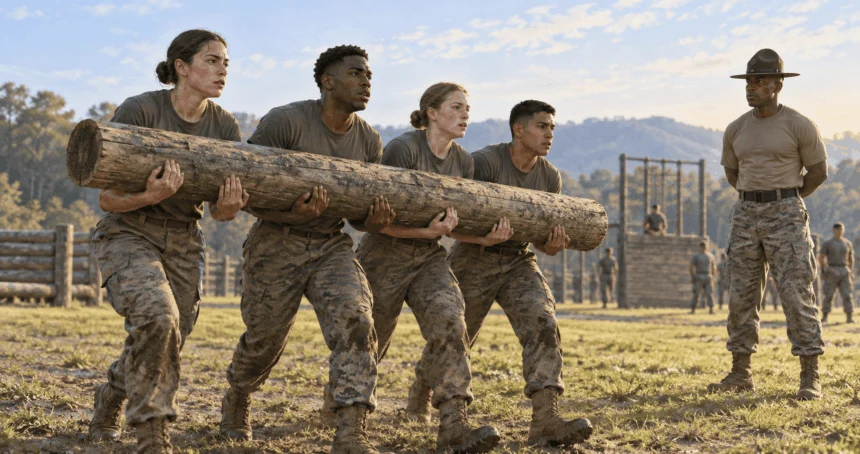
Recruits learn to follow orders precisely, adhere to strict schedules, maintain personal and living area tidiness, and master military customs and courtesies. This discipline is foundational for military life, where adherence to procedures can be critical. The training environment itself, often involving Drill Sergeants or Instructors employing direct, demanding methods, is geared towards fostering this discipline.
Military Customs and Values
Recruits are immersed in the unique culture of their service branch. This includes learning rank structures, proper saluting procedures, military time, the phonetic alphabet, branch history, traditions, songs, and creeds. Central to this acculturation is the emphasis on each branch’s core values.
Teamwork
Military operations depend heavily on cohesive teams. Basic training systematically breaks down excessive individualism and fosters collaboration, teaching recruits to work, live, and overcome challenges together. Checking egos and focusing on collective tasks are essential for success.
Basic Skills Training
Recruits receive initial instruction in fundamental military skills, such as basic rifle marksmanship, first aid/combat lifesaving, and sometimes navigation or defense techniques.
The structured, demanding nature of basic training serves a clear purpose: to rapidly build a foundation of essential skills, physical readiness, and shared values necessary for effective military service. While often perceived as intimidating, the goal is ultimately constructive – to build capable service members, not to break recruits.
Army Basic Combat Training (BCT)
The U.S. Army’s initial entry training program is known as Basic Combat Training (BCT). Its mission is to transform civilian volunteers into disciplined, physically fit Soldiers who embody the Army’s seven core values (Loyalty, Duty, Respect, Selfless Service, Honor, Integrity, Personal Courage) and possess fundamental soldiering skills.
Duration and Locations
Army BCT lasts 10 weeks, not including an initial “Reception” week for in-processing. Training is conducted at several U.S. Army installations:
- Fort Jackson, South Carolina (trains roughly 50% of all Soldiers and over 60% of women)
- Fort Sill, Oklahoma
- Fort Moore, Georgia (formerly Fort Benning)
- Fort Leonard Wood, Missouri
Training Phases
BCT is structured into distinct phases, often referred to by colors:
Reception Battalion (“Week Zero”): This initial phase involves paperwork, physical exams, immunizations, haircuts, uniform issue, and the first physical fitness test. It’s the transition from civilian life into the Army system.
Phase 1 / Red Phase (Weeks 1-3): Focuses on adapting to Army life, discipline, teamwork, Army values, traditions, and foundational physical and tactical training. Recruits learn basic drill and ceremony, navigate obstacle courses, and begin classroom instruction. First aid, map reading, and initial physical/mental endurance tests occur.
Phase 2 / White Phase (Weeks 4-5): Emphasis shifts to hands-on skills, particularly weapons handling and marksmanship. Recruits train with their assigned weapon, learn hand-to-hand combat, lifesaving skills, and participate in their first field training exercise (FTX), sometimes called “The Hammer”. Endurance and marksmanship tests are common.
Phase 3 / Blue Phase (Weeks 6-9/10): Training intensifies with advanced weaponry (machine guns, grenades), further rifle marksmanship, convoy operations overview, urban terrain operations, and more complex field exercises. Confidence courses, rappelling, and night training are typical. Teamwork and trust are heavily tested. This phase culminates in multi-day FTXs like “The Anvil” and “The Forge,” which test all skills learned. Passing an end-of-cycle test covering numerous tasks is required. Final inspections in Class A uniforms occur.
Key Skills Taught
BCT covers essential Soldier skills including Army core values, traditions, ethics, discipline, teamwork, physical fitness (including the Army Combat Fitness Test – ACFT), basic rifle marksmanship, weapons maintenance, hand-to-hand combat, first aid/combat lifesaving, land navigation, grenade throwing, rappelling, obstacle course negotiation, and movement under simulated fire.
Daily Life
A typical day starts very early (e.g., 4:30 AM) with physical training, followed by breakfast, drill, classroom instruction, hands-on training, meals, cleaning duties, and limited personal time before lights out. Recruits march everywhere, often carrying equipment. They sleep in barracks environments and operate under the constant supervision of Drill Sergeants.
Physical Fitness Requirements
Recruits must meet Army standards for physical fitness. The primary assessment is the Army Combat Fitness Test (ACFT). The ACFT is a six-event test: 3 Repetition Maximum Deadlift (MDL), Standing Power Throw (SPT), Hand-Release Push-up (HRP), Sprint-Drag-Carry (SDC), Plank (replacing the Leg Tuck), and a 2-Mile Run (2MR). Scoring is age and gender-normed for the official test of record, though the goal in BCT is to build foundational fitness. Recruits who initially fail fitness tests may receive additional training. Minimum entry requirements include being medically and physically fit.
Upon graduation, Soldiers proceed to Advanced Individual Training (AIT) to learn their specific Military Occupational Specialty (MOS) or, for eligible candidates, to Officer Candidate School (OCS).
Navy Recruit Training Command (RTC)
The U.S. Navy transforms civilian volunteers into Sailors through its Recruit Training Command (RTC), commonly called “boot camp.” The mission is to instill the Navy’s core values of Honor, Courage, and Commitment, while providing basic training in seamanship, military discipline, and physical fitness, preparing them for the fleet.
Duration and Location
Navy boot camp lasts 10 weeks. All Navy enlisted recruits attend boot camp at a single location: Recruit Training Command, Naval Station Great Lakes, located near North Chicago, Illinois.
Key Training Events & Structure
Training progresses through weekly milestones:
P-Days (Processing Days): Arrival, uniform issue, haircuts, medical/dental screening, paperwork, initial fitness assessment, and assignment to a Recruit Division led by Recruit Division Commanders (RDCs).
Week 1: Focus on water survival (3rd Class Swim Qualification: 50-yd swim, 5-min prone float, clothing inflation), core values, military basics.
Week 2: Naval history, ship/aircraft familiarization, Uniform Code of Military Justice (UCMJ), first aid.
Week 3: Basic seamanship (line handling, watch standing) on simulators like USS Marlinespike, Man Overboard drills.
Week 4: Damage Control (firefighting, watertight integrity, CBRNE defense), Confidence Chamber lab, RDC physical assessment (plank, pushups, 1.5-mile run).
Week 5: Firearms training (marksmanship fundamentals, safety, pistol qualification course), live fire exercises.
Week 6: Hands-on Damage Control testing (fire team training).
Week 7: Firefighting assessment, final personnel inspection.
Week 8: Final Physical Fitness Assessment (PFA), Battle Stations 21. Battle Stations 21 is the capstone event – an intense, 12-hour overnight evaluation aboard the USS Trayer (a realistic ship simulator) testing all skills learned (seamanship, damage control, teamwork, decision-making under stress). Passing Battle Stations 21 is required for graduation.
Week 9: Graduation preparation and the Pass-in-Review (PIR) ceremony.
Training Emphasis
Training heavily emphasizes naval traditions, discipline, teamwork, physical fitness, and skills essential for shipboard life, including basic seamanship, firefighting, damage control, and water survival. The process is called “Sailorization,” integrating recruits into the Navy’s warfighting culture.
Daily Life
The daily routine is highly structured, including scheduled meals, personal hygiene time, PT, classroom instruction, practical skills training, cleaning duties, study periods, and personal care time before lights out. Recruits live in barracks called “ships”. Communication is primarily via postal mail, with limited phone calls allowed (upon arrival and potentially mid-training).
Physical and Swimming Standards
Physical training occurs daily (one hour, six days/week). Recruits must pass the Navy Physical Readiness Test (PRT) to graduate. Standards vary by age/gender but for the 17-19 age group include: Males – 46 push-ups, 1:10 plank (2×30 sec hold implied), 12:15 1.5-mile run; Females – 20 push-ups, 1:10 plank, 14:45 1.5-mile run. Swimming proficiency is mandatory. Recruits must pass the 3rd Class Swim Qualification (50-yard swim, 5-minute prone float, clothing inflation). Remedial swim training is provided if needed, but graduation requires passing.
After graduation (Pass-in-Review), new Sailors typically receive brief liberty before proceeding to “A” School for specialized job training.
Air Force & Space Force Basic Military Training (BMT)
The U.S. Air Force provides the foundational training for both Airmen and U.S. Space Force Guardians through its Basic Military Training (BMT) program. The mission is to motivate, train, and inspire the next generation, providing the foundation for delivering 21st Century air and space power.
Duration and Location
Air Force BMT is currently 7.5 weeks long. All Air Force and Space Force enlisted recruits attend BMT at Joint Base San Antonio-Lackland (Lackland AFB) in San Antonio, Texas.
Key Training Weeks/Events
Training progresses weekly, building skills and knowledge:
Week 0 (Zero Week): Arrival, initial processing, haircuts, uniform issue, medical/dental appointments, first briefings.
Week 1: Introduction to Air Force life, rank structure, reporting/saluting procedures, drill, fitness briefings, initial PT assessment, weapon issue/familiarization.
Weeks 2-5: Continued drill, PT, classroom instruction on Air Force doctrine, history, customs and courtesies, law of armed conflict, cybersecurity, human relations, financial readiness. Introduction to Chemical, Biological, Radiological, Nuclear (CBRN) defense and Mask Confidence Training (“gas chamber”) occurs, typically in week 4. Combat Arms Training and Maintenance (CATM) for rifle qualification also takes place.
Week 6: PACER FORGE (Primary Agile Combat Employment Range, Forward Operations Readiness Generation Exercise). This is the capstone field training exercise, replacing the former BEAST week. PACER FORGE is a fast-paced, 36-hour scenario-based deployment exercise focused on Agile Combat Employment (ACE) principles and developing multi-capable Airmen/Guardians. Trainees operate in smaller, dispersed teams, applying skills like tactical combat casualty care (TCCC), weapons handling, teamwork, and problem-solving under simulated deployment conditions. An end-of-course written exam is also typically taken this week.
Week 7: Focus shifts to graduation preparation, final personnel appointments, and transition to Technical Training.
Focus Areas
BMT emphasizes discipline, teamwork, attention to detail, Air Force/Space Force core values and heritage, warrior ethos, physical fitness, and foundational Airmanship/Guardianship skills. For Space Force Guardians, while attending Air Force BMT, specific Space Force elements and identity are integrated, including interactions with Space Force leadership and traditions. The training methodology aims to build upon recruits’ existing talents rather than breaking them down.
Daily Schedule
A typical day involves early reveille, physical training, drill, classroom instruction, practical exercises, meals, cleaning/dorm maintenance, and some personal/study time before lights out. Strict adherence to schedule and standards is enforced by Military Training Instructors (MTIs). Phone use is limited to specific, scheduled opportunities.
Physical Fitness Standards
Recruits undergo regular physical conditioning. Graduation requires passing the Air Force Physical Fitness Assessment (PFA). The operational Air Force PFA typically includes components like push-ups, sit-ups (or alternative core exercises like planks or cross-leg reverse crunches), and a 1.5-mile run, with scoring based on age and gender categories. Recruits are expected to arrive with a baseline fitness level and are issued running shoes, though they may use approved personal running shoes. Minimum PT scores are required for certain roles like MTI duty. Height/weight/BMI standards also apply.
Following BMT graduation, Airmen and Guardians proceed to Technical Training (often called “Tech School”) at various locations to learn the specific skills required for their Air Force Specialty Code (AFSC) or Space Force Specialty Code (SFSC).
Marine Corps Recruit Training
Marine Corps Recruit Training is renowned for its intensity, designed to forge recruits into Marines through a demanding process that tests physical, mental, and moral toughness. The objective is to produce basically trained Marines grounded in core values, discipline, esprit de corps, and combat skills.
Duration and Locations
Marine Corps Recruit Training lasts 13 weeks. This includes an initial “Receiving” week followed by 12 weeks of formal training. Training occurs at one of two Marine Corps Recruit Depots (MCRDs):
- MCRD Parris Island, South Carolina (typically for recruits living east of the Mississippi River)
- MCRD San Diego, California (typically for recruits living west of the Mississippi River)
Phases of Training
The 13-week transformation is divided into four phases:
Phase 1 (Receiving & Weeks 1-4 approx.): Begins the moment recruits step on the iconic “yellow footprints.” Focuses on initial indoctrination, breaking down civilian habits, and instilling discipline. Includes processing, gear/rifle issue, haircuts, Initial Strength Test (IST), introduction to Marine Corps history, customs, courtesies, core values, close order drill, physical conditioning, and introduction to the Marine Corps Martial Arts Program (MCMAP).
Phase 2 (Weeks 5-8 approx.): Builds upon the foundation with increased intensity. Includes marksmanship training (learning to fire the M16 rifle accurately), combat water survival/swim qualification, field skills, continued physical conditioning, martial arts, and academic instruction. Rappelling and confidence courses test courage and physical ability.
Phase 3 (Weeks 9-12 approx.): Focuses on advanced field skills, basic warrior training, and culminates in the defining challenge of recruit training: The Crucible. This 54-hour continuous field event tests every skill learned – physical endurance, teamwork, leadership, ethical decision-making – under conditions of simulated combat stress, food rationing, and sleep deprivation. Successfully completing the Crucible earns recruits the Eagle, Globe, and Anchor emblem and the title of Marine.
Phase 4 (Week 13): Known as “Marine Week,” this final phase occurs after the Crucible. It involves final inspections, administrative out-processing, standard training requirements, leadership discussions, and preparation for graduation and the transition to the next stage of training.
Training Emphasis
The defining characteristic is the deliberate physical and mental stress designed to forge Marines. There is a profound emphasis on discipline, core values (Honor, Courage, Commitment), Marine Corps history and traditions, combat conditioning, marksmanship, teamwork, and the complete transformation of the individual into a Marine.
Daily Life
Days are long and highly structured, starting early with physical training. The schedule includes drill, classes, combat skills training, meals (eaten quickly), cleaning the barracks (“squad bay”), gear maintenance, and instruction from Drill Instructors (DIs). There is typically one hour of free time before lights out for about 8 hours of sleep. Communication is primarily via postal mail after an initial arrival phone call.
Physical Fitness Standards
Marine Corps physical standards are exceptionally high. Recruits must first pass the Initial Strength Test (IST) to begin training: Males – 3 pull-ups or 34 push-ups, 1.5-mile run in 13:30, 40-sec plank; Females – 1 pull-up or 15 push-ups, 1.5-mile run in 15:00, 40-sec plank. Throughout training, recruits must pass the Physical Fitness Test (PFT) (pull-ups/push-ups, plank, 3-mile run with times ≤ 28:00 for males, ≤ 31:00 for females) and the Combat Fitness Test (CFT) (Movement to Contact 880yd sprint, Ammunition Lift, Maneuver Under Fire obstacle course).
After graduating recruit training and taking a short period of leave, all new Marines attend the School of Infantry (SOI). Marines with infantry Military Occupational Specialties (MOS) attend the Infantry Training Battalion (ITB), while non-infantry Marines attend Marine Combat Training (MCT) before proceeding to their MOS school.
Coast Guard Recruit Training
The U.S. Coast Guard conducts its enlisted basic training program at Training Center Cape May, New Jersey. The goal is to transform civilian volunteers into physically fit, basically trained, smartly disciplined Coast Guard members ready for service, instilling the core values of Honor, Respect, and Devotion to Duty.
Duration and Location
Coast Guard recruit training lasts 8 weeks (53 days). All enlisted Coast Guard recruits train at a single location: U.S. Coast Guard Training Center (TRACEN) Cape May, New Jersey.
Program Structure
Training progresses weekly, covering a range of skills:
Week 1: Arrival (“Stepping off the Bus”), orientation, uniform issue, initial fitness test, introduction to Company Commanders (CCs – the Coast Guard equivalent of Drill Instructors).
Weeks 2-7: Intensive academic and practical instruction. Subjects include military justice (UCMJ), ethics, Coast Guard history, missions (including law enforcement, search and rescue, marine safety, environmental protection), military customs and courtesies, drill, and core values. Hands-on training covers firearms, basic seamanship (knots, line handling), firefighting, damage control, and first aid. Physical training is continuous. Recruits learn required knowledge weekly, covering topics like the chain of command, general orders of a sentry, rates/ranks, grooming standards, and uniform regulations. Recruits may be tested on this knowledge. Mid-way through training (around week 4), recruits list preferences for their first assignment.
Week 8: Final preparations for graduation, final inspections, and the graduation ceremony. Recruits may earn limited off-base liberty in the final weeks.
Training Emphasis
Training focuses on instilling discipline, teamwork, Coast Guard core values, physical fitness, and foundational skills relevant to Coast Guard missions, particularly seamanship, safety, and basic military knowledge.
Daily Life
The daily schedule is demanding, involving early reveille, physical training, classroom instruction, practical drills, meals, cleaning duties, and limited personal time under the supervision of Company Commanders. Communication is primarily through mail, although recruits may have opportunities for phone calls if set back in training or for emergencies relayed via the American Red Cross. Recruits live in barracks.
Physical/Swimming Standards
Recruits must be physically prepared and pass fitness tests. While specific graduation standards weren’t detailed in the provided snippets, training includes physical fitness testing and water survival/swim qualifications. Recruits are expected to meet standards in areas like push-ups, sit-ups, running, and swimming. A 5-minute tread water test and a 100-meter swim are typical components of swim qualification, though specifics should be confirmed with official sources.
Following graduation, new Coast Guardsmen may attend the Sentinel Transformation & Readiness Training (START) Program at TRACEN Yorktown, VA, a 5-day course designed to aid the transition from recruit training to active service, before proceeding to their first unit. Unlike other branches where graduates often go directly to specialized training, Coast Guard graduates typically report to their first unit as non-designated Seamen or Firemen. After gaining experience, they apply for “A” School for specialized rating training.
Preparing for Basic Training: Tips for Success
Success in basic training hinges significantly on preparation – both mental and physical. Arriving unprepared can make an already challenging experience significantly harder.
Physical Readiness
This is arguably the most critical preparation area. Do not expect basic training itself to get you into shape; aim to arrive already fit.
Focus Areas: Concentrate on running endurance, push-ups, and core strength exercises like sit-ups or planks. Being able to meet or exceed the initial fitness standards for your chosen branch is crucial.
Training Programs: Follow a structured workout plan for several weeks or months prior to shipping out. The Air Force provides a sample 14-week program. Consult a doctor before starting any new regimen.
Injury Prevention: Proper running shoes are essential. Gradually increase workout intensity to avoid injury. Good nutrition and adequate sleep are also vital for physical preparation and recovery.
Mental Preparation
Basic training is designed to be stressful and mentally taxing.
Expect Challenges: Understand that you will be pushed, yelled at, and face frustrating situations. This is part of the training process; try not to take it personally.
Develop Discipline: Practice self-discipline before arriving. Learn to follow instructions precisely and immediately.
Focus: Train yourself to concentrate on the task at hand and block out distractions or worries about past or future events.
Team Mindset: Be prepared to work as part of a team. Leave individual ego behind and focus on collaboration and accomplishing group tasks.
Learn the Basics: Familiarize yourself with military culture beforehand. Learn your branch’s rank structure, core values, song/creed, military time, the phonetic alphabet, and basic military jargon or acronyms. This knowledge provides a significant advantage. The Coast Guard provides a Recruit Training Pocket Guide with essential knowledge.
Administrative and Financial Preparation
Documents: Gather all required documents well in advance. This typically includes your Social Security card, valid government-issued photo ID (like a driver’s license), birth certificate, high school diploma/GED, college transcripts (if applicable), direct deposit information (bank routing and account numbers), immunization records, copies of prescriptions, and all paperwork/orders issued by your recruiter and the Military Entrance Processing Station (MEPS). If applicable, bring marriage certificates, divorce decrees, and children’s birth certificates.
Finances: Arrange for automatic payment of any personal bills (rent, car payments, credit cards, etc.) before leaving. Financial problems can jeopardize security clearances and career opportunities. Bring only a small amount of cash or a debit/credit card as advised by your recruiter.
Communication: Inform family and friends that communication will be severely limited, primarily through postal mail, with infrequent and brief phone calls. Provide them with your training unit address as soon as you receive it.
What to Bring and What to Leave Behind
Packing correctly is crucial. Bringing prohibited items will result in confiscation, and forgetting required items can cause delays. While specific lists vary slightly by branch and may change, the following provides a general guide:
Recommended/Required Items:
- Casual, comfortable civilian clothes (1-2 sets for arrival)
- White crew-neck t-shirts (check branch specifics)
- White underwear (briefs/boxers for males; briefs/sports bras/regular bras for females)
- White calf-length athletic socks (several pairs)
- Running shoes (good condition)
- Shower shoes (flip-flops)
- Basic toiletries (toothbrush, toothpaste, soap, shampoo, deodorant, razor)
- One washcloth and towel
- Required documents (Social Security card, ID, orders, etc.)
- Small amount of cash ($20-$50)
- One combination lock or padlock w/ 2 keys
- Inexpensive, durable wristwatch
Prohibited Items:
- Excessive civilian clothing
- Clothing with offensive logos/images
- Colorful or patterned socks/underwear
- Aerosol cans
- Alcohol-based products
- Cologne/perfume
- Large containers (travel sizes often recommended)
- Electric razors (usually)
- Hair dryers, curling irons
- Excessive makeup
- Decorative hair accessories
- Non-prescription colored contacts
- Large amounts of cash
- Weapons (knives, firearms, etc.)
- Expensive jewelry
- Tobacco products, e-cigarettes, vapes, lighters
- Alcohol
- Non-prescription drugs/medications
- Illegal drugs/narcotics/paraphernalia
- Vitamins, supplements (unless prescribed)
- Food, candy, gum
- Pornographic or obscene material
- Gambling items (dice, cards)
- External reading materials (books, magazines)
- Personal electronics (cameras, laptops, tablets, music players, games)
Always confirm the specific packing list with your recruiter, as requirements can change.
Life After Basic: Next Steps in Your Military Journey
Graduating from basic training is a significant accomplishment, marking the successful transition from civilian to Soldier, Sailor, Airman, Marine, or Guardian. However, it is only the beginning of a military career. The journey continues immediately with specialized training tailored to the service member’s specific job.
Graduation Ceremonies
Basic training culminates in a formal graduation ceremony, a proud moment for recruits and their families. These events often involve parades, inspections, and the demonstration of skills learned.
Families are typically invited to attend graduation events, though specific procedures for base access and ticketing must be followed. Security checks and ID requirements are standard.
Following the ceremony, graduates are often granted a short period of “liberty” (on-base or limited off-base time) to spend with family before departing for their next phase of training. This liberty comes with strict rules regarding conduct, uniform wear, prohibited activities, and return times.
Transition to Advanced Training
Basic training provides the foundational skills and discipline applicable to all members of a branch. The next step is specialized training focused on the specific job the service member will perform.
After graduation and often a short period of leave, new service members report to their next school. This phase has different names depending on the branch:
Army: Advanced Individual Training (AIT). Location varies by MOS. Eligible candidates may proceed to Officer Candidate School (OCS) at Fort Moore, GA.
Navy: “A” School. Locations vary by rating (job). Some may attend A school directly at Great Lakes, while others travel elsewhere.
Air Force & Space Force: Technical Training (“Tech School”). Locations vary widely depending on the AFSC/SFSC.
Marine Corps: School of Infantry (SOI), located at Camp Pendleton, CA or Camp Lejeune, NC. SOI consists of two tracks: Infantry Training Battalion (ITB) for infantry MOS (approx. 52 days) and Marine Combat Training (MCT) for non-infantry MOS (approx. 29 days), which teaches basic infantry skills before Marines attend their MOS-specific school.
Coast Guard: Unlike other branches, graduates usually report to their first unit as a non-rated member (Seaman/Fireman). After gaining experience, they attend “A” School for rating-specific training. Some may attend the 5-day START program at TRACEN Yorktown immediately after boot camp before heading to their first unit.
The duration and location of this advanced training are entirely dependent on the complexity and requirements of the chosen career field.
Joining Your First Unit
Upon successful completion of specialized training, the service member receives orders to their first permanent duty station (PDS).
Arriving at the first unit marks another transition. While still junior, service members typically experience more freedom and responsibility than during training periods. Initial weeks involve in-processing, meeting leadership, learning unit procedures, and integrating into the team.
Various resources are available on base to help with this transition and life at the first duty station, including Morale, Welfare, and Recreation (MWR) programs, Military and Family Support Centers, libraries, and recreational facilities. Getting involved, making connections, and exploring the installation and local community are encouraged.
This structured progression—from the standardization of basic training, through the specialization of advanced training, to integration at the first operational unit—is designed to build competent, confident, and contributing members of the Armed Forces step-by-step.
Ready for the Challenge?
Basic military training, regardless of branch, represents a profound physical and mental transformation. It is designed to be demanding, pushing recruits beyond their perceived limits to instill the discipline, resilience, teamwork, and core values essential for military service.
Success is achievable for those who arrive prepared, both physically and mentally, embracing the challenges with determination and a willingness to learn and adapt. Understanding what to expect, from the daily routine and physical demands to the specific requirements of each branch, is the first step toward navigating this critical phase successfully.
Potential recruits are strongly encouraged to utilize the official resources provided by each service branch and maintain close communication with their recruiter for the most accurate and up-to-date information regarding basic training requirements, packing lists, and expectations.
Official Recruiting Resources:
Our articles make government information more accessible. Please consult a qualified professional for financial, legal, or health advice specific to your circumstances.