- law.cornell.edu6 links
Last updated 10 months ago. Our resources are updated regularly but please keep in mind that links, programs, policies, and contact information do change.
Deployment readiness extends beyond mission preparation and equipment checks. Securing legal documents like Powers of Attorney (POA), Wills, and Advance Medical Directives provides essential peace of mind, ensuring trusted individuals can manage financial, family, and healthcare matters while you focus on your duties.
Taking proactive steps before deployment empowers designated individuals to handle necessary affairs effectively, especially when communication may be limited. Fortunately, the U.S. military provides free legal assistance through base Legal Assistance Offices (often part of the Judge Advocate General’s Corps, or JAG) or Region Legal Service Offices (RLSOs) to help service members and their families navigate this important process. This guide details these essential legal tools and the protections afforded under the Servicemembers Civil Relief Act (SCRA).
- Understanding Power of Attorney (POA): Your Vital Deployment Tool
- Putting POAs to Work: Common Deployment Scenarios for Special POAs
- Accessing Military Legal Assistance: Obtaining Your POA and Other Documents
- Essential Pre-Deployment Legal Checklist Beyond POAs
- Your Shield: Understanding the Servicemembers Civil Relief Act (SCRA)
- Choosing Your Agent Wisely: Selecting and Empowering Your Attorney-in-Fact
- Changing Course: How to Revoke a Power of Attorney
- Summary
Understanding Power of Attorney (POA): Your Vital Deployment Tool
What is a Power of Attorney? Its Role for Deployed Personnel
A Power of Attorney (POA) is a formal, legally binding document that grants an individual, known as the “agent” or “attorney-in-fact,” the legal authority to act on behalf of another person, the “principal” or “grantor”. The agent does not need to be a lawyer.
For deploying service members, a POA is a critical tool. It allows a trusted person—often a spouse, parent, or close friend—to manage essential personal business when the service member has limited communication capabilities or access to technology due to their military duties. This can include paying bills, handling banking transactions, managing insurance, accessing government benefits, or even buying or selling property. Essentially, the POA empowers the agent to sign documents on the principal’s behalf, and that signature carries the same legal weight as if the principal had signed it themselves.
Key POA Types for Service Members
Understanding the different types of POAs is essential for choosing the right level of authority needed during deployment. Military legal assistance offices can help determine the most suitable options.
General Power of Attorney (GPOA)
This is the broadest type of POA, granting the agent virtually unlimited authority to perform almost any legal act the principal could perform themselves. This might encompass:
- Managing all bank accounts
- Buying, selling, or investing property
- Handling insurance matters
- Entering contracts
- Managing a business
- Borrowing money
- Handling legal issues
- Applying for government benefits
The primary advantage is its comprehensive nature, potentially covering unforeseen circumstances without needing multiple documents. However, this breadth is also its greatest risk. Granting such extensive power requires absolute trust in the agent, as they could potentially misuse this authority to sell property, drain bank accounts, or incur significant debt in the principal’s name.
Consequently, many institutions, including banks, credit unions, military finance offices, and DEERS/ID card facilities, are wary of GPOAs and may refuse to honor them due to the high potential for abuse. This reluctance stems from the institutions’ need to protect both the service member from potential fraud and themselves from liability. This creates a difficult situation: the very document designed to provide the widest coverage might be ineffective for specific, critical transactions precisely when needed during deployment. Therefore, while seemingly all-encompassing, a GPOA is often less practical and potentially more problematic than more targeted options.
Special Power of Attorney (SPOA) / Limited Power of Attorney (LPOA)
In contrast to a GPOA, an SPOA grants the agent authority to perform only specific, clearly defined acts or handle particular transactions. Examples include:
- Authorizing an agent to manage a specific bank account
- Selling or registering a particular vehicle
- Shipping household goods
- Signing a lease for base housing
- Filing taxes
- Making specific childcare arrangements
The primary advantage of an SPOA is safety; it significantly limits the agent’s power, reducing the risk of unintended actions or abuse. Institutions are generally more willing to accept an SPOA because the authorized action is clearly delineated. Furthermore, SPOAs allow the principal to grant different specific powers to different individuals if desired.
The main drawback is that the principal must anticipate their specific needs in advance, potentially requiring multiple SPOAs to cover various tasks or relationships. Each SPOA must contain detailed information pertinent to the specific transaction authorized.
Durable Power of Attorney
A crucial feature for military personnel, “durability” means the POA remains legally valid and effective even if the principal becomes mentally or physically incapacitated (unable to make their own decisions). Regular (non-durable) POAs automatically terminate upon the principal’s incapacitation. Given the inherent risks associated with military service, a durable POA ensures that the chosen agent can continue managing the service member’s affairs without interruption if they are injured or ill.
This avoids the potential need for a court to appoint a guardian or conservator, which can be time-consuming, costly, and might result in someone other than the service member’s preferred choice being appointed. Durability can be added to both General and Special POAs through specific legal language included in the document.
Unless specified otherwise (like in a “springing” POA), a durable POA typically takes effect as soon as it is signed and remains valid until it expires, is formally revoked by the principal, or upon the principal’s death. State laws differ on whether a POA is automatically considered durable; some states assume durability unless the document states otherwise, while others require explicit language to make it durable. However, military POAs prepared through legal assistance fall under federal law (10 U.S.C. § 1044b), which aims for nationwide validity. To prevent potential conflicts with varying state interpretations and ensure the POA functions as intended if incapacity occurs, military-prepared POAs should always clearly state their durable nature.
Springing Power of Attorney
This type of POA is conditional and only “springs” into effect upon the occurrence of a specific event or condition defined in the document. Most commonly, this trigger is the principal’s incapacitation, often requiring certification from medical professionals.
The advantage is that the agent has no authority until the specified condition is met, limiting power until necessary. However, this can also be a disadvantage. Proving that the triggering event (like incapacitation) has occurred can cause delays and potential disputes, hindering the agent’s ability to act promptly when needed. Furthermore, not all states recognize springing POAs. A springing POA can also be made durable, meaning it takes effect upon the triggering condition and remains effective even during incapacitation.
Regular (Non-Durable) Power of Attorney
As mentioned, a regular POA lacks the durability provision and automatically becomes invalid if the principal becomes incapacitated. Due to the risk of injury or illness associated with military service, this type is generally less suitable for deployment planning compared to a durable POA.
Termination/Expiration
POAs do not last forever. They can be written to expire on a specific date or after a certain event (like the end of a deployment). Military legal assistance offices often recommend setting an expiration date, such as the anticipated end of deployment plus a buffer period (e.g., three months), to limit the duration of the agent’s power and associated risks. A POA also terminates automatically if the principal formally revokes it while competent, or upon the principal’s death.
Comparing POA Types for Military Deployment
To clarify these distinctions in the context of deployment, the following table summarizes the key features:
| Feature | General POA (GPOA) | Special/Limited POA (SPOA/LPOA) | Durable POA | Springing POA |
|---|---|---|---|---|
| Scope of Authority | Very Broad (almost any legal act) | Limited (only specific acts listed) | Can be General or Special; remains valid if principal is incapacitated | Can be General or Special; authority is conditional |
| When Effective | Usually immediately upon signing | Usually immediately upon signing | Usually immediately upon signing (unless springing) | Only upon occurrence of a specific event (e.g., incapacitation) |
| Key Benefit (Military) | Covers unforeseen needs (in theory) | Safer; higher acceptance by institutions | Ensures continuity of management if injured/incapacitated | Limits agent’s power until actually needed |
| Key Risk (Military) | High risk of abuse; often rejected | Need to anticipate all specific needs | Requires high trust; power continues during incapacity | Delays/disputes in proving trigger event occurred |
| Common Deployment Use | Discouraged; often insufficient | Banking, housing, vehicles, childcare, taxes | Recommended for most deployment POAs (General or Special) | Less common; used for incapacity planning |
Putting POAs to Work: Common Deployment Scenarios for Special POAs
Given the potential for General POAs to be rejected by institutions, Special Powers of Attorney are frequently necessary to accomplish specific tasks during deployment. The wide variety of situations where an agent might need to act underscores the importance of detailed planning. Relying solely on a GPOA can be risky, as it may not grant the specific authorization needed for a particular transaction with a bank, housing office, or government agency. Therefore, identifying potential needs and obtaining appropriately worded SPOAs through legal assistance is a critical pre-deployment step.
Managing Finances
Banking
An agent may need authority to access specific bank accounts, pay bills from those accounts, make deposits or withdrawals, or resolve banking issues that arise during deployment. Banks often require their own specific POA forms or may scrutinize military POAs closely. Checking the bank’s policy beforehand is essential.
Taxes
An agent might need to file joint income tax returns, receive tax refunds, or communicate with the IRS on the service member’s behalf. While a POA might grant this authority, the IRS often requires its own specific form, IRS Form 2848 (“Power of Attorney and Declaration of Representation”), for tax matters.
Credit Cards
Managing credit card payments, responding to fraud alerts, or disputing unauthorized charges may require specific authorization.
Investments
Buying, selling, or managing investments requires explicit authority granted in a POA.
Loans/Debts
Authority to borrow money, take out loans, or collect debts must be specifically granted.
Securing the Home Front
Leases
An agent may need to sign a new residential lease, renew an existing one, or terminate a lease (particularly important for exercising rights under the SCRA).
Housing Assignments
If the service member’s family is eligible for government or base housing during the deployment, an SPOA allows the agent to accept the assigned quarters, sign necessary paperwork, and take possession of furniture or equipment. The installation housing office should be notified and provided a copy of the POA in advance.
Property Management
An SPOA can authorize an agent to manage specific real estate, including selling or buying property, arranging for necessary repairs, or handling mortgage payments and related issues.
Utilities
Authority may be needed to start, stop, or manage utility services for a residence.
Handling Vehicles
Registration/Titling/Licensing
An agent may need authority to handle state vehicle registration, titling, or licensing requirements.
Sale/Purchase
An SPOA can authorize the agent to buy or sell a specific vehicle designated in the document.
Shipment
Specific authority is needed for an agent to arrange the shipment of a privately owned vehicle (POV) or take possession of it upon arrival.
Insurance
An SPOA can grant authority to purchase, maintain, or manage vehicle insurance policies.
Family Matters
Childcare Arrangements
An SPOA, often integrated into a Family Care Plan, can authorize a designated caregiver to enroll children in daycare or school, make educational decisions, access school records, consent to participation in activities, and handle related matters. This temporary delegation of parental rights is distinct from legal guardianship established by a court or through a will.
DEERS/ID Cards
Managing Defense Enrollment Eligibility Reporting System (DEERS) updates, enrolling newborn children, or resolving issues with dependent ID cards typically requires a specific military SPOA recognized by the ID card facility.
Medical Decisions for Children
An SPOA can grant the designated caregiver authority to consent to routine or emergency medical and dental treatment for minor children during the service member’s absence.
Naming Newborns
A specific SPOA can authorize a spouse or agent to officially name a baby born during the deployment and handle related paperwork like obtaining a birth certificate.
Accessing Support & Benefits
Emergency Financial Aid
Applying for emergency financial assistance from military aid societies like the Navy-Marine Corps Relief Society (NMCRS) or Army Emergency Relief (AER) may require an SPOA, sometimes with specific language or monetary limits included in the document.
Government Benefits
An agent may need authority to apply for or manage other government benefits on behalf of the service member or dependents.
Household Goods (HHG)
An SPOA can authorize an agent to arrange for the shipment, storage, receipt, or customs clearance of the service member’s household goods.
The diverse nature of these tasks—from highly specific banking actions to sensitive childcare decisions and complex property transactions—reinforces why a one-size-fits-all GPOA often falls short. Effective deployment preparation requires careful consideration of potential needs and consultation with legal assistance to draft precise SPOAs for each anticipated scenario, ensuring the agent has the explicit authority required by the relevant institution or agency.
Accessing Military Legal Assistance: Obtaining Your POA and Other Documents
Your Resource: The Base Legal Assistance Office (JAG/RLSO)
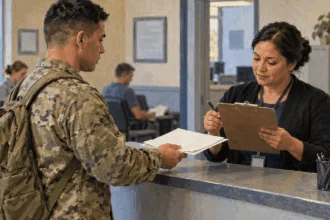
The primary resource for service members and their families seeking help with POAs, wills, and other pre-deployment legal documents is their installation’s Legal Assistance Office. These offices, staffed by Judge Advocate General’s Corps (JAG) attorneys and paralegals (or civilian equivalents in some branches/locations), provide free legal services on a variety of personal, civil legal matters.
This includes drafting and executing POAs, Last Wills and Testaments, and Advance Medical Directives, as well as providing advice on topics like family law, consumer issues, SCRA, and landlord-tenant matters. While these offices are invaluable for deployment readiness, it is important to understand that their services focus on personal civil legal matters and do not replace the need for a private attorney for complex issues outside their scope or for representation in civilian courts (except in limited pro bono or expanded legal assistance program circumstances).
Who is Eligible for Free Legal Services?
Eligibility for free military legal assistance is generally governed by federal statute (10 U.S.C. § 1044) and service regulations. Typically, eligible individuals include:
- Active Duty military members (Army, Navy, Air Force, Marine Corps, Coast Guard, Space Force) and their dependents
- Retired military members and their dependents
- Reserve component members (Reservists and National Guard) and their dependents, particularly when on federal active duty orders or in certain other statuses (check local office policy)
- Other specific categories, potentially including certain civilian employees deploying OCONUS
Proof of eligibility, typically a valid Uniformed Services ID card, is required to receive services. While offices aim to assist all eligible clients regardless of service branch, specific services or availability might vary by location due to staffing.
The Process: Obtaining POAs and Wills
While procedures can vary slightly between branches and installations, the general process for obtaining POAs and Wills involves these steps:
- Contact the Office/Schedule Appointment: Most legal assistance services, especially for wills and complex POAs, require an appointment. Walk-in services may be available for simple notarizations or basic POAs, often with priority given to deploying personnel.
- Complete Worksheets (If Applicable): Many legal offices, particularly in the Air Force and Space Force, utilize the centralized Air Force Legal Assistance website. Clients can fill out online worksheets for POAs, Wills, Advance Medical Directives, etc., prior to their appointment. Completing these worksheets generates a “ticket number” which may be needed to schedule or expedite the appointment. Note that legal documents cannot be printed from this website; the visit to the legal office is still required. Army, Navy, and Marine Corps offices may use similar online portals or provide paper/PDF worksheets.
- Gather Necessary Information: Bring your valid military ID card. If you completed online worksheets, bring your ticket number. For specific POAs, bring all relevant details, such as bank account numbers, property addresses or legal descriptions, vehicle identification numbers (VINs), or details about children for Family Care Plan POAs. For wills, consider beforehand who you want as beneficiaries, executor, and guardians for minor children.
- Consultation: You will typically meet with a legal assistance attorney or a supervised paralegal to discuss your needs, review the information provided, and ensure the documents accurately reflect your wishes and are legally sound.
- Execution: The final documents (POA, Will, etc.) must be signed by you (the principal or testator) in the presence of a notary public and/or witnesses, as required by law and military regulations. This formal execution process takes place at the legal assistance office.
- Safekeeping: Legal assistance offices generally do not keep copies of your executed POAs or Wills. You are responsible for safeguarding the original documents and providing copies to your designated agents, executors, or relevant institutions as needed. Consider storing originals in a secure place like a fireproof safe or safe deposit box.
Finding Your Local Office
Several resources can help locate the nearest military legal assistance office:
- Armed Forces Legal Assistance Locator
- Branch-Specific Websites:
- Military OneSource (800-342-9647)
- Installation Directories: Check your local base or installation website directory
Special Status: Military POAs and Federal Law (10 U.S.C. § 1044b)
Military POAs have a special status under federal law. Title 10, U.S. Code, Section 1044b specifically addresses military powers of attorney prepared for eligible personnel and notarized in accordance with military regulations (10 U.S.C. § 1044a). This law states that such military POAs:
- Are exempt from any state-specific requirements regarding form, substance, formality, or recording
- Must be given the same legal effect as a POA prepared and executed according to the laws of the state where it is presented
Congress enacted this provision because service members and their families faced significant hardships when states or institutions refused to honor military POAs simply because they didn’t match local formatting or execution requirements. Military regulations typically require that these POAs include a statement referencing this federal authority, although the absence of the statement does not negate the protection.
Despite this clear federal mandate, practical challenges persist. Numerous accounts confirm that civilian institutions, particularly banks and financial institutions, sometimes hesitate or even refuse to accept valid military POAs, especially GPOAs. This discrepancy between the legal requirement for acceptance and the reality on the ground highlights a critical point for service members: while the law is on their side, they cannot assume automatic acceptance. Practical steps, such as using highly specific SPOAs, communicating with institutions beforehand, and sometimes using the institution’s preferred forms, are often necessary to ensure the POA functions smoothly when needed during deployment.
Essential Pre-Deployment Legal Checklist Beyond POAs
While POAs are vital for managing affairs during an absence, other legal documents are equally important for comprehensive pre-deployment planning, addressing potential incapacity and wishes after death.
Last Will and Testament
A Last Will and Testament is a legal document that directs how a person’s property (their “estate”) should be distributed after their death. Critically for parents, a will is also the primary instrument used to nominate legal guardians for minor children in the event both parents pass away. Without a valid will, the laws of the deceased person’s state of legal residence (“intestacy laws”) dictate how property is divided, and a court will appoint guardians for children. These outcomes may not align with the service member’s wishes and can involve additional court costs and delays.
Any adult (18 years or older) who is of sound mind can create a will. Military legal assistance offices provide free will drafting and execution services for eligible personnel. Similar to POAs, online worksheets may be used to gather information before the legal appointment. Key decisions when creating a will include choosing beneficiaries (who inherits property), appointing an executor (the person responsible for managing the estate and carrying out the will’s instructions), and nominating guardians for minor children. It is crucial to review and update a will before deployment, especially after major life events like marriage, divorce, the birth of a child, or significant changes in assets.
It is important to note that a will does not control the distribution of certain assets that pass by beneficiary designation, such as life insurance proceeds. Servicemembers’ Group Life Insurance (SGLI) beneficiaries must be designated separately using the official SGLI Election and Certificate form (VA Form SGLV-8286). Similar to military POAs, military wills (referred to as “military testamentary instruments”) also receive special federal recognition under 10 U.S.C. § 1044d, exempting them from certain state-specific execution formalities if prepared through military legal assistance.
Advance Medical Directives (Living Will & Healthcare POA)
Advance Medical Directives are legal documents that allow individuals to state their preferences for end-of-life medical care and appoint someone to make healthcare decisions for them if they become unable to do so themselves. These documents typically include:
Living Will (also called Advance Medical Directive or Directive to Physicians)
This document outlines specific wishes regarding medical treatments, such as the use or withholding of life support, artificial nutrition (feeding tubes), and hydration, in situations of terminal illness or a persistent vegetative state where there is no reasonable hope of recovery. It allows individuals to define the limits of medical intervention they desire.
Healthcare Power of Attorney (also called Medical POA or Healthcare Proxy)
This document appoints a trusted individual (the healthcare agent) to make medical decisions on the principal’s behalf if they become incapacitated and unable to communicate their wishes. The agent’s authority typically includes accessing medical records, consulting with doctors, consenting to or refusing treatments, authorizing hospital transfers, and potentially making decisions about organ donation, all according to the principal’s known wishes or best interests.
These directives are critically important because they ensure a person’s healthcare preferences are respected, even when they cannot speak for themselves. They relieve family members from the burden and potential conflict of making difficult decisions during times of crisis and grief. Without these documents, healthcare providers might assume the patient wants all possible measures taken to prolong life, potentially contrary to their wishes, and families may face legal hurdles or disputes. Court intervention to appoint a healthcare guardian might also become necessary.
Military legal assistance offices routinely help prepare Advance Medical Directives, often in conjunction with wills. Like military POAs and wills, military Advance Medical Directives executed through legal assistance are given federal recognition under 10 U.S.C. § 1044c, exempting them from differing state law requirements for form or execution. It is advisable to provide copies of these documents to healthcare providers and the designated healthcare agent. A specific consideration for active duty Army personnel is Army Regulation (AR) 600-20, which notes that under certain circumstances, a commander may potentially override a soldier’s refusal of physician-recommended life-saving treatment.
Guardianship Designations for Minor Children / Family Care Plans
Ensuring the care of minor children during a deployment is a paramount concern, especially for single parents, dual-military couples, or families where the non-deploying parent may not be the designated caregiver. The military addresses this through the requirement of a Family Care Plan (FCP) for certain personnel.
An FCP is an official, documented plan mandated by military regulations (e.g., Army AR 600-20, Navy MILPERSMAN 1754-030, Air Force Instruction 36-2906, Marine Corps MCO P5800.16A Ch 15) that outlines detailed arrangements for the care of dependents (defined generally as children under 19 or other family members incapable of self-care) during the service member’s absence due to military duties. FCPs must be kept current and are reviewed periodically.
The FCP is more than just a list of names; it functions as a comprehensive package integrating logistical plans with necessary legal authorizations. Key components typically include:
- Designation of short-term and long-term guardians (caregivers)
- Detailed Letters of Instruction for the guardian regarding daily routines, school, medical needs, discipline, etc.
- Financial arrangements for supporting the dependents (e.g., proof of funds allocation or setting up an allotment using DD Form 2558)
- Copies or location information for essential documents (Birth certificates, insurance papers, Will, POAs)
- DEERS information and status of dependent ID cards (e.g., DD Form 1172 printout)
- Contact information for relatives, doctors, schools, and emergency contacts
- Required Legal Documents: Crucially, the FCP necessitates specific Powers of Attorney granting the designated guardian legal authority to act on the service member’s behalf regarding the child’s care. This includes consenting to medical/dental treatment, enrolling in school, accessing records, arranging travel, etc.
- The guardian must also typically sign a Certificate of Acceptance (e.g., DA Form 5840), acknowledging their responsibilities, which often requires notarization
Additionally, an Agent Letter of Authorization, signed by the installation commander and obtained through the ID card office, may be needed to grant the temporary caregiver access to on-base facilities like the commissary and exchange for the purpose of supporting the dependents.
The FCP framework demonstrates the military’s proactive approach to ensuring dependent care by mandating not just planning, but the execution of specific legal documents necessary for the designated caregiver to function effectively. It’s important to understand that an FCP and its associated POAs provide temporary authority during the service member’s absence and cannot override existing court-ordered custody arrangements. If the FCP designates a guardian other than a child’s legal parent or conflicts with a custody order, legal advice from the installation legal office is essential. Guidance and specific forms for FCPs can be obtained through service-specific channels (Army, Navy, Air Force, Marine Corps links are often available via Military OneSource or command resources).
Your Shield: Understanding the Servicemembers Civil Relief Act (SCRA)
What the SCRA Does for You and Your Family
The Servicemembers Civil Relief Act (SCRA) is a federal law designed to provide a range of legal and financial protections to active-duty service members, including mobilized National Guard and Reserve members, and sometimes their dependents. Its purpose is to allow service members to focus on their military duties by easing certain civilian obligations and potential legal conflicts that could arise due to their service. The SCRA covers personnel in the Army, Navy, Air Force, Marine Corps, Coast Guard, Space Force, and commissioned officers of the Public Health Service and National Oceanic and Atmospheric Administration (NOAA) during active service.
A key principle underlying many SCRA protections is that the service member’s military duty must “materially affect” their ability to meet a specific financial obligation or appear in a legal proceeding. Determining “material affect” can depend on the specific circumstances and protection being sought.
Major Protections Explained
The SCRA offers numerous protections; some of the most significant for deploying personnel include:
6% Interest Rate Cap on Pre-Service Debts (50 U.S.C. § 3937)
This is one of the most widely known SCRA benefits. It applies to debts incurred by the service member (or jointly with a spouse) before entering active duty. This includes mortgages, auto loans, student loans, credit cards, and other installment debts. The law caps the interest rate on these pre-service obligations at a maximum of 6% per year during the period of active military service. This cap includes most associated fees and service charges (except bona fide insurance).
To receive this benefit, the service member must provide written notice (electronic notice is acceptable) and a copy of their military orders (or a letter from their commanding officer or other valid proof of service) to the creditor. This notice generally must be provided no later than 180 days after the end of military service. Upon receiving a valid request, the creditor must forgive (not just defer) any interest charged above the 6% cap, retroactive to the date the service member entered active duty. The monthly payment amount must also be reduced to reflect the lower interest rate.
While some lenders may proactively check the Defense Manpower Data Center (DMDC) SCRA website for status and apply the benefit, the responsibility generally lies with the service member to provide proper notification to guarantee the protection. Failure to notify the creditor within the required timeframe could result in losing this valuable benefit. For mortgage loans, the 6% interest rate cap protection extends for one full year after the period of military service ends.
Terminating Leases Due to Orders (50 U.S.C. § 3955)
The SCRA provides significant relief for service members needing to break residential or auto leases due to military orders.
Residential Leases: A service member can terminate a residential lease for premises occupied or intended to be occupied by them or their dependents if the lease was signed before entering active duty, OR if the lease was signed during military service and the service member subsequently receives Permanent Change of Station (PCS) orders or deployment orders for a period of 90 days or more. Termination is also allowed upon receiving retirement or separation orders.
To terminate, the service member must provide the landlord (or their agent) with written notice (electronic, mail, or hand-delivery) AND a copy of their military orders (or a letter from their commanding officer verifying the service). If rent is paid monthly, the lease terminates 30 days after the first date on which the next rental payment is due after the notice is delivered. For example, if notice is given July 21st and rent is due August 1st, the lease terminates effective August 31st. The service member is responsible for rent only through the termination date, and any security deposit must be returned according to state law. Landlords generally cannot charge early termination fees or demand repayment of rent concessions under these circumstances. Any lease provision attempting to waive these SCRA rights is typically unenforceable.
Motor Vehicle Leases: Similar rights exist to terminate motor vehicle leases without penalty if the lease was entered into before service, or during service followed by qualifying PCS or deployment orders (typically 90 days or more, though some interpretations mention 180 days). Upon proper termination, the service member is entitled to a refund of any lease amounts paid in advance covering the period after the termination date, including amounts paid as capitalized cost reduction.
Protection Against Default Judgments (50 U.S.C. § 3931)
If a civil lawsuit is filed against a service member during their active duty, and they do not respond or appear in court (often due to their service obligations), the SCRA prevents a court from entering a default judgment against them without specific safeguards. The person suing (the plaintiff) must file an affidavit with the court stating whether or not the defendant is in military service. If the defendant is in service, the court cannot enter a default judgment until it has appointed an attorney to represent the absent service member’s interests. The court must also grant a delay (stay) of proceedings for at least 90 days if requested by the appointed attorney or if it determines the service member’s defense cannot be adequately prepared without their presence due to military duties. If a default judgment is entered against a service member during or within 60 days after their service, they may be able to have the judgment reopened if their military service prejudiced their ability to defend the case.
Stay of Proceedings (50 U.S.C. § 3932)
Beyond default situations, if a service member is involved in a civil court case or administrative proceeding (like divorce or custody cases) but cannot adequately participate due to their military duties, they can request a stay (delay) of the proceedings. An initial stay of at least 90 days must be granted if the service member submits a proper application showing how their current military duties materially affect their ability to appear and providing a date when they expect to be available, often accompanied by a letter from their commanding officer. Further stays may be granted by the court. This protection does not apply to criminal proceedings. It is particularly relevant for preventing adverse custody rulings while a parent is deployed.
Eviction Protection (50 U.S.C. § 3951)
Landlords cannot evict a service member or their dependents from their primary residence during a period of military service without first obtaining a court order. This protection applies to residences where the monthly rent is below a specific amount, which is adjusted annually for inflation (e.g., it was $3,991.90 in 2020). In an eviction proceeding, if the service member’s ability to pay rent is materially affected by their military service, the court must either grant a stay of eviction (typically for about 90 days) or adjust the lease obligations equitably.
Foreclosure Protection (50 U.S.C. § 3953)
The SCRA protects against non-judicial foreclosure on mortgages secured before the service member entered active duty. During the period of military service and for a specified time afterward, a mortgage holder cannot foreclose on, sell, or seize the property for nonpayment without a court order. If the service member’s ability to meet the mortgage obligation is materially affected by service, a court can stay the proceedings or adjust the debt.
Installment Contracts/Repossession (50 U.S.C. § 3952)
Creditors cannot repossess personal property (like a car) purchased under an installment contract signed before military service began, simply due to nonpayment, without first obtaining a court order. This applies if the service member paid a deposit or at least one installment payment before entering service.
Other Protections
The SCRA also includes provisions related to terminating telephone or internet service contracts without penalty upon receiving certain orders, protecting life insurance policies from lapse due to nonpayment of premiums under certain conditions, delaying income tax payments, protecting against enforcement of storage liens, and providing certain protections for small business owners.
Where to Learn More about SCRA
For personalized advice on how SCRA protections apply to a specific situation, the best resource is the installation Legal Assistance Office (JAG/RLSO). Additional authoritative resources include:
- Military OneSource
- U.S. Department of Justice (DOJ)
- Consumer Financial Protection Bureau (CFPB)
- SCRA Statute Text/Summary: 50 U.S.C. §§ 3901-4043 or summaries like the Congressional Research Service report
- DMDC SCRA Website (for status verification)
Choosing Your Agent Wisely: Selecting and Empowering Your Attorney-in-Fact
Granting someone Power of Attorney involves significant trust and responsibility. Selecting the right agent (attorney-in-fact) is paramount to ensuring your affairs are handled properly during deployment.
Who Should You Choose? Factors Beyond Trust
While trustworthiness is the absolute cornerstone, other factors are crucial when selecting an agent:
- Capability and Responsibility: The person chosen should be organized, reliable, and capable of handling the specific tasks assigned, whether managing finances, dealing with complex paperwork, or making sound decisions under potential stress. Consider their own financial responsibility; if they struggle with their own affairs, they may not be the best choice to manage yours. For POAs involving childcare, consider the agent’s health, availability, and alignment with your parenting values.
- Willingness and Availability: Ensure the potential agent is willing and able to take on the responsibilities involved. Discuss the scope of the POA with them beforehand.
- Location (Sometimes): Depending on the tasks, proximity might be a factor (e.g., needing to visit a local bank or manage local property).
- Common Choices: Typically, service members choose a spouse, parent, adult child, sibling, or other trusted family member or friend. The agent does not need to be an attorney.
- Accountability Measures: If there are concerns, or for added security, consider structuring the POA (where permissible) to require the agent to report certain actions (like significant financial transactions) to another trusted individual or provide periodic accountings.
Navigating Acceptance: Why Civilian Institutions Might Question a Military POA
As previously discussed, despite the federal protections under 10 U.S.C. § 1044b, service members and their agents may encounter difficulties when presenting a military POA to civilian institutions like banks, credit unions, landlords, or insurance companies. Understanding why rejection occurs can help in planning strategies to mitigate issues:
Fear of Liability and Fraud
Financial institutions, in particular, are highly regulated and cautious about preventing unauthorized access to accounts, fraud, and potential elder or dependent abuse. This caution can lead to stringent review processes for POAs.
Preference for Internal Forms
Many banks and financial institutions have developed their own standardized POA forms tailored to their specific procedures and liability concerns. They may strongly prefer or even insist on using their form over a general or military-specific POA.
“Staleness” Concerns
Institutions may be hesitant to accept a POA executed several years prior, fearing it might no longer reflect the principal’s current wishes or that the agent relationship may have changed, even though a durable POA legally remains valid until revoked or terminated by death.
Lack of Specificity (Especially with GPOAs)
A broad GPOA might not explicitly list the specific transaction the agent is attempting (e.g., accessing a specific safe deposit box, closing a particular account), leading the institution to reject it for lack of clear authority.
Unfamiliar Format or Wording
If the military POA format or legal language differs significantly from what the institution’s legal department is accustomed to seeing under state law, they may reject it out of caution or require lengthy internal review.
Additional Verification Requirements
Some institutions may require the agent to sign an affidavit or certification affirming the POA is still in effect and the principal is alive, or they may have internal procedures requiring meetings with the agent or principal (if possible) before honoring the document.
Strategies for Smoother Acceptance
Anticipating these potential hurdles is key. Proactive steps taken before deployment can significantly increase the likelihood that the POA will be accepted when needed:
- Prioritize Special POAs: Whenever a specific transaction or institutional relationship is anticipated (banking, housing, vehicle sale), use a narrowly tailored SPOA rather than relying on a GPOA.
- Communicate with Institutions in Advance: Before deploying, the service member (or designated agent, if the POA is already effective) should contact critical institutions (banks, credit unions, mortgage lenders, landlords) to inquire about their specific POA acceptance policies and requirements. If possible, provide a copy of the military POA for their review and potential pre-approval on file.
- Utilize Institution-Specific Forms: If a financial institution insists on its own POA form for managing accounts held there, strongly consider completing their form in addition to the military POA. This redundancy can prevent significant delays and frustration later.
- Ensure POAs are Current: Obtain new POAs or update existing ones shortly before deployment rather than relying on documents that are several years old. Follow legal assistance recommendations regarding duration limits (e.g., deployment length plus three months, or not exceeding one year).
- Verify Proper Execution: Ensure the POA obtained through military legal assistance is correctly signed, dated, witnessed (if required), and notarized according to 10 U.S.C. § 1044a standards.
- Include Reliance Language: Military POAs prepared under federal statute generally include language stating that third parties may rely on the document’s validity. Ensure such language is present.
- Educate Your Agent: Make sure the chosen agent understands the powers granted, the limitations, and the importance of having the physical POA document available when acting on the principal’s behalf.
The consistent message emerging from both legal guidance and practical experience is that proactive engagement with civilian institutions is essential. Service members cannot simply assume their military POA will be accepted without question, despite its federal backing. Verifying requirements, using specific language, and potentially complying with institutional form preferences are necessary steps to bridge the gap between the military legal framework and civilian operational realities, ensuring the POA serves its intended purpose during deployment.
Changing Course: How to Revoke a Power of Attorney
Circumstances change, and a Power of Attorney may need to be cancelled or revoked before its expiration date. Common reasons include the service member’s return from deployment, a loss of trust in the agent, the agent becoming unable or unwilling to serve, or simply that the POA is no longer needed.
The Formal Revocation Process
As long as the principal (the service member who granted the POA) is mentally competent, they have the absolute right to revoke a POA at any time. The process involves several key steps:
- Create a Written Revocation Document: A formal document titled “Revocation of Power of Attorney” must be prepared. This document should clearly state the principal’s intent to revoke a specific, previously granted POA, identifying the date the original POA was executed and the name of the agent whose authority is being revoked. Military legal assistance offices can prepare this revocation document.
- Execute the Revocation: The revocation document must be signed by the principal and notarized, similar to the original POA execution.
- Notify the Agent: A copy of the signed and notarized revocation must be delivered to the former agent. It is advisable to use a delivery method that provides proof of receipt, such as certified mail.
- Notify Third Parties: This is a critical, though potentially difficult, step. Copies of the revocation must be provided to all institutions, businesses, agencies, and individuals who received the original POA or might have relied upon it (e.g., banks, landlords, schools, financial institutions, government agencies). Failure to notify a third party means they might still accept the old POA in good faith, potentially allowing the former agent to act improperly.
- Retrieve and Destroy Copies: If possible, the principal should retrieve the original POA document and all known copies from the former agent and third parties and destroy them.
The challenge of ensuring all relevant third parties are notified of the revocation is significant and represents an inherent difficulty with POAs. This underscores why the initial selection of a trustworthy agent is so crucial.
Specific procedures may apply when revoking a POA filed with certain government agencies, like the Department of Veterans Affairs (VA). Revoking a VA Form 21-22 or 21-22a requires updating VA systems and formally notifying the revoked representative.
Automatic Termination
In addition to formal revocation, a POA automatically terminates under certain circumstances, including:
- Reaching a specific expiration date set forth in the document
- The death of the principal
- The death of the agent (in most cases, unless a successor agent is named)
- The incapacitation of the principal, if the POA was not durable
Summary
Comprehensive legal preparation before deployment stands as one of the most critical steps a service member can take to protect their interests and family well-being. By properly executing Powers of Attorney, Wills, Advance Medical Directives, and Family Care Plans, and by understanding SCRA protections, service members can deploy with the confidence that their affairs remain properly managed in their absence.
The key to success lies in early preparation, thorough discussion with chosen agents, and proactive communication with civilian institutions that may need to honor military legal documents. Military legal assistance offices provide invaluable support throughout this process, offering free services to ensure that service members and their families have the legal protection they need.
Remember that while the federal law provides strong backing for military legal documents, practical acceptance sometimes requires additional steps. The effort invested in proper legal preparation before deployment pays dividends in peace of mind, allowing service members to focus fully on their mission knowing their personal affairs are in trusted hands.