- uso.org3 links
- bluestarfam.org2 links
- militaryfamily.org2 links
- redcross.org2 links
- usmc-mccs.org
- nmcrs.org
Last updated 11 months ago. Our resources are updated regularly but please keep in mind that links, programs, policies, and contact information do change.
While deployment presents unique communication challenges. This guide provides information and recommendations on communication during deployment, focusing on official policies, various methods, potential challenges, and essential support networks.
Understanding Operations Security (OPSEC)
Maintaining operational security, commonly known as OPSEC, is paramount during deployment. OPSEC is a systematic process used by the Department of Defense (DoD) to protect sensitive, unclassified information from falling into the wrong hands.
- Understanding Operations Security (OPSEC)
- Official DoD and Branch Communication Policies
- Communication Methods: Pros, Cons, and Considerations
- Communication Methods Comparison
- Leveraging Support Services and Facilities
- Navigating Common Communication Challenges
- Essential Support Networks for Families
- Key Support Resources for Deployment Communication
- Best Practices for Effective and Secure Communication
Adversaries actively seek information, even seemingly small details, which they can piece together to gain advantages that could jeopardize missions and endanger personnel. Protecting this information is a shared responsibility, involving not just the service member but also their family and friends.
What is OPSEC?
OPSEC involves identifying critical information, analyzing threats and vulnerabilities, assessing risks, and implementing countermeasures to safeguard that information. It’s a continuous cycle requiring constant vigilance.
The goal is to deny adversaries the ability to collect and exploit information that could harm national security, military operations, or individuals. This requires thinking like an adversary to identify what information might be valuable to them.
Critical Information and Indicators (CII)
The core of OPSEC revolves around protecting Critical Information and Indicators (CII):
Critical Information: Specific information, classified or unclassified, about military intentions, capabilities, operations, or activities that adversaries need to act effectively against U.S. interests. Examples include:
- Specific deployment dates
- Locations
- Mission details
- Unit movements
- Troop strength
- Equipment specifics
- Security procedures
Indicators: Observable actions or pieces of open-source information that might reveal critical information, even if they seem harmless on their own. Examples include:
- Large-scale personnel transactions (like mass updates to wills or powers of attorney)
- Sudden changes in communication patterns
- Public discussions about unit morale
Adversaries are skilled at connecting these “puzzle pieces.”
The Critical Information and Indicators List (CIIL)
Units and organizations develop a Critical Information and Indicators List (CIIL) to guide personnel on what specific information needs protection. Service members and their families should be aware of the types of information considered critical by their specific unit or command. If a unit is located on a host installation, they should also be aware of the host’s CIIL.
General OPSEC Rules for Families
Families play a crucial role in OPSEC because they often know details that could be sensitive. These guidelines help protect service members:
- Be aware of your surroundings: Avoid discussing sensitive military matters in public places like restaurants, stores, or public transport where conversations can be overheard.
- Limit what you share: Practice a “need-to-know” attitude. If someone doesn’t need specific details, don’t share them. Be vague rather than specific, especially with those outside the immediate family or unfamiliar with military security.
- Exercise online caution: Assume adversaries monitor social media, forums, and websites. Use strong passwords and strict privacy settings. Scrutinize photos before posting for revealing details (geotags, backgrounds, uniforms, equipment). Disable location services on devices. Be wary of friend requests from strangers. Understand that even “private” or “encrypted” non-DoD platforms are not approved for sharing non-public DoD information.
- Use phone security: Remember that landlines, cordless phones, and cell phones are not secure and can be monitored. Avoid discussing critical information over the phone.
- Follow specific “don’ts”: Do not discuss specific deployment dates, return dates, locations, mission details, unit movements, specific job titles online, equipment status, or unit morale. Avoid speculation or spreading rumors.
- Educate others: Ensure extended family and friends understand the importance of OPSEC and the types of information they should not share.
Adhering to OPSEC helps protect service members, their families, and the mission. Military OneSource offers resources and guidelines on OPSEC for families.
Official DoD and Branch Communication Policies
While the core principles of OPSEC apply across the DoD, specific branches may have additional guidance or emphasis regarding communication during deployment. Official communication policies generally prioritize mission security while facilitating morale-boosting connections.
Department of Defense
The DoD emphasizes OPSEC as a critical component of all operations. Key directives include NSPM-28 (National Operations Security Program) and DoDI 8170.01 regarding electronic messaging services. The DoD prohibits using geolocation features in operational areas unless specifically authorized and restricts the use of non-DoD messaging apps for non-public information.
Military OneSource, a DoD program, provides extensive resources on deployment preparation, communication strategies, and OPSEC guidelines for all branches.
U.S. Army
The Army emphasizes OPSEC for families through resources like guides and smart cards, reinforcing what information is critical and should not be shared publicly or online. Army policy (AR 360-1, FM 3-0) highlights public affairs as a command responsibility, encouraging Soldiers to share their (unclassified) story appropriately while adhering to online conduct rules (“Think, Type, Post”).
Personal social media use is permitted but must be clearly personal, avoid implying official endorsement, and adhere to UCMJ and Army values. Army Family Readiness Groups (FRGs) are key communication channels. Army MWR provides support services, including potential communication facilities at installations.
U.S. Navy
Navy instructions (e.g., OPNAVINST 1754.5C regarding FRGs) and guidance documents emphasize OPSEC, particularly regarding ship movements, schedules, and locations. Navy Family Readiness Groups and the Navy Family Ombudsman Program are vital links for official communication and support.
Resources like the Navy Fleet and Family Support Program provide deployment support. Navy MWR’s Deployed Forces Support assists afloat commands.
U.S. Air Force
The Air Force provides OPSEC training and resources for families, often through Airman & Family Readiness Centers. Air Force instructions (e.g., DAFI 90-160) govern communications and publications. Specific guidance exists for tactical air control communications (AFTTP 3-2.8) and deployment logistics involving aerial ports (APOE/APOD) managed via systems like TPFDD and coordinated by entities like Air Mobility Command (AMC).
U.S. Marine Corps
The Marine Corps stresses OPSEC for families, highlighting the risks of sharing deployment details, locations, schedules, or even photos online via unofficial channels. Official Family Readiness Officers (FROs) and websites are recommended for sharing information safely.
Marine Corps guidance on social media use emphasizes personal responsibility and adherence to rules. Marine and Family Programs offer deployment support.
U.S. Coast Guard
The Coast Guard provides deployment guidance through resources like the Sea Legs guide, emphasizing OPSEC regarding ship movements and locations, especially on social media. The Coast Guard Ombudsman program is a key resource for family communication and support. Coast Guard Support (CG SUPRT) offers assistance.
Specific communication standards, like the use of Digital Selective Calling (DSC) on maritime radios, are also relevant for operational communication and safety.
Across all branches, the fundamental message is consistent: communicate with loved ones, but always prioritize security. When in doubt about what can be shared, service members should consult their command, and families should err on the side of caution.
Communication Methods: Pros, Cons, and Considerations
Service members and families have various ways to stay in touch during deployment. Each method comes with its own set of advantages, disadvantages, costs, and security implications. The best approach often involves using a combination of methods, adapted to the specific deployment environment and operational status.
Email (Personal and Military Accounts)
Description: Using web-based email services (like Gmail, Yahoo) or official military email accounts (.mil) for asynchronous text-based communication.
Pros: Faster than traditional mail, allows for detailed updates, relatively easy to access if internet is available. Can be reread.
Cons: Requires internet access, which can be unreliable or limited, especially on ships or in remote areas. Military networks often have bandwidth restrictions, requiring emails to be small and text-heavy (limit large attachments/photos). Not instantaneous; delays can occur. Less personal than voice or video calls. Potential for misinterpretation due to lack of tone. Official .mil accounts may be monitored. Emails are not considered confidential.
Cost: Generally free, aside from internet access costs.
OPSEC: Moderate risk. Avoid including CII (dates, locations, mission specifics). Be mindful of who might see the email. Never email sensitive personal information.
Tips: Keep emails concise and mostly text. Number emails if sending frequently, as they might arrive out of order. Avoid using email for arguments or highly emotional topics. Answer questions asked in previous messages.
Phone Calls
Morale Calls
Calls facilitated by the military, often through MWR or USO facilities, sometimes free or low-cost for limited durations. USO offers free calls via Operation Phone Home®. Cell Phones for Soldiers provides free calling cards.
Pros: Low or no cost, provides direct voice connection.
Cons: Availability depends on location and facility access, calls may be time-limited. May require waiting in line or scheduling.
OPSEC: Moderate risk; conversations can be overheard. Avoid discussing CII.
Satellite Phones
Handheld devices connecting directly to satellites, offering coverage in remote areas where cellular networks are unavailable. Often used for official operational communication but sometimes available for personal use.
Pros: Global or near-global coverage, reliable in areas without other infrastructure. Rugged devices available (e.g., Iridium Extreme, IsatPhone 2).
Cons: Very expensive hardware (approx. $900 – $1500+) and service plans (e.g., $50-$200+/month for limited minutes/data, or high per-minute rates). Voice quality can vary. Potential security risks if signals are intercepted (though encryption exists). Availability for personal use may be restricted.
OPSEC: High risk if unencrypted or used carelessly. Location can potentially be tracked. Avoid discussing CII.
Wi-Fi Calling
Using a personal smartphone connected to Wi-Fi to make calls, potentially bypassing international cellular charges.
Pros: Can be cheaper than international roaming if calling rates over Wi-Fi are favorable (check provider plan). Uses existing smartphone.
Cons: Requires a stable Wi-Fi connection, which may be unavailable or unreliable. Call quality depends on Wi-Fi speed/stability. Potential for unexpected charges if the phone switches to cellular roaming without notice. Reliability can be inconsistent.
OPSEC: Moderate risk. Depends on Wi-Fi network security. Avoid discussing CII. Public Wi-Fi poses higher risks.
International Plans / Personal Cell Phones
Using a personal cell phone with an international roaming plan or local SIM card.
Pros: Convenient if coverage is available and policy allows personal phone use.
Cons: Can be extremely expensive due to high international roaming rates or plan costs. Network coverage may be poor or non-existent in deployment locations. Use of personal devices may be restricted by command or OPSEC policy.
OPSEC: High risk. Cellular calls can be intercepted. Location tracking is possible. Adhere strictly to OPSEC rules and command policy regarding personal device use.
Video Calls (Skype, FaceTime, Zoom, etc.)
Description: Real-time visual and audio communication using internet-based platforms.
Pros: Offers the richest form of communication, allowing face-to-face interaction and sharing visual context. Helps maintain strong emotional connection, especially with children. USO centers often provide facilities.
Cons: Requires significant, stable internet bandwidth, which is often unavailable or restricted in deployed environments. Can be costly if using paid data/Wi-Fi. Subject to time zone challenges. High OPSEC risk due to visual information shared (backgrounds, uniforms, location indicators). Use of specific platforms may be restricted.
Cost: Platform use is often free, but requires reliable, often paid, internet access.
OPSEC: Very high risk. Be extremely mindful of what is visible in the background. Avoid showing maps, documents, specific equipment, or location identifiers. Check command policy before use. Ensure conversations avoid CII.
Tips: Schedule calls in advance. Use during off-peak hours if possible. Have backup methods ready if video fails. Be aware of surroundings during the call.
Traditional Mail and Care Packages (APO/FPO/DPO System)
Description: Sending physical letters, cards, photos, and packages through the U.S. Postal Service (USPS) Military Mail system via Army Post Office (APO), Fleet Post Office (FPO), or Diplomatic Post Office (DPO) addresses.
Pros: Highly personal and tangible; letters can be kept and reread, providing significant morale boost. Care packages deliver a “piece of home”. Cost-effective, as shipments use domestic USPS rates. USPS provides free APO/FPO flat-rate boxes and shipping kits. Creates anticipation and something to look forward to.
Cons: Slowest method; delivery can take weeks or even longer, and can be sporadic or delayed due to operational tempo or location. Packages have size/weight limits (often 70 lbs, 108 inches length+girth, but can vary). Subject to customs regulations and restrictions on contents (varies by destination country). Requires careful addressing and customs forms. Not suitable for urgent communication.
Cost: Domestic USPS postage rates apply. Free boxes available.
OPSEC: Low risk for letters if content avoids CII. Care package contents should be considered (avoiding items that reveal capabilities or needs). Ensure return address doesn’t contain sensitive unit info.
Addressing: Use recipient’s full name, rank, unit, and the APO/FPO/DPO address with the correct 9-digit ZIP Code (e.g., APO AE 09021, FPO AP 96691, DPO AE 09498). Do NOT include city or country names. Address to a specific person. Include return address. Tuck an address copy inside the box.
Customs Forms: Required for packages to overseas APO/FPO/DPO (PS Form 2976-R or online via USPS Click-N-Ship).
Restrictions: Check the USPS website and the APO/FPO/DPO Restrictions Tool for country-specific and general prohibitions (e.g., flammable liquids, explosives, alcohol, certain foods, tobacco limitations, lithium batteries).
Social Media & Messaging Apps (Risks and Restrictions)
Description: Using platforms like Facebook, Instagram, Twitter, WhatsApp, Signal, etc., for informal communication.
Pros: Easy to use, allows quick updates and photo sharing (if bandwidth permits), informal and potentially fun way to connect. Can foster a sense of community if used carefully within official groups.
Cons: HIGHEST OPSEC RISK. Easy to accidentally share CII (location tags, background details, group affiliations, casual mentions of activities/dates). Subject to DoD/Branch restrictions (e.g., DoDI 8170.01 prohibits non-DoD apps for non-public info, even if “private” or “encrypted”). Geolocation features are a major concern and often prohibited in operational areas. Potential for misinformation, rumors, and scams. Can lead to misinterpretation due to lack of tone/context. Reliability depends on internet access.
Cost: Platform use is free, but requires internet access, which may have costs.
Tips: Extreme caution required. Assume nothing is truly private. Check command policy before using specific platforms/apps. Use strict privacy settings. Be vague, avoid specifics. Scrutinize photos before posting. Disable location services/geotagging. Verify contacts/friend requests. Do not use for arguments or sensitive topics. Be aware of phishing attempts and fake profiles.
The inherent tension between the desire for rich, immediate communication (like video calls) and the realities of limited bandwidth, potential costs, and strict security requirements means that families must be adaptable. Relying on a single method is often impractical. Instead, a flexible approach using multiple methods – perhaps frequent emails and occasional scheduled calls, supplemented by letters and care packages – is often necessary.
Planning for communication costs should also be part of pre-deployment preparations, given the wide range from free options like morale calls to potentially high costs for international plans or satellite phone use. Furthermore, despite the speed of digital options, the tangible nature of traditional mail holds a unique emotional weight, offering a physical connection and something to hold onto during lonely moments, making it an irreplaceable part of the communication mix for many.
Communication Methods Comparison
| Method | Typical Cost | Speed | Reliability/Access | Key OPSEC Risks | Connection Type (Immediacy/Emotional Depth) | Key Pros | Key Cons |
|---|---|---|---|---|---|---|---|
| Free (requires internet access) | Moderate | Depends on internet; bandwidth limits common | Sharing CII, unsecured networks, monitoring | Moderate (Asynchronous, Text-based) | Faster than mail, detailed updates, can reread | Requires internet, delays possible, bandwidth limits, less personal, misinterpretation risk | |
| Phone (Morale) | Free / Low-Cost | Real-time | Depends on facility access (MWR/USO); may be limited | Overhearing conversations, discussing CII | High (Real-time voice) | Low/no cost, direct voice connection | Limited availability/duration, potential queues |
| Phone (Satellite) | Very High (Hardware + Service Plan/Usage) | Real-time | High (Global coverage) | Interception (if unencrypted), location tracking, discussing CII | High (Real-time voice) | Works anywhere, reliable | Extremely expensive, variable voice quality, potential personal use restrictions |
| Phone (Wi-Fi) | Low (requires Wi-Fi) / Potential Plan Costs | Real-time | Depends on Wi-Fi stability/availability | Unsecured Wi-Fi networks, discussing CII | High (Real-time voice) | Can be cheaper than roaming, uses own phone | Requires stable Wi-Fi, inconsistent quality, risk of unexpected charges |
| Phone (Int’l Plan) | High / Very High | Real-time | Depends on cellular coverage | Interception, location tracking, discussing CII, personal device restrictions | High (Real-time voice) | Convenient if allowed/coverage exists | Very expensive, poor coverage likely, potential policy restrictions |
| Video Call | Free (requires reliable, high-bandwidth internet) | Real-time | Low (needs good, stable internet) | Visual info (backgrounds!), unsecured networks, discussing CII, platform policy | Very High (Real-time visual & voice) | Richest connection, face-to-face | High bandwidth needed, often unavailable/restricted, time zones, high OPSEC risk |
| Mail/Packages | Domestic USPS Rates (Free boxes available) | Very Slow | High (via APO/FPO/DPO) | Low (if content avoids CII); check item restrictions | High (Tangible, Personal, Delayed) | Tangible, personal, high morale boost, domestic rates, free supplies | Very slow, sporadic delivery, size/weight/content restrictions, requires customs forms |
| Social Media/Apps | Free (requires internet access) | Near Real-time | Depends on internet access | HIGHEST RISK: Accidental CII disclosure, geolocation, scams, platform policy | Moderate/High (Informal, often text/photo) | Easy, quick updates, photo sharing, informal | Highest OPSEC risk, easily misused, requires internet, potential for misinterpretation, policy limits |
Leveraging Support Services and Facilities
A robust network of organizations and facilities exists to support service members and their families, often providing crucial communication resources during deployment.
Morale, Welfare, and Recreation (MWR) Centers
MWR programs are established on military installations worldwide to enhance the quality of life and support the readiness of service members and their families. They offer a wide array of services, including sports, fitness, entertainment, dining, libraries, and travel assistance.
For communication, MWR facilities like community centers or libraries often provide access to computers, internet, and Wi-Fi, sometimes free or at a low cost, which can be vital for deployed personnel stationed on base. Specific programs, like the Navy MWR’s Deployed Forces Support, directly assist units at sea with recreational needs.
Access to MWR facilities is typically available on established installations. Families can find local MWR resources through branch-specific websites like Army MWR or the MyArmyBenefits Resource Locator.
USO Centers: A Home Away From Home
The United Service Organizations (USO) is a non-profit dedicated to supporting the military community globally. USO centers, found at airports, military bases, and even in deployed locations including combat zones, serve as a “home away from home”.
Critically for communication, USO centers offer free high-speed Wi-Fi, access to computers with secure internet, and free phone calls home through secure networks like Operation Phone Home®. They also facilitate video chats and offer programs like the USO Reading Program, where deployed parents can record themselves reading books for their children.
Mobile USO vehicles extend these services to more remote locations. With over 250 locations, the USO provides invaluable, free connectivity options. Visit their website at USO.org.
Wi-Fi Availability on Bases and Ships
Internet access varies significantly depending on the deployment location.
On Bases: Wi-Fi is generally available in living quarters (barracks, dorms) and common areas like MWR facilities. Commercial providers like Boingo Wireless offer paid subscription plans for reliable internet in barracks at many participating installations. Additionally, technologies like Fixed Wireless Access (FWA), using 5G or LTE cellular networks, are being implemented on some bases to provide more resilient and flexible internet connectivity.
On Ships: Connectivity is typically much more limited and less reliable than on land. Shipboard systems prioritize official operational traffic, meaning personal use bandwidth for email or browsing is often slow and restricted, especially during operations. While some ships might have newer satellite systems (like Starlink) improving access, limitations and restrictions are likely still in place. Outbound phone calls might be possible via systems like the Sailor Phone.
Remote/Combat Zones: Internet access is often scarce and challenging, primarily relying on military satellite communication (SATCOM) systems. Bandwidth is extremely limited and prioritized for mission needs, making personal use difficult and slow. Reliability can be affected by weather, terrain, and network congestion. In these areas, MWR or USO facilities, if available, might be the main points for personal internet access.
Access through MWR or USO is often free, but personal subscriptions (like Boingo) or using personal hotspots (if allowed and feasible) involve costs. This variability underscores that consistent, free, high-speed internet should not be assumed during deployment, especially away from major bases.
Third-Party Communication Services and Apps
Many families use popular commercial applications like Skype, WhatsApp, FaceTime, Zoom, Signal, and others for communication. While convenient, it is crucial to reiterate the significant OPSEC risks associated with these platforms.
Service members must check their command’s policy regarding the use of specific applications before using them, as many may be restricted or prohibited for official or sensitive discussions. For low-bandwidth situations, apps known for efficiency with texting or audio-only calls (like WhatsApp text) may be more successful than video-heavy apps.
Additionally, services like Cell Phones for Soldiers offer free international calling cards, providing a cost-effective alternative for voice calls. Commercial calling cards are also an option, but rates and fees should be carefully checked. Convenience should never compromise security; unapproved apps must not be used for sharing sensitive or critical information.
The existence of dedicated support structures like MWR and USO, offering free or low-cost communication tools, is a testament to the recognized importance of connectivity for morale. They provide essential alternatives, especially when personal options are expensive, unreliable, or restricted.
Navigating Common Communication Challenges
Deployment inherently brings communication hurdles. Anticipating these challenges and having strategies to cope can reduce stress and help maintain connections.
Time Zone Differences
Challenge: Coordinating real-time calls or video chats across multiple time zones can be difficult, especially with demanding operational schedules.
Solutions: Proactively schedule calls when possible, understanding that flexibility is key. Leverage asynchronous methods like email, letters, or pre-recorded audio/video messages that don’t require simultaneous availability. Patience and understanding are essential when schedules don’t align perfectly.
Communication Blackouts, Delays, and Limited Access
Challenge: For operational security or during specific missions, commands may impose communication blackouts (often called “River City” or EMCON – Emissions Control), cutting off external communication like email and phone calls. Delays can also occur due to network issues, mission priorities, or simply the remote location. Mail delivery can be particularly slow and unpredictable. Access might also be limited by rank or billet.
Solutions: Understand that communication disruptions are normal and often necessary for safety; “no news is usually good news” and doesn’t automatically signal a problem. Discuss backup communication plans beforehand (e.g., relying on letters if email is down). During official blackouts, rely on designated command channels like the Family Readiness Group (FRG) or Ombudsman for necessary updates. Practice patience, manage anxiety through support networks or self-care, and avoid spreading rumors or speculating.
Bandwidth Limitations and Network Congestion
Challenge: Deployed networks, especially satellite-based ones on ships or in remote areas, have finite bandwidth. Mission-critical data always takes priority, meaning personal communications (email, web browsing, calls) can be very slow, restricted, or intermittently available. High demand from many users can lead to network congestion, further degrading performance.
Solutions: Adapt communication habits to conserve bandwidth. Send small, text-only emails and limit large attachments like high-resolution photos or videos. Choose lower-bandwidth options like text messages or audio calls over video calls when connections are poor. If possible, try communicating during off-peak hours. Download desired media (movies, music, books) before deployment or during periods of better connectivity. Be patient with slow speeds and dropped connections; it’s often a technical limitation, not a personal slight. While the DoD explores technical solutions like Time-Sensitive Networking (TSN) to better manage network traffic for operations, families should anticipate continued bandwidth limitations for personal use.
Managing Expectations and Maintaining Flexibility
Challenge: The unpredictable nature of military operations means communication plans often change with little notice. Departure/return dates can shift, missions can change, and access can fluctuate. Holding rigid expectations about call frequency or duration can lead to frustration and disappointment.
Solutions: The most effective tool is proactive planning before deployment. Discuss realistic expectations about how often and through which methods communication will likely occur. Critically, talk about how you’ll handle it when plans inevitably change. Build flexibility into your mindset; accept that the mission and security come first. Understand that the service member may not be able to share details due to OPSEC. Focus on the quality of connection during available opportunities, rather than just the quantity. Embracing flexibility is key to navigating military life successfully.
Emotional Aspects of Long-Distance Communication
Challenge: Bridging emotional distance through technology can be difficult. Text-based methods like email or chat lack non-verbal cues (tone, facial expression, body language), increasing the risk of misunderstandings or misinterpretations. Limited time or poor connections can make conversations feel rushed or superficial. Trying to resolve arguments or discuss deeply emotional topics via delayed, asynchronous methods like letters or email can be frustrating and may leave issues unresolved. Constant worry about the deployed member’s safety adds underlying stress. Conversely, sharing too many problems or negative news from home can unduly burden the deployed service member.
Solutions: Communicate with honesty but also sensitivity. Try to maintain a positive tone when possible, focusing on good news and expressing love and appreciation. If angry or upset, consider writing feelings down first (perhaps in a journal) before communicating, and avoid arguing via text or email. If possible, save difficult conversations for phone or video calls where tone is clearer. When sharing bad news is necessary, be clear, provide context, and offer solutions if possible. Acknowledge difficult feelings but avoid dwelling on negativity or self-pity. Try to end conversations on a positive and supportive note. Lean on personal support networks (friends, family, FRGs, counselors) to process stress and avoid overloading the deployed service member.
Successfully navigating these challenges often hinges less on the technology itself and more on the internal coping strategies employed by both the service member and the family. Flexibility, patience, and realistic expectations, established through open communication before the deployment begins, are critical foundations for managing the inevitable hurdles imposed by distance, time, technology limitations, and operational demands. Maintaining the emotional connection requires conscious effort beyond simple information exchange, involving careful management of tone, content selection, and personal emotional regulation.
Essential Support Networks for Families
Military families are not expected to navigate the challenges of deployment alone. A wide range of resources, from official DoD programs to command-level groups and non-profit organizations, offers support, information, and connection.
Military OneSource: Your 24/7 Connection
Military OneSource is a cornerstone of support, funded by the DoD and available 24/7/365 to service members and their families worldwide. It offers a wealth of resources specifically for deployment, including the Plan My Deployment online tool, checklists, articles, and podcasts.
Key services include free, confidential non-medical counseling for issues like deployment stress, relationship challenges, parenting, and financial worries. They also provide financial counseling, tax assistance, spouse employment support (SECO program), parenting resources, document translation, and referrals to other military and community resources.
Access is easy via their website at Military OneSource, toll-free phone (800-342-9647 with OCONUS options), or live chat. All inquiries are confidential.
Family Readiness Groups (FRGs) and Command Support
FRGs (or similar unit-level family support groups) are command-sponsored organizations, often led by volunteers, that serve as a vital link between the command leadership and unit families. They are a key component of the broader Military Family Readiness System.
FRGs disseminate official command information and updates, which is especially important during deployments when direct communication might be limited. They also provide mutual support, organize social events, share resources, offer peer mentoring, and help families prepare for deployment phases like homecoming.
Staying connected with the unit’s FRG can provide families with reliable information and a sense of community with others experiencing similar challenges. Families should contact their service member’s unit or the installation’s Military and Family Support Center to get connected with their FRG. Navy FRG information can be found at Fleet And Family Support Program.
Ombudsmen: Command Liaisons
Particularly prominent in the Navy and Coast Guard, Ombudsmen are volunteers (often spouses) appointed by the Commanding Officer (CO) to act as official liaisons between the command and its families. They are trained information and referral specialists who relay official information down from the command and communicate family concerns back up the chain of command, while maintaining confidentiality.
Ombudsmen provide crucial resource referrals to agencies like Fleet and Family Support Centers (FFSC), chaplains, legal aid, and relief societies. They are a key point of contact, especially during emergencies or when families need help navigating the military system.
Contact information is typically provided by the command; Navy families can also use the Ombudsman Registry Contact Finder.
Chaplains: Spiritual and Confidential Support
Military chaplains are commissioned officers who provide spiritual support, pastoral care, and confidential counseling to service members and their families, regardless of religious affiliation. They are available on installations and often deploy with units.
Chaplains offer a safe space to discuss personal challenges related to deployment stress, marriage, family issues, grief, work problems, or finances, with absolute confidentiality (except in cases of imminent harm). They also conduct religious services and lead relationship enrichment programs and retreats designed to strengthen families (e.g., Army Strong Bonds, Navy CREDO).
Families can connect with chaplains through their unit, the installation chapel office, or via resources like the Navy Chaplain finder (1-855-NAVY-311). Chaplain services are free.
Non-Profit Organizations Supporting Military Families
Numerous non-profit organizations dedicate their efforts to supporting military families through various programs:
- USO: Provides centers with free communication tools (Wi-Fi, phones, computers), recreational programs, and general morale support globally. Website: USO.org
- Blue Star Families: Focuses on connecting military families with their local communities, offering programs, peer support (including for caregivers), research, and advocacy. Website: Blue Star Families
- National Military Family Association (NMFA): Advocates for military families, provides information, and runs programs like Operation Purple camps for military children. Website: Military Family
- Cell Phones for Soldiers: Provides free international calling cards to deployed troops through its “Minutes That Matter” program. Website: Cell Phones for Soldiers
- American Red Cross: Offers emergency communication services for families needing to contact deployed service members urgently, financial assistance, and other support. Website: Red Cross Military Families
- Branch-Specific Relief Societies: (e.g., Navy-Marine Corps Relief Society, Air Force Aid Society, Army Emergency Relief): Provide financial assistance (grants, loans) and education. NMCRS Website: NMCRS
- Others: Organizations like Operation Homefront, USA Cares, and VFW Unmet Needs Program offer financial aid and support.
This layered system ensures that families have multiple avenues for assistance. Understanding the distinct roles – official command communication (FRG/Ombudsman) versus broader support and counseling (Military OneSource, Chaplains, Non-profits) – helps families seek the right help from the right place.
Key Support Resources for Deployment Communication
| Resource Name | Type (DoD/Command/Non-Profit) | Key Services Related to Communication/Deployment Support | Primary Contact Method (Website URL / Phone) |
|---|---|---|---|
| Military OneSource | DoD | 24/7 info, confidential counseling (deployment stress, relationships, etc.), financial counseling, Plan My Deployment tool, referrals, peer support connection, document translation. | Military OneSource 800-342-9647 (OCONUS options available) Live Chat via website |
| Family Readiness Group (FRG) | Command | Official command communication link, unit updates, resource sharing, peer support network, social events, deployment/homecoming preparation support. | Contact Unit Command or Military & Family Support Center. Navy Example: Navy FRG |
| Ombudsman (Navy/Coast Guard) | Command | Official command liaison, disseminates info, relays family concerns, provides resource referrals (FFSC, NMCRS, etc.), advocates for families, emergency contact point. | Contact Unit Command. Navy Contact Finder: Ombudsman Registry |
| Unit Chaplain | DoD/Command | Confidential counseling (deployment, marriage, grief, stress), spiritual guidance, relationship enrichment programs/retreats, worship services. | Contact Unit Command or Installation Chapel. Navy Finder: 1-855-NAVY-311 |
| USO (United Service Organizations) | Non-Profit | Centers with free Wi-Fi, computers, phone calls home (Operation Phone Home®), video chat facilities, Reading Program, morale-boosting events. | USO.org |
| Blue Star Families | Non-Profit | Community connection, peer support groups (incl. caregivers), deployment resources, research, advocacy. | Blue Star Families |
| National Military Family Assoc. (NMFA) | Non-Profit | Information, advocacy, Operation Purple camps, resource portal. | Military Family |
| Cell Phones for Soldiers | Non-Profit | Provides free international calling cards (“Minutes That Matter”) to deployed service members. | Cell Phones for Soldiers |
| American Red Cross (Military) | Non-Profit | Emergency communication services, financial assistance verification. | Red Cross Military Families 1-877-272-7337 |
| Military & Family Support Centers | DoD/Installation | Central hub on installations offering access/referrals to deployment support, relocation assistance, financial readiness, counseling, EFMP support, etc. (Services vary by location). | Find local center via MilitaryINSTALLATIONS: MilitaryINSTALLATIONS |
Best Practices for Effective and Secure Communication
Maximizing connection while minimizing risk requires deliberate effort and adherence to best practices before and during deployment. Success hinges on proactive planning and consistent effort from both the service member and the family at home.
The Crucial Role of Pre-Deployment Planning
The foundation for smooth communication is laid before the separation begins.
Open Dialogue: Have honest conversations about communication needs and expectations. Discuss preferred methods (email, calls, letters), desired frequency, and acknowledge that flexibility will be needed.
Develop a Plan (and Backup): Decide on primary communication methods but also establish backup options for when technology fails or access is restricted. Discuss how you’ll handle missed calls or periods of silence to avoid unnecessary worry.
Review OPSEC Together: Ensure both partners understand the OPSEC rules and agree on what topics are off-limits or require vagueness. This shared understanding prevents accidental disclosures.
Practical Prep: Align communication plans with budget realities (potential costs for calls/data). Ensure legal documents like Power of Attorney are updated in case communication becomes impossible for extended periods.
Involve Children: Talk to children in age-appropriate ways about how they can stay in touch (letters, drawings, recordings) and what to expect regarding communication frequency.
Communication Tips for Deployed Service Members
- Initiate When Possible: Understand that families worry; make contact when operationally feasible and permitted.
- Communicate Limitations: Clearly explain OPSEC restrictions, lack of access, or mission demands that prevent communication, managing expectations on the home front.
- Share the Everyday: When possible, share non-sensitive details about daily routines, environment, or activities to help families feel connected.
- Be Present: During limited communication windows, focus on listening actively to updates and news from home.
- Use Resources: Leverage free or low-cost options at MWR or USO centers when available.
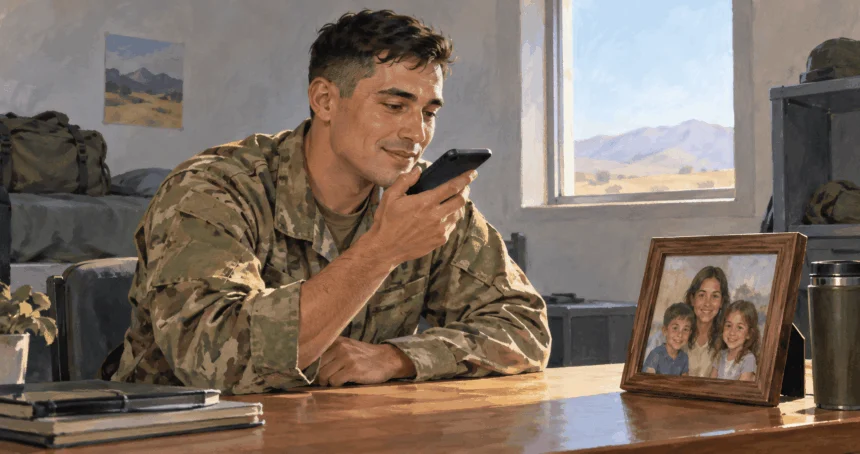
- Record Messages: If time zones or access make real-time calls difficult, consider recording audio or video messages, especially for children.
Communication Tips for Families at Home
- Share Daily Life: Keep your service member connected by sharing everyday happenings, big or small. Details make the distance feel smaller. Even short “thinking of you” notes matter.
- Maintain Positivity: While acknowledging challenges is okay, try to focus on positive news and offer encouragement. Express love and appreciation often. Avoid burdening the service member with problems they cannot solve from afar.
- Embrace Patience & Flexibility: Accept that communication will likely be irregular and plans will change. Delays are normal.
- Mind Your Tone (Especially in Writing): Be aware that text (email, chat) lacks nuance. Use sarcasm cautiously and assume positive intent in messages received. Avoid arguments via text/email.
- Verify Information: Don’t spread rumors or gossip about the deployment or other families. Rely on official sources for information.
- Keep Children Involved: Encourage children to participate in communication through letters, drawings, or recordings. Maintaining routines helps children cope.
- Stay Engaged: Keep busy with hobbies, work, volunteering, or connecting with support networks (FRGs, spouse groups) to combat loneliness and manage stress.
- Prioritize Self-Care: Taking care of your own physical and mental well-being is essential for resilience.
Keeping the Connection Alive Beyond Words
Maintaining emotional intimacy requires more than just talking or writing.
- Thoughtful Care Packages: Send packages tailored to your service member’s preferences, including favorite snacks (non-perishable), toiletries, photos, drawings, small reminders of home, or funny notes. Always check shipping restrictions.
- Visuals: Share photos and short videos of family life (always mindful of OPSEC).
- Shared Experiences (Asynchronous): Read the same book or watch the same movie/series separately, then discuss it during your next communication opportunity. Play online games together if feasible.
- Journals: Keep a physical journal to share upon return, or maintain a private online blog or shared document where you can both record thoughts and experiences.
- Music: Create and share playlists of songs that are meaningful to your relationship.
- Reading Programs: Participate in programs like the USO’s or United Through Reading, allowing the deployed parent to record story time for children.
Ultimately, successful deployment communication is a proactive partnership. It requires planning before separation, consistent effort from both sides during the deployment, and a focus not just on exchanging information but on actively nurturing the emotional bond through various means.