Last Checked: November 26, 2026Next Check: December 2, 2027
- sos.mn.govcited ×9
- eac.govcited ×7
- vote.minneapolismn.govcited ×4
- revisor.mn.govcited ×3
- vote.nyccited ×1113 reviewed
- pollworker.vote.nyccited ×4
- studentpollworker.vote.nyccited ×1
Last updated 34 seconds ago. Our resources are updated regularly but please keep in mind that links, programs, policies, and contact information do change.
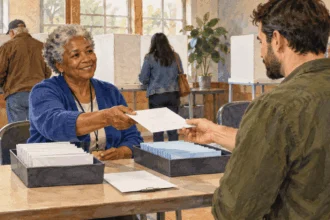
Poll workers welcome voters, check their registrations and issue ballots, and explain how to use the voting equipment. To become one, start with the Poll Worker Recruitment Lookup Tool from the U.S. Election Assistance Commission, which links applicants to the state or local election office where they can sign up.
Duties and pay vary by location: New York City pays $250 for an Election Day in several poll-worker jobs, while Minneapolis advertised $17.15 an hour for the November 2026 general election. Local election officials typically train the workers, who often serve on teams that include people from different parties. This guide draws most of its examples from New York City and Minnesota.
Who does what at the polls
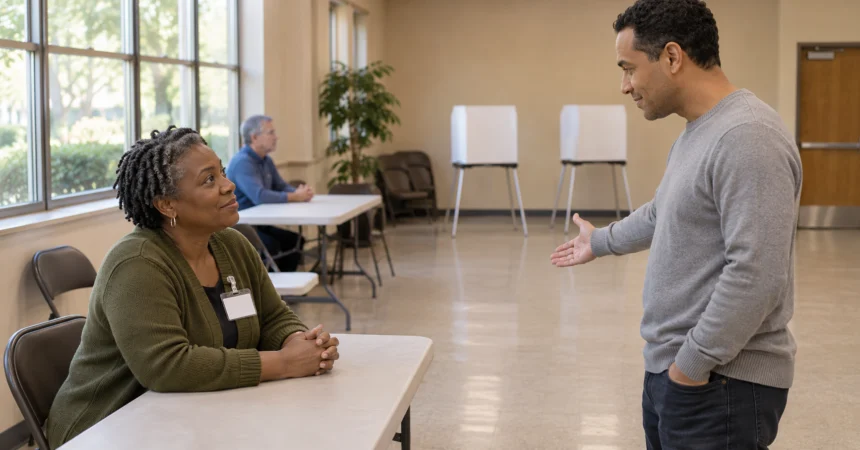
The team’s duties stretch from opening the polls and checking in voters through closing the polls and accounting for the ballots cast. A New York City information clerk posts signs inside the building, greets voters as they enter and directs them to the right table or, when necessary, the right voting site. The city’s election inspectors prepare the site and assist voters, then help close it and take part in the official count and reporting of results. The city’s application lists inspector and poll clerk as one position, generally responsible for opening the polls, serving voters and closing the polls.
The city’s Board of Elections instructs its workers to administer the election impartially and follow the law. The city calls attempts to persuade voters to vote a particular way electioneering and bars that activity within 100 feet of a polling-place entrance. In practice, a worker can explain how to use the equipment but leaves every choice on the ballot to the voter.
A poll watcher has a different role, observing how the election is conducted while respecting voters’ privacy and allowing voting to proceed without disruption. The rules for watchers vary by state, and the local election office explains the rules that apply in its community.
Before the doors open and after the last vote
Before voting starts in New York City, an accessibility clerk puts directional arrows outside, makes sure ramps and mats are in place, and installs a doorbell at an alternate accessible door if one is needed. That clerk also monitors the alternate accessible entrance during the shift so that someone who needs the door opened can get in. Inside, a worker checking each privacy booth looks for a magnifier and aims the light at the writing surface. If the light does not work, the worker should tell the site coordinator.
The city’s closing instructions protect the place of anyone in line by 9 p.m. and tell workers to wait until the last voter has voted before starting to close. One of the team’s end-of-day jobs is reconciliation, which the Election Assistance Commission describes as comparing how many voters checked in with how many ballots were cast at that location.
Helping someone cast their own ballot
The Election Assistance Commission says voters with disabilities have the right to vote privately and independently and to seek help from a worker trained to use the accessible voting machine. An election judge in Minnesota is a temporary local election employee trained to handle voting at the polling place. Minnesota’s election judge manual tells workers to ask before offering help and to get permission before touching a voter, a mobility aid, another assistive device or a service animal. The manual also places responsibility on the workers arranging the room: they must set up the polling place so people can cast their ballots independently and in private.
In Minneapolis, the ballot-marking machine can display a ballot in large print or high contrast, or read it aloud through headphones. A voter can enter choices on a touchscreen, use a Braille keypad or use a device controlled by sipping and puffing, and the machine prints the ballot once the voter has made those choices.
Minnesota law gives a voter who needs help because they cannot read English or cannot physically mark the ballot the option of help from two election judges who belong to different major political parties. Those judges must mark what the voter directs and preserve as much secrecy as the circumstances allow. The voter may choose a helper, although the voter’s employer or the employer’s agent, or an officer or agent of the voter’s union, cannot provide that assistance. Minneapolis tells voters that judges helping mark a ballot may neither influence their choices nor disclose them. New York City assigns interpreters to translate voting information and the ballot in a designated language and to interpret conversations between a voter and a poll worker.
Where to apply for a local assignment
The federal lookup brings together local information on eligibility, hours, pay and training, then points to the election office that takes applications. Before applying, use the listing for the place where you intend to work and read the assignment terms, particularly if travel or attending a training class would be difficult.
Minnesota directs prospective election judges to contact their city or county election office, and its state recruitment page also links to applications for some local jurisdictions. If the area is missing from that list, the state directs applicants to email an election judge interest form to their county election office.
New York City takes applications through its Board of Elections recruitment form, which asks applicants to authorize contact by phone or email about poll work. Applicants must be willing to travel within the borough for an assignment. To get an Election Day assignment, an applicant must attend training and pass the exam. A worker who reports to a site other than the assigned one will not be paid. Plan travel to the assigned site, even if another voting site is closer to home.
Eligibility depends on the place and the job
Rules differ from state to state. An Election Assistance Commission report says most states and territories require a poll worker to be a qualified or registered voter, and that states generally prefer workers who live in the precinct where they serve. Many states require poll workers to be 18, but the report says 46 states have youth poll worker programs that allow 15- to 17-year-olds to serve.
To serve as an adult election judge in Minnesota, a person must be eligible to vote in the state and able to read, write and speak English. For an election inspector, New York City specifies a registered voter residing in the city who is enrolled as a Democrat or Republican and can read and write English. The party requirement decides who can hold that job; it does not let an inspector favor a party while working.
Minnesota also limits who can serve in a given precinct, the local voting district a judge is assigned to. A candidate, including a write-in candidate, cannot serve in the precinct where they are a candidate, and the restriction there also covers specified relatives and household members of the candidate. The candidate’s family members covered by Minnesota law are a spouse, parent, child or sibling, including stepparents, stepchildren and stepsiblings. A separate provision lets two election judges who are related to each other in one of those ways work in the same precinct on different shifts, provided their shifts do not overlap.
Minnesota lets a student who is 16 or 17 on or before Election Day train to work. The student must be a U.S. citizen in good standing at a Minnesota high school or home-schooled, with permission from parents and school. Trainees serve in their county or an adjoining county, take the same training as other judges and do the same tasks except those requiring party affiliation. In practice, a student leaves to other judges any help that requires judges from two parties.
New York City’s student application specifies age 17 by Election Day, U.S. citizenship, attendance at school in the city and permission from both a school official and a parent or guardian. The city form also calls for a grade-point average of at least 2.5, which it describes as a B or 80, and registration as a future voter.
Training time, working hours and pay
Minnesota requires at least two hours of election judge training before service and requires judges to repeat it every two years to keep their certification. The Minneapolis student program requires a three-hour training course and offers a choice between an eight-hour and a 15-hour shift on Election Day. New York City’s poll-worker manual tells workers to arrive by 5 a.m. for a 6 a.m. opening, and polls close at 9 p.m. An assignment runs longer than the voting hours, with setup before voters arrive and work after the last one leaves.
Minnesota’s recruitment guide says people can volunteer or be paid, with wages varying by location and experience, and sets a floor of two-thirds of the minimum wage for student trainees. For the November 3, 2026 general election, Minneapolis advertised an hourly rate of $17.15 for election judges, paid training and some half-day positions. New York City’s online application lists $250 for an Election Day for inspectors, poll clerks and information clerks, plus $100 for training if the worker attends, passes the exam and works an election at the assigned site. The city’s paper application, dated August 2024, lists the same rates and conditions. The city tells workers to complete the time sheet using the details from their assignment card and to check in on the tablet. Its manual tells workers to expect payment in six to eight weeks.
In Minnesota, a worker selected as an election judge can take time off from a regular job without penalty. The worker must give the employer at least 20 days’ written notice, with the appointing authority’s certification of the hours of service and the hourly pay. The employer may reduce the worker’s regular pay by the amount paid for election service during the absence and may limit the number away for that purpose to 20 percent of the workforce at any one worksite. A worker who needs that leave should get the hours and pay in writing from the hiring office before asking the employer.