

Last Checked: October 5, 2026Next Check: June 1, 2030
- supremecourt.govcited ×3
- law.cornell.educited ×43
Last updated 4 weeks ago. Our resources are updated regularly but please keep in mind that links, programs, policies, and contact information do change.
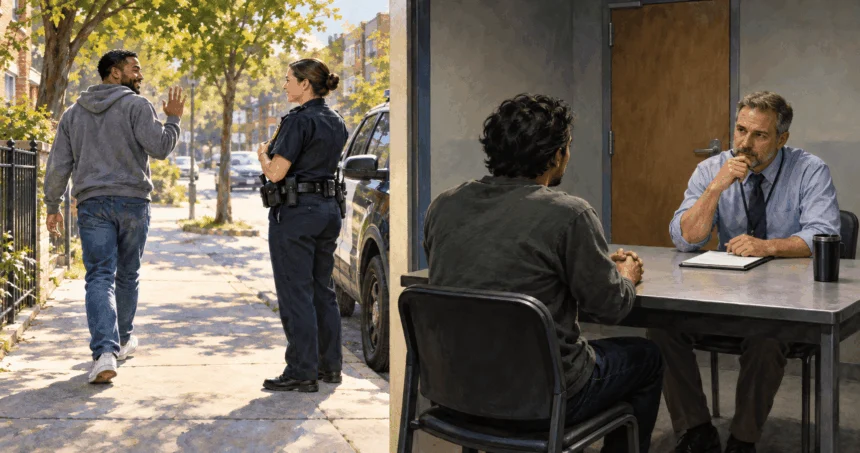
Police do not have to read the Miranda warning, the notice of the right to remain silent and the right to a lawyer, every time they ask a question. Miranda generally requires warnings for custodial interrogation. That means police have imposed restraints comparable to formal arrest and are asking questions or using tactics likely to draw an incriminating response. What matters is the real restrictions and the questioning, not whether an officer has announced an arrest.
In a noncustodial interview, such as one a person attends voluntarily and is free to leave, Miranda does not apply. But police can use voluntary answers as evidence in a criminal case, so the decision to speak can matter before any warning is read.
- A police question is not automatically custody
- Custody depends on the whole encounter
- Interrogation includes more than direct questions
- Warnings create a choice, and a waiver matters
- Silence and counsel stop questioning in different ways
- Roadside stops, hospital interviews and children
- A missing warning does not erase the case
A police question is not automatically custody
Under Florida v. Bostick, police may approach someone in a public place, ask whether the person will answer questions, and use voluntary answers without that contact itself violating the Fourth Amendment. For a voluntary encounter, the useful question is whether the person can decline the conversation rather than whether the officer is investigating a crime.
An encounter is a seizure under the Fourth Amendment only if, considering the circumstances, a reasonable person would believe they were not free to leave. Under United States v. Mendenhall, a threatening group of officers, a displayed weapon, physical touching, or a tone suggesting that compliance is compulsory can point toward a seizure.
Under Terry v. Ohio, to justify a seizure or a search, police must be able to identify specific facts and reasonable inferences that warrant it, rather than rely on a hunch. The authority to detain and the duty to give Miranda warnings are separate questions. An ordinary traffic stop can restrict a motorist’s freedom without creating Miranda custody. A person may ask the officer whether answering is voluntary and whether leaving is permitted. If the officer says leaving is not permitted, that alone does not establish Miranda custody; it is a reason to look at the restraints.
Refusing to discuss an investigation is not the same as refusing to give a name, which a state’s law may require. In Hiibel v. Sixth Judicial District Court of Nevada, the Supreme Court rejected a Fifth Amendment objection to that state’s requirement that a person lawfully stopped on reasonable suspicion disclose a name. The objection failed because there was no reasonable belief that giving the name would be incriminating. That ruling concerned Nevada’s law and a person’s name; it does not show that a name must be given to police in every state, or that other questions must be answered.
Custody depends on the whole encounter
Under Howes v. Fields, the Miranda custody analysis starts by asking whether an objectively reasonable person would have felt free to end the interrogation and leave. Courts consider the location, duration, statements made during the interview, physical restraints, and release at its end. A promise that the meeting is voluntary belongs in that analysis, alongside what officers actually permit.
The custody test sounds like the seizure test, but it asks for more. Limits on movement are necessary but not enough for Miranda custody: the setting must also present the same coercive pressures as station-house questioning.
Under Stansbury v. California, an officer’s uncommunicated belief that a person is the suspect does not determine custody. Nor can describing someone as a witness erase restraints that make the questioning custodial.
In Oregon v. Mathiason, a 1977 Supreme Court decision, a suspect voluntarily came to a police station, was not arrested there, and was allowed to leave at the end of the interview. The Supreme Court found that the unrestricted freedom to depart made that interview noncustodial, even though any police interview of a suspect has coercive aspects.
In Orozco v. Texas, the Supreme Court required warnings when a man was questioned in his own bedroom in the early hours of the morning and an officer testified that he was under arrest and not free to leave. Police do not need to move an interview to an interrogation room for the custody issue to arise.
Interrogation includes more than direct questions
Under Rhode Island v. Innis, interrogation includes direct questioning and police words or actions that officers should know are reasonably likely to produce an incriminating response. That second category leaves out the words and actions that normally accompany an arrest and custody. An officer need not put a question mark at the end of a remark for the rule to matter.
The test for the equivalent of questioning focuses primarily on the suspect’s perceptions and foreseeable responses, rather than solely on the officer’s intent. Police are not held accountable for unforeseeable results of their words or actions, only for responses they should have anticipated.
Freely volunteered statements are not barred by Miranda. Custody therefore does not make every word spoken inadmissible.
Under Pennsylvania v. Muniz, a routine-booking exception lets police ask, without a warning, for biographical information needed for booking or pretrial services when the questions serve recordkeeping and administrative purposes. Under New York v. Quarles, a separate public-safety exception permits unwarned questions reasonably prompted by a concern for public safety. These are specific exceptions, not a general permission to call investigative questions preliminary and omit the warning.
Warnings create a choice, and a waiver matters
Before custodial questioning, the warning must convey the right to remain silent and that statements can be used in court. It must also convey the right to an attorney’s presence and to appointed counsel before questioning if the person cannot afford a lawyer and wants one. Under Florida v. Powell, Miranda does not require one exact script, but the warning must reasonably convey the required rights. Miranda’s right to a lawyer applies during custodial interrogation; a voluntary noncustodial interview does not by itself trigger it.
Under Moran v. Burbine, a valid waiver, a decision to give up these rights and answer questions, must reflect an uncoerced choice and awareness of both the right abandoned and the consequences of giving it up. Under Berghuis v. Thompkins, when warnings have been given and understood, an uncoerced statement can establish an implied waiver. A person should not assume that avoiding a signed form means answers cannot be used. Before agreeing to speak, a person can ask police to explain any part of the warning that is unclear.
Under Colorado v. Spring, a waiver can still be valid when police did not say in advance what the questioning would be about. Agreeing to answer about one investigation does not guarantee that every later question will concern it. Protection against further questioning comes from invoking a right, that is, clearly stating that it is being used, not from a change of subject.
Silence and counsel stop questioning in different ways
Remaining quiet during an interview does not by itself invoke the Miranda right to silence; the invocation must be unambiguous. To make the choice clear, state that the right to remain silent is being invoked and that questioning should stop.
Under Michigan v. Mosley, once silence is invoked, the person’s right to cut off questioning must be scrupulously honored. Police must stop, but invoking silence does not permanently bar every later interview. The Supreme Court has allowed renewed questioning about a different crime after officers stopped the first interview, waited more than two hours, changed the officer and location, and gave fresh warnings. Those circumstances explain the ruling; they are not a universal timer allowing police to disregard a refusal.
Under Davis v. United States, a request for an attorney must be sufficiently clear that a reasonable officer understands it as a request for counsel. If counsel is wanted, request an attorney directly rather than wondering aloud whether one might be useful. Under Edwards v. Arizona, after a custodial request for counsel, police generally cannot resume interrogation without counsel present unless the accused initiates further communication. This protection against police restarting the questioning is stronger than the one that follows an invocation of silence.
Under Arizona v. Roberson, that restriction applies even when police want to ask about a separate investigation. Under Maryland v. Shatzer, a break in Miranda custody lasting 14 days can end that bar on renewed questioning after counsel was invoked. A mere pause between questions is not such a break.
Under McNeil v. Wisconsin, the Sixth Amendment right to counsel is separate: it begins with a formal prosecution, such as a criminal charge or arraignment, and is specific to the offense charged. Having a lawyer in one case therefore does not answer every question about an interview concerning another case.
Roadside stops, hospital interviews and children
Under Berkemer v. McCarty, the usual traffic stop is more public and less police dominated than the station-house environment. A roadside stop requires Miranda protection once police impose restraints comparable to formal arrest. So a stop that begins without any need for warnings can require them later.
Whether a suspect questioned by police in a hospital is in custody depends on the whole situation; a hospital bed is no more decisive by itself than a station desk. Courts assess location, duration, police statements and restraints as part of the objective custody inquiry. Whether a statement was voluntary is a separate question: pain, shock, isolation and impaired consciousness can undermine a meaningful choice to answer.
Under J. D. B. v. North Carolina, a child’s age must enter the custody analysis when officers know it or it is objectively apparent, although age need not decide every case. A child’s sense of being free to leave cannot simply be assumed to match that of an adult in the same room.
Under Fare v. Michael C., a juvenile’s waiver is evaluated through the circumstances, including age, experience, education, background, intelligence, and capacity to understand the warning and its consequences. A child’s ability to repeat the warning and a child’s ability to understand giving up a right are different questions. This is the federal constitutional framework; obtain advice about the law governing the particular juvenile interview rather than assuming a parent’s absence settles it.
A missing warning does not erase the case
Statements obtained in violation of Miranda generally cannot be used in the prosecution’s case in chief, the evidence offered to prove guilt. That is an evidence rule, not a promise that an arrest or an entire prosecution disappears. In United States v. Patane, a decision without a majority opinion, physical evidence resulting from voluntary unwarned statements did not have to be excluded solely because the warning was missing.
Under Mincey v. Arizona, an involuntary statement cannot be used against the defendant at any point in a criminal trial without violating due process. An interview without Miranda custody does not give police a free pass to obtain an involuntary statement.
In its 2013 decision in Salinas v. Texas, a Supreme Court plurality, a group of justices short of a majority, rejected a Fifth Amendment claim arising from a voluntary pre-arrest interview because the person did not expressly invoke the privilege. Going quiet before arrest does not guarantee that the silence will be kept out of evidence.
In its 2022 decision in Vega v. Tekoh, the Supreme Court held that a Miranda violation alone does not let a person sue the officer for damages under Section 1983, a federal civil-rights law.
In federal criminal cases, a request to suppress evidence, meaning to keep it out of the trial, generally must be made before trial when its basis is reasonably available and it can be decided without a trial on the merits. For a disputed interview, bring counsel the sequence of events, the restraints imposed, what was said about leaving, and any request to stop or see a lawyer.