- uscourts.gov3 links
- orangecountygov.com3 links
- history.nycourts.gov2 links
- congress.gov2 links
- justice.gov
- courts.ca.gov
- casamo.com2 links
Last updated 10 months ago. Our resources are updated regularly but please keep in mind that links, programs, policies, and contact information do change.
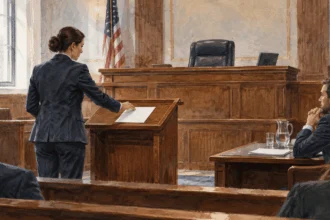
In American courtrooms, the default setting is open doors.
The principle stands in stark contrast to the secret tribunals and shadowy proceedings that have marked authoritarian regimes throughout history. When justice is done in America, it must also be seen to be done.
This openness serves multiple purposes: it protects the accused from persecution, ensures judges and prosecutors remain accountable, builds public trust in the system, and educates citizens about how their courts work.
From the open fields of medieval England to modern debates over cameras in courtrooms, the story of the public trial reflects a nation’s enduring commitment to accountable government.
The Historical Foundation
The American guarantee of a public trial isn’t a modern innovation. It’s a deeply ingrained tradition inherited from Anglo-American common law, born from a profound and historically justified fear of secret, arbitrary state power.
Ancient Roots of Open Justice
Long before the United States existed, the concept of public trials was taking shape in England. Criminal trials have been presumptively open to the public since the very origins of the Anglo-American legal system, with evidence of community participation in justice predating even the Norman Conquest of 1066.
In a time before professional police forces or a formal judiciary, justice was a communal affair. Early English trials were often held in the open air, in forums like the County or Hundred Courts, where the freemen of the community served as judges of both law and fact.
The “public” wasn’t a passive audience but an active participant. Justice was administered by the community, for the community. This tradition became so central to civic life that attendance at trials evolved into a duty, with fines sometimes levied against those who failed to appear.
The early jury trial itself, which could involve as many as 84 jurors, was inherently a public spectacle and a communal responsibility. The public’s presence wasn’t a privilege granted by a king or court—it was a fundamental component of the system’s operation and legitimacy.
This original structure, where the public and jury were almost indistinguishable, began changing as the legal system professionalized over centuries. The rise of full-time law enforcement and the emergence of the public prosecutor—a surprisingly late development in legal history—gradually shifted the ordinary citizen’s role.
The public was no longer the direct administrator of justice but became its watchful guardian. This evolution from participant to observer set the stage for the modern framework of public access, where the central tension lies between the public’s right to scrutinize proceedings and the court’s need to manage an increasingly complex legal process.
A Rejection of Secret Courts
The commitment to open proceedings in the common law world became a defining characteristic that set it apart from another major legal tradition. The public nature of the “accusatorial” system, which presumes innocence and pits the state against the defendant in a contest of evidence, was a direct counterpoint to the “inquisitorial” systems that took root in continental Europe.
Influenced by Roman and canonical law, inquisitorial justice was often conducted in secret, with a magistrate leading the investigation and questioning witnesses outside the view of the public or even the accused.
This distinction wasn’t merely academic—it was forged in the crucible of political and religious persecution. The “traditional Anglo-American distrust for secret trials” is directly traceable to the notorious abuses of institutions like the Spanish Inquisition and, most significantly for American law, the English Court of Star Chamber.
The Star Chamber, which operated from the late 15th to mid-17th century, became a symbol of oppressive state power. While some of its sessions may have been technically open, its most critical function—the examination of witnesses against the accused—was conducted privately, stripping the defendant of any opportunity to challenge their accusers.
The court was an instrument of the Crown, used to suppress dissent and punish enemies without the safeguards of a regular trial.
The legacy of the Star Chamber and other secret tribunals created a powerful and lasting association in the Anglo-American psyche: secrecy in justice is a tool of persecution. The public trial wasn’t simply a procedural preference but a profound political choice—a conscious rejection of an entire model of governance.
The Sixth Amendment
By the time of the American Revolution, the tradition of public trials was already a well-established and cherished right in the colonies. The Founders saw it as an essential attribute of a just society.
When the Bill of Rights was drafted, including this principle was a foregone conclusion. The Sixth Amendment to the U.S. Constitution didn’t invent a new right but rather codified an existing, deeply held belief into the nation’s highest law.
Ratified in 1791, the amendment’s text is unequivocal: “In all criminal prosecutions, the accused shall enjoy the right to a speedy and public trial…” This guarantee was a direct message to the new federal government, ensuring that the feared practices of the Star Chamber would not be resurrected on American soil.
It established that the American system of justice would be one of accountability, not unchecked authority. While the public benefits immensely from this openness, the right is framed, first and foremost, as a shield belonging to the accused—a fundamental protection against the immense power of the state.
The public trial is not just a legal procedure; it’s a political institution and a cornerstone of the American democratic experiment.
Who Benefits and Why
The principle of a public trial functions as a complex, interconnected system that provides mutually reinforcing benefits to the accused, the judiciary, the public, and the democratic process itself. These four pillars work in concert to ensure that justice is not an abstract ideal but a tangible reality.
Protecting the Accused
At its core, the right to a public trial is “for the benefit of the accused.” It’s an essential element of the broader right to a fair trial, a concept recognized as a fundamental human right in both U.S. constitutional law and international agreements.
The presence of interested spectators in the courtroom acts as a powerful deterrent against abuse and error.
This protection manifests in several practical ways. First, the requirement that witnesses testify in the open, under the public gaze, is a strong check against perjury. It’s far more difficult to lie when one’s words are being recorded and heard by community members, friends, and the press.
Second, public proceedings can bring forth previously unknown witnesses who, upon hearing testimony, may realize they have relevant information and come forward.
Most importantly, the presence of the public keeps the judge and jury “keenly alive to a sense of their responsibility” and to the importance of their functions. Knowing that their conduct is subject to scrutiny encourages all participants to adhere to proper procedure and to act with the gravity the situation demands.
This transparency serves as a powerful “safeguard against any attempt to employ our courts as instruments of persecution,” ensuring that a defendant is not “unjustly condemned” in the shadows.
Ensuring Judicial Accountability
While the right primarily belongs to the defendant, its benefits radiate outward to the entire justice system. Public trials provide an indispensable “extra layer of accountability,” allowing citizens to observe whether judges, prosecutors, and other government officials are performing their duties properly.
The very legitimacy of the judiciary rests on the public’s trust, a trust that is earned through demonstrated adherence to high ethical standards and a willingness to hold personnel accountable for misconduct.
Accountability in this context means more than just avoiding corruption. It involves a commitment to “reasoned decisionmaking grounded in publicly recognized values and facts” and justifying decisions to others who can evaluate, influence, or override those judgments.
The courtroom is the primary stage where this justification happens. The public trial is a vital part of America’s system of checks and balances, ensuring that the judicial branch remains answerable to the people it serves.
Judicial independence, while critical, isn’t absolute. It must be balanced with accountability, and open courtrooms are the most powerful mechanism for maintaining that equilibrium.
Building Public Trust
The accountability fostered by open trials is the bedrock upon which public trust is built. Public trust is the belief that the courts are “fair, unbiased, and work well.” Following fair and open legal processes is one of the most important factors in cultivating this belief.
When citizens can see for themselves that legal standards are being applied, that both sides have a chance to be heard, and that decisions are based on evidence presented in court, they’re more likely to view the system as legitimate.
The consequences of a collapse in this trust are dire. A public that distrusts the courts may refuse to accept their authority, leading to the flouting of laws and court orders. Citizens may become unwilling to participate in the legal process by reporting crimes or, critically, by serving on juries.
In a worst-case scenario, a widespread loss of faith in the justice system could threaten the social order itself, as people may feel compelled to take matters into their own hands.
Public trials aren’t just about the outcome of a single case—they’re about continually reinforcing the legitimacy of the rule of law. When people trust the fairness of the process, they’re more likely to respect the outcome, even when they disagree with it.
Civic Education
Beyond its role as a safeguard, the public trial serves a proactive function as a powerful engine of civic education. As Thomas Jefferson believed, an educated citizenry is a prerequisite for a free society, and understanding how courts work is a vital part of that education.
Public trials, and especially jury service, are “little schools of democracy.” They demystify the justice system, correcting the misapprehensions often created by fictional media portrayals and giving citizens direct insight into their own communities.
For most citizens, jury service is their “most significant opportunity to participate” in the democratic process—an experience often more active and impactful than voting.
It’s a process that transforms “private individuals into public citizens” by giving them a direct role in the administration of justice. This hands-on experience in applying legal principles, weighing evidence, and engaging in deliberation fosters a deeper respect for the rule of law and equips citizens with the skills and dispositions necessary for self-governance.
These four pillars create a virtuous cycle. Open trials promote fairness for the accused and ensure judicial accountability. This transparency builds public trust in the system’s legitimacy. A trusting public is more willing to participate, for instance, by answering the call for jury duty.
This participation provides a profound civic education, creating a more informed citizenry that, in turn, understands the importance of and continues to demand fairness and accountability, completing the circle.
When Courts Can Close Their Doors
While the presumption of openness is a cornerstone of American justice, the right to a public trial is fundamental but not absolute. The legal system recognizes that in certain specific circumstances, the principle of transparency can conflict with other vital interests, such as a defendant’s right to a fair trial, a witness’s safety, or national security.
Because the right is so important, the bar for closing a courtroom to the public is extraordinarily high.
A High Standard for Secrecy
The Supreme Court has made it clear that courtroom closures are the exception, not the rule. The default is always openness. This principle is so strong that the U.S. Department of Justice has an official policy stating it has a “general overriding affirmative duty to oppose” the closure of judicial proceedings and should only consent to it when “plainly essential to the interests of justice.”
This institutional stance underscores that any deviation from transparency must be rigorously justified. The legal system has developed a formal, procedural test that frames any closure not as a routine matter of judicial discretion but as a constitutional event requiring extraordinary justification.
The Waller Test
In the landmark 1984 case Waller v. Georgia, the Supreme Court established a demanding four-part test that a court must satisfy before it can close a proceeding over a defendant’s objection. This test is analogous to “strict scrutiny,” the highest level of judicial review, which is reserved for protecting fundamental constitutional rights.
The four prongs of the Waller test are:
An Overriding Interest: The party seeking to close the courtroom must demonstrate an “overriding interest” that is likely to be prejudiced if the proceeding remains open. This cannot be a minor concern or a matter of convenience—it must be a value of the highest order, such as protecting a witness from imminent danger or safeguarding classified national security information.
Narrowly Tailored Closure: The closure must be “no broader than necessary” to protect that interest. This means a judge cannot close an entire week-long trial to protect the identity of a single undercover officer who will testify for only one hour. The closure must be precisely targeted to the specific testimony or evidence that requires protection.
Consideration of Reasonable Alternatives: The court must actively consider “reasonable alternatives” to a complete closure. This critical step forces a judge to think creatively before resorting to secrecy. Alternatives could include sequestering the jury, changing the venue of the trial, or protecting a witness’s identity by allowing them to testify using a pseudonym or initials.
Adequate Findings on the Record: The judge must make specific, on-the-record findings that are “adequate to support the closure.” This creates a record that allows an appellate court to review the decision and determine if the closure was properly justified. Vague or general statements about privacy or safety are not sufficient.
The gravity of this right is further underscored by the remedy for its violation. An improper courtroom closure is considered a “structural error.” Unlike most trial errors, a defendant whose right to a public trial has been violated doesn’t need to prove that the error affected the outcome of their case. The conviction is subject to automatic reversal.
This rare and powerful remedy signifies that a secret trial is so fundamentally at odds with the American concept of justice that the process itself is deemed illegitimate, regardless of the evidence of guilt.
Justifiable Reasons for Closure
While the Waller test sets a high bar, there are situations where courts have found closure to be justified. These exceptions aren’t arbitrary but are tied to protecting other significant rights and compelling public interests:
National Security: Cases involving classified information where public disclosure could endanger the country.
Witness Safety: Protecting the identity of undercover police officers or shielding witnesses from intimidation, particularly in cases involving organized crime or gangs.
Victim Protection: Safeguarding the privacy and preventing the re-traumatization of victims, especially child victims in sex crime cases.
Juvenile Proceedings: Juvenile court proceedings are generally closed to the public. This protects the minor from the lifelong stigma of a public record and promotes the goal of rehabilitation.
In each instance, a court must still meticulously apply all four parts of the Waller test, ensuring that the closure is the last resort and is as limited in scope and duration as possible.
Public Trials vs. Secret Grand Juries
To fully appreciate the significance of a public trial, it’s useful to contrast it with another critical but often misunderstood institution in the American legal system: the grand jury. The fact that grand jury proceedings are conducted in secret while trials are held in public isn’t a contradiction—it reflects a coherent legal philosophy where the rules are tailored to protect citizens from state overreach at different stages of the justice process.
The Grand Jury’s Role
A grand jury isn’t a trial jury. It doesn’t decide guilt or innocence. Its sole function is to serve as an investigative body, typically composed of 16 to 23 citizens, that hears preliminary evidence presented by a prosecutor.
Its job is to determine whether there’s “probable cause”—a reasonable basis for believing a crime has been committed—to justify issuing an indictment and formally accusing someone of a crime. It stands between the government and the citizen, acting as a shield to prevent the state from bringing unfounded or malicious prosecutions.
Why Grand Juries Meet in Secret
Unlike a trial, grand jury proceedings are conducted in complete secrecy. This secrecy isn’t meant to hide government misconduct but to serve several crucial protective functions:
Protecting the Innocent: It shields individuals who are being investigated, but who may never be charged with a crime, from the devastating and often permanent harm to their reputation that a public investigation would cause.
Encouraging Witness Testimony: It allows witnesses to testify freely and fully without fear of retaliation from potential defendants or public pressure.
Preventing Flight: It prevents potential targets of an investigation from fleeing before an indictment can be issued and an arrest can be made.
Ensuring Free Deliberation: It allows the grand jurors to deliberate without being subjected to outside influence or popular opinion, ensuring their decision is based only on the evidence presented.
Two Sides of the Same Coin
The secrecy of the grand jury and the openness of a trial are two sides of the same coin, both designed to protect the citizen. Secrecy protects the unaccused citizen from the immense power of the state to merely investigate.
Once the state has met its burden before a grand jury and has formally issued an indictment, the power dynamic shifts. The citizen is now the accused, facing the full prosecutorial power of the government. At this stage, transparency becomes the citizen’s primary shield.
The open trial ensures that the state’s power to prosecute, convict, and punish is exercised fairly and under the watchful eye of the public.
| Feature | Public Trial | Grand Jury Proceeding |
|---|---|---|
| Primary Purpose | To adjudicate guilt or innocence in an open, adversarial process | To investigate potential criminal conduct and determine if probable cause exists to issue an indictment |
| Public Access | Presumptively open to the public and media | Secret and closed to the public |
| Key Participants | Judge, jury, prosecutor, defense attorney, defendant, witnesses, public spectators | Grand jurors, prosecutor, witnesses (No judge or defense attorney present) |
| Defendant’s Role | Present throughout, with the right to confront witnesses and present a defense | Not present; has no right to present evidence or cross-examine witnesses |
| Outcome | Verdict of guilty or not guilty | “True bill” (indictment) or “no bill” (no indictment) |
Technology and Modern Challenges
The centuries-old principle of the public trial is facing new opportunities and challenges in the 21st century. Technology is rapidly transforming the very definition of “public access,” pushing the legal system to grapple with how to apply timeless values of fairness and transparency in an era of live streaming, social media, and digital records.
Cameras in the Courtroom
The most prominent modern debate over public access centers on the presence of cameras and the broadcasting of court proceedings. This isn’t a new issue, but it represents the latest chapter in the long-running effort to balance the public’s right to know with the defendant’s right to a fair trial.
Proponents argue that cameras are the logical extension of the public gallery, allowing a far wider audience to witness justice in action, thereby enhancing transparency and civic education. Opponents raise serious concerns that broadcasting could undermine the integrity of the trial itself.
Federal vs. State Courts
There’s no national consensus on this issue, resulting in a starkly divided legal landscape. Most state courts have embraced technology to some degree, allowing cameras and broadcasting in many trial and appellate proceedings, subject to specific rules and a judge’s discretion.
In sharp contrast, the federal court system has remained far more restrictive. Since 1946, Federal Rule of Criminal Procedure 53 has imposed a near-total ban on photography and broadcasting from federal criminal proceedings.
While the federal judiciary has conducted limited pilot programs for cameras in civil cases, and a few appellate courts, notably the U.S. Court of Appeals for the Ninth Circuit, permit video of their arguments, the prohibition in criminal trials remains firmly in place.
This deep institutional difference reflects a philosophical disagreement about the primary purpose of a trial. The federal system’s rigid stance prioritizes the trial as a solemn, controlled forum for discovering truth and protecting participants’ rights above all else. The more permissive approach in many states places greater relative weight on the trial’s role as a public, educational, and transparent civic event.
Balancing Transparency and Due Process
The debate over cameras brings the core historical tension of the public trial into the digital age. The arguments for broadcasting are a direct extension of the traditional rationale for public access: maximizing observation enhances accountability and informs the public, especially in high-profile cases of great national interest.
However, the arguments against cameras are rooted in the fear that the public’s presence, when amplified by technology, could corrupt the very process it’s meant to oversee. These concerns include:
Witness Intimidation: Witnesses may be less willing to testify, or may alter their testimony, if they know their face and words will be broadcast to a global audience, potentially exposing them to harassment or danger.
Juror Prejudice: The risk of jurors being exposed to outside commentary or public pressure increases dramatically when a trial is televised.
Altered Behavior: The presence of cameras may cause lawyers, judges, and even the defendant to “perform” for the audience rather than focus on the sober business of presenting evidence and seeking truth. This can turn a trial into a form of public entertainment, undermining its dignity and purpose.
Technology hasn’t changed the fundamental principles at stake—it has simply magnified their scale and complexity, transforming the audience from a local community gathered in a courthouse to a potential global viewership online.
Beyond the Camera
The conversation about technology and access extends beyond cameras. The digitization of court records is making dockets, filings, and decisions more accessible to the public than ever before, enhancing transparency and efficiency.
The widespread adoption of remote proceedings, accelerated by the COVID-19 pandemic, has reduced costs and barriers for many litigants.
However, these innovations also raise new challenges, including ensuring cybersecurity, maintaining the decorum of virtual proceedings, and bridging the “digital divide” to guarantee that access isn’t limited to those with reliable technology and internet service.
As technology continues to evolve, the courts will face the ongoing task of adapting their practices to uphold the ancient and essential promise of a truly public trial. The core principle remains unchanged: in America, justice must not only be done—it must be seen to be done.