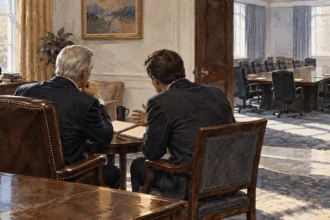
The U.S. foreign policy process involves complex interactions between the president, Congress, the military, intelligence agencies, and the State Department. The National Security Council coordinates the president’s top advisers to address global challenges from trade to military interventions. While the president directs foreign affairs, Congress checks this power through funding and war declarations.
The President and Executive Branch
The president leads via the State Department, which manages diplomacy. The White House prepares leaders for high-stakes international calls and assesses foreign interventions.
The National Security Council
The National Security Advisor guides responses to global events, anticipating crises and countering disinformation. The NSC coordinates with the Pentagon and State, despite common agency tensions, enabling rapid crisis decisions.
Congress and Oversight
Congress oversees the National Security Council and debates lost war powers. The Senate approves treaties and ambassadors.
Ideas Shaping Policy
Think tanks and public advocacy influence policy through deliberation stages.
Congress holds substantial constitutional powers to shape America's foreign policy alongside the president. While the…
The executive branch leads U.S. foreign policy, with the President wielding constitutional powers to negotiate…
Foreign policy decisions shape America's relationships with nations worldwide, but the process of making those…
Six years. That is how long the Iraq War continued after public opinion turned against it. By early 2005, Gallup…
When Donald Trump spoke with Chinese President Xi Jinping on February 4, 2026, the call itself lasted perhaps an hour.…
On February 4, 2026, President Donald Trump spoke with Chinese President Xi Jinping for 90 minutes—discussing Taiwan's future, Iranian nuclear…
The phone rings at the State Department Operations Center at 3 a.m. Washington time. Fighting has erupted in South Sudan's…
President Donald Trump exercised his executive clemency power on November 28, 2025, to pardon Juan Orlando Hernández, the former President…
The National Security Council possesses no crystal ball. Instead, it employs a system of people, processes, and analytical tools designed…
Think tanks wield influence over American national security policy through a network of former officials, policy papers, and behind-the-scenes access…
At the heart of American national security lies a critical tension: the relationship between those who gather intelligence and those…