Last updated 11 months ago. Our resources are updated regularly but please keep in mind that links, programs, policies, and contact information do change.
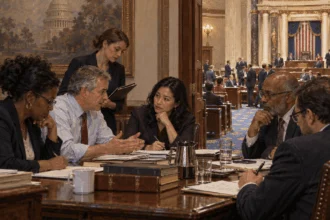
The United States Congress relies on a complex system of committees to manage its immense workload of creating laws and overseeing the federal government. These committees allow members to develop specialized knowledge and divide labor across the many policy areas Congress must address.
Often called “little legislatures,” committees are where the detailed work of crafting legislation happens, frequently away from the public spotlight of floor debates. Most bills never make it out of committee, and those that do are largely shaped by committee members before reaching a full chamber vote.
This article explains two key types of congressional committees: Standing Committees and Conference Committees. While both are called “committees,” they serve distinctly different functions in the legislative process.
The Workhorses of Congress: Understanding Standing Committees
Standing committees are the central pillars of the legislative process in both the House of Representatives and the Senate. They handle the bulk of legislative work, policy development, and government oversight.
What Are Standing Committees?
Standing committees are permanent panels established under the rules of the House and Senate. They specialize in particular subject areas, such as agriculture, finance, armed services, or foreign affairs. Unlike temporary committees, standing committees continue their work from one Congress to the next, allowing members and staff to build deep policy expertise over time.
Currently, the U.S. House of Representatives has 20 standing committees, and the U.S. Senate has 16. These numbers have changed throughout history to meet evolving needs; in the early 20th century, the House had as many as 59 standing committees.
Each standing committee has a defined area of public policy, known as its jurisdiction, outlined in the rules of its chamber. For instance, the Senate Committee on Finance has jurisdiction over taxation, revenue measures, U.S. debt, customs, trade agreements, tariffs, and health programs under the Social Security Act, such as Medicare and Medicaid. The House Committee on Rules holds a unique and powerful jurisdiction: it determines the rules under which bills will be presented to the full House, effectively acting as a “traffic cop” for legislation moving to the House floor.
These defined jurisdictions make standing committees initial gatekeepers for legislation. When a bill is introduced, its subject matter determines which committee(s) it will be referred to. The committee’s actions (or inaction) can determine whether the bill progresses or “dies.” This system concentrates significant power within specialized groups of lawmakers. Because committees decide which bills to consider and the committee chair typically sets the agenda, a relatively small number of members can effectively prevent legislation from reaching a vote by the full chamber, regardless of broader support.
Origins and Evolution: How Standing Committees Came to Be
Interestingly, congressional committees aren’t mentioned in the U.S. Constitution. They emerged early in the nation’s history out of practical necessity as the legislative workload grew. In the initial Congresses, both chambers relied more on temporary, or “select,” committees appointed to handle specific bills or issues as they arose.
Over time, as legislation became more complex and voluminous, these temporary bodies evolved into a system of permanent standing committees. The House established its first truly standing committee, the Committee on Ways and Means, during the Fourth Congress (1795-1797), while the Senate formally adopted a system of 11 standing committees in 1816, including the Finance and Foreign Relations Committees, which still exist today.
The modern committee structure was significantly shaped by major reforms in the 20th century, most notably the Legislative Reorganization Acts of 1946 and 1970. These acts streamlined congressional operations, reduced the number of committees, clarified their jurisdictions, and enhanced their capacity for policy development and oversight. A key change was the formal authorization of subcommittees and the provision of professional staff for committees. This increased staffing allowed committees to develop greater expertise and reduce their reliance on outside sources for information and analysis.
The evolution of standing committees from ad-hoc groups to a complex, formalized system with dedicated staff and defined jurisdictions reflects the corresponding growth and increasing complexity of the federal government. As the nation expanded and faced new challenges, the committee system adapted. The consolidations and professionalization brought about by the Reorganization Acts were direct responses to the need for more efficient and expert handling of an ever-expanding scope of governmental business.
Getting a Seat at the Table: How Members Are Assigned
Assignment to standing committees is a critical step for members of Congress, influencing their legislative impact, ability to serve their constituents, and even their political careers. The process is largely driven by the political parties within each chamber.
At the beginning of each new Congress, each party (through mechanisms like a “committee on committees” or a “steering committee”) determines which of its members will serve on which committees. The proportion of seats each party holds on a committee generally reflects its overall strength in that chamber, with the majority party holding a majority of seats and the chairmanship of each committee. There are exceptions; for example, the House Ethics Committee typically has an equal number of members from each party.
Members can request assignments to specific committees based on personal interests, professional background, policy expertise, or the particular needs of their constituents and district. For example, a representative from a largely agricultural district might seek a seat on the House Agriculture Committee, while a senator from a state with a significant military presence might want a position on the Senate Armed Services Committee.
Seniority—a member’s length of continuous service in Congress or on a particular committee—has traditionally played a significant role in committee assignments, especially in securing more sought-after positions and, historically, the chairmanship of a committee. While seniority remains a factor, party rules and leadership decisions can sometimes lead to deviations from strict seniority, particularly in the selection of committee chairs.
Party leaders, such as the Speaker of the House and the Senate Majority and Minority Leaders, along with the party steering committees, wield considerable influence in finalizing committee assignments. These assignments can be used strategically to reward party loyalty, ensure ideological alignment on key committees, or provide opportunities for promising junior members. A desirable committee assignment can significantly elevate a member’s influence, enhance their ability to deliver benefits to their constituents, and even improve their fundraising capabilities.
Inside a Standing Committee: The Legislative Gauntlet
Once a bill is introduced in the House or Senate, its journey through a standing committee is a rigorous and often determinative process. This legislative gauntlet involves several key stages:
From Bill to Hearing: Gathering Information and Testimony
After a bill is introduced by a member, it is formally assigned a bill number and referred to the standing committee (or committees) with the appropriate jurisdiction by the Speaker of the House or the Senate’s presiding officer. Committees receive many more bill referrals than they can possibly act upon. The committee chair typically has the chief agenda-setting authority and decides which bills or issues the committee will formally consider.
A common first step for a committee considering a bill is to hold public hearings. These hearings provide a formal forum for committee members to gather information and hear testimony from a variety of sources. Invited witnesses often include representatives from key executive branch agencies, industry experts, academics, leaders of advocacy groups, and private citizens who would be affected by the proposed legislation. Witnesses typically provide both oral summaries and more detailed written statements. Hearings allow for diverse viewpoints to be presented, create a public record on the issue, and can help to educate committee members, other lawmakers, the press, and the public about the bill’s potential impacts. While common, a hearing is not always a procedural requirement for a bill to advance.
The Markup Process: Debating, Amending, and Shaping Legislation
Following hearings (if held) and other informal information gathering, the committee may schedule a “markup” session for the bill. This is a critical stage where committee members meticulously review the text of the bill, debate its provisions, and offer, debate, and vote on amendments. The “chair’s mark,” which is the version of the bill that the committee chair chooses as the starting point for the markup, can be a powerful tool in shaping the direction of the discussion.
Amendments can range from minor technical corrections to substantial changes that can alter the bill’s scope and impact. This is where much of the detailed legislative craftsmanship occurs, and where compromises are often hammered out among committee members. A markup session concludes when the committee votes on whether to report the bill, as amended, to the full chamber. Committees rarely hold a markup unless the bill is expected to receive majority support for reporting.
Reporting Out: The Committee’s Recommendation to the Full Chamber
If a majority of the committee members vote in favor of the bill during the markup, it is “ordered reported” to the floor of the House or Senate. The committee then typically prepares a formal written report to accompany the bill. This committee report explains the bill’s purpose, its provisions, and any changes made by the committee. It may also include the committee’s reasoning for its recommendations, cost estimates, an analysis of the bill’s impact on existing law, and sometimes dissenting or minority views from committee members who opposed the bill or specific provisions.
This report can be an influential document during subsequent debate on the chamber floor. If a committee chooses not to act on a bill or votes against reporting it, the bill effectively “dies in committee” and will not proceed further in that Congress unless resurrected through extraordinary procedures.
Subcommittees: The Specialists Within the Specializations
To manage their extensive workloads and allow for even deeper specialization, many standing committees are divided into smaller subcommittees. Each subcommittee focuses on a specific area within the full committee’s broader jurisdiction. For example, the House Committee on Armed Services has subcommittees on areas like Seapower and Projection Forces, or Cyber, Information Technologies, and Innovation.
Subcommittees often conduct the initial hearings and markups on bills referred to them by the full committee. After its review, a subcommittee reports its findings and recommendations back to the full committee. However, it’s important to note that only the full committee has the authority to report legislation to the chamber floor for consideration by the entire House or Senate. The extent to which subcommittees are formally involved in policymaking can vary by committee and chamber tradition.
The multi-stage process within standing committees—from referral and hearings to markup and reporting—acts as a crucial filter and shaping mechanism for legislation. Thousands of bills are introduced in each Congress, but only a small fraction receive serious consideration and make it to the floor for a vote. Committees select which bills to pursue from this vast pool. The markup process, in particular, allows for significant alteration of a bill’s content. Therefore, standing committees do not merely review bills; they actively shape them, often dramatically. Their decisions on whether to advance a bill, and in what form, are immensely powerful and can determine a bill’s viability and its ultimate impact should it become law.
Beyond Lawmaking: The Crucial Oversight Role of Standing Committees
In addition to their primary role in drafting and considering legislation, standing committees perform a vital oversight function. This involves monitoring the executive branch to ensure that laws are being implemented and administered effectively, efficiently, and in accordance with legislative intent. Committees review the performance of federal agencies and programs within their specific jurisdictions.
Oversight activities can take many forms, including regular hearings where agency officials testify about their programs and budgets, investigations into allegations of waste, fraud, abuse, or mismanagement, and formal requests for information or reports from executive agencies. This function is a critical component of the system of checks and balances, allowing Congress to hold the executive branch accountable for its actions.
Furthermore, specific Senate standing committees play a crucial role in the “advice and consent” powers granted to the Senate by the Constitution. Committees such as the Senate Judiciary Committee (for judicial appointments, including Supreme Court Justices) and the Senate Foreign Relations Committee (for ambassadors and treaties) hold confirmation hearings for presidential nominees to key executive and judicial positions. These hearings scrutinize the qualifications and views of nominees before the full Senate votes on their confirmation.
The oversight function is not merely about finding fault or assigning blame; it serves as a continuous feedback loop. Information gathered during oversight activities—such as identifying problems with how a law is working in practice or discovering emerging issues that require governmental attention—can directly lead to proposals for new legislation or amendments to existing laws. This makes standing committees powerful watchdogs over the government and influential agenda-setters, extending their impact far beyond the direct act of writing laws.
Forging Consensus: The Critical Role of Conference Committees
When the House of Representatives and the Senate pass different versions of the same bill—a common occurrence in a bicameral legislature—a mechanism is needed to resolve these differences. This is where conference committees often come into play, serving as a crucial tool for forging a single, unified piece of legislation.
What Are Conference Committees?
A conference committee is a temporary, ad hoc panel composed of members from both the House of Representatives (known as “conferees” or “managers”) and the Senate. Its sole and specific purpose is to reconcile the differences between the versions of a particular bill that has passed both chambers in different forms. This reconciliation is constitutionally necessary because, for a bill to be sent to the President to be signed into law, it must be approved by both the House and the Senate in precisely the same form.
Unlike standing committees, conference committees are not permanent. They are created to address the differences in a single bill and automatically disband once they have completed their work by producing a conference report, or if they determine they cannot reach an agreement. Conference committees are typically convened to resolve bicameral differences on major, complex, or controversial pieces of legislation where the discrepancies between the House and Senate versions are significant and cannot be easily resolved through simpler means.
When Differences Arise: How and Why Conference Committees Are Formed
The legislative journey of a bill often involves passage through one chamber, followed by consideration and amendment in the other. For example, the House might pass a bill, send it to the Senate, and the Senate might then pass the same bill but with its own set of amendments. If the House (the originating chamber in this example) does not agree to the Senate’s amendments, the two chambers are considered to be in a state of “disagreement”. This formal disagreement can occur if one chamber insists on its own version of the bill or formally disagrees with the amendments proposed by the other chamber.
At this point, one chamber can propose to the other that a conference committee be formed to resolve their differences. The other chamber must then agree to this request for the conference committee to be officially established.
However, before resorting to a conference committee, the chambers have another option: an exchange of amendments, sometimes informally called “ping-pong”. In this process, the bill is sent back and forth between the House and Senate, with each chamber proposing amendments to the other’s version, until they hopefully arrive at an identical text. This method is often used when the disagreements are relatively minor or when leadership believes a quicker resolution is possible without the formalities of a conference.
The decision to proceed to a conference committee often signals that the legislation is facing significant hurdles and that these simpler methods of reconciliation have either failed or are deemed insufficient for the complexity of the disagreements. Given that conference committees are typically reserved for major or controversial legislation and are formed only after the chambers reach a formal stage of disagreement, their formation marks a critical juncture. It indicates that the bill’s fate requires intensive, high-level negotiation and a more resource-intensive process than amendment exchange.
The Negotiators: Appointing Members to a Conference Committee
The members of a conference committee, known as conferees (or managers), are formally appointed by the leadership of each chamber: the Speaker of the House and the presiding officer of the Senate. In practice, these appointments are often made upon the recommendation of the chairs and ranking minority members of the standing committee(s) that originally handled the bill, as well as party leaders.
Conferees are typically chosen from the members of the standing committee(s) that had jurisdiction over the bill in each chamber, as these members are most familiar with the legislation’s substance and the issues at stake. Senior members of these committees, including the committee chair and ranking minority member, are usually selected. Key sponsors of the original bill or proponents of significant amendments adopted on the floor may also be appointed.
House Rule I, clause 11, provides specific guidance for the Speaker’s appointments: the Speaker must appoint “no less than a majority who generally supported the House position as determined by the Speaker,” must name “those who are primarily responsible for the legislation,” and should, “to the fullest extent feasible, include the principal proponents of the major provisions of the bill…as passed by the House”. In the Senate, committee assignment processes, guided by Senate rules and party practices, also influence who might be chosen, with factors like seniority, expertise, and relevance to a senator’s state being considered by party leaders and steering committees.
The size of each chamber’s delegation to the conference committee can vary, and the House and Senate delegations do not need to be equal in number. This is because each chamber’s delegation votes as a single unit during the conference negotiations; a majority of House conferees must agree, and separately, a majority of Senate conferees must agree for a proposal to be adopted by the conference.
The selection of conferees is a highly strategic process. Leadership in each chamber aims to appoint members who will vigorously and effectively represent their chamber’s position on the disputed provisions, possess strong negotiating skills, and are ultimately likely to secure an outcome favorable to their chamber’s priorities or an acceptable compromise. The specific individuals chosen to serve as conferees can significantly influence the final version of the bill that emerges from the conference. Appointing staunch advocates for particular provisions, or conversely, excluding members known to be strongly opposed to certain compromises, can shape the dynamics of the negotiation and the content of the final conference report. This appointment power is a significant point of leverage for congressional leadership.
The Art of the Deal: How Conference Committees Reconcile Bills
Once appointed, the House and Senate conferees meet to negotiate a resolution to the disagreements between the two versions of the bill. Their primary task is to produce a single, unified piece of legislation that can then be passed by both chambers.
The scope of these negotiations is generally limited. Conferees are expected to address only the matters on which the House and Senate bills differ. They are not supposed to introduce entirely new subject matter that was not included in either the House or Senate version, nor can they change parts of the bill that both chambers have already approved in identical language. However, they do have some flexibility to propose compromises that fall within the “scope of the differences” between the two bills. For example, if the House bill appropriates $100 million for a program and the Senate bill appropriates $200 million, the conferees can agree on any figure between $100 million and $200 million, or even outside that range if it is a germane modification of the matter in disagreement.
Negotiations within a conference committee can be both formal and informal, and can occur in private sessions or public meetings. House rules generally require that conference committee meetings be open to the public unless the full House votes to close a specific meeting, and at least one meeting must be public. The conferees from each chamber meet, debate the points of contention, and attempt to find common ground. While conferees may receive instructions from their respective chambers on how to negotiate, these instructions are typically non-binding, allowing them flexibility.
For any provision to be included in the final conference agreement, or for the entire agreement to be approved, it must receive the support of a majority of the House conferees AND, separately, a majority of the Senate conferees. Each chamber’s delegation votes as a unit. This means that one chamber’s delegation cannot outvote the other, regardless of the number of conferees each chamber appointed. If the conferees are unable to reach an agreement on all points of difference, the conference committee may be dissolved, and the bill effectively dies at that stage.
While some conference committee meetings are open and their proceedings can be observed, a significant portion of the crucial bargaining and deal-making can occur behind closed doors or in informal settings among key conferees. This can make the conference committee stage appear somewhat like a “black box” in the legislative process, potentially less transparent than the earlier stages of committee hearings and markups in standing committees. The final conference report often emerges as a comprehensive, take-it-or-leave-it package, reflecting the compromises struck by this select group of negotiators. This concentration of power and decision-making in a small group, sometimes operating with reduced public visibility, means that significant policy decisions can be made or fundamentally altered at this very late stage of the legislative process.
The Final Blueprint: Understanding the Conference Report and Joint Explanatory Statement
If the House and Senate conferees successfully reach an agreement on all the differences between the two versions of the bill, they formalize their compromise in two key documents: the conference report and a joint explanatory statement.
The conference report itself contains the agreed-upon text of the unified bill. This is the version of the legislation that will be sent back to both the House and Senate for a final vote.
Accompanying the conference report is the joint explanatory statement, sometimes referred to as the “statement of managers”. This is a crucial document that details the initial positions of the House and Senate on the points of disagreement and explains how the conference committee resolved each of those differences. It outlines the conferees’ actions and the rationale behind their compromises. This statement is not just a procedural formality; it can be very important for understanding legislative intent, especially if questions arise later about the meaning or application of the law, potentially being consulted by executive agencies implementing the law or by courts interpreting it.
For the conference agreement to be official, a majority of the conferees from the House delegation and a majority of the conferees from the Senate delegation must sign both the conference report and the joint explanatory statement. Congressional rules also govern the availability of the conference report to members before a vote is taken. For example, Senate rules typically require that a conference report be available to members and the public for at least 48 hours before a vote on it can occur, allowing time for review.
Approval by Both Chambers: The Last Step Before the President
Once the conference report and joint explanatory statement are prepared and signed, the reconciled bill is reported back to both the House and the Senate for final consideration. Each chamber must then vote to approve or disapprove the conference report.
A critical aspect of this stage is that the conference report is not amendable on the floor of either the House or the Senate. Members must vote to accept the entire package as negotiated by the conferees or reject it in its entirety. They cannot propose changes to specific provisions of the conference report.
This “up-or-down” vote on an unamendable conference report presents a high-stakes decision for members of Congress. They are often faced with a difficult choice: accept the entire legislative package, which may include compromises they dislike or provisions they opposed, or reject the report and risk killing the entire bill, potentially losing provisions they strongly support. This dynamic gives significant power to the conferees who drafted the final version of the bill. It’s a take-it-or-leave-it moment that often involves members “holding their nose” to vote for a bill that contains a mix of desirable and undesirable elements from their perspective.
If both the House and the Senate vote to approve the conference report, the bill, now in identical form as agreed to by both chambers, is “enrolled” (traditionally printed on parchment) and then sent to the President of the United States for signature or veto.
Standing Committees vs. Conference Committees: Key Differences at a Glance
To further clarify the distinct roles and characteristics of these two vital committee types, the following table provides a direct comparison:
| Feature | Standing Committee | Conference Committee |
|---|---|---|
| Primary Purpose | Develop, review, amend, and report legislation within a specific subject area; conduct ongoing oversight of government agencies and programs. | Reconcile differences between House and Senate versions of a specific bill to produce a single, identical version that can be passed by both chambers. |
| Permanence | Permanent panels established by chamber rules; they continue their existence from one Congress to the next, maintaining jurisdiction over their designated policy areas. | Temporary (ad hoc) panels, formed for the specific purpose of resolving differences on a single bill. They disband once their work is completed (a report is issued or they fail to agree). |
| Timing in Process | Involved in the early to mid-stages of the legislative process; they consider bills after introduction and before they are debated and voted on by the full chamber. | Involved in the late-stage of the legislative process; they are formed after both chambers have already passed differing versions of the same bill and are attempting to reach a final agreement. |
| Membership | Composed of members from a single chamber (either the House or the Senate). Assignments are typically made by party leadership based on factors like member preference, expertise, and seniority. | Composed of members (conferees) from both the House and the Senate. Conferees are appointed by the leadership of each chamber, usually from the committees that originally handled the bill. |
| Scope of Work | Broad jurisdiction over a defined policy area (e.g., agriculture, defense, judiciary, foreign affairs). They handle numerous bills and oversight matters within that area. | Narrowly focused on the specific points of disagreement between the House and Senate versions of one particular bill. They do not address matters outside these differences. |
| Key Output | Bills reported to the full chamber (with or without amendments), committee reports detailing their findings and recommendations, oversight reports, and findings from investigations. | A conference report, which contains the final, reconciled version of the bill, and an accompanying joint explanatory statement (statement of managers) detailing the compromises made. |
| Can it “Kill” a Bill? | Yes, very effectively. If a standing committee does not act on a bill or votes against reporting it out, the bill typically “dies in committee” and does not advance. | Yes. If the conferees from the House and Senate cannot reach an agreement on how to resolve their differences, the conference committee will fail to produce a report, and the bill will likely die. |
| Typical Number in Congress | A fixed number of standing committees exist in each chamber (e.g., currently 20 in the House and 16 in the Senate), as established by chamber rules. | The number of conference committees varies. They are formed on an as-needed basis for individual bills when bicameral differences require reconciliation. There can be many in one session and few in another, depending on legislative activity. |
This table provides a clear, structured way to see the main distinctions at a glance, reinforcing the detailed explanations provided earlier. It highlights how standing committees are the ongoing workshops for policy development and oversight, while conference committees are specialized, temporary negotiating bodies for final legislative agreement.
Why These Committees Matter to You: Shaping Laws and Governance
Understanding the functions of standing and conference committees is not just an academic exercise; it’s crucial for comprehending how the laws that shape American society are made and how the government is held accountable. These committees are far more than just procedural cogs in the legislative machine; their work has a direct and profound impact on the daily lives of all citizens.
Direct Impact on Laws
The meticulous work undertaken in standing committees (drafting initial bill language, holding hearings to gather diverse perspectives, debating provisions, and amending proposals) directly determines the content of federal laws. Similarly, the final compromises hammered out in conference committees often represent the definitive version of legislation that will govern everything from healthcare access and tax rates to educational standards and environmental protection. These committees can be thought of as factories for legislation, where raw ideas and policy proposals are processed, refined, and assembled into the laws that affect everyone. It is in these committees that legislative fixes to issues raised by constituents or other stakeholders are often identified, debated, and incorporated into bills.
Examples of Landmark Legislation Shaped by Committees
The history of the United States is marked by landmark pieces of legislation that have fundamentally altered the course of the nation. Many of these were significantly shaped by the work of congressional committees.
Standing Committee Example: The Civil Rights Act of 1964
The Civil Rights Act of 1964, a cornerstone of American civil rights law, underwent critical development in standing committees. The House Judiciary Committee, for instance, played a central role. After President Kennedy introduced his civil rights bill, Subcommittee Number 5 of the House Judiciary Committee held extensive hearings starting in June 1963, taking testimony from figures like Attorney General Robert F. Kennedy.
The subcommittee then reported a strengthened bill to the full Judiciary Committee, which further marked up and eventually reported H.R. 7152 in November 1963. This demonstrates the intensive review and shaping process that major legislation undergoes in a standing committee. Interestingly, when the House-passed bill reached the Senate, Majority Leader Mike Mansfield strategically placed it directly on the Senate calendar, bypassing referral to the Senate Judiciary Committee, which was chaired by James Eastland, a staunch opponent of civil rights legislation. This maneuver itself highlights the profound influence of standing committees—and their leadership’s perceived stance—on legislative strategy. The ability of a committee to either propel or impede a bill is a powerful factor that leadership must always consider.
Conference Committee Example: The Tax Reform Act of 1986
The Tax Reform Act of 1986 was a sweeping overhaul of the U.S. federal income tax system. The House and Senate passed significantly different versions of this complex legislation, necessitating a conference committee to reconcile them. The resulting conference report (H. Rept. 99-841) details the intricate compromises made.
For example, regarding the basic individual income tax rate structure, the House bill proposed four tax brackets (15%, 25%, 35%, 38%), while the Senate amendment proposed two (15%, 27%) with a phase-out for higher incomes. The conference agreement settled on two brackets (15% and 28%), with a rate adjustment (effectively a third, higher marginal rate) for taxpayers with income above specified levels, demonstrating a clear compromise between the two chambers’ approaches. The joint explanatory statement accompanying the conference report became a vital document for understanding the numerous changes and the rationale behind them. This case vividly illustrates the critical role conference committees play in forging a single, comprehensive piece of legislation from divergent and complex starting points.
Alternative Process Example: The Affordable Care Act (ACA)
The passage of the Patient Protection and Affordable Care Act (ACA) in 2010 provides an example of how Congress can use alternative methods to reconcile major legislation, particularly in highly polarized political environments. While standing committees like the Senate Health, Education, Labor, and Pensions (HELP) Committee, the Senate Finance Committee, and House committees (Ways and Means, Energy and Commerce, Education and Labor) were instrumental in drafting the initial versions of the health care reform bills, the final reconciliation of differences between the House and Senate largely bypassed a traditional conference committee.
Instead, Democratic leadership utilized a combination of “amendment exchange” between the chambers and the budget reconciliation process, which has special rules limiting debate in the Senate. The House Rules Committee played a crucial role in managing the complex floor procedures for the final passage of both the Senate’s bill and the subsequent reconciliation bill that amended it. The ACA’s journey highlights the evolving nature of bicameral reconciliation. While conference committees remain a primary tool, Congress possesses the flexibility—often driven by political calculations and procedural necessities—to employ alternative, sometimes more intricate and party-driven, procedures to navigate major legislation through to enactment. This underscores the adaptability and inherently political nature of the legislative process.
Gatekeepers of Policy and Public Discourse
Through their power to select which bills to consider, to amend them substantially, or to prevent them from advancing, both standing and conference committees act as powerful gatekeepers. They shape not only which laws are ultimately passed but also which issues gain prominence and dominate public and political discussion. Oversight hearings conducted by standing committees, for example, can bring critical issues to national attention, scrutinize government actions, and hold officials accountable, thereby influencing public opinion and setting the stage for future legislative action.
The decisions made within these committees—often by a relatively small number of elected representatives—have profound and lasting impacts on all Americans. These bodies oversee various functions of the Federal government, and their work can encompass any issue over which Congress has jurisdiction. The laws they craft and the oversight they conduct directly affect citizens’ rights, opportunities, and well-being. Therefore, understanding how these committees function is key to understanding how representative democracy works—or sometimes struggles—in practice.
Citizens have a direct stake in who serves on these committees, what issues they prioritize, and how they conduct their business. Information about committee activities, such as schedules, witness lists for hearings, testimony, and committee reports, is increasingly accessible to the public through resources like Congress.gov and individual committee websites. This accessibility empowers citizens to engage with a vital, though often less visible, part of their government.