- pcsmypov.com7 links
Last updated 11 months ago. Our resources are updated regularly but please keep in mind that links, programs, policies, and contact information do change.
A Permanent Change of Station (PCS) involves countless details, and figuring out how to move a privately owned vehicle (POV) – the service member’s car, truck, or motorcycle – is a major one. Whether the move is within the continental U.S. (CONUS) or to/from an overseas (OCONUS) location, the rules and processes differ significantly.
This guide breaks down the official regulations and procedures based on sources like the Joint Travel Regulations (JTR), Military OneSource, and U.S. Transportation Command (USTRANSCOM), providing clear, actionable steps to help service members and their families navigate POV shipment smoothly.
- Shipping Your POV: Eligibility & Key Entitlements
- CONUS PCS Moves: Getting Your Car to Your New Station
- OCONUS PCS Moves: The Government-Funded Shipment Process
- Receiving Your POV: Pickup and Post-Shipment Steps
- Understanding Costs, Liability, and Insurance
- Service-Specific Information & Resources
- Troubleshooting Common POV Shipment Problems
- Key Contacts for Assistance
Shipping Your POV: Eligibility & Key Entitlements
Who Can Ship a POV at Government Expense?
Eligibility to ship or store one POV at government expense primarily depends on the service member’s official PCS orders, specifically when moving to, from, or between OCONUS locations. Department of Defense (DoD) civilian employees may also have POV shipment entitlements under specific circumstances, often tied to OCONUS assignments or when deemed advantageous to the government for CONUS moves.
It is critical to understand that a notification of an assignment or a planned separation/retirement date does not constitute authorization; official, approved PCS orders are required to initiate the entitlement. Eligibility isn’t automatic; it’s tied directly to the type and location specified in the PCS orders. Misinterpreting orders or assuming entitlement based on unofficial advice can lead to significant unexpected out-of-pocket expenses.
The vehicle itself must meet certain criteria. The POV must be owned or leased (on a long-term basis, typically 12 months or more) by the service member or their dependent and intended for personal use. It must be self-propelled, licensed to travel on public highways, and designed primarily to carry passengers or household goods. Generally, trailers, airplanes (though the JTR definition of POV can be broad, specific shipment rules usually focus on wheeled vehicles), or any vehicle intended for commercial use are not eligible for shipment as a POV at government expense.
The Big Difference: CONUS vs. OCONUS Moves
The location of the PCS move fundamentally changes the process and financial responsibility for POV transport.
OCONUS (Overseas) Moves: This category includes moves to, from, or between locations outside the 48 contiguous United States (including Alaska, Hawaii, U.S. territories, and foreign countries). For authorized OCONUS moves, the government generally provides shipment of one POV. This process is managed by an official DoD contractor, currently International Auto Logistics (IAL), through their website PCSmyPOV.com and involves using designated Vehicle Processing Centers (VPCs) for drop-off and pickup.
CONUS (Continental US) Moves: These moves start and end within the 48 contiguous states and the District of Columbia. For CONUS moves, transporting a POV is largely the service member’s financial responsibility. The government’s primary contribution is reimbursement for driving the vehicle(s) via a Monetary Allowance in Lieu of Transportation (MALT). A limited reimbursement mechanism exists for shipping a second POV under very specific conditions (“MALT Plus”). Government-funded shipment of a POV within CONUS is rare, typically requiring specific justification like medical inability to drive, documented cost-effectiveness for the government, or specific authorizations for certain trainees or civilian employees.
OCONUS Moves: Your One-Vehicle Entitlement
When PCS orders authorize an OCONUS move (CONUS-to-OCONUS, OCONUS-to-CONUS, or OCONUS-to-OCONUS), the government will generally pay to ship only one POV per service member/family. This vehicle must meet the eligibility criteria mentioned earlier (owned/leased, personal use, etc.).
Shipping a second POV during an OCONUS move is typically entirely at the service member’s personal expense. Arrangements for a second vehicle must be made commercially, outside the government system. Furthermore, importing a second vehicle into an OCONUS location may subject the member to host nation import duties, taxes, and potentially different registration requirements. This “one POV rule” is a significant planning factor for families who rely on multiple vehicles, requiring them to budget for potentially substantial out-of-pocket costs and manage complex logistics for any additional vehicles.
CONUS Moves: Member Responsibility & Reimbursement Options
For PCS moves entirely within the continental US, the government expects service members to drive their POVs to the new duty station. The primary financial support provided is MALT reimbursement.
MALT may be authorized for up to two POVs, provided certain conditions are met, such as having dependents listed on the orders who relocate with the service member, or the service member (or dependent) owning more than one POV needed for the relocation.
If a service member chooses to ship a POV commercially within CONUS instead of driving it, this is generally done at their own expense. However, a specific rule, often referred to as “MALT Plus,” provides a potential, though often partial, reimbursement for shipping a second POV under narrow circumstances. This applies only if the service member and all eligible dependents own more than one POV but travel together concurrently in the first POV. The calculation for this reimbursement is complex and based on hypothetical travel costs, not the actual shipping invoice.
Exceptions where the government might fully fund a CONUS POV shipment exist but are uncommon. These typically require strong justification, such as a documented medical condition preventing the member from driving, official determination that shipping is more cost-effective for the government than having the member drive, or specific authorizations for personnel like new trainees or certain DoD civilians transferring between CONUS locations. These exceptions require formal justification, often a cost analysis, and specific authorization documented on the PCS orders or an amendment.
Size Limits: Understanding the 20 MTON Rule (OCONUS)
For government-funded OCONUS shipments, the POV generally cannot exceed 20 measurement tons (MTON) in size. A standard family sedan is usually well under this limit, but larger vehicles like heavy-duty trucks, large SUVs, or recreational vehicles might exceed it.
The MTON calculation is based on the vehicle’s dimensions:
MTON = (Length (in) × Width (in) × Height (in)) ÷ (1728 × 40)
If an authorized POV exceeds the 20 MTON limit, the service member is typically liable for paying the excess transportation costs associated with the additional size/weight. Exceptions to the size limit might be granted through the Secretarial Process, usually only for documented medical reasons requiring a larger vehicle. Members with potentially oversized vehicles should measure and calculate the MTONs well in advance of their OCONUS move to anticipate and budget for potential excess costs.
Table 1: CONUS vs. OCONUS POV Entitlements Summary
| Feature | CONUS PCS | OCONUS PCS (To/From/Between) |
|---|---|---|
| Primary Transport Method Expected by Gov’t | Driving the POV | Government-arranged Shipping |
| Government Funding Responsibility | Primarily Member Responsibility (except MALT, limited MALT Plus/exceptions) | Primarily Government Responsibility (for one authorized POV) |
| Number of POVs Covered (Gov’t Expense) | 0 (Driving reimbursed via MALT for up to 2); 1 via MALT Plus (partial) | 1 |
| Primary Reimbursement/Service Mechanism | MALT (Mileage Reimbursement); MALT Plus (Limited Shipping Reimbursement) | Government Contracted Shipment (e.g., IAL / PCSmyPOV.com) |
| Size Limitation (Gov’t Funded) | N/A (as shipment is typically member expense) | 20 Measurement Tons (MTON) |
| Shipping Contractor Involvement (Gov’t Funded) | Minimal/None (Member contracts commercially if shipping) | Yes (Mandatory use of DoD Contractor, e.g., IAL via VPCs) |
CONUS PCS Moves: Getting Your Car to Your New Station
When moving between duty stations within the continental United States, service members have several options for transporting their POVs, primarily centered around driving.
Option 1: Driving Your POV (MALT Reimbursement Explained)
The standard, government-preferred method for moving POVs during a CONUS PCS is for the service member and their family to drive. To offset the costs of driving, the government provides a Monetary Allowance in Lieu of Transportation (MALT).
MALT is calculated based on the official distance between the old and new permanent duty stations (PDS), using a specific per-mile rate established annually by the IRS and adopted by GSA/DoD. The current MALT rate can be found on the Defense Travel Management Office (DTMO) website. For example, the MALT rate effective January 1, 2024, was $0.21 per mile.
It’s important to note that MALT is intended as an allowance instead of the government providing commercial transportation (like a plane or train ticket) and is not designed to reimburse all actual operating expenses of the vehicle (like fuel, wear and tear, insurance). The MALT payment covers all authorized travelers driving together in that specific POV.
Service members may be authorized MALT for driving up to two POVs if specific criteria outlined in the JTR are met. This typically involves the service member and eligible dependents relocating, owning multiple vehicles necessary for the move, and potentially traveling concurrently or non-concurrently depending on the specific authorization.
Alongside MALT, the number of authorized travel days determines the amount of per diem (allowance for lodging and meals/incidentals) the member receives. The calculation for authorized travel days during a PCS move is:
- One day for the first 400 miles of the official distance
- For any distance beyond the first 400 miles, divide the remaining mileage by 350 miles
- If the final remainder is 51 miles or more, an additional travel day is authorized
While members can physically drive more or less than 350-400 miles per day, the reimbursement for per diem is capped by this calculation. Driving significantly faster than the allotted travel days might save leave time but won’t increase the total MALT or per diem paid.
Option 2: Shipping a POV within CONUS
If driving is not preferred or feasible, service members can choose to ship their POV(s) within CONUS using a commercial auto transport company. However, unlike OCONUS moves, the cost for CONUS POV shipment is generally the service member’s personal financial responsibility.
In the context of a Personally Procured Move (PPM, formerly DITY), where members move their own household goods (HHG) for a potential financial incentive, the cost of commercially shipping a POV is typically not included in the PPM incentive calculation, which is based on the weight of HHG moved. While some moving expenses might be tax-deductible, tax laws change frequently, and members should consult current IRS guidance or a tax professional regarding the deductibility of POV shipping costs. Reimbursement received for a PPM itself is generally considered taxable income.
A specific, limited reimbursement mechanism exists for shipping a second POV during a CONUS move, known as the “MALT Plus” rule (detailed in JTR Chapter 5, Part F, specifically paragraph 052901 for service members, though the exact paragraph number might vary slightly with JTR updates). This rule applies only under the following conditions:
- The service member has an eligible dependent authorized to travel at government expense
- The service member or dependent owns more than one POV that needs relocating
- The service member and all dependents travel together concurrently in the first POV
If these conditions are met, the government may reimburse the cost of shipping the second POV, but the reimbursement amount is limited. It is capped at the difference between the calculated total travel cost (MALT + Per Diem) if the family had traveled non-concurrently in two separate POVs versus the calculated total travel cost of them traveling concurrently in one POV.
MALT Plus Calculation Example:
Imagine the calculated cost for a family traveling together in one POV (MALT for 1 car + lower dependent per diem rates) is $4,407. Imagine the calculated cost if they had traveled separately in two POVs (MALT for 2 cars + higher per diem rates for non-accompanying spouse) is $5,238. The difference ($5,238 – $4,407 = $831) is the maximum amount the government will reimburse towards the actual cost of shipping the second POV. If the actual shipping bill was $1,500, the member would be reimbursed $831 and pay the remaining $669 out-of-pocket.
This calculation demonstrates that MALT Plus is often only a partial reimbursement. Members considering this option should perform the calculation (or request assistance from their transportation or finance office) beforehand to understand the potential out-of-pocket expense.
As mentioned previously, rare exceptions allowing full government-funded CONUS shipment require specific justification (medical, government cost-effectiveness) and formal approval on orders. For DoD civilians, CONUS POV shipment may be authorized if the distance is over 600 miles and a cost construct shows it’s advantageous to the government.
OCONUS PCS Moves: The Government-Funded Shipment Process
Shipping a vehicle overseas (or returning from overseas) involves a structured process managed by the government’s contracted carrier and requires careful planning and adherence to specific procedures.
Step 1: Start with Your Transportation Office & PCSmyPOV.com
The moment official OCONUS PCS orders authorizing POV shipment are in hand, the first step is to contact the local Transportation Office (TO), also known as the Personal Property Shipping Office (PPSO). The TO/PPSO provides essential counseling on specific entitlements based on the orders, explains destination-specific restrictions (vehicle modifications, import rules), outlines the shipment process, and answers initial questions.
Simultaneously, become familiar with the primary online tool for managing the OCONUS POV shipment: PCSmyPOV.com. This website is operated by the current DoD Global POV Contractor (GPC), International Auto Logistics (IAL). Service members use PCSmyPOV.com to locate Vehicle Processing Centers (VPCs), schedule mandatory drop-off appointments, upload required documentation (using the FASTPASS option is recommended to save time at the VPC), and track the vehicle’s status during transit. Engaging both the official TO/PPSO for guidance and the contractor’s PCSmyPOV.com portal for operational steps early in the process is crucial for a smooth OCONUS shipment.
Step 2: Locate Your Vehicle Processing Center (VPC) & Schedule Drop-Off
Vehicle Processing Centers (VPCs) are specific facilities operated by IAL where POVs are turned in for shipment and picked up upon arrival. They are not located on every military installation. Use the “Locations” tab on PCSmyPOV.com to find the authorized VPC serving the departing duty station or potentially other VPCs along the route to the port of embarkation. Note the specific address, operating hours, and contact information for the chosen VPC.
Appointments are generally mandatory for dropping off a vehicle at the VPC. These appointments must be scheduled through the PCSmyPOV.com website. While some VPCs might occasionally accommodate walk-ins, relying on this is risky, especially during peak PCS season; scheduling an appointment ensures the VPC is prepared to process the vehicle. Many VPCs offer live virtual briefings (often weekly) to explain the turn-in process and requirements. Attending one of these briefings, often accessible via links on the VPC’s detail page on PCSmyPOV.com or through email invitations sent after scheduling an appointment, is highly recommended.
Service members may have the option to use an “alternate” VPC – one that is not the officially designated VPC for their losing PDS (e.g., a VPC closer to the port or between the old and new PDS). However, choosing an alternate VPC within the same country might result in the service member being liable for any excess transportation costs incurred by the government due to the deviation. Using an alternate VPC located in a different country than the authorized one requires prior approval through the appropriate channels (e.g., Secretarial Process via the TO/PPSO) and is generally discouraged unless operationally necessary. Using an unapproved alternate VPC can lead to significant costs or even refusal of service.
Step 3: Essential Documents for OCONUS Shipment
Gathering the correct documentation before the VPC appointment is critical. Missing paperwork is a common reason for delays or being turned away at the VPC. Requirements can sometimes vary slightly based on the destination country, so confirming specifics on PCSmyPOV.com or with the TO is wise.
Table 2: OCONUS POV Drop-Off Document Checklist
| Document | Requirement Details | Notes/Tips |
|---|---|---|
| PCS Orders | Complete set, including all pages (front/back) and any amendments. Must authorize OCONUS travel/shipment. | Ensure legibility. Name on orders must match ID and ownership docs (or provide proof of name change like marriage cert/official name change orders). |
| Valid Photo ID | Government or State-issued (e.g., Military CAC, Dependent ID, Driver’s License, Passport). | Must belong to the person turning in the vehicle (service member, dependent on orders, or authorized agent). |
| Proof of Ownership | One of the following: Current Vehicle Registration; OR Legible copy of Title (front & back, or e-title copy); OR Bill of Sale (if purchased within 90 days). | Vehicle must generally be registered/titled in the name of the service member or authorized dependent. If titled to a third party, authorization may be needed. |
| Lienholder/Leaseholder Authorization | Required if vehicle is leased or has an active lien. A formal letter from the lienholder/leasing company explicitly authorizing the export of the vehicle to the specific OCONUS location. | Obtain this well in advance; processing can take time. Lack of this letter will prevent shipment. |
| Power of Attorney (POA) | Required if an agent (not the service member or spouse listed on orders) is turning in the vehicle. Must be specific, notarized, authorizing the agent to ship the specific POV (include VIN) and sign documents. | Generic POAs may not suffice. Agent must also present their valid photo ID. |
| Recall Clearance Proof | Documentation showing no open safety recalls (especially fire/electrical). Check VIN at NHTSA recalls. Print or screenshot the results page showing “0 Unrepaired Recalls”. | Mandatory requirement. If recall exists but parts/repair unavailable OCONUS, obtain memo from dealer stating this. VPC can refuse shipment if recall poses safety hazard. |
| IAL Shipping Forms | Forms provided by IAL/PCSmyPOV.com, such as the Shipper or Storage Acknowledgment Form, IAL Shipping Instruction Form. | Complete accurately. Uploading via FASTPASS online option before appointment saves time. |
| EPA/DOT Compliance Proof | Especially crucial for import TO the US. Vehicle must have original, affixed manufacturer’s EPA & DOT certification labels (usually engine bay/door jamb). If missing, need alternate proof (e.g., US title/reg stating compliance, manufacturer letter). | Non-conforming vehicles (not meeting US standards) face complex and costly import procedures. Ensure labels are present before turning in overseas for return shipment. |
Step 4: Preparing Your Vehicle
Proper vehicle preparation according to strict guidelines is non-negotiable for acceptance at the VPC. Failure to comply often leads to rejection, requiring the member to fix the issue and reschedule, potentially impacting their PCS timeline.
Cleanliness is Crucial: The vehicle must be thoroughly cleaned, both inside and out. This isn’t just cosmetic; it’s required for agricultural inspections (preventing transport of soil, pests, plant matter) by the U.S. Department of Agriculture (USDA) when importing vehicles, and often by host nations.
Specific attention should be paid to washing the exterior, undercarriage, wheel wells, engine compartment, door jambs, window seals, and trunk seals. The interior must be completely vacuumed, including under seats, floor mats, crevices, and all compartments (glove box, console, door pockets, trunk). The interior must also be dry at turn-in; allow at least 14 days after interior washing/shampooing if possible, or ensure thorough drying. A vehicle rejected for cleanliness will require re-cleaning before it can be accepted.
Fuel Level: The fuel tank must contain one-quarter (1/4) tank of fuel or LESS. This is a strict safety regulation for transport. Arriving with too much fuel will require the member to drive off and burn fuel before the VPC can accept the vehicle.
Operational Condition: The vehicle must be in safe, operable condition to be driven onto and off transport carriers. Brakes, including the parking brake, must be fully functional. There should be no significant fluid leaks (oil, coolant, etc.). While minor cosmetic issues are acceptable (and should be documented during inspection), major safety defects like large windshield cracks impacting visibility may lead to rejection.
Certain modifications can also cause issues: vehicles modified to be extremely low (“low riders”) must typically have at least 6 inches of ground clearance, and suspension lift kits are often limited (e.g., to 3 inches) to ensure they fit on carriers.
Prohibited Items Inside POV: The vehicle must be emptied of almost all personal belongings. Shipping personal items inside the POV is generally forbidden and poses risks of theft or damage for which claims are likely to be denied. See Table 3 below for a detailed list.
Permitted Items Inside POV: Only a very limited set of items directly related to the operation of the vehicle or the transport of passengers during the trip to/from the VPC are allowed to remain inside. These typically include:
- Standard vehicle tools provided by the manufacturer (jack, lug wrench)
- Safety items (fire extinguisher, first aid kit, warning triangles, jumper cables)
- One spare tire; up to two snow tires (mounted or unmounted)
- Child safety seats, portable cribs, strollers needed for the journey
- Permanently installed luggage racks
- Basic hand tools for emergency repairs (e.g., screwdrivers, pliers, wrenches) with a total value not exceeding $200
Other Preparation: Any installed car alarms or anti-theft devices must be disabled prior to turn-in. A complete set of keys (ignition, door, trunk, gas cap, wheel lock key if applicable) must be provided to the VPC; the member should retain a duplicate set for pickup. For vehicles potentially transiting or arriving in cold climates, ensure the cooling system has adequate antifreeze protection (tested to -20°F or lower). Check and ensure proper tire inflation. Remove toll tags or parking passes to avoid unintended charges.
Table 3: Items Prohibited Inside Shipped POVs
| Item Category | Specific Examples | Why Prohibited / Risk |
|---|---|---|
| Personal Electronics (Non-Installed) | Loose GPS units, DVD players, tablets, laptops, radar detectors, non-factory radios/CD players, tapes, CDs/DVDs. | High risk of theft; claims often denied. |
| Household Goods / Camping Gear | Clothes, bedding, kitchen items, furniture, tents, sleeping bags, coolers. | POV is not for HHG transport; adds weight/bulk; risk of damage/loss. |
| Hazardous / Flammable Materials | Fuel cans (even empty), propane tanks (unless purged/certified), aerosols, paints, oils, solvents, waxes, polishes, flares, matches, lighters. | Safety hazard (fire/explosion risk); strictly forbidden. |
| Pressurized Cans | Hairspray, cleaning products, tire inflators (non-flammable inflators may be allowed). | Risk of rupture/leakage due to temperature/pressure changes. |
| Liquids (Non-Essential) | Antifreeze (except in cooling system), cleaning supplies, beverages, air fresheners. | Risk of spilling, staining, freezing/bursting. |
| Firearms / Ammunition | Guns, bullets, gunpowder. | Strict regulations govern transport; must be shipped separately according to regulations. |
| Excessive Tools / Parts | Tools valued over $200, large toolboxes, spare engines, transmissions, tires beyond authorized spares. | Exceeds allowance; risk of theft/loss; adds weight. |
| Valuables / Personal Papers | Jewelry, cash, important documents (orders, passports, titles – carry these!). | High risk of loss/theft; irreplaceable items. |
| CB Radios | Citizen Band Radios. | Often illegal to import/operate in overseas locations; may be confiscated. |
Step 5: Turning In Your Vehicle at the VPC
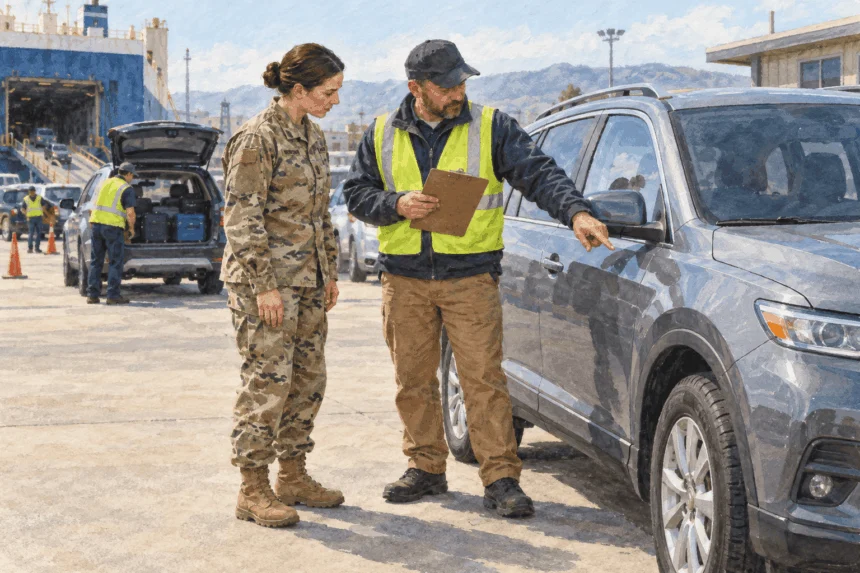
Upon arriving at the VPC for the scheduled appointment, the service member (or authorized agent) will complete the formal turn-in process. This involves a critical joint inspection where a VPC inspector and the member examine the vehicle’s condition together, documenting any pre-existing damage like scratches, dents, or chips on the official shipping document.
This form is often the DD Form 788, Private Vehicle Shipping Document for Automobile, or a commercial equivalent provided by IAL, commonly referred to as the Vehicle Inspection Form (VIF). Photographs may also be taken by the VPC as part of the documentation.
It is essential for the service member to be thorough during this inspection and ensure all existing damage is accurately noted on the form before signing it. Both the member and the VPC inspector sign the completed form, and the member receives a legible copy. This signed copy serves as the official receipt for the vehicle and, critically, as the baseline evidence of the vehicle’s condition before it entered the contractor’s custody. It is vital for supporting any potential damage claims upon delivery. Members should read any liability statements printed on the form.
Along with the inspection, the member provides all the required documents gathered in Step 3 (orders, ID, ownership proof, lienholder letter, recall proof, etc.) and the vehicle keys to the VPC representative. The VPC should provide the member with information regarding the shipment, including contact details for the destination VPC and an estimated Required Delivery Date (RDD).
Step 6: Tracking Your POV’s Journey Online
Once the vehicle is accepted by the VPC, its journey can be monitored online. IAL provides tracking capability through the PCSmyPOV.com website and potentially through a dedicated mobile app.
To access the tracking information, the member typically needs to enter their Shipping Instruction (SI) number, which should be provided by the VPC/IAL upon turn-in, or possibly their last name and order number. The online system, often referred to as In-Transit Visibility (ITV), should display the vehicle’s current status or location within the shipping process and provide an estimated arrival date at the destination VPC.
While this provides helpful visibility, it’s important to remember that the system relies on timely updates from the contractor and various shipping partners, and estimated dates can change due to unforeseen circumstances like weather, port congestion, or customs delays.
Step 7: Shipping Timelines
The time it takes to ship a POV OCONUS can vary widely. Factors influencing transit time include the distance between origin and destination VPCs, ocean shipping routes and schedules, vessel availability, port operations at both ends, customs clearance processes, and potential weather delays.
The TO/PPSO or the VPC may provide an estimated transit time during counseling or at vehicle turn-in. The online tracking system also provides an estimated delivery date. However, these are estimates. Real-world experiences indicate that OCONUS shipments can take anywhere from several weeks to a few months. For example, a shipment from Hawaii to San Diego was reported to take about 4 weeks.
Service members should therefore plan conservatively and anticipate being without their POV for a significant period after arriving at their new OCONUS duty station or upon returning to CONUS. Relying solely on initial estimates without building in buffer time can lead to transportation challenges at the destination.
Receiving Your POV: Pickup and Post-Shipment Steps
The process isn’t over once the vehicle is dropped off. Receiving the POV at the destination involves notification, pickup procedures, a critical inspection, and potentially navigating local registration and customs.
Getting Notified: When Your Vehicle Arrives
IAL, through the destination VPC, is responsible for notifying the service member when their POV has arrived and is ready for pickup. This notification is typically sent via email and possibly a phone call, usually shortly after the vehicle physically arrives at the VPC facility. It is crucial that the contact information (email address and phone number) provided during the turn-in process remains accurate and accessible throughout the shipping period. Any changes to contact details should be communicated to the destination VPC.
Upon receiving notification, members should make arrangements to pick up their vehicle promptly. There is typically a limited timeframe, often stated as 21 days from the notification date, during which the vehicle should be retrieved. VPCs are transit facilities, not long-term storage lots. If circumstances prevent pickup within this window (e.g., member still in transit, awaiting housing), it is important to contact the destination VPC immediately to explain the situation and make alternative arrangements if possible. Failure to pick up the POV within the allowed timeframe without communication could lead to storage fees or other complications.
Picking Up Your POV from the VPC
To retrieve the vehicle, the service member (or their authorized agent) must go to the destination VPC during its operating hours. The VPC location and hours can be confirmed on PCSmyPOV.com. Pickup procedures may vary slightly by location; some VPCs might require appointments for pickup, while others operate on a walk-in basis. Checking the specific requirements for the destination VPC via PCSmyPOV.com or by calling them is advisable.
The individual picking up the vehicle must present required documentation:
- Valid Government or State-issued Photo ID: To verify identity
- Copy of the Original Vehicle Inspection Form (VIF / DD 788 equivalent): This is the form completed and signed at the origin VPC during drop-off. It’s needed for the damage inspection comparison
- Copy of PCS Orders: While not always explicitly listed for pickup, having a copy is good practice
- Power of Attorney (if applicable): If an agent (friend, family member not on orders) is picking up the vehicle, they MUST have a specific, notarized Power of Attorney or Letter of Authorization from the service member authorizing them to receive the specific vehicle, along with their own valid photo ID
Upon arrival, the individual will typically sign in and present their documentation.
Crucial Step: Inspecting Your Vehicle for Damage
This is arguably the most critical step during pickup. Before accepting the vehicle and leaving the VPC premises, a thorough joint inspection must be conducted with a VPC representative.
Using the original VIF/DD 788 from the drop-off appointment, carefully compare the vehicle’s current condition (exterior and interior) against the documented pre-existing condition. Look meticulously for any new damage that may have occurred during shipment or handling – scratches, dents, broken glass, torn upholstery, etc. Also, check that any permitted items left in the vehicle at origin are still present. Check the odometer for any excessive or unexplained mileage increase (some mileage for loading/unloading is normal). Check tires for damage potentially caused by improper tie-downs.
If any new loss or damage is discovered, it must be carefully and completely documented on the reverse side (or designated section) of the VIF/DD 788 before signing for receipt of the vehicle. Be specific in describing the damage. Failure to note damage on the form at the time of pickup can severely jeopardize, or even invalidate, a subsequent claim for that damage. Do not feel rushed during this inspection. If the VPC representative seems uncooperative in documenting damage, seek assistance from the government Contracting Officer’s Representative (COR) at the VPC, if available, before leaving.
If damage is discovered after leaving the VPC, it is imperative to notify the VPC and/or IAL Claims immediately in writing. There is typically a very short window for reporting such latent damage (e.g., 10 business days mentioned in IAL documents). The notification should explain the damage discovered and why it was not identified during the pickup inspection. Proving that such damage occurred while in the contractor’s custody becomes significantly more challenging once the vehicle has left the VPC.
Navigating Customs, Registration, and Potential Modifications
Receiving a POV internationally involves navigating local laws and regulations, both when arriving OCONUS and when returning to CONUS.
OCONUS Arrival: Before shipping a POV to an overseas duty station, it is essential to research the host nation’s specific requirements for vehicle importation, registration, licensing, and insurance. These rules vary significantly by country. Information can often be found in the Personal Property Consignment Instruction Guide (PPCIG), accessible through the TO/PPSO or online resources, or by contacting the gaining command sponsor or installation transportation/vehicle registration office.
The vehicle may need modifications (e.g., lighting, emissions) to meet local standards, often at the member’s expense. Some countries may have restrictions on vehicle age, size, or type. Failure to meet host nation standards could result in the vehicle being impounded at the port or denied registration. Upon arrival, the vehicle will need to be registered and insured according to local laws, often within a tight deadline. Some locations (like Germany/Kapaun) may facilitate registration and inspection near the VPC.
Return to CONUS: When shipping a POV back to the United States, it must comply with U.S. Department of Transportation (DOT) safety standards and Environmental Protection Agency (EPA) emission standards. Vehicles originally manufactured for the U.S. market (U.S. specification) should have the required DOT and EPA certification labels permanently affixed (usually in the driver’s side door jamb or under the hood). These labels are the primary proof of compliance for U.S. Customs and Border Protection (CBP).
If these labels are missing or illegible, the member must provide alternative proof of compliance when turning the vehicle in overseas, such as a prior U.S. title or registration explicitly stating the vehicle meets U.S. standards, or a formal letter from the vehicle manufacturer confirming compliance. Foreign-specification vehicles purchased overseas that do not meet U.S. standards generally cannot be imported easily or cheaply. They typically require extensive and costly modifications performed by a DOT-Registered Importer and EPA-Independent Commercial Importer to bring them into compliance, a process that can take months. Members considering buying a vehicle overseas should be aware of these significant hurdles before purchasing. Upon arrival back in CONUS, the vehicle will need to be registered and insured according to state requirements.
Proactive research and preparation regarding import/export regulations are crucial to avoid significant costs, delays, or the inability to use the vehicle at the new location.
Understanding Costs, Liability, and Insurance
While the government covers certain aspects of POV shipment, service members may still incur various costs and need to understand liability limits and insurance options.
What the Government Covers vs. What You Might Pay
Government Generally Covers:
- The cost of transporting one authorized POV (meeting size/eligibility criteria) via the contracted carrier (IAL) for authorized OCONUS PCS moves (to, from, or between OCONUS locations)
- MALT reimbursement for authorized driving during CONUS PCS moves (up to two POVs if criteria met)
- Limited “MALT Plus” reimbursement for shipping a second POV during a CONUS PCS, only if specific conditions are met (family travels together in the first POV)
- Authorized POV storage at a government-contracted facility under specific circumstances related to OCONUS assignments (e.g., country restrictions prohibiting POVs, certain deployments, contingency operations, emergency evacuations)
- Reimbursement for reasonable transportation expenses (e.g., mileage, taxi) incurred by one traveler for one round trip to drop off or pick up a POV at the authorized VPC for an OCONUS shipment (claimed via travel voucher DD 1351-2)
Member May Pay (Out-of-Pocket Expenses):
- Shipping a second POV during an OCONUS move
- Shipping a POV during a CONUS move (unless the limited MALT Plus reimbursement applies or a rare exception for government-funded shipment is approved)
- The portion of shipping costs for a second CONUS POV that exceeds the calculated MALT Plus reimbursement limit
- Excess costs for shipping an oversized POV (>20 MTON) during an OCONUS move
- Storage costs beyond authorized entitlement periods or for storage arranged for personal convenience
- Costs for using commercial storage facilities if the rate exceeds the government’s maximum reimbursable cost for authorized storage
- Vehicle modifications required to meet host nation standards (OCONUS arrival) or U.S. EPA/DOT standards (CONUS return)
- Costs associated with vehicle recalls (the repairs themselves)
- Supplemental vehicle insurance beyond the basic carrier liability
- Repair costs for damage that occurred before shipment, damage to prohibited items left in the vehicle, or damage exceeding liability limits not covered by personal/supplemental insurance
- Import duties or taxes, potentially applicable to second vehicles imported OCONUS
- Rental car costs incurred due to shipment delays, beyond what is covered by IAL under the current GPC V contract
Understanding these potential costs is vital for financial planning during a PCS. While the core OCONUS shipment for one vehicle is covered, numerous other expenses related to POV transport and compliance can arise.
POV Damaged During Shipment? The Claims Process Explained
Damage to a POV during shipment or storage while in the custody of the government contractor (IAL) is unfortunately possible. A process exists to file claims for such loss or damage.
Step 1: Document Damage at Pickup
As emphasized earlier, meticulously inspect the vehicle upon pickup at the destination VPC and document all new damage on the VIF/DD 788 before leaving the facility. This is the most critical step for a successful claim.
Step 2: File the Claim
Service members generally have two primary avenues for filing a damage claim:
Directly with the Contractor (IAL): This is often the first step. Claims can be initiated in several ways:
- On-Site Settlement: At the VPC during pickup, for minor damages (the exact monetary limit may vary, check with VPC/IAL – past documents mentioned $1000 or $1500), IAL may offer an immediate settlement payment, often via direct deposit. Accepting this offer is final for the specific damage noted and settled. Damage discovered later (and reported promptly within the deadline, typically ~10 business days) can still be claimed separately.
- Formal IAL Claim: If damage is more significant, discovered later, or the on-site offer is declined, a formal claim can be submitted to IAL’s claims department (Email: CLAIMS@ialpov.us, Phone: 912-602-6376). This typically involves obtaining repair estimates (from an IAL-approved shop or one of the member’s choice) and submitting them with the claim documentation. IAL is expected to review and resolve (pay, deny, or make a settlement offer) within 40 calendar days of filing.
Directly with the Military Claims Office (MCO): Service members always have the right to bypass IAL or transfer their claim to their respective service branch’s MCO. This is common if the member is unsatisfied with IAL’s settlement offer, if IAL denies the claim, or if communication breaks down. The MCO adjudicates the claim based on military claims regulations. This process is handled outside of IAL’s systems and may require submitting repair estimates (the cost of obtaining one estimate is often reimbursable by the MCO). MCO contact information can usually be found via service-specific moving assistance pages on Military OneSource.
Claim Deadlines
While claims should be filed promptly, the general statute of limitations is often two years from the date of delivery. However, reporting damage discovered after leaving the VPC must be done much sooner (typically within 10 business days).
Contractor Liability
IAL, as the contractor, is generally liable for loss or damage to POVs that occurs while the vehicle is in their care, custody, or control, unless the damage results from specific excluded causes like acts of God, public enemy, or inherent vice of the vehicle, and without the contractor’s fault or negligence. Their liability is typically limited to the fair market value of the vehicle (often based on NADA guides) or the cost of repairs, whichever is less. Specific, lower liability limits may apply to certain items like audio equipment ($1,000) or tools ($200) left in the vehicle. IAL is prohibited from placing liens on POVs for unpaid government freight charges.
Understanding these options and the critical importance of documenting damage at pickup empowers members to navigate the claims process effectively.
Delayed Shipment? Rental Car Reimbursement Rules
Shipment delays beyond the Required Delivery Date (RDD) can cause significant inconvenience. Policies regarding reimbursement for rental car expenses incurred due to these delays have recently changed.
Current Rule (Applies to POV shipments under the Global POV Contract V starting on or after October 1, 2024): If an authorized POV shipment managed by IAL under the current contract (GPC V) is delayed past the RDD due to the contractor’s fault, the responsibility for reimbursing reasonable rental vehicle costs falls solely on the contractor (IAL). Service members experiencing such delays should file an inconvenience claim directly with IAL. There is no longer a separate entitlement under the JTR for the government to reimburse $30 per day for the first 7 days for these specific shipments. IAL may also consider reimbursement for other delay-related expenses like temporary lodging on a case-by-case basis.
Previous Rule (Applied to shipments initiated before October 1, 2024, or potentially to shipments outside the GPC V contract, like certain USPHS members): Under the old system, if a POV shipment was delayed, military members could claim reimbursement from the government (via travel voucher/finance office) for rental car costs, but it was limited to a maximum of $30 per day for up to 7 days. Any rental costs exceeding $30/day during that first week, any costs beyond the 7th day, or any rental costs for DoD civilians, required filing a separate inconvenience claim with IAL. This previous system is no longer applicable for most DoD POV shipments starting on or after October 1, 2024.
Filing an Inconvenience Claim with IAL: To file for delay-related expenses under the current policy, members should notify IAL of their intent to file an inconvenience claim and request the necessary form. The completed form, along with supporting receipts (rental agreement, payment proof), should be submitted to IAL Claims. IAL will review the claim based on the circumstances and the cause of the delay.
This policy change simplifies the process by consolidating responsibility with the contractor but makes it crucial for members to understand they must pursue reimbursement directly from IAL for delays under the current contract.
Considering Supplemental Insurance
The liability coverage provided by the government/IAL for OCONUS shipments, while substantial, does have limits. As noted, liability might be capped at the vehicle’s fair market value (e.g., NADA value) and specific lower limits apply to items like audio equipment or tools left inside.
Service members should review their personal automobile insurance policy to determine if it provides any coverage during transit, especially for OCONUS moves. Coverage may cease or require changes once the vehicle leaves the US or enters a new country. Notifying the insurance provider about the PCS move is essential.
For shipments arranged commercially (e.g., CONUS moves at member expense, second OCONUS POVs), the shipping company will have its own liability coverage, but members might consider purchasing supplemental or “gap” insurance. Some brokers offer policies for an additional fee that can help cover the owner’s insurance deductible if damage occurs, provide broader coverage, or offer extended timeframes for reporting damage. While not typically offered or needed for the standard government-funded OCONUS shipment of one POV, evaluating personal policy coverage and the potential need for supplemental insurance is a prudent step, particularly for high-value vehicles or when using commercial shippers.
Service-Specific Information & Resources
While the Joint Travel Regulations (JTR) establish the overarching DoD policy for travel and transportation allowances, including POV shipments, individual military service branches often publish supplemental regulations, maintain specific procedures, utilize unique forms, or designate specific points of contact for assistance.
How Service Policies Might Differ
Minor variations might exist in how services implement JTR policies, particularly in areas like counseling methods, internal processing, specific claim points of contact, or rules related to unique situations like Navy homeport changes.
Army: Generally follows JTR/DTR guidance closely. Emphasizes using PCSmyPOV.com for appointments and preparation. Army-specific claims office contacts exist within the MCO structure. DTR Attachment K3 provides detailed guidance often referenced.
Navy/Marine Corps: The Navy utilizes the Naval Supply Systems Command (NAVSUP) for household goods and POV shipment information and oversight. Navy Personnel Command publishes the MILPERSMAN, which includes specific articles like 4050-010 detailing Navy POV shipment rules (eligibility nuances, alternate VPC use, non-conforming vehicle policies, time limits on OCONUS tours for shipment eligibility, storage request processes).
The Navy has unique procedures involving Vessel Move Coordinators (VMCs) for coordinating POV movements during ship Homeport Changes (HPCs). The Marine Corps has specific guidance for submitting Personally Procured Move (PPM) claims via Marine Online (MOL) or directly to LOGCOM G8 and provides PCS resources through Installations & Logistics (I&L). Both services have designated MCO contacts.
Air Force/Space Force: The Air Force Personnel Center (AFPC) provides resources, including civilian PCS guides and relocation assistance program information. Air Force Instruction (AFI) 24-602, Volume 4, details personal property moving and storage procedures, emphasizing mandatory counseling standards and shipment inspection rates.
The Air Force relies heavily on Military OneSource and the Defense Personal Property System (DPS) for move management. The Space Force, as a newer service, generally adheres to DoD and Air Force regulations and uses the same systems and resources; JTR applies directly. Both have MCO contacts.
Coast Guard: While following the JTR for uniformed members’ entitlements, the Coast Guard uses its own Pay & Personnel Center (PPC) for processing and has specific procedures within its Direct Access system for generating PCS orders. They maintain their own Personnel & Pay Procedures Manual (PPPM).
Notably, Coast Guard civilian employee allowances may be governed by the Federal Travel Regulation (FTR) and Department of Homeland Security (DHS) policy rather than the JTR for POV shipments. Coast Guard MCO contacts are available.
While the core OCONUS shipping process via IAL/VPCs and CONUS MALT rules are largely consistent, service members should always consult their branch-specific resources and local TO/PPSO for any unique forms, procedures, or points of contact relevant to their move.
Links to Service Resources
- Navy: NAVSUP Household Goods Portal: https://www.navsup.navy.mil/NAVSUP-Household-Goods/Home/; MyNavy HR (for MILPERSMAN lookup): https://www.mynavyhr.navy.mil/
- Air Force: Air Force PCS Moving Support (via Military OneSource): https://www.militaryonesource.mil/moving-pcs/plan-to-move/air-force-pcs-moving-support/; AFPC Civilian PCS: https://www.afpc.af.mil/Civilian-Career-Management/Civilian-PCS/; AFPC Relocation Assistance: https://www.afpc.af.mil/Military-and-Family/Relocation-Assistance/
- Marine Corps: Marine Corps PCS Moving Assistance (via Military OneSource): https://www.militaryonesource.mil/moving-pcs/plan-to-move/marine-corps-pcs-moving-assistance/; LOGCOM PPM Page: https://www.logcom.marines.mil/Marines/Personally-Procured-Move/; I&L PCS Resources: https://www.iandl.marines.mil/Divisions/Logistics-Division-LP/Logistics-Distribution-Policy-Branch-LPD/PCS-Move-Resources/
- Coast Guard: USCG Pay & Personnel Center (PPC): https://www.dcms.uscg.mil/Our-Organization/Assistant-Commandant-for-Human-Resources-CG-1/Pay-and-Personnel-Center-PPC/; Coast Guard PCS Moving Assistance (via Military OneSource): https://www.militaryonesource.mil/moving-pcs/plan-to-move/coast-guard-pcs-moving-assistance/
- Space Force: Generally utilizes Air Force / DoD resources. Refer to JTR/DTMO and Military OneSource. Official Space Force Portal: https://www.spaceforce.mil/
Troubleshooting Common POV Shipment Problems
Despite careful planning, issues can arise during POV shipment. Knowing how to address common problems is essential.
Handling Delays
Problem: The POV shipment arrives at the destination VPC significantly later than the estimated Required Delivery Date (RDD).
Troubleshooting:
- Track: Monitor the vehicle’s status regularly via PCSmyPOV.com
- Contact VPC: If the RDD passes or seems likely to be missed, contact the destination VPC directly for the latest information
- Rental Car Claim (GPC V Shipments from 10/1/2024): If a rental car is needed due to a contractor-caused delay, file an inconvenience claim directly with IAL. Request their claim form, submit it with rental receipts and documentation of the delay. Remember, government reimbursement for the first 7 days is no longer applicable for these shipments
- Escalate if Needed: If issues arise in resolving the inconvenience claim with IAL, contact the local TO/PPSO or potentially the service MCO for assistance in mediating or understanding entitlements
Dealing with Damage
Problem: The POV arrives at the destination VPC with new scratches, dents, or other damage not present at drop-off.
Troubleshooting:
- Inspect Thoroughly at Pickup: This cannot be overstressed. Before leaving the VPC, compare the vehicle to the origin VIF/DD 788 and note every single new discrepancy on the form. Take clear photos of the new damage
- Report Latent Damage Immediately: If damage is genuinely missed at pickup and discovered shortly after, notify the VPC and IAL Claims in writing immediately (within the short deadline, e.g., 10 business days)
- Choose Claim Route: Decide whether to accept IAL’s on-site settlement (if offered for minor damage), file a formal claim with IAL (submitting estimates), or file directly with the service MCO
- Follow Up Persistently: Claims processing can take time. Keep copies of all correspondence, estimates, and forms. Follow up regularly with IAL or the MCO as appropriate. Do not proceed with repairs until the claim is settled or authorization is given by the claims adjudicator
Storage Entitlements and Issues
Problem: Uncertainty about eligibility for government-funded POV storage, exceeding storage time limits, or concerns about vehicle condition during storage.
Troubleshooting:
- Verify Eligibility: POV storage at government expense is a limited entitlement, primarily authorized for specific OCONUS situations like assignments to countries prohibiting POVs, extensive modifications being required, certain unaccompanied tours, deployments, or contingency operations. It’s generally not authorized for member convenience or standard CONUS PCS moves. Confirm eligibility based on PCS orders with the TO/PPSO
- Use Authorized Storage: If entitled, arrange storage through IAL/PCSmyPOV.com at a designated Vehicle Storage Facility (VSF). Using the government contractor avoids the risk of exceeding reimbursable cost limits associated with commercial storage
- Prepare for Storage: Prepare the vehicle similarly to shipping (clean, low fuel, battery disconnected/maintained per guidance) to minimize deterioration. Concerns about seals drying or fuel degrading over long periods are valid
- Manage Duration: Be aware of the authorized storage duration. Extensions may be possible but require justification and formal approval through service-specific channels
Why a Shipment Might Be Denied
Problem: Being turned away at the VPC during the drop-off appointment.
Troubleshooting: Denials usually stem from failing to meet preparation requirements. Avoid denial by:
- Clearing Recalls: Check for and resolve safety recalls (or get documentation if unrepairable) before the appointment using NHTSA recalls
- Gathering ALL Documents: Use the checklist (Table 2) – ensure orders, ID, ownership proof, and especially lienholder authorization (if needed) are present and correct
- Ensuring Operability: Confirm the vehicle runs safely, brakes work, and there are no major leaks or windshield cracks
- Cleaning Thoroughly: Meet the strict cleanliness standards (inside, outside, undercarriage)
- Checking Fuel Level: Ensure the tank is 1/4 full or less
- Removing Prohibited Items: Empty the vehicle according to guidelines (Table 3)
- Verifying Compliance: Ensure the vehicle meets import/export requirements (EPA/DOT labels for US import)
- Addressing Modifications: Discuss any significant vehicle modifications with the TO/PPSO beforehand to ensure compliance
Most denials are preventable through diligent preparation and adherence to the documented requirements.
Key Contacts for Assistance
Navigating the POV shipment process can be complex. Knowing who to contact for specific issues is crucial:
Table 4: Key Contacts for POV Shipment Assistance
| Resource/Office | Primary Responsibilities | How to Contact / Website |
|---|---|---|
| Your Local Transportation Office (TO/PPSO) | Initial counseling, entitlement verification, regulation interpretation, guidance on process/forms, assistance with contractor issues, alternate VPC requests, storage authorization. | Use MilitaryINSTALLATIONS tool: https://installations.militaryonesource.mil/ to find local contact info. |
| International Auto Logistics (IAL) / PCSmyPOV.com (Current Contractor) | OCONUS shipment scheduling (VPC appointments), vehicle tracking, VPC operations, direct damage/inconvenience claims processing, providing shipping forms. | Website: https://www.pcsmypov.com/; Toll-Free: 855-389-9499; Claims Email: CLAIMS@ialpov.us; Specific VPC contacts on website. |
| Military Claims Office (MCO) (Service-Specific) | Adjudicating damage claims unresolved with/denied by IAL, handling claims disputes based on service regulations. | Find contacts via service branch moving assistance pages on Military OneSource (links provided earlier). |
| Military OneSource | General PCS information, relocation assistance programs, links to resources (DPS, PCSmyPOV, service pages), fact sheets, guides, 24/7 support consultants. | Website: https://www.militaryonesource.mil/; Phone: 800-342-9647. |
| Defense Travel Management Office (DTMO) | Publishes and maintains the Joint Travel Regulations (JTR), sets per diem and mileage rates (MALT). | Website: https://www.travel.dod.mil/; JTR Document: https://www.travel.dod.mil/Policy-Regulations/Joint-Travel-Regulations/. |