- wpc.ncep.noaa.gov3 links
- weather.gov2 links
Last updated 11 months ago. Our resources are updated regularly but please keep in mind that links, programs, policies, and contact information do change.
The National Weather Service’s Winter Storm Severity Index (WSSI) provides a way to understand not just if winter weather is coming, but how significant its impacts might be. This powerful tool helps emergency managers, road crews, businesses, and the public prepare for winter storms based on their expected severity rather than just their meteorological characteristics.
What Is the Winter Storm Severity Index?
The Winter Storm Severity Index (WSSI) is a relatively new forecasting tool developed by the National Weather Service to communicate the potential impacts of winter weather. Unlike traditional winter weather alerts that focus primarily on meteorological thresholds, the WSSI attempts to translate weather predictions into real-world consequences.
- What Is the Winter Storm Severity Index?
- How the WSSI Works
- WSSI Severity Levels
- Components of the WSSI
- Using the WSSI in Decision-Making
- How the WSSI Differs from Traditional Winter Alerts
- Accessing WSSI Information
- Limitations and Considerations
- Evolution and Future Development
- Case Studies: The WSSI in Action
- Winter Weather Safety Using the WSSI
- Frequently Asked Questions
Introduced experimentally in 2017 and made operational nationwide in 2019, the WSSI represents a shift toward impact-based forecasting. This approach recognizes that the same weather conditions can have drastically different effects depending on location, timing, and other factors.
According to the National Weather Service, the WSSI was designed to “provide NWS partners and the general public with an indication of the level of winter precipitation severity and its potential societal impacts across the country.”
How the WSSI Works
The WSSI combines multiple data sources to create a comprehensive picture of potential winter storm impacts:
Meteorological Inputs
The system incorporates forecast data for:
- Snow and sleet accumulation
- Ice accumulation
- Wind speed
- Blowing snow potential
- Flash freeze risk
- Ground conditions (including temperature and moisture)
Contextual Factors
These weather predictions are then evaluated against:
- Climatological normals for the region
- Time of day/week (rush hour vs. overnight)
- Population density
- Local infrastructure resilience
- Seasonal timing (early/late season vs. mid-winter)
Output Format
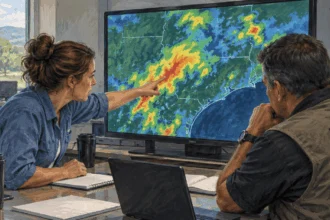
The WSSI presents its analysis through color-coded maps showing:
- Overall potential impact levels across geographic areas
- Individual component impacts (snow load, ice accumulation, etc.)
- Temporal evolution of impacts over a multi-day period
The WSSI web interface provides interactive maps that can be zoomed to specific regions and filtered by individual impact components.
WSSI Severity Levels
The WSSI uses a six-level scale to communicate potential impacts:
No Impacts (Gray)
- No snow or ice expected
- No travel problems anticipated
- Normal daily activities can proceed without weather concerns
Limited Impacts (Light Blue)
- Small accumulations of snow or ice
- Brief, isolated slippery conditions
- Minor delays possible but generally manageable
- Typical winter commuting challenges in affected areas
Minor Impacts (Blue)
- Snow or ice accumulations causing slippery roads
- Delays likely for schools and businesses
- Some travel disruptions, especially during commute times
- Limited power outages possible
- Generally manageable with standard winter precautions
Moderate Impacts (Yellow)
- Significant snow or ice accumulations
- Dangerous travel conditions with reduced visibility
- School closings and business interruptions likely
- Some power outages expected
- Travel may be difficult without proper vehicle equipment
- Emergency services may be slightly delayed
Major Impacts (Orange)
- Heavy snow, significant icing, or both
- Travel becoming difficult or impossible for extended periods
- Widespread power outages possible
- Road closures and highway shutdowns likely
- Strong recommendation to avoid non-essential travel
- Emergency services potentially significantly hampered
Extreme Impacts (Red)
- Crippling snow and/or ice accumulations
- Near-impossible or impossible travel conditions
- Extended road and highway closures
- Widespread, potentially long-duration power outages
- Life-threatening conditions for those stranded or without adequate shelter
- Emergency services potentially unable to reach all areas
According to the Weather Prediction Center, these categories are designed to be nationally consistent while still accounting for local climatological differences—meaning a “major impact” storm in Georgia might have less snow than a “major impact” storm in Minnesota, but both would create similar disruptions relative to local preparedness.
Components of the WSSI
The WSSI breaks down winter storm impacts into six specific categories:
1. Snow Load
This component evaluates the potential for snow accumulation to:
- Cause roof collapses
- Down trees and power lines
- Create structural damage
- Hamper snow removal efforts
Snow load impacts consider not just total accumulation, but also snow density (wet vs. dry snow) and rate of accumulation.
2. Ice Accumulation
This focuses specifically on glaze ice from freezing rain that can:
- Create extremely hazardous driving and walking conditions
- Cause catastrophic damage to trees and utility infrastructure
- Lead to widespread, long-duration power outages
- Make roads impassable regardless of treatment efforts
Even small amounts of ice (0.25 inches or less) can create significant impacts in some regions.
3. Snow Amount
This component considers the expected snowfall relative to:
- Local climatological normals
- Seasonal timing (early/late vs. mid-winter)
- Rate of accumulation
- Snow-to-liquid ratios (fluffy vs. dense snow)
A region’s typical snowfall significantly influences how this component is calculated, recognizing that 6 inches of snow has vastly different impacts in Atlanta versus Minneapolis.
4. Blowing Snow
This measures the potential for winds to:
- Create snow drifts blocking transportation routes
- Reduce visibility to dangerous levels
- Extend the duration of hazardous conditions after snowfall ends
- Complicate snow removal efforts
Blowing snow depends on wind speed, snow consistency, temperature, and surrounding terrain.
5. Flash Freeze
This component addresses rapid temperature drops that can:
- Turn wet surfaces to ice almost instantly
- Create “black ice” conditions that are difficult to detect
- Occur even with minimal precipitation
- Happen after rain or when melting snow refreezes
Flash freeze situations are particularly dangerous because they can develop with little visible warning.
6. Ground Blizzard
This evaluates the risk of blizzard conditions from:
- Strong winds lifting existing snow on the ground
- Significantly reduced visibility without ongoing snowfall
- Snow drifting across transportation routes
- Dangerous wind chills
Ground blizzards can occur days after actual snowfall, extending the timeline of winter storm impacts.
Using the WSSI in Decision-Making
For Emergency Management
The WSSI provides emergency managers with:
- Lead time for resource positioning
- Scalable response planning based on expected impact levels
- Geographic specificity for targeted preparations
- Temporal information for staffing decisions
- Consistent communication framework for public messaging
The Federal Emergency Management Agency recommends using tools like the WSSI for developing appropriate emergency response plans.
For Transportation Agencies
Road maintenance departments use the WSSI to:
- Pre-position snow removal equipment
- Schedule staff for anticipated storm duration
- Determine appropriate treatment methods (salt, sand, brine)
- Plan for possible road closures
- Coordinate with neighboring jurisdictions
Many state Departments of Transportation directly incorporate WSSI data into their winter operations planning.
For Businesses and Schools
Organizations use the WSSI to make informed decisions about:
- Early dismissals or closures
- Remote work policies
- Delivery and service adjustments
- Facility preparations (heating systems, pipe protection)
- Supply chain contingencies
The specificity of WSSI forecasts helps organizations avoid unnecessary closures while still prioritizing safety.
For the Public
Individuals can use the WSSI to:
- Plan travel around highest-impact periods
- Prepare homes appropriately for the expected severity
- Make informed decisions about necessary supplies
- Understand the likely duration of impacts
- Set realistic expectations about potential disruptions
The color-coded WSSI maps are designed to be intuitive even for those without meteorological training.
How the WSSI Differs from Traditional Winter Alerts
Traditional NWS Winter Alerts
The National Weather Service’s traditional winter alerts include:
- Winter Weather Advisory: Issued for expected hazardous winter conditions with accumulations just below warning criteria
- Winter Storm Watch: Issued when winter storm conditions are possible within 24-72 hours
- Winter Storm Warning: Issued when heavy snow (generally 6+ inches in 24 hours) is expected within 24 hours
- Ice Storm Warning: Issued when ice accumulations of 0.25 inches or more are expected
- Blizzard Warning: Issued for sustained winds/gusts over 35 mph with considerable falling or blowing snow reducing visibility below 1/4 mile for at least 3 hours
These alerts are primarily threshold-based, focusing on specific meteorological conditions.
The WSSI Advantage
The WSSI complements these traditional alerts by:
- Focusing on impacts rather than just meteorological thresholds
- Providing more nuanced severity levels (six vs. three)
- Accounting for local climatology and preparedness
- Breaking down impacts into specific components
- Displaying information geographically rather than just by county boundaries
- Showing how impacts evolve over time
According to the National Weather Service, the WSSI “is not meant to replace existing winter weather watches, warnings, and advisories,” but rather to enhance them with more specific impact information.
Accessing WSSI Information
Official NWS Sources
The WSSI is available through several official channels:
- Weather Prediction Center WSSI Page: The primary source with interactive maps
- Local National Weather Service forecast office websites
- NOAA Weather Radio broadcasts during winter events
- NWS social media accounts during significant winter storms
Media and App Integration
Many weather providers now incorporate WSSI data into their products:
- Local TV meteorologists frequently reference WSSI categories
- Several major weather apps display WSSI maps during winter events
- Online weather services translate WSSI data into impact timelines
Timing of Updates
The WSSI is typically updated:
- Four times daily during non-storm periods
- More frequently as winter storms approach
- Hourly during high-impact events in some regions
- Whenever significant forecast changes warrant updates
Limitations and Considerations
Regional Interpretation
While the WSSI attempts to normalize impacts nationally, some regional differences remain:
- A “moderate impact” might still mean different things in Buffalo versus Birmingham
- Local experience with winter weather affects community response
- Urban versus rural areas may experience the same meteorological conditions differently
- Coastal regions may have different concerns than inland areas
Probabilistic Nature
The WSSI is based on forecast data, which inherently contains uncertainty:
- The further in advance the WSSI is viewed, the more likely it is to change
- Some winter storms defy prediction and deliver more or less severe impacts
- Small shifts in storm tracks can significantly change local impacts
- The index can only be as accurate as the underlying forecast data
Not a Replacement for Watches/Warnings
The WSSI complements but doesn’t replace traditional NWS alerts:
- Official watches and warnings remain the primary alert mechanism
- Emergency management decisions are still based on official NWS products
- The WSSI provides additional context but doesn’t trigger automatic actions
Evolution and Future Development
Recent Improvements
Since its nationwide implementation, the WSSI has been enhanced with:
- Higher resolution mapping
- More frequent updates
- Better mobile device accessibility
- Improved integration with other NWS products
- Enhanced visualization options
Ongoing Research
NOAA continues to refine the WSSI through:
- Post-storm verification studies
- User feedback from emergency managers and the public
- Integration of new data sources as they become available
- Artificial intelligence to improve impact predictions
- Enhanced communication of uncertainty
According to the NOAA Weather Prediction Center, continued refinement of the WSSI remains a priority for improving winter weather safety.
Case Studies: The WSSI in Action
Major Northeast Blizzard (January 2022)
During the January 28-29, 2022 blizzard that affected the Northeast:
- The WSSI correctly identified “extreme impact” areas days in advance
- Areas predicted to experience the most significant impacts saw 1-3 feet of snow
- Strong winds created ground blizzard conditions as forecasted
- Power outages affected thousands in areas highlighted by the ice accumulation component
- Transportation shutdowns aligned closely with areas designated for major impacts
Southern Ice Storm (February 2021)
The February 2021 ice storm across Texas and the South showed:
- WSSI “major” and “extreme” impact areas experienced catastrophic power outages
- Flash freeze component correctly identified areas most vulnerable to rapid icing
- Areas with lower predicted impacts generally experienced fewer disruptions
- The duration of impacts was accurately reflected in the temporal evolution products
- Some localized impacts were underestimated due to infrastructure vulnerabilities
Winter Weather Safety Using the WSSI
Interpreting WSSI Maps for Personal Decisions
When using the WSSI for decision-making:
- Check the overall impact level for your specific location (zoom in)
- Review individual components most relevant to your situation
- Note how impacts change over time (when conditions worsen/improve)
- Consider the timing relative to your planned activities
- Remember that actual conditions may vary from forecasts
Appropriate Responses by Impact Level
Different WSSI levels suggest different preparation strategies:
Limited Impacts (Light Blue)
- Normal winter precautions
- Allow extra travel time
- Check transportation conditions before traveling
Minor Impacts (Blue)
- Consider adjusting travel times
- Ensure vehicle winter readiness
- Stock basic supplies for possible minor disruptions
Moderate Impacts (Yellow)
- Prepare for potential school/business disruptions
- Consider postponing non-essential travel
- Have sufficient supplies for 1-2 days of disruption
- Check on vulnerable neighbors
Major Impacts (Orange)
- Avoid travel if possible
- Prepare for potential power outages
- Ensure adequate heating alternatives
- Have supplies for several days of disruption
- Take action to prevent pipe freezing
Extreme Impacts (Red)
- Cancel all non-emergency travel
- Prepare for extended power outages
- Have supplies for prolonged disruption (7+ days in some cases)
- Consider location consolidation (staying with family/friends)
- Take comprehensive cold weather survival precautions
Frequently Asked Questions
How is the WSSI different from the old winter weather alerts?
The WSSI focuses on impacts rather than just meteorological conditions. While traditional alerts (Watches, Warnings, Advisories) primarily indicate that certain snow or ice thresholds will be met, the WSSI translates those conditions into expected societal impacts, accounting for local climate norms, timing, and existing conditions.
Can the WSSI predict power outages?
While not designed specifically as a power outage predictor, the ice accumulation and snow load components correlate strongly with outage potential. Areas with “major” or “extreme” impacts in these categories frequently experience significant power disruptions during winter storms.
Why does the WSSI sometimes show different impact levels than I would expect for the forecast snow amounts?
The WSSI considers many factors beyond simple snow accumulation:
- Local climatological normals (what’s typical for your area)
- Timing (rush hour vs. overnight)
- Ground and air temperatures
- Snow density and type
- Wind conditions
- Pre-existing ground conditions
- Infrastructure resilience in your region
These factors explain why 6 inches of snow might show as “moderate” impact in one location but “minor” in another.
How reliable is the WSSI for advance planning?
The WSSI becomes more reliable as the event approaches:
- 5-7 days out: General guidance only, subject to significant changes
- 3-4 days out: Increasing reliability for general impact categories
- 1-2 days out: Generally reliable for planning purposes
- Within 24 hours: Highly reliable for most winter storm types
Flash freeze and ground blizzard components may have less lead time reliability than snow accumulation predictions.
Does a higher WSSI value automatically trigger school or business closures?
No. The WSSI provides decision support information but doesn’t automatically trigger specific actions. Local authorities, school districts, and businesses make closure decisions based on multiple factors, with the WSSI being just one input in that process.