Last updated 2 weeks ago. Our resources are updated regularly but please keep in mind that links, programs, policies, and contact information do change.
- How Mobile Fortify Works
- Privacy Assessment Requirements and ICE’s Response
- Algorithmic Matches Override Documentary Evidence
- Facial Recognition Accuracy Problems
- Congressional Authorization and Oversight
- State Driver’s License Database Access
- Expansion to Local Law Enforcement
- Surveillance and Political Expression
- Removal of Facial Recognition Policy Framework
- Supreme Court Decision on ICE Stops
- Current Status and Constraints
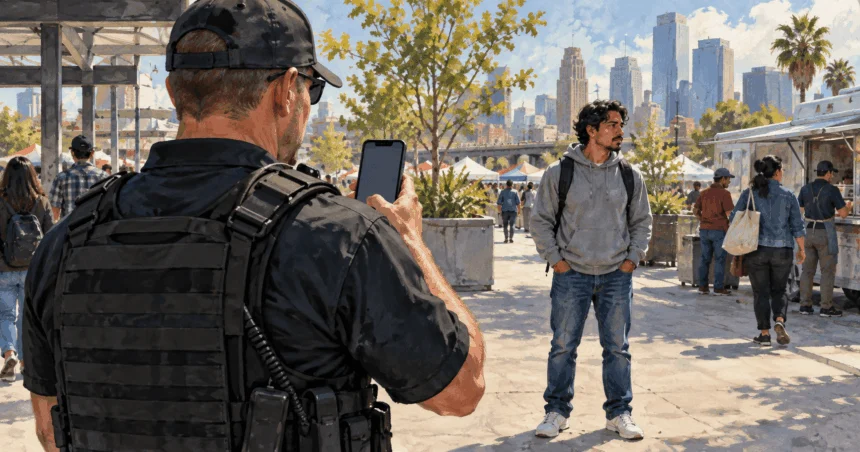
An ICE agent points a government-issued smartphone at someone’s face, snaps a photo, and within seconds knows whether that person has a deportation order—or at least, whether an algorithm thinks they do. The tool, called Mobile Fortify, went live in June 2025, and it searches more than 200 million photographs stored in federal databases. No warrant required. No reasonable suspicion needed. Point and scan.
CBP’s systems operate at fixed checkpoints where people present themselves for inspection, under controlled lighting, with advance notice that their body measurements will be collected. Mobile Fortify works anywhere—on street corners, during traffic stops, at protests, outside apartment buildings. According to leaked internal documents, the app’s “Super Query” feature pulls up associated vehicles, addresses, phone numbers, and firearms ownership information by connecting to FBI databases and state motor vehicle records.
The app stores every scan—even when it finds no match—in the Department of Homeland Security’s government database that stores and tracks all scans for fifteen years. That includes scans of U.S. citizens.
How Mobile Fortify Works
Mobile Fortify converts standard government smartphones into portable devices that identify people using their unique physical features like faces or fingerprints. An ICE officer photographs someone’s face or captures fingerprints by the phone’s camera without touching. The system immediately searches CBP’s database of photos from border crossings and visa applications, and the government’s fingerprint and facial recognition database—holding fingerprints, face photos, and other body measurements on more than 270 million people, including eye scans and DNA samples.
When the app returns a match, officers see the person’s name, date of birth, nationality, a unique government ID number assigned to immigrants (called an “A-number”), information about previous encounters with authorities, and whether a judge has issued a deportation order. The whole process takes seconds.
The app can search driver’s license photos from state databases in 41 states. That means ICE officers can potentially identify nearly anyone in the country who has a driver’s license by pointing a phone camera at them during a street encounter.
Internal DHS documents explicitly link Mobile Fortify to President Trump’s January 20, 2025, executive order on enforcement, framing the application as part of a broader “Fortify the Border” initiative designed to identify people the government believes should be deported inside American territory, not at border crossing points only.
Social media videos show what this looks like in practice. ICE officers in Chicago scanning young people on bicycles. Officers in New Mexico photographing faces during street encounters as early as February 2025. An officer demanding that a driver who verbally declared his U.S. citizenship submit to a facial scan anyway—to verify what he’d already stated.
Privacy Assessment Requirements and ICE’s Response
Federal law requires agencies conducting systematic surveillance to publish detailed public reports about what data gets collected and how it’s protected. The Privacy Act of 1974 mandates these assessments to prevent unchecked surveillance expansion.
ICE completed an initial review in February 2025 that explicitly states Mobile Fortify “is privacy sensitive and requires a detailed public report about data collection and protection and a public notification about what information is being collected.” Then ICE decided that existing privacy documentation from 2019, prepared for a different system called the database of people ICE has arrested or detained, was sufficient.
That 2019 assessment covered collection of body measurements from people already known to ICE—individuals who’d been arrested, detained, or encountered in contexts where officers had prior investigative basis for collecting such data. It was designed for scenarios where ICE officers verify the identity of specific suspects, not scenarios involving suspicionless scanning of random people whose status is completely unknown.
Mobile Fortify is engineered to generate new records for people ICE officers encounter without any prior knowledge or reasonable suspicion. Anyone an officer decides to scan. According to the initial review itself, “every encounter—regardless of whether a match is found—is treated as a record and stored in the government database that stores and tracks all scans for fifteen years.”
If an ICE officer scans your face during a raid in your neighborhood, your facial image, the location where you were scanned, the date and time, and associated metadata remain searchable in government databases for over a decade and a half. Even if you’re a U.S. citizen. Even if the scan returns no match.
Algorithmic Matches Override Documentary Evidence
Representative Bennie G. Thompson, ranking member of the House Homeland Security Committee, says ICE officials told Congress that an apparent match by Mobile Fortify is a “definitive” determination of a person’s status, and ICE officers may ignore evidence of American citizenship—including a birth certificate—if the app says the person is an alien.
A U.S. citizen stated his citizenship to ICE officers during an encounter. They handcuffed him, placed him in a vehicle, and detained him for approximately one hour while they scanned his face using Mobile Fortify. Only after the facial recognition scan did officers determine his status and release him, even though he had tried to show citizenship documentation on his phone during the encounter.
In Alabama, someone presented a REAL ID when stopped by officers. Alabama issues REAL IDs only to people lawfully authorized to be in the United States. The officers told him the ID was fake. They scanned his face with the app anyway. His brother was deported from the same encounter.
ProPublica documented that more than 170 U.S. citizens were detained by officers during the first nine months of the Trump administration’s second term.
Treating an algorithmic match as definitive, even when documentary proof of citizenship contradicts it, puts software output ahead of a birth certificate. That raises questions about how the practice fits with ordinary burden-of-proof standards.
Facial Recognition Accuracy Problems
The National Institute of Standards and Technology, the federal agency responsible for testing facial recognition algorithms, has found that most algorithms exhibit statistically significant differences in accuracy rates across demographic groups, with higher error rates for women and people of color, especially Black women.
The most accurate commercial algorithms experience more mistakes in outdoor lighting and moving people—which is exactly where Mobile Fortify operates. Images captured by smartphone cameras outdoors with variable lighting, at oblique angles as people pass by, or through vehicle windows present what NIST researchers describe as “challenges for face recognition” that degrade system performance compared to controlled border crossing photographs.
Algorithms consistently exhibit more pronounced accuracy problems for individuals with darker skin tones.
ICE hasn’t publicly disclosed which facial recognition algorithms Mobile Fortify uses, what accuracy testing was conducted before deployment, what the documented error rates are for different demographic groups, or whether the agency is tracking real-world error rates as the app operates.
Robert Williams, a Black man in Detroit, became the first publicly documented case of wrongful arrest directly resulting from a false facial recognition match in January 2020. Police used a blurry surveillance image and a low-quality facial recognition match to a nine-year-old expired driver’s license photo to arrest him for a watch theft he didn’t commit and wasn’t near when it occurred. The ACLU documented at least two additional wrongful arrests of Black individuals in Detroit from facial recognition false matches.
The settlement in Williams’s case required Detroit Police to adopt policy changes: officers cannot arrest people based solely on facial recognition results and must confirm matches with other evidence before arresting.
Congressional Authorization and Oversight
ICE’s power comes from federal immigration law, which grants ICE authority to investigate violations, arrest people the government wants to deport, and conduct operations. But immigration laws were written before facial recognition technology existed. They predate the surveillance infrastructure that’s been constructed within DHS.
In September 2025, nine Democratic senators led by Edward Markey of Massachusetts and Ron Wyden of Oregon sent a detailed letter to ICE Acting Director Todd Lyons demanding that ICE immediately cease using Mobile Fortify. They warned that scanning is “frequently biased and inaccurate, particularly against people of color,” noted that deployment “threatens privacy and free speech rights,” and expressed concern that the tool enables ICE to “aggressively expand its data collection activities across the United States.”
The senators set an October 2 deadline for responses. ICE didn’t meet it. A follow-up letter in November called the non-responsiveness “unacceptable” and reiterated the demand to halt use of the app.
House Democrats on the Homeland Security Committee requested that DHS identify all databases the application accesses, provide evidence of accuracy testing and field trials, clarify the constitutional and statutory basis for deploying facial recognition on U.S. citizens away from ports of entry, and explain protocols for situations when facial recognition results conflict with government-issued identification documents.
Mobile Fortify was deployed to the field while still in beta testing, raising questions about whether accuracy testing had been completed before operational deployment to officers making decisions affecting people’s liberty and deportation status.
State Driver’s License Database Access
The app queries a national law enforcement system that shares DMV data, providing ICE access to driver’s license photographs from 41 states. Most state officials don’t realize this is happening.
Senator Ron Wyden and other congressional Democrats sent letters to Democratic governors explaining that states have substantial technical ability to restrict or block ICE access to DMV data through the system, but few state officials understand this capability “because of the technical complexity of the national law enforcement system.”
ICE made over 292,000 data queries through the system during the year leading up to October 1, 2025. Of the 41 states sharing driver’s license photographs, many could restrict ICE access if they understood the mechanism.
As of November 2025, only five states—Illinois, New York, Massachusetts, Minnesota, and Washington—had blocked ICE access to their DMV data. Oregon was in the process of implementing restrictions. That leaves 35 states potentially providing ICE with unfettered access to resident driver’s license photographs.
If you live in one of those 35 states, your driver’s license photo is in a database ICE officers can search by pointing a phone camera at your face.
Expansion to Local Law Enforcement
In November 2025, CBP deployed a companion application called Mobile Identify to state and local law enforcement agencies participating in agreements that let local police help ICE with immigration enforcement. The app enables local officers to conduct facial recognition scans during encounters, with the app instructing officers either to contact ICE for detention or to release the individual.
The Trump administration has expanded the 287(g) program from approximately 150 participating agencies at the end of the Biden administration to over 1,000 agencies, according to ACLU documentation. That means Mobile Identify is now available to thousands of state and local officers across the country.
Many work in sanctuary jurisdictions that have formal policies refusing to cooperate with federal authorities. Facial recognition can circumvent those policies—a local officer scans someone’s face, the app says to contact ICE, and suddenly a sanctuary city’s police department is participating regardless of what local elected officials decided.
Surveillance and Political Expression
Social media videos show ICE officers pointing smartphones at people engaged in protest and political expression. Civil liberties organizations warn this discourages people from exercising their rights—people won’t attend protests, exercise free speech rights, or engage in political organizing if they believe officers are using facial recognition to identify and target participants.
Official administration documents reference “ideologies that are supposedly motivating ‘domestic terrorism,’ including opposition to ‘foundational American principles (e.g., support for law enforcement and border control).'” When facial recognition capable of identifying individuals from a distance and without consent is deployed by an agency with stated intentions to investigate protest participation, the First Amendment concerns become serious.
ICE contracts explicitly reference use of surveillance for investigating “assaults against law enforcement officers.”
Beyond Mobile Fortify, ICE has expanded its surveillance infrastructure through a $9.2 million contract with a company that has collected 50 billion facial images from social media, expanded use of software that analyzes driver’s license data, deployment of iris scanners in field operations, and contracts for social media monitoring systems and cellphone location tracking.
Removal of Facial Recognition Policy Framework
In October 2025, the Trump administration removed from public view a Department of Homeland Security policy that had specified requirements for facial recognition deployment including testing for bias, prohibition on using facial recognition to profile individuals based on constitutionally protected expression, and restrictions on using facial recognition as sole basis for law enforcement action.
DHS said it was routine website maintenance. But an independent government board that monitors surveillance noted that the removal created substantial uncertainty about whether any policy framework remained governing DHS use of facial recognition.
Supreme Court Decision on ICE Stops
In the 2025 decision Noem v. Vasquez Perdomo, the Supreme Court blocked a lower court’s order preventing ICE from conducting stops based primarily on individuals’ appearance, location, and ethnicity in the Los Angeles area. The decision allowed ICE to continue conducting stops based on what the District Court had found constituted illegal searches without proper warrants or suspicion.
Justice Brett Kavanaugh’s concurring opinion suggested that high prevalence of undocumented people in particular locations creates sufficient reasonable suspicion to justify stops of individuals appearing to be of particular ethnicities in those locations.
ICE could systematically scan individuals in locations where the agency has determined a “high prevalence” of undocumented people exists, use algorithmic matches to generate the “specific, concrete reasons” required for reasonable suspicion, and create an appearance of legal compliance while enabling suspicionless mass screening.
Current Status and Constraints
Mobile Fortify is operational. Thousands of ICE officers carry it on government-issued smartphones. Over 1,000 state and local agencies now have access to the companion Mobile Identify app. Your driver’s license photo is searchable unless you live in one of six states that have blocked access.
Congressional Democrats are demanding answers and calling for deployment to stop. ICE isn’t responding to their letters. The Trump administration has removed published privacy policy frameworks and expanded surveillance contracts.
State-level action represents the most immediate constraint available. Several Democratic-governed states have begun blocking ICE access to DMV data through the system. That removes millions of driver’s license photographs from the databases the app can search. But such action is fragmented and incomplete.
The documented incidents, the absence of required detailed public reports about what data gets collected and how it’s protected, the accuracy problems affecting people of color, the detentions of U.S. citizens, and the fifteen-year retention of every scan are operational realities affecting people right now.
Once this infrastructure is built, once these databases are populated, once these operational practices become routine, reversing them becomes exponentially harder.
An ICE officer can point a phone at your face and access fifteen years of your data, your associated vehicles and addresses, your travel history, and information about whether you own firearms. Without a warrant. Without reasonable suspicion. Without you knowing it happened.
Our articles make government information more accessible. Please consult a qualified professional for financial, legal, or health advice specific to your circumstances.