Last updated 10 months ago. Our resources are updated regularly but please keep in mind that links, programs, policies, and contact information do change.
- A Shadow from the Cold War: The B-2’s Origins
- The “Spirit” of Innovation: Unpacking the Technology
- The Price of Dominance: A Deep Dive into the B-2’s Costs
- The Doctrine of Deterrence: The B-2’s Strategic Role
- From Theory to Reality: The B-2 in Combat
- The Great Debate: Justifying an Unprecedented Investment
- The Industrial Engine: Economic and Political Realities
- The Next Generation: Modernization and the B-21 Raider
The Northrop Grumman B-2 Spirit, a menacing black triangle gliding silently through the upper atmosphere, is one of the most recognizable and potent symbols of American military power.
It’s also a symbol of immense government expenditure. With a total program cost of nearly $45 billion for just 21 aircraft, the B-2 is, by a wide margin, the most expensive aircraft ever built.
This price tag raises a fundamental question for any citizen seeking to understand their government’s priorities: Why does the United States commit such vast resources to a single weapon system?
A Shadow from the Cold War: The B-2’s Origins
To understand the B-2 is to understand the world it was designed to fight in. The aircraft wasn’t conceived in a vacuum; it was a direct answer to a specific and existential threat that defined the latter half of the 20th century: the seemingly impenetrable air defenses of the Soviet Union.
The Strategic Imperative: Penetrating the Iron Curtain’s Defenses
During the late 1970s and 1980s, U.S. military planners faced a growing crisis. The Soviet Union had invested heavily in a sophisticated, multi-layered, and continent-spanning integrated air defense system.
This network of radars, surface-to-air missiles, and interceptor aircraft threatened to make it impossible for the existing U.S. bomber fleet, primarily composed of aging B-52 Stratofortresses, to reach and destroy high-value targets deep within Soviet territory. This capability was the cornerstone of the airborne leg of America’s nuclear deterrent, and its potential failure was a critical strategic vulnerability.
The initial U.S. response was the B-1A Lancer, a bomber designed to penetrate Soviet defenses by flying at very high speeds (Mach 2+) and extremely low altitudes. However, the administration of President Jimmy Carter, having been briefed on the revolutionary potential of emerging “low-observable” or “stealth” technology, made a pivotal and controversial decision in 1977.
Believing that making an aircraft invisible to radar was a more promising long-term solution than simply trying to outrun it, Carter canceled the B-1A program. In its place, he authorized the development of a top-secret new aircraft under the Advanced Technology Bomber program.
This decision represented a high-stakes doctrinal gamble. It abandoned a known, if expensive, evolutionary approach (a faster bomber) for a revolutionary but entirely unproven concept based on radical new physics and materials science. This choice set the course for both the B-2’s unparalleled capabilities and its future of astronomical costs and development hurdles.
From Flying Wings to Black Projects: The Secretive Development
The ATB program was designated a “black project,” meaning its existence and details were highly classified, conducted under a cloak of near-total secrecy to prevent the Soviet Union from discovering the technology and developing countermeasures before the aircraft could be fielded.
In 1981, the U.S. Air Force selected the Northrop Corporation (later Northrop Grumman) to lead the industry team that would build the bomber. The choice was fitting. Northrop’s founder, Jack Northrop, had been a pioneer of the “flying wing” concept, an aircraft design that lacks a distinct fuselage and tail.
He had developed experimental flying wing aircraft for the U.S. military in the 1940s, including the propeller-driven XB-35 and the jet-powered YB-49. While these early designs were ultimately unsuccessful due to aerodynamic instability and other technical challenges, the decades of research provided Northrop with a crucial foundation for the ATB project.
The development of what would become the B-2 was one of the most challenging aerospace programs in history. It required breakthroughs in multiple disciplines, including the first large-scale use of computer-aided design and manufacturing, the invention of new composite materials, and the creation of incredibly complex flight control software to manage the inherently unstable flying wing shape.
The program was a massive national effort, ultimately involving a team of over 40,000 people from more than 6,000 companies across the country.
After years of secret development, the first B-2, christened “Spirit,” was publicly unveiled at a tightly controlled ceremony at Air Force Plant 42 in Palmdale, California, on November 22, 1988. Spectators were kept hundreds of feet away to prevent close inspection of its revolutionary features.
The bomber’s first flight took place on July 17, 1989, and the first operational aircraft was delivered to the Air Force on December 17, 1993.
The “Spirit” of Innovation: Unpacking the Technology
The B-2 Spirit is an engineering marvel, defined by a suite of revolutionary technologies that work in concert to achieve its primary mission: to penetrate the world’s most sophisticated defenses undetected. Its capabilities aren’t the result of a single invention but a careful blending of advanced aerodynamics, exotic materials, and immense computing power.
How Stealth Works: The Science of Being (Almost) Invisible
The B-2’s defining characteristic is its “low observability,” a term more commonly known as stealth. This isn’t a cloaking device that makes the aircraft truly invisible, but rather a collection of design features that drastically reduce its ability to be detected by enemy sensors, particularly radar.
The goal is to shrink the aircraft’s signature across the entire sensory spectrum: electromagnetic (radar), infrared (heat), acoustic (sound), and visual.
The main focus is on reducing the aircraft’s Radar Cross-Section, which is a measure of how detectable an object is by radar. The B-2 achieves its remarkably small RCS in two primary ways:
Purposeful Shaping: The B-2’s iconic flying wing shape, with its smooth, flowing curves and absence of flat, vertical surfaces like tail fins, is meticulously designed to deflect incoming radar waves away from the radar receiver, much like a tilted mirror deflects light away from the viewer.
Traditional aircraft are full of right angles and vertical stabilizers that act as perfect reflectors, sending radar energy straight back to the source. The B-2 is engineered to have as few of these features as possible.
Radar-Absorbent Materials: The aircraft’s skin is made from advanced composite materials and covered with special coatings that are designed to absorb radar energy, converting it into a tiny amount of heat and preventing it from bouncing back to the detector.
Beyond radar, other signatures are also suppressed. The four General Electric F118-GE-100 engines are buried deep within the aircraft’s thick wing to shield their heat from infrared sensors on the ground. The engine exhausts are designed to cool the hot gases before they exit the aircraft, further reducing its heat signature.
An Engineering Marvel: The Flying Wing Design
The B-2’s shape isn’t just for stealth; the “flying wing” is theoretically the most efficient design for an airplane, providing exceptional lift and aerodynamic performance, which translates directly into long range and high altitude capabilities.
However, this efficiency comes at a steep price: the design is inherently unstable. Without a traditional tail to provide stability, a flying wing is prone to uncontrollable pitching and yawing.
This is where the B-2’s advanced computing comes in. The aircraft is controlled by a quadruple-redundant fly-by-wire flight control system. The pilot’s inputs are fed to a bank of computers, which then translate those commands into thousands of minute, continuous adjustments to the control surfaces on the wing’s trailing edge.
This system effectively tames the unstable airframe, making it, according to pilots, as smooth and responsive to fly as a fighter jet.
The airframe itself is a masterpiece of materials science. Nearly 80% of the aircraft is constructed from advanced composite materials, including woven carbon, graphite, and glass fibers, with the remainder made of aluminum and titanium. These materials aren’t only crucial for absorbing radar but are also stronger than steel and lighter than aluminum, allowing for the B-2’s massive size and payload capacity without a prohibitive weight penalty.
The B-2’s celebrated technological superiority is, in fact, a carefully orchestrated series of engineering trade-offs. Each feature that grants it an advantage in one domain, such as stealth, often imposes a limitation in another.
The flying wing is aerodynamically efficient and stealthy, but so unstable it’s unflyable without its complex and costly computer system. The internal weapons bay is essential for minimizing the bomber’s radar signature, but it limits the total volume and type of ordnance it can carry compared to aircraft with external pylons.
The engines are non-afterburning to reduce the infrared signature, but this restricts the aircraft to high subsonic speeds, unlike the faster B-1B bomber. The B-2 isn’t a universally “better” bomber; it’s a hyper-specialized tool, exquisitely designed for one mission—undetected penetration—at the expense of speed, payload flexibility, and cost and maintainability.
Global Reach, Massive Firepower: Payload and Intercontinental Capability
The B-2 is a multi-role heavy bomber, designed to “bring massive firepower to bear, in a short time, anywhere on the globe.” It has two internal weapons bays that can carry a combined payload of up to 40,000 pounds.
Carrying all ordnance internally is a critical design feature that prevents bombs and missiles from creating radar reflections, thus preserving the aircraft’s stealth profile.
The bomber is “dual-capable,” meaning it’s a core part of both America’s conventional and nuclear forces. Its conventional arsenal includes up to eighty 500-pound class GPS-guided bombs and, most notably, the 30,000-pound GBU-57 Massive Ordnance Penetrator, a “bunker buster” bomb designed to destroy deeply buried targets.
The B-2 is the only aircraft in the U.S. inventory certified to carry the MOP. For its nuclear mission, it can carry up to sixteen B61 or B83 nuclear gravity bombs.
This massive payload is paired with true intercontinental range. The B-2 can fly approximately 6,000 nautical miles on a single tank of fuel. With a single mid-air refueling, its range extends to over 10,000 nautical miles, allowing it to strike any target on Earth and return to its base in the continental United States.
B-2 Spirit Technical Specifications
| Characteristic | Specification | Source |
|---|---|---|
| Primary Function | Multi-Role Heavy Stealth Bomber | U.S. Air Force |
| Prime Contractor | Northrop Grumman Corp. | U.S. Air Force |
| Crew | 2 Pilots | U.S. Air Force |
| Power Plant | Four General Electric F118-GE-100 engines | U.S. Air Force |
| Wingspan | 172 ft (52.12 m) | U.S. Air Force |
| Length | 69 ft (20.9 m) | U.S. Air Force |
| Max Takeoff Weight | 336,500 lbs (152,634 kg) | U.S. Air Force |
| Payload | 40,000 lbs (18,144 kg) | U.S. Air Force |
| Speed | High Subsonic (~628 mph) | U.S. Air Force |
| Ceiling | 50,000 ft (15,240 m) | U.S. Air Force |
| Range (Unrefueled) | ~6,000 nautical miles | U.S. Air Force |
| Armament | Conventional and Nuclear | U.S. Air Force |
The Price of Dominance: A Deep Dive into the B-2’s Costs
The B-2 Spirit’s technological prowess is matched only by its astronomical price tag. The bomber program represents one of the most significant defense expenditures in U.S. history, a fact that has fueled controversy since its inception. Understanding this cost requires looking beyond the sticker price of a single plane to the total investment in development, production, and long-term sustainment.
The Most Expensive Aircraft Ever Built: Deconstructing the $45 Billion Program
The total acquisition cost for the B-2 program—which includes research and development, procurement of the aircraft, and military construction—was approximately $44.75 billion for a fleet of just 21 bombers.
When this total program cost is averaged across the small fleet, it results in a staggering figure of over $2.1 billion per aircraft.
The cost can be broken down further. The “flyaway cost,” or the price of producing one aircraft, was around $737 million in 1997 dollars. The “procurement cost,” which adds spare parts, ground equipment, and software support, averaged $929 million per aircraft in the same year.
The single biggest factor behind these unprecedented per-unit costs was a geopolitical event: the end of the Cold War. The B-2 program was originally planned to produce 132 aircraft to counter the Soviet threat.
With the dissolution of the Soviet Union in 1991, the primary justification for such a massive fleet evaporated. Under intense budgetary pressure and congressional opposition, President George H. W. Bush announced in 1992 that production would be capped at 20 aircraft, with a 21st test aircraft later converted for operational use.
This decision created a severe economic distortion. The program’s massive research and development costs, estimated to be $23 billion by 1989 alone, were now spread across a fleet less than one-sixth the size of the one originally planned.
This amortization of huge fixed costs over a tiny number of units is the primary reason the B-2’s per-plane price soared into the billions, earning it the title of the most expensive aircraft ever built. The B-2 was a program designed for one world that had to be paid for in another, fundamentally different one.
The Hidden Costs: Maintenance, Upgrades, and a Demanding Supply Chain
The financial commitment to the B-2 doesn’t end with its acquisition. The aircraft is exceptionally expensive to fly and maintain. Official estimates place the operating cost at between $130,000 and $150,000 for every hour of flight. This figure includes fuel, crew salaries, and logistical support.
A huge driver of this cost is the bomber’s intensive maintenance requirements, particularly for its stealth features. The radar-absorbent materials and coatings that make the B-2 so difficult to detect are also notoriously fragile.
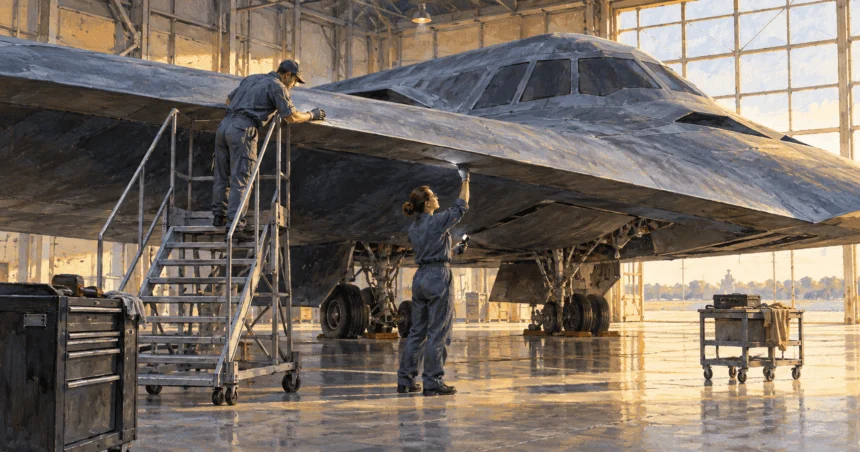
After every mission, the aircraft must undergo extensive, labor-intensive inspections and reapplication of its stealth coatings. This work is so sensitive to environmental conditions that it must be performed in specialized, climate-controlled hangars, which exist at only a handful of locations worldwide.
A 1997 Government Accountability Office report highlighted the severity of this issue, noting that maintaining the low-observable materials accounted for 39% of the B-2’s total maintenance hours during testing. The report also found that the aircraft’s mission-capable rate plummeted from 66% to just 26% when the readiness of its stealth features was factored in, because the materials were frequently damaged and required lengthy repairs.
When all these expenses are tallied—fuel, maintenance, mid-air refueling tankers, mission planning, and support personnel—a single long-range combat sortie can cost between $3 million and $4 million.
Putting the Cost in Perspective: Comparisons and Analogies
To grasp the scale of the B-2’s cost, it’s useful to compare it to other high-value assets. One analysis noted that for the price of a single B-2 bomber, the military could purchase six F-22 Raptor stealth fighters or about seventeen F-35 Lightning II fighters.
The cost of one B-2 could also cover roughly 40% of the cost of building a Nimitz-class nuclear-powered aircraft carrier, a floating city that houses nearly 5,000 personnel and 100 aircraft. Another study calculated that the B-2 was worth more than five times its weight in solid gold.
These comparisons illustrate the profound investment the nation has made in this small fleet of aircraft.
B-2 Program Cost Breakdown
| Cost Metric | Estimated Value | Source |
|---|---|---|
| Total Program Acquisition Cost (21 aircraft) | ~$44.75 billion | GAO Report |
| Average Cost Per Aircraft (Total Program) | ~$2.13 billion | History of Tech |
| Average Procurement Cost Per Aircraft | $929 million (1997 dollars) | History of Tech |
| Average Flyaway Cost Per Aircraft | $737 million (1997 dollars) | History of Tech |
| Operating Cost Per Flight Hour | ~$130,000 – $150,000 | WION News |
| Cost of a Single Combat Sortie | ~$3-4 million | WION News |
| Initial Planned Fleet Size | 132 aircraft | National Interest |
| Final Fleet Size | 21 aircraft | SFL Media |
The Doctrine of Deterrence: The B-2’s Strategic Role
Beyond its impressive technology and daunting cost, the B-2 Spirit’s value to the United States is rooted in military doctrine—the fundamental principles that guide how the armed forces operate. The B-2 isn’t just a piece of hardware; it’s a physical embodiment of key strategic concepts, including nuclear deterrence, global power projection, and technological superiority.
The Visible Leg of the Nuclear Triad: Signaling and Strategic Deterrence
America’s nuclear deterrent capability rests on a three-pronged structure known as the “nuclear triad.” This consists of land-based intercontinental ballistic missiles housed in hardened silos, submarine-launched ballistic missiles carried by stealthy submarines, and strategic bombers like the B-2.
Each leg has unique strengths that complicate an adversary’s calculations and ensure a credible retaliatory capability.
Strategic bombers are considered the most flexible and visible component of the triad. Unlike a missile, which once launched cannot be stopped, a bomber can be deployed as a show of force and then recalled, providing a powerful tool for crisis management and signaling.
The forward deployment of B-2s to a region like Europe or the Pacific sends an unambiguous message of U.S. resolve and readiness to both allies and adversaries, without firing a single shot.
The B-2’s unique stealth capability adds a critical psychological dimension to this deterrent role. Because an adversary can never be certain where a B-2 is or what it can target, they must operate under the assumption that their most heavily defended assets are perpetually at risk.
This uncertainty is a powerful form of deterrence, forcing potential enemies to question their ability to withstand a U.S. strike.
Projecting Power Across the Globe: The “Strike Anywhere, Anytime” Doctrine
A core tenet of modern U.S. military strategy is the ability to project power globally—to respond to crises and conduct military operations anywhere in the world on short notice. The B-2 is a central pillar of this doctrine.
Its combination of intercontinental range and mid-air refueling capability allows it to fly non-stop missions from its main operating base at Whiteman Air Force Base, Missouri, to virtually any point on the globe.
This capability reduces the need to deploy large forces to forward-operating bases in potentially volatile regions, which can be logistically complex and politically sensitive. The Air Force regularly conducts “Bomber Task Force” missions, where B-2s and other bombers deploy to theaters like the Indo-Pacific or Europe for joint exercises.
These missions serve the dual purpose of reassuring allies of America’s security commitments and demonstrating to potential adversaries the global reach of U.S. airpower.
In this context, the B-2’s primary value in the post-Cold War era has evolved. While its original mission was a kinetic one—to penetrate Soviet airspace and destroy targets—its most frequent use today is non-kinetic.
It has become a powerful instrument of geopolitical communication and psychological deterrence. Flying a B-2 over the Pacific is a message to China; deploying it to a base in the UK is a message to Russia.
This reframes the cost-benefit analysis. If viewed purely as a system for delivering bombs, its cost is difficult to justify. But when viewed as a unique, non-verbal diplomatic tool that communicates national resolve and technological dominance, its high price becomes more understandable within the logic of great power competition. It’s a symbol of power as much as an application of it.
Technological Superiority as a National Security Pillar
The investment in a platform like the B-2 also reflects a deep-seated belief within the U.S. Air Force that technological superiority is a fundamental pillar of national security.
Air Force doctrine is built on the principle of using advanced technology to offset potential adversaries’ numerical advantages and to “fly, fight, and win” in any environment.
The B-2 is the quintessential example of this doctrine put into practice. It was designed as a “dramatic leap forward in technology” intended to provide a decisive, non-negotiable advantage over any potential foe.
The investment is therefore justified not just for the capability the aircraft provides today, but for its role in pushing the technological frontier forward. By mastering the complex sciences of stealth, advanced materials, and flight controls, the B-2 program helped create the industrial and intellectual base necessary to maintain America’s “enduring airpower capability” for future generations, a legacy that continues directly with its successor, the B-21 Raider.
From Theory to Reality: The B-2 in Combat
While much of the B-2’s value lies in deterrence, its capabilities aren’t merely theoretical. The bomber has a proven combat record, having been deployed in multiple conflicts since the 1990s. Its operational history reveals a clear pattern of use as a specialized, high-impact asset.
Trial by Fire: Proving Its Worth Over Kosovo (1999)
The B-2’s combat debut came during Operation Allied Force, NATO’s air campaign over Serbia and Kosovo. This was the first real-world test of whether a stealth bomber could successfully penetrate a modern, Soviet-era integrated air defense system.
The B-2s performed exceptionally well. Flying 30-hour, non-stop round-trip missions from their base in Missouri, a small contingent of B-2s was responsible for destroying 33 percent of all Serbian military targets in the first eight weeks of the war.
This performance validated the core concept of stealth bombing and demonstrated its effectiveness in a contested environment.
Longest-Range Missions: Striking Targets in Afghanistan and Iraq
Following the September 11th attacks, the B-2 played a critical role in the opening days of Operation Enduring Freedom in Afghanistan. In 2001, B-2s flew some of the longest combat missions in aviation history, with some sorties lasting over 44 hours, to strike key Taliban and Al Qaeda targets from the continental U.S.
In 2003, during Operation Iraqi Freedom, the B-2 was again called upon to strike the most heavily defended and highest-value targets. The bombers flew 22 sorties from a forward operating location and another 27 from Whiteman AFB, releasing more than 1.5 million pounds of munitions on Iraqi command and control facilities and other critical infrastructure.
A Versatile Tool for Modern Conflicts: Libya, Yemen, and Beyond
The B-2 has continued to prove its relevance in more recent, limited conflicts. In 2011, B-2s were used to destroy hardened aircraft shelters at a Libyan airfield, crippling the air force of Muammar Gaddafi’s regime.
In October 2024, B-2s were used to strike five underground weapons storage facilities in Houthi-controlled Yemen, demonstrating their unique ability to neutralize deeply buried targets.
This “bunker-busting” capability is perhaps the B-2’s most critical conventional role today. It’s the only aircraft in the U.S. arsenal capable of delivering the 30,000-pound GBU-57 Massive Ordnance Penetrator, a weapon specifically designed to defeat the hardened, deeply buried facilities that nations use to protect their most sensitive military and nuclear programs.
The B-2’s combat deployment history reveals its specific, niche role as a “first night of the war” asset. It’s not a workhorse bomber that drops vast quantities of munitions throughout a campaign; its sortie count is consistently low compared to the total number of missions flown.
Instead, it’s a specialized surgical tool used to eliminate an enemy’s most dangerous capabilities—their air defenses, their command centers, and their most hardened bunkers—at the outset of a conflict. By “kicking in the door,” the B-2 paves the way for less-stealthy and less-expensive aircraft to operate with significantly reduced risk.
This explains why the military values it so highly despite its cost and small numbers. Its importance is measured not by the quantity of bombs it drops, but by the strategic significance of the specific targets it can uniquely eliminate.
The Great Debate: Justifying an Unprecedented Investment
The B-2 Spirit has been a subject of intense debate since its development was first acknowledged. The controversy centers on a fundamental question: does its unique capability justify its unprecedented cost? This debate pits arguments of strategic necessity against concerns of economic prudence and opportunity cost.
The Case for the B-2: A Unique and Irreplaceable Capability
Proponents of the B-2 argue that it provides a capability that is both unique and indispensable. It’s the only aircraft in the world that can combine intercontinental range, a large payload, and a high degree of stealth. This combination allows it to penetrate any existing or foreseeable air defense system and hold any target on the planet at risk, providing the President with options that no other weapon system can offer.
This capability is seen as an invaluable deterrent. The mere existence of the B-2 forces potential adversaries to make massive investments in air defense systems that may ultimately prove ineffective, imposing significant costs on them. The strategic uncertainty it creates is believed to discourage aggression.
In an era of renewed great power competition with nations like China and Russia, which are fielding increasingly sophisticated air defenses, proponents argue that the need for a penetrating strike platform like the B-2 is more critical than ever to maintain a credible deterrent.
The Case Against the B-2: Opportunity Costs and Questions of Value
Critics, on the other hand, have long argued that the B-2 is a Cold War relic, a superfluous weapon designed for a conflict with the Soviet Union that never happened. The most powerful argument against the bomber is its staggering opportunity cost.
The tens of billions of dollars spent on the B-2 program represent funds that could not be used for other priorities. Within the military, that money could have purchased hundreds of additional conventional fighter jets or funded other modernization programs. Outside of defense, critics argue those funds could have been directed toward domestic needs like education, infrastructure, or healthcare.
Some analysts also question the B-2’s marginal utility, particularly in its nuclear role. They argue that the other two legs of the nuclear triad—land-based ICBMs and submarine-launched ballistic missiles—provide a more survivable and cost-effective deterrent. From this perspective, the B-2 is an enormously expensive and only incrementally beneficial addition to an already robust nuclear force.
The Vulnerability Question: Can the “Invisible” Bomber Be Seen?
While the B-2 is exceptionally stealthy, it’s not literally invisible. A persistent line of criticism holds that its stealth capabilities are overstated and that it’s vulnerable to certain types of detection.
Military experts have argued that while the B-2 is designed to defeat modern high-frequency targeting radars, it can be detected by older, lower-frequency surveillance radars.
The 1999 shootdown of an F-117 Nighthawk stealth fighter over Serbia by a 1960s-era Soviet-made missile system is often cited as proof that stealth isn’t a guarantee of invincibility. Furthermore, emerging technologies like Infrared Search and Track systems, which detect the heat from an aircraft’s engines and airframe friction rather than relying on radar, pose a growing threat to stealth platforms.
In a more lighthearted but telling incident, a B-2 was famously captured in flight by publicly available Google Earth satellite imagery, sparking a wide-ranging debate about its observability from space.
The debate over the B-2 is ultimately a proxy war between two competing philosophies of national security investment. Proponents subscribe to a “silver bullet” approach, which holds that it’s worth investing whatever it takes to have one perfect tool to solve the single most difficult problem—in this case, penetrating a peer adversary’s defenses.
Critics favor a “mass and versatility” approach, arguing that it’s better to have many good, flexible tools that can handle 99% of potential problems than one exquisite, hyper-expensive tool for a 1% worst-case scenario.
The B-2 program represents the ultimate triumph of the “silver bullet” philosophy in Pentagon procurement, a choice that explains why it’s simultaneously hailed as a national treasure and condemned as a colossal waste.
The Industrial Engine: Economic and Political Realities
The story of the B-2 isn’t just one of strategy and technology; it’s also a story of economics and politics. The immense scale of the program created a powerful industrial and political ecosystem that has played a crucial role in its development, survival, and enduring legacy.
Building the Bomber: A Nationwide Effort and Its Economic Footprint
The B-2 program was a monumental industrial undertaking. Prime contractor Northrop Grumman led a team of the nation’s largest aerospace firms, including Boeing, which built the outboard wing section and landing gear; Hughes (later Raytheon), which developed the radar; General Electric, which supplied the engines; and Vought Aircraft Industries, which produced the intermediate wing section.
The program’s supply chain was vast. At its peak, it involved more than 40,000 workers at over 6,000 companies spread across 46 states, creating a significant national economic engine.
The program was particularly vital to the economy of Southern California, where Northrop Grumman’s main assembly and test facility is located at Air Force Plant 42 in Palmdale. The influx of thousands of high-paying, high-tech engineering and manufacturing jobs has had a lasting impact on the region’s aerospace industry, which had shrunk in the decades following the end of the Cold War.
The Politics of Procurement: Lobbying and Congressional Support
Such a large economic footprint inevitably translates into powerful political influence. Defense contractors like Northrop Grumman are major players in Washington, investing heavily in lobbying and campaign contributions to ensure continued congressional support for their key programs.
From 2010 to 2015, for instance, Northrop Grumman spent over $85 million lobbying Congress and the Department of Defense on issues including the new bomber program, employing a staff that included former members of Congress.
The widespread distribution of jobs and subcontracts creates a powerful political constituency. Members of Congress whose districts benefit from the B-2 program have a strong incentive to vote for continued funding to protect their local economies.
This dynamic creates an inertia that can make it difficult to curtail or cancel large defense programs, even when their strategic rationale is questioned. A study by the Brookings Institution famously noted that the decision to fund the 21st B-2 bomber was made not at the request of the Air Force, but specifically to enhance employment in the Los Angeles area, a clear example of regional economic stimulation driving national defense procurement.
Technological Dividends: Did the B-2 Program Drive Broader Innovation?
Proponents of large defense projects often point to their potential to generate “spin-off” technologies that benefit the civilian economy. The B-2 program undoubtedly pushed the boundaries of aerospace engineering. It required the invention of entirely new manufacturing processes, from the creation of an Integrated Composites Center in a former auto factory to the development of automated tape-laying systems and the first large-scale use of 3D computer-aided design.
More recently, the need to modernize the B-2’s aging computer systems led to the creation of the “Spirit Realm” software factory, a modern DevSecOps environment that has dramatically cut software upgrade timelines from years to months and saved millions in flight test costs.
However, unlike NASA programs that have produced well-known consumer spin-offs like memory foam or scratch-resistant lenses, there’s little evidence of direct civilian applications emerging from the highly classified B-2 program.
The primary “spin-off” has been the creation of a highly specialized industrial base and a wealth of knowledge in stealth technology, advanced composites, and systems integration. This technological and human capital, funded by the B-2, is now the foundational asset being leveraged to design and build its successor, the B-21 Raider.
This demonstrates how the B-2 program created a powerful, self-perpetuating cycle: a strategic need spawned a massive industrial base, which in turn created a political imperative to sustain that base, leading to lobbying and political pressure that helped justify and secure the contract for the next-generation bomber.
The Next Generation: Modernization and the B-21 Raider
The B-2 Spirit isn’t a museum piece; it’s an active and evolving weapon system. As the strategic landscape changes and new threats emerge, the Air Force is investing in both modernizing the B-2 fleet and developing its successor, the B-21 Raider.
The relationship between these two programs reveals how the lessons learned from the B-2’s troubled but successful history are shaping the future of American airpower.
Keeping the Spirit Flying: Continuous Upgrades for a Contested World
Despite being based on 1980s technology, the B-2 isn’t a static “legacy” platform. It’s undergoing a continuous series of upgrades to ensure it remains survivable and effective in a 21st-century threat environment. These modernization efforts are focused on several key areas:
Communications: Upgrading satellite communication links to allow the B-2 to receive and transmit large amounts of data in real-time, enabling its crew to receive updated target information while in flight.
Survivability: Enhancing the B-2’s stealth characteristics with new, more durable low-observable materials and coatings, and improving its situational awareness with new sensors and defensive systems.
Avionics and Software: Replacing aging computer processors and rewriting software to improve performance and enable the integration of new, advanced munitions.
The Air Force plans to continue operating the B-2 fleet until at least 2032, by which time its successor is expected to be fielded in sufficient numbers to take over the penetrating strike mission.
Enter the Raider: Designing the B-2’s Successor
The future of America’s long-range strike capability is the B-21 Raider. Also built by Northrop Grumman, the B-21 is the Air Force’s next-generation penetrating stealth bomber.
Its primary purpose is to perform the same core mission as the B-2—flying deep into contested airspace to deliver conventional and nuclear payloads—but to do so more affordably, sustainably, and with greater adaptability.
The Air Force’s plan to procure a minimum of 100 B-21s is a direct response to the problems created by the B-2’s small fleet size. A larger production run will allow the significant R&D costs to be spread more widely, lowering the per-unit price, and will provide commanders with greater operational flexibility than the current fleet of just 19 active B-2s allows.
Comparing Generations: How the B-21 Aims to Be Cheaper and More Advanced
The B-21 Raider program is both a powerful validation of the B-2’s core strategic mission and a direct repudiation of its programmatic failures. Its entire design and acquisition philosophy appears to be a point-by-point correction of the B-2’s most significant flaws.
Cost: The B-21’s average unit procurement cost is targeted at approximately $692 million (in 2022 dollars). Adjusted for inflation, this is roughly one-third the cost of a B-2, making it a far more affordable proposition.
The very existence of the B-21 program validates the central argument for the B-2: that the U.S. requires a long-range, penetrating stealth bomber. The mission is enduring.
Size and Payload: The B-21 is visibly smaller than the B-2 and is expected to have a smaller payload capacity (roughly 20,000 pounds vs. the B-2’s 40,000 pounds). This reflects a crucial design trade-off. With the increasing accuracy of modern precision-guided munitions, the B-21 is designed to achieve greater effects with fewer, smaller weapons. This prioritizes affordability and fleet size over the raw carrying capacity of a single aircraft.
Technology and Upgradability: The B-21 is being designed with a modular, “open systems architecture.” This is a fundamental departure from the B-2’s bespoke, closed design. An open architecture will make it vastly easier and cheaper to integrate new technologies, software, and weapons over the aircraft’s decades-long service life, allowing it to evolve with the threat environment without requiring expensive, one-off modernization programs.
The B-21 is a product of the digital age, designed entirely with computer modeling, whereas the B-2 was conceived in an era of slide rules and drafting tables.
Maintainability: The B-21 is being built with next-generation stealth materials that are expected to be far more durable and less maintenance-intensive than those used on the B-2. A key program goal is to reduce operating costs and increase readiness rates, directly addressing one of the B-2’s most persistent and expensive problems.
Our articles make government information more accessible. Please consult a qualified professional for financial, legal, or health advice specific to your circumstances.