Last updated 11 months ago. Our resources are updated regularly but please keep in mind that links, programs, policies, and contact information do change.
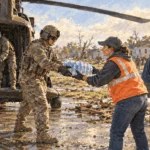
When Hurricane Katrina slammed into New Orleans, when wildfires raged across California, when massive floods swamped the Midwest—the images were the same. Military helicopters plucking people from rooftops. Soldiers filling sandbags. National Guard troops delivering food and water to devastated communities.
These aren’t scenes from a foreign war zone. They’re snapshots of Defense Support of Civil Authorities, better known as DSCA—the formal process that allows the vast resources of the U.S. military to be deployed on American soil during emergencies.
The foundational principle is crystal clear: the military always acts in a supporting role to civilian agencies, never in the lead. Federal military forces, DoD civilians and contractors, and National Guard forces are called upon only when requested and when civilian capabilities are exhausted or unavailable.
This assistance can range from clearing debris-clogged roads and transporting life-saving supplies to conducting large-scale search and rescue operations.
Getting the military involved isn’t automatic—it follows a complex legal framework designed to provide essential aid during a crisis while protecting the long-standing American tradition of civilian control over the military.
The Legal Foundation
The use of the United States military on its own soil is governed by a complex and deliberately constructed legal architecture. These laws both empower and strictly constrain the DoD’s role in domestic operations.
The Stafford Act: Opening the Door
The primary legal key that unlocks federal disaster assistance is the Robert T. Stafford Disaster Relief and Emergency Assistance Act. This law authorizes the President to issue a “major disaster” or “emergency” declaration when an event overwhelms the resources of state and local governments.
The process starts at the state level. A governor, responsible for the safety and welfare of their state’s citizens, must first determine that the disaster’s magnitude exceeds the state’s ability to respond effectively. The governor then makes a formal request to the President for a federal declaration.
Once the President issues this declaration, it triggers a wide range of federal support, coordinated by the Federal Emergency Management Agency (FEMA). This includes authorizing the DoD to provide its unique resources to the relief effort.
A critical element of the Stafford Act is what it doesn’t authorize. While it allows the military to perform a wide array of disaster relief tasks—such as logistics, medical support, and engineering—it doesn’t grant military personnel law enforcement authority. This fundamental limitation leads directly to the next pillar of the legal framework.
The Posse Comitatus Act: Drawing the Line
At the heart of American civil-military relations lies the Posse Comitatus Act, enacted in 1878. This federal law generally prohibits the willful use of the U.S. Army and Air Force to “execute the laws” of the nation. While the original text doesn’t name the Navy or Marine Corps, Department of Defense regulations and policy have extended the same prohibition to them.
The Posse Comitatus Act reflects a deep-seated American tradition that views the direct involvement of a standing army in civilian governance as a potential threat to liberty. In practice, courts have interpreted the act to forbid military personnel from engaging in direct law enforcement activities such as search, seizure, and arrest.
This creates a clear boundary: military forces responding under the Stafford Act can rescue a person from a flooded home, but they cannot arrest someone for looting that same home. The latter is a job for civilian police.
This legal structure creates an inherent operational tension for military forces on the ground. The Stafford Act empowers them to provide aid, while the Posse Comitatus Act simultaneously restricts their actions, particularly in the chaotic aftermath of a disaster where the line between humanitarian support and maintaining public order can become blurred.
A crucial exception to the Posse Comitatus Act involves the National Guard. When Guard members are operating under the command of their state governor (in what’s known as State Active Duty or Title 32 status), they’re not considered federal forces for the purposes of the act. This is why National Guard troops can be seen performing tasks that may appear to be law enforcement, such as directing traffic or securing a perimeter, during a state-led emergency response.
The Insurrection Act: The Nuclear Option
The most significant statutory exception to the Posse Comitatus Act is the Insurrection Act of 1807. This law grants the President the authority to deploy federal troops on U.S. soil to enforce federal laws or suppress rebellion, insurrection, or domestic violence. Invoking the Insurrection Act effectively suspends the restrictions of the Posse Comitatus Act, allowing the military to perform law enforcement functions.
The threshold for its use is exceptionally high and is reserved for situations where state authorities are unable or unwilling to maintain public order or protect the constitutional rights of citizens. Historically, it has been invoked not for natural disasters, but for instances of profound civil unrest, such as when President Eisenhower deployed troops to enforce school desegregation in Little Rock, Arkansas, or when President George H.W. Bush sent troops to restore order during the 1992 Los Angeles riots.
The Insurrection Act provides a legal pathway for domestic military law enforcement, but it’s a path fundamentally separate from the disaster relief mission authorized by the Stafford Act.
Key DoD Policies
To translate these complex laws into actionable policy, the Department of Defense relies on its own internal regulations. The central document is DoD Directive 3025.18, “Defense Support of Civil Authorities”. This directive serves as the primary rulebook, defining the scope, responsibilities, and procedures for all DSCA activities.
It’s supplemented by other policies, such as DoD Instruction 3025.21, “Defense Support of Civilian Law Enforcement Agencies,” which provides further clarification on interactions with police and other law enforcement bodies. Together, these documents form a comprehensive regulatory framework that guides every aspect of the military’s domestic support mission.
Key Legal Authorities Governing Military Domestic Operations
| Law/Directive | Primary Purpose | Who Can Invoke It? | Key Limitation/Feature |
|---|---|---|---|
| Stafford Act | Authorize federal disaster relief and emergency assistance | President, upon Governor’s request | Does not authorize law enforcement functions |
| Posse Comitatus Act | Prohibit use of federal military for civilian law enforcement | N/A (It is a prohibition) | Exceptions must be authorized by Constitution or Congress |
| Insurrection Act | Allow use of federal military for domestic law enforcement | President | Suspends Posse Comitatus; used for rebellion/civil unrest, not typical disasters |
| DoD Directive 3025.18 | Establish policy and procedures for DSCA | Secretary of Defense | Provides internal DoD guidance for executing DSCA missions |
Who’s in Charge
The command and control structure for a major disaster response is intentionally complex, designed to uphold the principle of civilian control over the military. It’s not a system built for maximum military efficiency, but rather for adherence to the legal and constitutional norms that govern the nation.
The National Response Framework
The guiding doctrine for how the nation responds to all types of disasters and emergencies is the National Response Framework. The NRF is built on a simple but critical principle: all response begins and ends at the local level.
Local responders are always first on the scene. They’re supported by the state, and only when a disaster’s needs exceed state and local capabilities is federal assistance requested. The NRF provides a scalable, flexible, and unified structure to coordinate the actions of local, tribal, state, and federal governments, as well as non-governmental organizations and the private sector.
The Key Players
In a large-scale disaster requiring federal support, a clear hierarchy of roles and responsibilities emerges.
Local and State Governments: The initial response is managed by local emergency managers, mayors, and county officials. The state’s Governor holds ultimate responsibility for the public safety of their citizens. The Governor commands the state’s National Guard and is the key official who formally requests a presidential disaster declaration under the Stafford Act.
FEMA: The Federal Coordinator: Once a disaster is federally declared, the Federal Emergency Management Agency becomes the lead federal agency responsible for coordinating the entire federal response. FEMA isn’t a first responder; it’s a coordinating body that brings the full resources of the federal government to bear.
To manage the on-the-ground effort, FEMA appoints a Federal Coordinating Officer (FCO), who establishes a Joint Field Office (JFO) near the disaster area. The FCO is the senior federal official in charge of the response and recovery efforts.
USNORTHCOM: The DoD’s Operational Commander: Established in the wake of the September 11th attacks, U.S. Northern Command is the military’s unified combatant command responsible for homeland defense and providing DSCA within North America.
When federal military forces (known as Title 10 forces) are deployed for a disaster, they fall under the operational command of USNORTHCOM. It’s important to note that USNORTHCOM has very few permanently assigned forces; instead, it draws units from across the Army, Navy, Air Force, and Marine Corps as needed for a specific mission.
Defense Coordinating Officer: To ensure seamless integration, the DoD embeds a Defense Coordinating Officer (DCO) and their staff directly into FEMA’s Joint Field Office. There’s one DCO assigned to each of the ten FEMA regions across the country.
The DCO is the critical link in the chain—they’re DoD’s single point of contact for the FCO. All requests for military assistance are funneled through the DCO, who then works with USNORTHCOM to find and deploy the right military capabilities. This structure ensures that the military is responding to the needs identified by the lead civilian agency, reinforcing the principle of military support to civil authority.
The National Guard: Dual Mission
The National Guard occupies a unique and vital position in disaster response due to its dual state and federal mission.
State Control: In most disasters, the first military uniforms on the scene belong to the National Guard. Activated by their governor, Guard members operate under state command and are paid with state funds (State Active Duty) or federal funds under Title 32 of the U.S. Code. In this status, they’re under the authority of the governor and are not restricted by the Posse Comitatus Act. This makes them the primary military force for immediate response within a state’s borders.
Federal Control: The President has the authority to “federalize” National Guard units, calling them to active duty under Title 10 of the U.S. Code. When this happens, they transition from state control to federal control, falling under the command of the President and USNORTHCOM. In Title 10 status, they’re subject to the same rules and restrictions as active-duty forces, including the Posse Comitatus Act.
This dual nature makes the National Guard an incredibly flexible tool, able to act as a state’s own force or be integrated into a larger federal response.
The Dual-Status Commander Solution
The catastrophic response to Hurricane Katrina in 2005 revealed a massive flaw in the command structure. Federal active-duty forces (under Title 10) and National Guard forces (under Title 32) operated in the same disaster zone but under separate, uncoordinated chains of command, leading to confusion and inefficiency.
The solution was the formal implementation of the Dual-Status Commander (DSC) concept. A DSC is a single military officer, typically a high-ranking National Guard general, who is given special authority by both the state’s Governor and the U.S. Secretary of Defense.
This unique appointment allows the DSC to simultaneously command both state-controlled National Guard forces and federally-controlled active-duty forces within the disaster area. This structure ensures unity of command and a coordinated, efficient use of all military assets, preventing the command-and-control chaos that plagued the Katrina response.
From Request to Response
Getting military assistance to a disaster zone isn’t an automatic process. It follows a deliberate, structured path designed to ensure that military force is used legally, appropriately, and only when necessary. This process is centered on a formal evaluation of risk and resources, balancing civilian needs against the military’s primary national defense mission.
The Request for Assistance
The standard pathway to secure DoD support is through a formal Request for Assistance (RFA). In a major disaster declared under the Stafford Act, the RFA is typically submitted by the lead federal agency, FEMA, to the Department of Defense on behalf of the affected state.
The request originates from the needs identified on the ground by civilian authorities. The FCO in the Joint Field Office works with the DCO to articulate the specific support required. The DCO then forwards this request up the military chain of command to USNORTHCOM and, for final approval, to the Office of the Secretary of Defense.
The Pentagon’s Evaluation Process
The DoD doesn’t approve requests automatically. Every RFA is formally evaluated against six key criteria outlined in DoD policy to ensure the requested support is proper and feasible. These criteria provide a transparent look into the Pentagon’s decision-making process:
Legality: Is the request fully compliant with all U.S. laws, including the Stafford Act and the Posse Comitatus Act?
Lethality: What’s the potential for the use of lethal force by or against DoD personnel? Missions with a high potential for violence are generally not approved under DSCA.
Risk: What are the safety risks to the military forces who would be deployed?
Cost: Who’s paying for the mission? Under the Stafford Act, support is typically reimbursable by FEMA. The DoD must also consider the impact on its own budget.
Appropriateness: Is this a mission that’s in the interest of the DoD to conduct? Is the military the only entity with the capability, or could a commercial or other civilian agency perform the task? This prevents the military from becoming the default solution for every problem.
Readiness: What’s the impact of this deployment on the military unit’s ability to perform its primary warfighting mission? A unit deployed to a disaster cannot simultaneously be training for combat or deploying overseas.
These evaluation criteria aren’t mere bureaucratic hurdles; they represent an institutional negotiation of risk. The “Readiness” and “Appropriateness” criteria, in particular, force a deliberate conversation that balances the urgent needs of a domestic crisis against the military’s core responsibility to national defense.
Immediate Response Authority
The DoD recognizes that the formal RFA process can take time—time that may not be available in a life-threatening emergency. For these situations, there’s a critical exception known as Immediate Response Authority (IRA).
IRA allows local military commanders and certain DoD officials to respond immediately to a request from a local civil authority (such as a mayor, police chief, or fire chief) to save lives, prevent immense human suffering, or mitigate great property damage. This authority can be used when an imminent danger exists and there’s simply no time to seek approval from higher up the chain of command.
This is the “break glass in case of emergency” option. An action taken under IRA is temporary and must be reported up the chain of command immediately. The situation must be reassessed within 72 hours to determine if continued support is necessary and if it should transition to a formal RFA.
What the Military Brings
The Department of Defense doesn’t maintain special units that sit idle waiting for a disaster. Instead, it adapts its powerful, general-purpose warfighting capabilities to meet the needs of a domestic crisis. This approach is both a great strength, providing an unmatched scale of resources, and a potential weakness, as these tools aren’t always perfectly tailored for a civilian environment.
This support is almost always provided on a reimbursable basis, with the costs covered by the lead federal agency under the Stafford Act.
Key Military Capabilities
When a request for assistance is approved, the DoD can deploy a vast array of assets and personnel.
Aviation: This is one of the most critical and visible forms of military support. It includes helicopters like the UH-60 Black Hawk and the heavy-lift CH-47 Chinook, which are invaluable for medical evacuations, search and rescue missions, and transporting personnel and critical supplies like food, water, and medicine into areas with impassable roads.
Engineering: The military’s engineering capabilities are essential for recovery. Engineer units can clear roads of debris, construct temporary bridges, build emergency shelters, and perform both horizontal (earth-moving) and vertical (building) construction.
Logistics: The DoD is a world leader in logistics. It can transport massive quantities of supplies, provide large generators for temporary power to critical facilities like hospitals, and deploy water purification units that can provide thousands of gallons of potable water per day.
Medical: In a mass casualty event, the military can deploy a range of medical assets, including ground ambulances, specialized medical teams (such as surgical or preventive medicine teams), and even entire combat support hospitals to augment overwhelmed civilian facilities.
Communications: When local cell towers and communication lines are destroyed, military units can establish their own satellite and radio networks, providing a vital communication lifeline for emergency responders.
Search and Rescue: While FEMA coordinates 28 elite civilian Urban Search & Rescue task forces, the military can supplement these efforts with its own personnel and, most importantly, its aerial reconnaissance and search capabilities.
The Reserve Components
A significant portion of the DoD’s most in-demand disaster response capabilities resides in its reserve components. The Army Reserve, for instance, provides a substantial percentage of the Army’s total logistical, engineering, and medical units.
Likewise, the National Guard’s presence in over 1,200 communities across the country, combined with its dual state-federal mission, makes it uniquely positioned for rapid and effective local response.
Integration with National Response
These military capabilities are integrated into the National Response Framework through a system of Emergency Support Functions (ESFs). The NRF organizes response capabilities into 15 ESFs, such as ESF #1 (Transportation), ESF #6 (Mass Care, Housing), and ESF #9 (Search and Rescue).
While FEMA has overall coordination, a specific federal agency is designated as the lead for each ESF. The Department of Defense is the designated lead coordinator for ESF #3 (Public Works and Engineering) and is a key supporting agency for almost all of the other ESFs, demonstrating how deeply its capabilities are woven into the national response plan.
The use of general warfighting forces for DSCA is a double-edged sword. On one hand, it provides a surge capacity that no other agency can match. The sheer scale of DoD’s logistical and engineering power, maintained for national defense, can be brought to bear on a disaster with overwhelming effect.
On the other hand, these forces are trained for combat, not for operating in a delicate, legally complex domestic environment. This can lead to cultural friction with civilian partners and a lack of familiarity with the specific rules and procedures of disaster response.
Lessons from Real Disasters
The principles and processes of DSCA aren’t just theoretical; they’ve been tested and refined by real-world disasters. Case studies reveal that DSCA isn’t a monolithic mission. The nature of the disaster dictates the type of military response, the key players involved, and the primary challenges faced.
Hurricane Katrina: The Catalyst for Change
The military response to Hurricane Katrina stands as the single most important focusing event in the history of modern DSCA. The storm’s aftermath was a catastrophic failure of government at all levels, and the initial military response was plagued by chaos.
The most significant problem was a fractured command structure. More than 54,000 National Guard troops and 20,000 active-duty federal troops were deployed to the Gulf Coast, but they operated under separate and uncoordinated chains of command.
The governor of Louisiana refused the President’s request to grant the lead federal general authority over state forces, resulting in confusion, duplicated efforts, and public “finger pointing” between state and federal leaders.
Despite these high-level failures, the sheer scale of the military effort eventually provided life-saving support to tens of thousands of people. More importantly, the lessons learned from Katrina’s failures became a powerful catalyst for reform.
In the years that followed, USNORTHCOM developed far more detailed contingency plans, the Council of Governors was created to improve federal-state military coordination, and the Dual-Status Commander model was widely adopted to ensure a unified military command in all future large-scale disasters.
California Wildfires: Sustained Support
The military’s role in fighting California’s increasingly frequent and destructive wildfires showcases a different model of DSCA: sustained, specialized, and deeply integrated support to a highly competent state agency.
Aerial Firefighting: The most prominent military contribution is the Modular Airborne Fire Fighting System (MAFFS) program. This program uses C-130 cargo aircraft from Air National Guard and Air Force Reserve units, fitted with a special pressurized tank system that can drop up to 3,000 gallons of water or fire retardant in seconds.
These military air tankers are called in when the civilian fleet is fully committed, and they’ve dropped millions of gallons of retardant on California fires over the years.
Ground Support: On the ground, the California National Guard works in close partnership with the California Department of Forestry and Fire Protection (CAL FIRE). Joint units, like the aptly named “Task Force Rattlesnake,” are trained by CAL FIRE to perform critical support missions like clearing brush, digging firebreaks, and conducting mop-up operations after a fire has passed.
Recovery: After the flames are out, other military assets, like the U.S. Army Corps of Engineers, often play a major role in the recovery phase, managing massive debris removal operations from burned-out neighborhoods.
Midwest Floods: Classic Guard Mission
The response to major flooding events, such as those that struck the Midwest in 2011 and 2019, illustrates the quintessential domestic mission of the National Guard. With Guard units present in nearly every community, they’re perfectly positioned to respond to widespread, ground-level disasters under the command of their governors.
During these floods, Guard members performed a variety of critical tasks. They used high-clearance military vehicles to conduct search and rescue operations and transport supplies over flooded roads. They patrolled and monitored thousands of miles of levees, and when breaches occurred, they used helicopters like the UH-60 Black Hawk to precisely place one-ton sandbags to plug the gaps.
In a uniquely Midwestern mission, Nebraska Guard members even used CH-47 Chinook helicopters to air-drop bales of hay to feed thousands of cattle stranded by floodwaters.
The response also highlighted interstate cooperation through the Emergency Management Assistance Compact (EMAC), a system that allows governors to send their National Guard forces to assist a neighboring state in need.
The Challenges and Limitations
While the Department of Defense provides an indispensable capability in times of crisis, relying on the military for domestic disaster response comes with a unique set of challenges and limitations. These issues stem from the fundamental tension between the military’s primary warfighting mission and its secondary role in supporting civil authorities.
The Readiness Dilemma
A primary concern for military leaders and some members of Congress is the potential impact of DSCA missions on military readiness. The DoD’s core purpose is to fight and win the nation’s wars, and every resource—from soldier training time to equipment maintenance hours—is finite.
Large-scale or frequent DSCA deployments can divert units from their essential combat training schedules. This creates a constant balancing act. While some argue that DSCA missions provide valuable real-world experience in logistics and planning that enhances readiness, there’s an undeniable opportunity cost. A brigade fighting floods in Missouri cannot simultaneously be preparing for a deployment to a global hotspot.
Cultural and Operational Friction
The military’s organizational culture is hierarchical, decisive, and built on a command-and-control structure designed for the battlefield. This can clash with the more collaborative, consensus-based culture of civilian emergency management agencies.
This cultural mismatch has, at times, led to significant friction. There’s a documented tendency for military units, accustomed to taking charge, to try and direct operations rather than support them. This approach not only violates the core principle of DSCA but can also alienate civilian partners and create inefficiency, as military personnel may lack the local knowledge and specific expertise of their civilian counterparts.
Training and Education Gaps
This cultural friction is compounded by significant gaps in training and education. The average soldier or Marine receives extensive training in combat tasks but often has little to no formal education on the unique aspects of DSCA.
Many are unfamiliar with the legal limitations of the Posse Comitatus Act or the roles and structures of the civilian agencies they’re tasked to support, like FEMA or state emergency managers. Furthermore, there’s no systematic, DoD-wide curriculum for critical disaster competencies.
For example, military medical personnel are highly trained in battlefield trauma, but this doesn’t fully translate to the public health, sanitation, and chronic disease management needs often seen in a displaced civilian population after a disaster.
These gaps in training and planning mean that the military and civilian worlds often operate in separate spheres, only to be forced together during a crisis. The response to Hurricane Katrina demonstrated what happens when this forced integration fails.
The key to improving DSCA lies in proactive, pre-disaster efforts: conducting more joint training exercises, building relationships between military units and local emergency managers, and educating all service members on the unique legal and cultural demands of the DSCA mission. The challenge is to build the bridge between the military and civilian worlds before the storm hits.
Getting Help and Being Prepared
While the government and military have robust plans for disaster response, national resilience begins at home. Individual and family preparedness is a civic responsibility that not only protects you and your loved ones but also reduces the strain on emergency responders, allowing them to focus on the most critical needs.
Individual and Family Preparedness
The Department of Defense requires its own personnel and their families to be prepared for emergencies, and their guidance provides a simple, effective model for all citizens.
Make a Plan: Take the time to discuss a plan with your family. Key questions to answer include:
- How will we receive emergency alerts and warnings?
- What is our primary evacuation route, and what is our backup?
- Where will we shelter if we have to evacuate? Where will we shelter-in-place if we cannot leave?
- How will we communicate if cell service is down? (Designate an out-of-state contact for everyone to call.)
- What are the unique needs of our family (medical prescriptions, infants, elderly members, pets)?
Assemble a Kit: Every household should have a basic emergency supply kit that can sustain the family for a minimum of 72 hours. This kit should be easily accessible. Consider having one larger kit for sheltering at home and a smaller, portable “go-bag” in case of evacuation.
Key items include:
- Water (one gallon per person per day for several days)
- Non-perishable food (a several-day supply)
- Battery-powered or hand-crank radio and a NOAA Weather Radio
- Flashlight and extra batteries
- First-aid kit
- Whistle to signal for help
- Filter mask or cotton t-shirt to help filter the air
- Moist towelettes, garbage bags, and plastic ties for personal sanitation
- Wrench or pliers to turn off utilities
- Manual can opener
- Local maps
- Cell phone with chargers and a backup battery
Applying for Federal Assistance
If you’re affected by a major disaster, federal assistance may be available. Here’s how to access it.
Eligibility: To be eligible for assistance from FEMA, you must live in a county that has been included in a presidential disaster declaration. You can check if your area is eligible by visiting FEMA’s website or using their address lookup tool.
How to Apply: There are four primary ways to apply for FEMA disaster assistance:
Online: The fastest way is to apply online at DisasterAssistance.gov.
FEMA App: You can apply through the official FEMA app on your smartphone.
Phone: You can call the FEMA Helpline at 1-800-621-3362. If you use a relay service (such as a video relay service or captioned telephone), provide FEMA with the number for that service.
In Person: FEMA may open Disaster Recovery Centers (DRCs) in affected communities where you can apply in person. You can find DRC locations on the FEMA website or by calling the helpline.
What You’ll Need: When you apply, you should have the following information ready:
- Your Social Security number
- A description of the damage to your property
- Your insurance information
- Your annual household income
- Your contact information (phone number and mailing address)
- Your bank account and routing numbers for direct deposit of funds
Other Resources: If you’re in a federally declared disaster area, you may also be eligible for free legal help through Disaster Legal Services (DLS) if you have a low income.
For disasters that aren’t federally declared, you should contact your state emergency management agency and local non-profits like the American Red Cross for information on available assistance.
The Balance of Power and Protection
Defense Support of Civil Authorities represents one of the most delicate balances in American governance—between providing essential aid in times of crisis and maintaining the civilian control of government that defines our democracy.
The framework isn’t perfect. The response to Hurricane Katrina showed what can go wrong when coordination breaks down. Cultural friction between military and civilian responders remains a persistent challenge. Training gaps can lead to misunderstandings about roles and limitations.
But the system has evolved and improved. The Dual-Status Commander concept ensures unified military command while respecting state authority. Better contingency planning helps prevent the chaos that marked earlier responses. Increased joint training builds relationships before disasters strike.
Perhaps most importantly, DSCA serves as a reminder that America’s military isn’t just a force for projecting power abroad—it’s also a guardian of communities at home. When local resources are overwhelmed and state capabilities exhausted, the same soldiers, sailors, airmen, and Marines who defend our nation overseas stand ready to defend our neighbors from the forces of nature.
The helicopters that search for survivors, the engineers who clear debris, the medics who treat the injured—they’re all part of a uniquely American approach to disaster response that harnesses military might in service of civilian need, all while carefully preserving the constitutional principles that make such service both possible and safe.
In an era of increasing natural disasters and growing threats to homeland security, understanding this balance isn’t just important for emergency managers and military planners. It’s essential knowledge for every citizen who may one day need help—or who may be called upon to provide it.