- fcc.gov2 links
- firstamendment.mtsu.edu2 links
Last updated 1 month ago. Our resources are updated regularly but please keep in mind that links, programs, policies, and contact information do change.
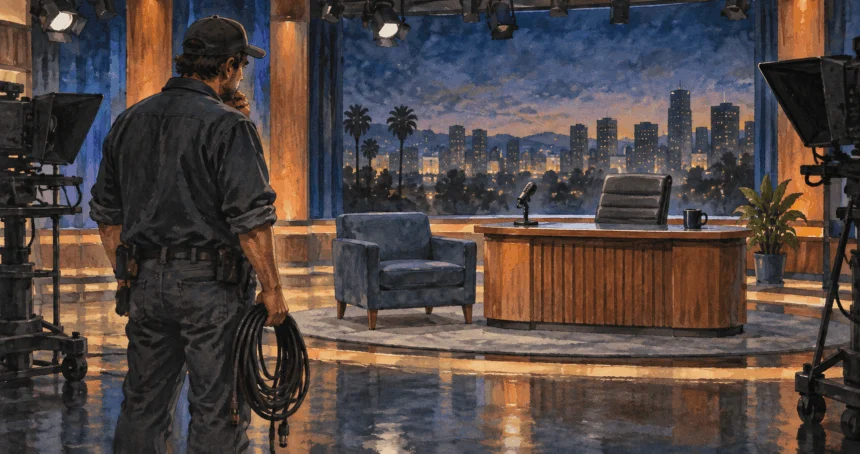
In September 2025, a media firestorm erupted when Disney-owned ABC abruptly suspended its flagship late-night program, Jimmy Kimmel Live!, announcing at the time that it would be “preempted indefinitely.”
This move pulled one of television’s most recognizable hosts from the airwaves during an active political season, leaving audiences and media observers stunned.
The catalyst was a series of monologues in which Kimmel addressed the recent killing of conservative activist Charlie Kirk. Kimmel alleged that political allies of the president were attempting to “capitalize on the murder” and mischaracterize the shooter for political gain, specifically calling out the “MAGA gang.”
The backlash was swift, but it came from an unexpected and powerful direction. It wasn’t just public opinion or advertiser boycotts. The full weight of a federal regulatory agency was brought to bear.
Brendan Carr, Chairman of the Federal Communications Commission (FCC), publicly condemned Kimmel’s remarks as “truly sick.” Speaking on a conservative podcast, Carr warned that local television stations carrying Kimmel’s show, and their parent companies, were “running the possibility of fines or licensed revocation from the FCC.”
He stated bluntly: “We can do this the easy way or the hard way … there’s going to be additional work for the FCC ahead.”
This sequence of events (a comedian’s political commentary, a regulator’s public warning, and a major network’s sudden suspension of the show) ignited fierce national debate.
Understanding the FCC’s Power
The Federal Communications Commission is an independent agency established by the Communications Act of 1934. Its jurisdiction is vast, regulating interstate and international communications by radio, television, wire, satellite, and cable across all 50 states and U.S. territories.
The agency is directed by five commissioners appointed by the President and confirmed by the Senate for five-year terms. To ensure political balance, no more than three commissioners may be from the same political party. The President designates one commissioner to serve as chairman, a position holding significant influence over the agency’s agenda and enforcement priorities.
This structure, designed to create independence, ensures that agency leadership is tied to the political climate of the current administration – a fact central to the Kimmel controversy.
The ‘Public Interest’ Standard
The legal bedrock of all FCC broadcast regulation is a deceptively simple phrase embedded in the Communications Act. In exchange for receiving a free and exclusive license to use public airwaves, a broadcast station must serve the “public interest, convenience, and necessity.”
Every FCC decision regarding a broadcast license – from initial granting to renewal every eight years – is theoretically measured against this standard.
However, for nearly a century, neither Congress nor the FCC has ever provided a concrete, comprehensive definition of what “public interest” actually means. The term’s deliberate ambiguity is both its greatest strength and most significant vulnerability.
This flexibility allows the standard to evolve with technology and societal values. But it also creates a nebulous requirement that can be interpreted vastly differently depending on the FCC leadership’s political orientation.
This ambiguity can serve as a significant factor in regulatory decisions. In the Kimmel situation, both FCC Chairman Carr and the station groups that dropped the show cited “public interest” as justification for their actions. Carr characterized Kimmel’s commentary not as disagreeable speech, but as content potentially violating local stations’ community obligations.
The broad standard enabled the situation involving the monologue to be addressed through the regulatory framework. This created uncertainty for license holders – the local stations – who chose to act cautiously to avoid potential regulatory issues.
The law’s ambiguity serves as a significant aspect of the FCC’s regulatory approach, providing flexibility in how standards are applied and interpreted.
Why TV and Radio Are Different
The First Amendment broadly protects freedom of speech and press, strictly limiting government’s ability to regulate content. For example, a government agency telling a newspaper what it can or cannot publish would be a clear violation.
Yet for nearly a century, the government has exercised control over broadcast radio and television that would be unthinkable in print. This unique regulatory power rests on two foundational legal concepts: the scarcity doctrine and the public trustee model.
The Scarcity Doctrine
The legal theory justifying broadcast regulation dates back to chaotic early radio days in the 1920s. With unregulated broadcasters setting up transmitters wherever they pleased, the radio dial became a cacophony of overlapping signals, rendering the medium useless.
Congress stepped in with the Radio Act of 1927, establishing that public airwaves – the electromagnetic spectrum used to transmit signals – are a finite public resource. Unlike printing presses, which anyone can own, there are limited usable frequencies in any geographic area.
Because substantially more people want to broadcast than there are channels available, the government must act as a traffic cop, assigning licenses to prevent interference and ensure spectrum is used effectively for the public good.
The Public Trustee Model
This scarcity rationale gave rise to the public trustee model of broadcasting. Under this framework, a broadcaster doesn’t own its frequency; it’s merely granted temporary privilege to use it. In legal terms, the station owner acts as a “public fiduciary” or “trustee,” holding the license in trust for the community it serves.
This trusteeship comes with obligations, chief among them the duty to operate in the “public interest.” The FCC was established to oversee these trustees and monitor compliance with their regulatory obligations.
Landmark Ruling: Red Lion Broadcasting
The Supreme Court gave its most forceful endorsement of this regulatory framework in the 1969 case Red Lion Broadcasting Co. v. FCC. The case involved the FCC’s “Fairness Doctrine,” requiring broadcasters to present controversial public issues in a manner that was honest, equitable, and balanced.
Red Lion Broadcasting, which owned a radio station that aired content targeting journalist Fred Cook, challenged the rule as a First Amendment violation. The Supreme Court disagreed unanimously.
Writing for the Court, Justice Byron White articulated the definitive legal justification for broadcast regulation. He affirmed the scarcity doctrine, noting that “where there are substantially more individuals who want to broadcast than there are frequencies to allocate, it is idle to posit an unabridgeable First Amendment right to broadcast comparable to the right of every individual to speak, write, or publish.”
Most important, the Court inverted traditional First Amendment analysis. Instead of focusing on the speaker’s rights (the broadcaster), it prioritized the audience’s rights. The decision’s most famous passage declared: “It is the right of the viewers and listeners, not the right of the broadcasters, which is paramount … It is the purpose of the First Amendment to preserve an uninhibited marketplace of ideas in which truth will ultimately prevail, rather than to countenance monopolization of that market.”
Red Lion cemented the principle that government could compel broadcasters to share their frequency with other voices to ensure public access to diverse viewpoints.
The Modern Paradox
This ruling lies at the heart of the modern regulatory paradox. The scarcity doctrine justifying the Red Lion decision is, in the 21st century, a technological relic. The rise of cable television, satellite broadcasting, and the infinite internet has created a media environment of abundance, not scarcity.
Yet because Red Lion has never been overturned by the Supreme Court, its legal precedent remains law for over-the-air broadcasters. The law makes a critical distinction based on transmission method.
Jimmy Kimmel Live! airs on ABC, a broadcast network whose signal is transmitted over public airwaves by local affiliate stations. A program on a cable-only channel like CNN or streaming service like Netflix uses private infrastructure and is therefore not subject to the same regulatory regime.
This creates different regulatory standards for different types of media. The legal framework distinguishes between broadcast and nonbroadcast content, with the FCC maintaining authority over traditional broadcasters that does not extend to cable or streaming platforms. As a result, broadcast television hosts operate under regulatory oversight that their cable and streaming counterparts do not face.
The FCC’s Content Authority
While the “public interest” standard provides broad philosophical basis for regulation, the FCC’s most visible and debated power lies in policing specific content types. The public sometimes conflates this authority, grouping different types of restricted material into a single category.
Legally, however, the FCC’s rules are built on three distinct tiers of prohibited content: obscenity, indecency, and profanity. Understanding these precise definitions is critical to determining whether the FCC had legitimate grounds to intervene in the Kimmel case.
Obscenity
Obscenity represents the most extreme speech category and receives no First Amendment protection. This means it can be banned entirely. For material to be legally obscene, it must meet all three prongs of the Miller test, established by the Supreme Court in Miller v. California (1973):
- An average person, applying contemporary community standards, must find that the work, taken as a whole, appeals to the prurient interest (a morbid or shameful interest in sex).
- The work must depict or describe, in a patently offensive way, sexual conduct specifically defined by applicable state law.
- The work, taken as a whole, must lack serious literary, artistic, political, or scientific value.
Because this is an extremely high legal bar, obscenity prosecutions are rare. Due to its unprotected speech status, obscene content is prohibited at all times on broadcast television, cable, and satellite.
Indecency and Profanity
These two categories are what the FCC deals with most frequently. Unlike obscenity, indecent and profane speech have some First Amendment protection, at least for adult audiences. The FCC’s authority to regulate them is therefore more limited.
Indecency is defined by the FCC as “language or material that, in context, depicts or describes, in terms patently offensive as measured by contemporary community standards for the broadcast medium, sexual or excretory organs or activities.”
Profanity is defined more vaguely as “grossly offensive” language considered a public nuisance.
The key distinction from obscenity is that indecent material doesn’t have to appeal to prurient interest or be utterly devoid of artistic or political value to be regulated.
The Safe Harbor
To balance adults’ First Amendment rights with the government’s interest in protecting children from potentially harmful content, the FCC established a time-of-day restriction for indecent and profane material.
Such content is prohibited on broadcast radio and television only between 6 a.m. and 10 p.m., when there’s reasonable risk children may be in the audience. The period between 10 p.m. and 6 a.m. is the “safe harbor,” during which broadcasters can air more adult-oriented programming.
This is why a late-night show like Kimmel’s, which airs at 11:35 p.m. Eastern Standard Time, operates within this safe harbor and can feature more risqué humor and language than a primetime sitcom.
However, these indecency and profanity rules don’t apply to cable and satellite services. Courts have reasoned that because these are subscription-based services viewers affirmatively choose and pay to bring into their homes, they are less “pervasive” and “intrusive” than free, over-the-air broadcasting.
| Feature | Obscenity | Indecency | Profanity |
|---|---|---|---|
| Definition | Content that appeals to prurient interest, depicts sexual conduct in patently offensive way, and lacks serious literary/artistic/political/scientific value | Language/material depicting sexual or excretory organs/activities in terms patently offensive by contemporary community standards for broadcast medium | “Grossly offensive” language considered a public nuisance |
| First Amendment Status | Not protected. Can be banned entirely | Protected for adults, but can be regulated to protect children | Same as Indecency. Can be regulated |
| When is it Banned? | At all times (24/7) on broadcast, cable, and satellite | Banned on broadcast TV/radio from 6 a.m. to 10 p.m. | Banned on broadcast TV/radio from 6 a.m. to 10 p.m. |
| Governing Legal Test | Three-pronged Miller Test from Miller v. California (1973) | Standard established in FCC v. Pacifica Foundation (1978) | FCC interpretation, often context-dependent |
| Applies to Cable/Satellite? | Yes | No. Because they are subscription services | No |
The ‘Seven Dirty Words’ Case
The legal foundation for the FCC’s entire indecency enforcement regime was built on a single, now-famous comedy routine. In 1973, WBAI, a New York radio station owned by the Pacifica Foundation, aired an afternoon broadcast of George Carlin’s monologue, “Filthy Words.”
In the routine, Carlin satirically dissected the “seven words you can never say on television.” A man driving with his young son heard the broadcast and filed a complaint with the FCC.
That single complaint set in motion a legal battle culminating in the 1978 Supreme Court decision, FCC v. Pacifica Foundation. The Court faced a critical question: Could the government regulate speech that was indecent but not legally obscene?
In a narrow 5-4 decision, the Court sided with the FCC, upholding its authority to sanction the station. Justice John Paul Stevens, writing for the majority, argued that the broadcast medium’s unique nature justified a different First Amendment standard. He put forth two key arguments that continue defining indecency law today:
Broadcasting is “uniquely pervasive.” Unlike a book or movie ticket, which a person must actively choose to consume, broadcast signals enter the home uninvited. Stevens wrote that broadcasting “confronts the citizen, not only in public, but also in the privacy of the home, where the individual’s right to be left alone plainly outweighs the First Amendment rights of an intruder.”
Broadcasting is “uniquely accessible to children.” The Court reasoned that the government has a compelling interest in protecting minors from exposure to offensive material, and the ease with which children can turn on a radio or television makes them particularly vulnerable.
The Pacifica decision was a watershed moment. It affirmed that the FCC could regulate a category of speech over the airwaves – indecency – that would be fully protected in print or in a public park. The ruling didn’t ban the seven dirty words outright, but established the framework allowing the FCC to prohibit their broadcast during hours when children are likely in the audience.
Every indecency fine levied by the FCC since, from those against Howard Stern to the one against CBS for the Super Bowl incident, stands on the legal foundation laid in this case.
How the FCC Enforces Its Rules
The FCC doesn’t proactively monitor the content of the nation’s thousands of radio and television stations. Its enforcement power is almost entirely reactive, triggered by public complaints.
When a viewer or listener believes a station has aired obscene, indecent, or profane material, they can file a complaint with the Commission, providing the date, time, station call sign, and detailed description of the content.
FCC staff review these complaints, and if they find a potential violation, they can launch a formal investigation. If an investigation confirms a violation, the FCC has a range of enforcement tools at its disposal.
Financial Penalties
The FCC’s primary enforcement weapon is the monetary forfeiture, or fine. For decades, the maximum fine for a single indecency violation was a relatively modest $32,500.
This changed dramatically after the 2004 Super Bowl XXXVIII halftime show, during which a brief exposure of Janet Jackson’s breast – a so-called “wardrobe malfunction” – unleashed public outrage and more than half a million FCC complaints.
In response, Congress passed the Broadcast Decency Enforcement Act of 2005, which increased the maximum fine per violation tenfold to $325,000.
This power to levy substantial fines has been used to target controversial broadcasters. The most famous example is radio host Howard Stern. Throughout the 1990s and early 2000s, the FCC engaged in a protracted battle with Stern, whose show frequently featured explicit sexual and excretory humor.
Between 1990 and 2004, the FCC issued fines totaling $2.5 million to various radio licensees carrying his show, making him the most-fined broadcaster in American history. The relentless regulatory pressure was a major factor in Stern’s 2004 decision to leave terrestrial radio for the unregulated world of satellite radio.
License Revocation: The Nuclear Option
The most severe penalty in the FCC’s arsenal is license revocation – the agency’s “nuclear option” is the power to put a station off the air permanently. However, for a content violation alone, this penalty is almost unheard of.
The true power of license revocation lies not in its use, but in its threat. For a broadcast station, whose license is its most valuable asset, even the remote possibility of losing it is a powerful motivator to stay in the agency’s good graces.
The Kimmel Case Study: Power, Politics, and Pressure
The controversy surrounding Jimmy Kimmel’s monologues wasn’t about indecency. His commentary contained no sexual or excretory themes that would trigger the rules established in Pacifica. Instead, his remarks were political in nature.
In his September 16, 2025 monologue, Kimmel said: “We had some new lows over the weekend with the MAGA gang desperately trying to characterize this kid who murdered Charlie Kirk as anything other than one of them and doing everything they can to score political points from it.”
The next night, he added: “Many in Maga-land are working very hard to capitalize on the murder of Charlie Kirk.”
This was political commentary and satire, a category of speech that typically receives strong First Amendment protection.
Understanding what happened next requires examining the roles and actions of key players in the broadcast ecosystem.
The Players
The FCC Chairman: As a presidential appointee, Chairman Brendan Carr’s public statements reflect his official position. Carr criticized Kimmel on a podcast and referenced potential regulatory action, though he did not initiate a formal FCC proceeding. His comments about the FCC’s authority over licenses drew attention from broadcast industry stakeholders who hold those licenses.
The Network (ABC/Disney): As the producer of Jimmy Kimmel Live!, ABC faced a crisis. However, with the exception of a few major market stations, ABC doesn’t hold the majority of FCC licenses that put its show on the air across the country. Its programming is distributed through a patchwork of hundreds of independently owned local stations.
The Local Affiliates (Nexstar, Sinclair): These station groups are the crucial links in the chain. They are the actual holders of FCC broadcast licenses. It’s their legal responsibility to serve the “public interest” of their local communities, and their licenses that would be at risk in any FCC enforcement action.
At the time of the controversy, these companies had business matters pending before the FCC. Nexstar was seeking approval for a $6.2 billion merger with Tegna, a deal requiring federal regulatory approval.
The Cascade Effect
This alignment of interests created conditions for a cascade of events leading to Kimmel’s suspension:
- Kimmel delivered his political monologues.
- FCC Chairman Carr publicly criticized the comments and referenced the FCC’s authority over station licenses.
- Nexstar Media Group, the largest owner of ABC affiliates, announced it would preempt the show, stating that airing Kimmel was not in the “public interest.”
- Sinclair Broadcast Group, another major affiliate owner, made a similar decision.
- With reduced distribution in major markets, ABC announced the show would be “preempted indefinitely.”
This sequence of events illustrates how regulatory oversight can influence content decisions without formal enforcement action. The FCC did not issue fines, launch investigations, or hold hearings. The Chairman’s public statements appeared to influence the decisions of license holders who have ongoing regulatory relationships with the agency.
This situation prompted the licensees – the local affiliates – to consider their regulatory relationships and ongoing business matters with the agency.
The affiliates subsequently chose not to carry the program. The network, with reduced distribution across the country, decided to suspend the show indefinitely.
First Amendment Limits on FCC Authority
Despite the outcome of the Kimmel situation, the legal authority for the FCC to take direct action against his speech would face significant First Amendment challenges. Kimmel’s monologue was political commentary, a category of speech that typically receives strong constitutional protection.
It didn’t contain the sexual or excretory content necessary to meet the legal definition of indecency, rendering the FCC’s primary content regulation tool completely irrelevant.
The ‘News Distortion’ Standard
Recognizing the inapplicability of indecency rules, Chairman Carr appeared to gesture toward another, much more obscure FCC policy: the prohibition against news distortion.
In his podcast appearance, he claimed: “You can’t be engaging in a pattern of news distortion, we have a rule on the book that interprets the public interest standard that says news distortion is something that is prohibited.”
However, the FCC’s own guidelines make clear that this policy is extremely narrow and difficult to enforce. The policy applies only to deliberate falsification of facts related to a significant news event. It makes a “crucial distinction between deliberate distortion and mere inaccuracy or difference of opinion.”
Expressions of opinion, commentary, satire, and errors stemming from mistakes are not actionable. To prove a violation, a complainant must provide extrinsic evidence of deliberate intent to mislead the public, such as testimony from a station insider, written instructions from management to falsify a report, or evidence of bribery.
Kimmel’s monologue, which consisted of opinion and commentary, does not meet the evidentiary requirements outlined in the policy. Applying the news distortion rule to a comedian’s late-night commentary would represent a significant expansion of the policy’s traditional scope and would likely face substantial First Amendment challenges in court.
The Final Verdict
The evidence suggests a complex answer to whether the FCC can take Jimmy Kimmel off the air. The response depends on whether one considers what the FCC can do through formal regulatory action versus what influence it can have through other means.
The Direct Answer: No
The Federal Communications Commission does not possess legal authority to directly order a broadcast network to fire a host or cancel a program because of political views expressed on that program. Any such action would be blatant government censorship – a prior restraint on speech – and a clear First Amendment violation.
It would be immediately challenged and defeated in court. The FCC’s established powers to regulate content are narrowly tailored to specific categories like obscenity and indecency, neither of which applied to Kimmel’s political commentary.
The Indirect Path: Yes
While the law prevents direct censorship, the Kimmel case study starkly illustrates the FCC’s immense indirect power to achieve the same result. The structure of American broadcasting, which separates national networks from the locally licensed affiliates that carry their programming, creates a critical vulnerability.
The FCC’s congressionally mandated authority over those local licenses, rooted in the ambiguous “public interest” standard, is the agency’s ultimate leverage.
By publicly raising the prospect of action against the licenses and business interests of local station owners, an FCC chairman can create a climate of regulatory fear. This pressure can compel licensees to make what they frame as a “business decision” to drop a controversial program to mitigate their risk.
When enough major station groups take this step, they can effectively dismantle a network’s national distribution platform, forcing the network’s hand and pushing a host off the air.
The System’s Vulnerability
The analysis indicates that the FCC cannot directly order Jimmy Kimmel off the air through formal regulatory action. However, the regulatory framework creates relationships between the FCC and license holders that can influence content decisions. Statements from FCC leadership, combined with the business interests of broadcasters, can lead to content changes without formal enforcement action.
The Kimmel situation illustrates how regulatory relationships can influence content decisions without formal enforcement action, highlighting questions about the interaction between broadcast regulation and editorial independence.
The case demonstrates how regulatory oversight can influence decisions without formal enforcement, how broad regulatory standards can affect broadcaster behavior, and how the relationships between federal agencies, local licensees, and national networks can produce content changes that might not be achievable through direct regulatory action.
This isn’t about whether Jimmy Kimmel’s comments were appropriate or inappropriate, right or wrong. It’s about whether a federal agency chairman can use the mere suggestion of regulatory consequences to effectively silence a voice on national television – and whether the current system provides adequate protection against such pressure.
The evidence suggests the current framework may have limitations. In an environment where media ownership is concentrated, where regulatory approval is required for major business transactions, and where the definition of “public interest” remains broad, these factors can create significant influence over content decisions.