- nps.gov11 links
- whitehouse.gov7 links
- trumpwhitehouse.archives.gov3 links
- recreation.gov2 links
- house.gov2 links
- obamawhitehouse.archives.gov
- secretservice.gov
- whitehousehistory.org5 links
- en.wikipedia.org2 links
- thenationaltree.org
Last updated 1 month ago. Our resources are updated regularly but please keep in mind that links, programs, policies, and contact information do change.
The White House at 1600 Pennsylvania Avenue represents executive power but it’s also “The People’s House.” From time to time, the gates open for major public events, welcoming thousands of citizens onto the historic grounds.
The annual White House Easter Egg Roll is the oldest and most beloved tradition. This festival transforms the South Lawn into a playground for families. Behind children rolling eggs with wooden spoons operates an operation involving White House offices, federal agencies, private partners, and hundreds of volunteers.
- Who Runs White House Events
- Federal Agency Partners
- Volunteers and Private Support
- Easter Egg Roll History
- Today’s Easter Egg Roll
- Other White House Public Events
- Complete Ticket Guide
- Security Rules and Prohibited Items
- Tips from Attendees and Volunteers
- Accessibility and Accommodations
- Event Planning Timeline
- Behind the Magic
- The Broader Significance
- Planning Your White House Visit
This guide reveals how these celebrations work, who runs them, and how Americans can attend these national traditions.
Who Runs White House Events
Staging a major public event at the White House requires coordination across multiple offices and agencies. The process involves a clear chain of command, from high-level vision to ground-level execution.
The First Lady Sets the Vision
The First Lady traditionally serves as the principal architect of the White House Easter Egg Roll. This role goes far beyond ceremonial hosting. She acts as the event’s chief planner and creative director, setting themes and infusing the tradition with her personal style and the administration’s policy priorities.
First Ladies throughout history have shaped the event significantly. Lou Hoover introduced folk and maypole dances in the early 1930s, creating dedicated performance areas on the South Lawn. Pat Nixon brought the first costumed Easter Bunny character in 1969 and formalized the egg rolling races in 1974. Nancy Reagan began the tradition in 1981 of giving each child a souvenir wooden egg signed by the President and First Lady.
Recent First Ladies have used the event to promote signature initiatives. Michelle Obama integrated her Let’s Move! campaign by adding sports courts with professional athletes, cooking demonstrations, and the first White House Fun Run to promote health and wellness.
President Donald Trump highlighted the extensive effort his wife Melania put into organizing the 2025 event, noting the months of work required. This role exemplifies political “soft power,” allowing administrations to communicate values in a positive, non-partisan setting that generates favorable media coverage.
The Visitors Office Handles Operations
The White House Visitors Office serves as the primary engine behind public events. This office administers White House tours and organizes large-scale events including the Easter Egg Roll, Garden Tours, and holiday open houses.
The director of this office has been called the most powerful person in Washington that most people have never heard of. The Easter Egg Roll is considered the single most high-profile event at the White House each year, making the Visitors Office central to a massive operational challenge that measures an administration’s public engagement.
The Social Office Manages Protocol
The White House Social Office, headed by the Social Secretary, handles planning and execution of all official social functions. This ranges from intimate teas to grand State Dinners for over 200 guests.
The Social Secretary works with the First Lady to compile guest lists, design invitations, set menus, arrange seating, and select decorations and entertainment. For large events, the office’s expertise in protocol and event flow proves essential. They coordinate with the White House Graphics and Calligraphy Office for official invitations and manage White House Military Social Aides, who assist with diplomatic protocol during events.
Federal Agency Partners
The White House cannot stage these events alone. Success depends on partnerships with federal agencies that provide essential operational capacity.
Secret Service Provides Security
The U.S. Secret Service extends far beyond protecting the First Family. Their crowd management and security expertise shapes event design fundamentally.
As early as 1939, the Secret Service handled crowd control, breaking up schemes where children charged adults to sneak into the Easter Egg Roll. Today, their responsibilities are more complex.
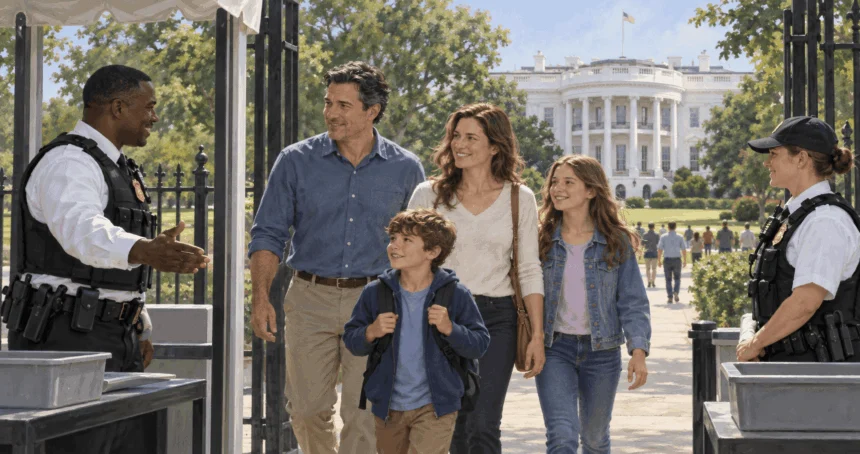
The USSS protects the President, Vice President, their families, and visiting heads of state by law. For public events, advance teams work with federal, state, and local law enforcement to implement comprehensive security measures. They establish security perimeters, manage screening checkpoints, and determine prohibited items lists that profoundly shape the visitor experience.
National Park Service Maintains Grounds
The National Park Service serves as official steward of the White House grounds, part of the 82-acre President’s Park. The NPS maintains this historic landscape, including iconic gardens and seasonal plantings that keep the venue pristine for events.
Beyond groundskeeping, the NPS plays a direct role in event logistics. For Garden Tours, NPS staff distribute free tickets to the public. For the Easter Egg Roll, the NPS manages extensive line systems on the Ellipse, guiding over 30,000 guests to security checkpoints.
The NPS also recruits and manages volunteers essential for special events, demonstrating that these celebrations are fundamentally co-productions relying on established agency expertise.
Volunteers and Private Support
Large-scale events require extensive volunteer support and private funding to succeed.
Volunteer Army
The Easter Egg Roll needs hundreds of volunteers performing critical tasks including crowd management, ticket scanning, providing directions, and greeting tens of thousands of guests. Many volunteers arrive at 5:00 AM to help with setup.
The volunteer corps includes specialized professionals like American Sign Language interpreters and medical teams from institutions like George Washington University, plus university students providing accessibility support for guests with disabilities.
Private Funding Model
The Easter Egg Roll operates through private donations rather than taxpayer funding. The White House Historical Association, a private non-profit founded in 1961 by Jacqueline Kennedy, plays a central role.
The WHHA preserves White House public rooms and enhances public access to its history. It relies entirely on private donations and merchandise sales, accepting no government funding. For events like the Easter Egg Roll, the WHHA collaborates with White House staff to facilitate contributions and in-kind gifts used during the event.
Long-standing partners include the American Egg Board, which donates tens of thousands of eggs, plus corporate sponsorships offering branding opportunities with funds managed through the WHHA.
Easter Egg Roll History
The White House Easter Egg Roll offers a perfect case study in how national traditions evolve over more than a century, adapting to modern demands while preserving historical roots.
Capitol Hill Origins
The tradition didn’t start at the White House. Throughout the 1870s, children and families gathered on the U.S. Capitol’s west grounds on the Monday after Easter to roll eggs.
The event’s popularity damaged the landscape. By 1876, Congress passed the Turf Protection Law, forbidding the Capitol grounds from being used as a children’s playground. After a rainout in 1877, hopeful children arriving at the Capitol in 1878 found their access blocked.
President Rutherford B. Hayes learned of the children’s disappointment and issued an order to open the White House gates, inviting them to roll eggs on the South Lawn. The first official White House Easter Egg Roll was held in 1878, born from a congressional ban and presidential invitation.
Some historians suggest informal egg-rolling parties may have occurred during Abraham Lincoln’s presidency, or that Dolley Madison first proposed the idea of a public egg roll.
Evolution Through the Decades
The Easter Egg Roll serves as a barometer of American social and political climate. Its evolution reflects broader history, from post-Reconstruction optimism to wartime austerity and modern security concerns.
The event quickly grew in scale and formality. In 1889, President Benjamin Harrison invited “The President’s Own” United States Marine Band to perform, adding musical elements that continue today.
Major geopolitical events proved disruptive. The tradition was suspended during World War I (1917-1920) and World War II (1943-1945) due to security concerns and food rationing. A major White House renovation under Harry Truman, combined with post-war food conservation, extended the hiatus for ten total years.
The 1953 revival by Dwight Eisenhower generated massive public response. A Vermont newspaper reported more than 50,000 people were expected to attend. The first wave of 12,000 guests was so large and eager to see the President that the crowd swarmed toward the First Family, forcing them to withdraw for safety.
In the Eisenhower era, participation rules were simple: children who looked 12 or younger got in, adults got in only with a child, and guests brought their own eggs.
Subsequent First Ladies continued innovations. Betty Ford and Rosalynn Carter gave children plastic eggs with paper autographs inside. This evolved when Nancy Reagan introduced collectible wooden eggs with printed signatures in 1981, creating cherished keepsakes that remain tradition today.
Ronald Reagan started the egg hunt, adding another activity layer. The event has faced modern interruptions, with the last weather cancellation in 2001 and COVID-19 cancellations in 2020 and 2021.
Today’s Easter Egg Roll
The modern Easter Egg Roll is a highly structured, professionally managed festival bearing little resemblance to 19th-century informal gatherings. It’s the largest public event at the White House, welcoming 30,000 to 40,000 guests to the South Lawn in a single day.
Scale and Logistics
The operation requires approximately 30,000 hard-boiled and dyed eggs for rolling races and egg hunts, plus 4,500 eggs for decorating stations. Special “chirping eggs” that emit sound allow visually impaired children to participate.
The planning follows a predictable timeline:
Late February/Early March: The online ticket lottery opens for approximately one week on Recreation.gov.
Mid-to-Late March: The lottery closes and winners receive email notifications with ticket claim instructions. Simultaneously, the White House begins recruiting hundreds of needed volunteers.
April: The First Lady’s office announces the year’s theme and previews planned activities for media. In final days, the South Lawn transforms with installation of stages, activity tents, and security infrastructure.
Modern Activities and Themes
Today’s event balances historical roots with contemporary entertainment and education. Under First Lady Jill Biden, the theme has been “EGGucation,” reflecting a learning focus.
A typical Easter Egg Roll includes egg hunts, a storytime stage with celebrity and political readers, live music from military bands and popular performers, and numerous arts and crafts stations. Corporate and non-profit partners sponsor activity zones, such as Amazon’s Reading Nook, The Toy Association’s Play Garden, Meta’s AI-powered photo opportunity, and digital egg hunt games.
Ticket Distribution
To manage demand and ensure fairness, tickets are distributed via a free online lottery designed to provide access to guests from all 50 states and territories. Lottery rules require each application to include at least one child (age 12 or 13 and under, depending on the year) and at least one adult, with a maximum of two adults per group. Each household gets one application for up to six tickets.
Beyond the public lottery, tickets go directly to military families and public schools in the Washington, D.C., Maryland, and Virginia area.
Other White House Public Events
The White House hosts several major public events throughout the year, each with unique characteristics and ticket processes. Access methods vary from online lotteries to first-come, first-served lines to formal congressional requests, balancing national fairness with local accessibility and security requirements.
Garden Tours
Twice yearly, typically on weekends in April and October, the White House provides rare opportunities to tour its spectacular grounds and gardens. These tours differ from interior White House tours and showcase the oldest continually maintained landscape in the United States.
Visitors walk past the famous Rose Garden near the West Wing, the Jacqueline Kennedy Garden near the East Wing, the White House Kitchen Garden established by Michelle Obama in 2009, and commemorative trees planted by former presidents.
Getting Tickets: Free, timed tickets are required for all attendees, including small children. The National Park Service distributes tickets on a first-come, first-served basis on tour mornings.
The Process: Attendees must queue in person at a designated NPS tent near the White House Visitor Center at 1450 Pennsylvania Avenue NW. Ticket distribution typically begins at 8:30 AM.
Important: Lines are notoriously long, and tickets often run out within hours. Arriving very early is essential. Each person needs a ticket, and group members must all be present in line to receive tickets.
Fourth of July Celebrations
White House Independence Day celebrations date to 1801, when Thomas Jefferson first opened the mansion to the public for a July 4th reception. Throughout the 19th and 20th centuries, celebrations varied from formal receptions and private dinners to staff picnics and special guest events.
Recently, the White House has hosted events for military families, staff, and invited guests to enjoy barbecues and watch national fireworks over the National Mall from the South Lawn’s prime location. While these specific gatherings are typically invitation-only, the public can participate in broader patriotic celebrations, with the White House serving as an iconic fireworks backdrop visible from numerous public spaces throughout Washington.
The White House is planning year-long festivities for America’s 250th anniversary, culminating July 4, 2026.
Holiday Tours and Christmas Events
During December, the White House transforms into a festive showcase, welcoming tens of thousands of visitors to see elaborate holiday decorations. Attending holiday tours requires advance planning through formal processes.
Getting Tickets: Holiday tour tickets are part of the standard White House public tour system. U.S. citizens must submit requests through their Member of Congress (Representative or Senator).
The Process: Submit tour requests in fall, up to three months or 90 days in advance but no less than 21 days before desired dates. These tours are exceptionally popular, so submit requests as early as possible. Foreign citizens should contact their country’s embassy in Washington for assistance.
National Christmas Tree Lighting: This annual ceremony on the Ellipse officially kicks off the holiday season. Free tickets to attend the lighting ceremony are distributed through an online lottery typically held in October. After the ceremony, the National Christmas Tree and 58 smaller trees representing states, territories, and D.C. remain open for public viewing throughout December.
Complete Ticket Guide
Different events use different ticket methods. Here’s the essential information for planning visits:
| Event | Timing | How to Get Tickets | Key Details |
|---|---|---|---|
| White House Easter Egg Roll | Monday after Easter | Online lottery via Recreation.gov | Free. Lottery opens late February/early March. For families with children 13 and under. Official info |
| Spring Garden Tour | One weekend in April | First-come, first-served, in-person | Free. Timed tickets from NPS tent near White House Visitor Center, starting ~8:30 AM. Arrive very early. Official info |
| Fall Garden Tour | One weekend in October | First-come, first-served, in-person | Free. Same process as Spring Garden Tour. Official info |
| Holiday Tours | December | Request via U.S. Member of Congress | Free. Submit requests in fall, 21-90 days in advance. Find your member |
| National Christmas Tree Lighting | Early December | Online lottery | Free. Lottery for ceremony typically opens in October. Tree viewable throughout December. Official info |
| Standard White House Tour | Year-round (Tues-Sat) | Request via U.S. Member of Congress | Free. Submit 21-90 days in advance. Official info |
Security Rules and Prohibited Items
Security compliance is mandatory for entry. Arriving with prohibited items results in being turned away, and no storage facilities exist on or near the White House complex.
Required Identification
U.S. Citizens (18+): Must present valid, government-issued photo ID. This means REAL ID-compliant driver’s license or state ID, U.S. passport, or U.S. military ID.
Foreign Nationals (all ages): Must present valid passport. No other foreign ID is accepted.
Critical Requirement: Personal information submitted for security background checks (full name, date of birth, etc.) must exactly match information on the government-issued ID presented upon arrival. Any discrepancy may result in delayed or denied entry.
What You Cannot Bring
Travel as light as possible. These items are consistently prohibited:
- Bags of any kind: Backpacks, purses, fanny packs, or clutches. Wallet-sized clutches or essential medical/parenting bags may be permitted but require screening.
- Food and beverages: Including water
- Recording equipment: Video recorders, cameras with detachable lenses, tablets, tripods, monopods, selfie sticks
- Strollers: Sometimes permitted for outdoor events but not interior tours
- Weapons: Guns, ammunition, fireworks, knives of any size, mace
- Other items: Aerosols, tobacco products, e-cigarettes, pointed objects (sometimes including pens)
What You Can Bring
The permitted items list is very short:
- Electronics: Cell phones (usage may be restricted inside) and compact cameras with lenses no longer than 3 inches
- Personal items: Wallets and car keys
- Weather protection: Umbrellas without metal tips
- Medical necessities: Wheelchairs, EpiPens, medication (must be declared to Secret Service upon arrival)
Tips from Attendees and Volunteers
Past participants offer valuable advice for navigating White House events successfully.
Timing and Patience
Arrive Early: This is the most consistent advice. Whether lining up for first-come, first-served Garden Tour tickets or waiting for security screening at timed Easter Egg Roll entries, long lines are unavoidable.
Plan Your Time: For multi-activity events like the Easter Egg Roll, grounds time is limited (typically around two hours). Review event schedules beforehand and prioritize most important activities, heading to top choices first.
Presidential Sightings
Appearances by the President and First Lady are never guaranteed and often not announced in advance. At the Easter Egg Roll, the main egg rolling race area and storytime stage are often high-probability locations for presidential sightings.
Family Considerations
Bathroom Planning: No public restrooms are available until inside the security perimeter, so plan accordingly.
Crowd Management: Events can be crowded and loud. For children with sensory sensitivities, noise-canceling headphones are wise precautions. Strollers can be invaluable for giving small children rest places and carrying coats and items.
Accessibility and Accommodations
The White House commits to providing access for all visitors through multiple accommodation options.
Physical Accessibility
Tour routes and event grounds are wheelchair accessible. A limited number of wheelchairs are available to loan to guests on a first-come, first-served basis. Visitors should notify Secret Service officers upon arrival if they need one.
Registered service animals are permitted on grounds and tours.
Communication Support
For interior tours, visitors can request American Sign Language interpreters by notifying the congressional office that submitted their tour request.
Recent Easter Egg Rolls have improved accessibility by hosting dedicated sensory-friendly sessions for families and utilizing volunteers trained to offer support for attendees with physical, cognitive, and linguistic needs.
Event Planning Timeline
Understanding when to act for different events maximizes your chances of attendance success.
Easter Egg Roll Timeline
January: Internal White House planning intensifies Late February: Public lottery opens on Recreation.gov (typically runs one week) Early March: Lottery closes Mid-March: Winners notified by email Late March: Volunteer recruitment begins Early April: Theme and activities announced to media Event week: South Lawn transformation with infrastructure installation
Garden Tours Timeline
March: Spring tour dates typically announced April: Tour weekend occurs (usually mid-to-late April) Tour day: Arrive very early for first-come, first-served tickets September: Fall tour dates typically announced October: Fall tour weekend (usually mid-October)
Holiday Events Timeline
July-August: Begin planning congressional requests for holiday tours October: Submit tour requests through congressional offices October: National Christmas Tree Lighting lottery opens November: Holiday tour notifications sent December: Holiday events occur
Behind the Magic
The success of White House public events depends on year-round preparation and seamless execution of complex logistics during the events themselves.
Year-Round Preparation
Planning for major events like the Easter Egg Roll begins immediately after the previous year’s event concludes. The First Lady’s office conducts post-event reviews, gathering feedback from attendees, volunteers, and partner agencies to improve future iterations.
Security assessments by the Secret Service influence everything from permitted activities to crowd flow patterns. The NPS begins grounds preparation months in advance, ensuring gardens and lawns are in peak condition. The Social Office coordinates with federal agencies, non-profit partners, and corporate sponsors to secure necessary resources and support.
Event Day Execution
On event days, the White House becomes a carefully choreographed operation. Volunteers arrive before dawn to assist with setup. Security personnel establish checkpoints and screening areas. NPS staff manage crowd flow and line systems. White House staff coordinate activities and manage VIP movements.
The Visitors Office oversees the entire operation, ensuring smooth transitions between activities and managing any unexpected challenges. Medical teams stand ready for emergencies. Weather contingency plans activate if needed.
Media and Public Relations
These events generate significant media coverage, providing administrations with valuable opportunities to showcase accessibility and family-friendly governance. The First Lady’s office coordinates with White House communications staff to maximize positive coverage while ensuring events remain focused on public service rather than political messaging.
Photography and videography restrictions protect both security and guest privacy while allowing official documentation of the events for historical records and future planning.
The Broader Significance
White House public events serve multiple functions beyond entertainment and tradition. They demonstrate democratic accessibility, allowing ordinary citizens to experience the seat of executive power firsthand. They provide administrations with opportunities to connect with constituents in non-political settings.
These events also showcase American soft power to international audiences, demonstrating openness and democratic values through welcoming public celebrations. The volunteer component reinforces civic engagement, allowing citizens to participate directly in national traditions.
The private funding model for events like the Easter Egg Roll reflects broader American traditions of public-private partnerships and philanthropic support for national institutions. This approach ensures events can occur without taxpayer burden while maintaining high quality and broad accessibility.
Historical Preservation
Organizations like the White House Historical Association play crucial roles in maintaining these traditions while adapting them for contemporary needs. Their work ensures continuity across administrations, preserving institutional knowledge and operational expertise that transcends political changes.
The careful documentation of these events creates historical records that future researchers and citizens can study, understanding how American democracy has expressed itself through public celebration across different eras and administrations.
Planning Your White House Visit
Successfully attending a White House public event requires careful preparation and realistic expectations about the experience.
Research and Preparation
Start by identifying which events interest you most and understanding their specific requirements. Each event has different timing, ticket processes, and target audiences. The Easter Egg Roll focuses on families with young children, while Garden Tours appeal to history and horticulture enthusiasts of all ages.
Review prohibited items lists carefully and plan to arrive with minimal personal belongings. Consider weather conditions and dress appropriately for outdoor events. Comfortable walking shoes are essential, as you’ll be standing and walking for extended periods.
Setting Expectations
These are high-security, high-profile events with large crowds. Wait times for security screening, activities, and restrooms are significant. Presidential appearances, while exciting possibilities, should not be expected or planned around.
The experience offers unique access to one of America’s most important historic sites, opportunities to participate in genuine national traditions, and chances to connect with fellow citizens from across the country in celebration of shared democratic values.
Making the Most of Your Visit
Arrive early and prepared for long waits. Bring patience and a positive attitude. Focus on the unique opportunity to be on the White House grounds rather than specific activity outcomes.
For families, prepare children for crowds, noise, and waiting. Bring snacks if allowed by specific event rules. Consider the educational value of the experience and discuss the historical significance with children.
Document your visit through permitted photography, but remember that the experience itself matters more than perfect pictures. Take time to appreciate the grounds, architecture, and gardens that represent American history and democracy.
The White House public events offer remarkable opportunities for civic engagement and national celebration. With proper planning and realistic expectations, attending these events can create lasting memories while participating in traditions that connect generations of Americans to their democratic heritage.