- cdc.gov7 links
- dea.gov7 links
- fda.gov6 links
- samhsa.gov5 links
- epa.gov4 links
- nida.nih.gov2 links
- apps.deadiversion.usdoj.gov2 links
- hhs.gov
Last updated 10 months ago. Our resources are updated regularly but please keep in mind that links, programs, policies, and contact information do change.
American medicine cabinets hold a hidden danger. Expired, unused, and unwanted prescription medications become starting points for misuse, addiction, and overdose deaths.
These drugs threaten not just the people they were prescribed to, but entire families and communities.
The U.S. Drug Enforcement Administration created the National Prescription Drug Take Back Day to address this crisis. This nationwide program provides a safe, convenient way to dispose of dangerous medications.
The Scale of Prescription Drug Misuse
Understanding the importance of safe disposal programs requires grasping the scope of America’s prescription drug crisis. This epidemic doesn’t stem from street drugs alone – it’s rooted in the misuse of legal, prescribed medications sitting in millions of homes.
What Counts as Misuse?
The National Institute on Drug Abuse defines misuse as taking medication in a manner or dose other than prescribed by a doctor. This broad definition covers a wide spectrum of dangerous behaviors.
Examples include:
- Taking medication prescribed for someone else, like a teenager using a friend’s stimulant to study
- Using leftover prescriptions to self-treat new injuries without consulting doctors
- Taking drugs specifically for euphoric feelings they produce
This definition captures not only behavior of people with substance use disorders, but seemingly minor actions that can gateway to addiction. The problem begins long before full dependency develops, often with a single decision to use medication outside its intended purpose.
A Highly Medicated Nation
The foundation of prescription drug misuse lies in the sheer volume of medications circulating in American society. Centers for Disease Control and Prevention data from 2017-2020 shows nearly half the U.S. population (49.9%) used at least one prescription drug within 30 days. Furthermore, 24.7% used three or more prescriptions, and 13.5% used five or more in the same period.
This widespread availability directly correlates with high misuse rates. National survey data shows an estimated 16.3 million Americans aged 12 or older (5.76% of this population) engage in nonmedical prescription drug use each year. Over a lifetime, an estimated 52 million people (20% of those aged 12 and older) have misused prescription drugs at least once.
The problem particularly affects adolescents and young adults. Prescription drugs rank as the second most abused drug category among teenagers, surpassed only by marijuana. Every day, an average of 2,000 teenagers use prescription drugs to get high for the first time, often accessing these substances easily from their own homes.
The Three Most Misused Drug Classes
Research consistently highlights three classes of prescription medications as most commonly abused, each with distinct risks and motivations for misuse.
Opioids (Pain Relievers): This represents the largest and most lethal category of misused prescription drugs. Opioids include medications like oxycodone (OxyContin, Percocet), hydrocodone (Vicodin), morphine, and codeine. An estimated 8.7 to 9.7 million people misuse prescription pain relievers annually. Significantly, 65.7% of people who misuse painkillers report doing so to relieve physical pain, blurring lines between patient care and substance use disorder development.
Central Nervous System Depressants (Sedatives and Tranquilizers): This class includes barbiturates and benzodiazepines like diazepam (Valium) and alprazolam (Xanax). These drugs slow brain activity and treat anxiety and sleep disorders. Approximately 4.9 to 5.9 million people misuse these medications yearly. Primary motivations often relate to self-medication for mental health struggles, with 41.1% of tranquilizer misusers using drugs to relieve tension and 20.9% using them as sleep aids.
Stimulants: Prescribed for ADHD and narcolepsy, this class includes dextroamphetamine (Adderall) and methylphenidate (Ritalin). Stimulants increase alertness, attention, and energy. An estimated 3.7 to 4.9 million people misuse prescription stimulants annually. Unlike opioids or depressants, 50.7% of stimulant misusers report taking drugs to stay alert or concentrate, linking misuse closely to academic and professional pressures.
The Home Medicine Cabinet: Source of the Crisis
A critical aspect of the prescription drug epidemic is the supply chain. For most people who misuse these drugs, the source isn’t an anonymous street dealer but a trusted friend or family member, and the point of diversion is the home medicine cabinet.
National surveys reveal that approximately 70% to 75% of individuals who misuse prescription pain relievers obtain them from friends or relatives. This happens through drugs being given freely, taken without knowledge, or purchased.
This statistic provides the foundational logic behind the National Prescription Drug Take Back Day. It reframes the issue from illicit trafficking to household safety, community responsibility, and prevention. The most direct way to cut off this supply is removing the source – millions of bottles of unused and expired medications in homes nationwide.
The environment where these drugs exist contributes to their misuse potential. Because doctors prescribe them, pharmacists dispense them, and they’re normal for nearly half the population taking at least one prescription, a dangerous “safety myth” develops. This perception significantly lowers barriers to initial misuse, particularly for young people.
Teenagers often view prescription drugs as safer alternatives to illicit drugs like heroin or cocaine. However, this perception is dangerously flawed. Opioid painkillers are chemically similar to heroin and act on the same brain receptors, making them highly addictive with devastating health consequences.
| Drug Class | Annual Misusers (12+) | Population % | Primary Motivations | Key Facts |
|---|---|---|---|---|
| Opioids/Pain Relievers | 8.7-9.7 million | 3.1-3.5% | Relieve physical pain (65.7%) | Most misused category; 70% with prescription drug addiction are addicted to painkillers |
| CNS Depressants/Sedatives | 4.9-5.9 million | 1.7-2.1% | Relieve tension (41.1%); help sleep (20.9%) | Often self-medication for anxiety, stress, insomnia |
| Stimulants | 3.7-4.9 million | 1.3-1.7% | Stay alert/concentrate (50.7%) | Heavily linked to academic and professional pressures |
The Opioid Crisis: Driving Force Behind Take Back Efforts
While all prescription drug misuse is serious, the opioid crisis represents the most acute and deadly aspect of this epidemic. The staggering rise in addiction and overdose deaths from prescription and illicit opioids has been the primary catalyst for federal actions, including creating and expanding the National Prescription Drug Take Back Day.
Three Waves of Crisis
The CDC characterizes the opioid overdose epidemic as occurring in three distinct but overlapping waves, each defined by the primary opioid type driving fatalities.
Wave 1: Rise of Prescription Opioids (1990s-Present): The crisis began in the 1990s with dramatic increases in opioid medications prescribed for pain management. This surge led to widespread exposure and corresponding increases in misuse and addiction. Between 1999 and 2007, unintentional overdose deaths involving opioid pain relievers quadrupled, outnumbering those from heroin and cocaine combined. This first wave established the home medicine cabinet as the crisis epicenter.
Wave 2: Heroin Resurgence (2010-Present): As awareness of prescription opioid dangers grew and regulatory measures tightened access, many people with established opioid use disorders turned to cheaper, more accessible heroin. Data shows approximately 80% of people who use heroin first misused prescription opioids, demonstrating a clear gateway effect.
Wave 3: Synthetic Opioids (2013-Present): The current and most devastating wave is defined by proliferation of potent synthetic opioids, particularly illegally manufactured fentanyl and its analogs. Fentanyl is 50 to 100 times more potent than morphine and now drives most overdose deaths. Criminal networks mass-produce counterfeit pills identical to legitimate prescriptions like OxyContin or Xanax, but laced with potentially lethal fentanyl doses.
The Human Cost
According to the CDC, more than 100,000 Americans died from drug overdoses in 2023. Of those deaths, nearly 80,000 – about 76% – involved opioids. This equals an average of 217 people dying from opioid overdoses every day.
Since 1999, the United States has lost more than 806,000 people to opioid overdoses. While overdose deaths involving prescription opioids decreased nearly 12% from 2022 to 2023, deaths from synthetic opioids remain exceptionally high.
National Emergency Declaration
The crisis severity prompted the U.S. Department of Health and Human Services to officially declare the opioid crisis a national Public Health Emergency on October 26, 2017, a declaration repeatedly renewed. This mobilized massive federal response, with Congress appropriating billions for prevention, treatment, and recovery efforts.
The fentanyl-dominated landscape has amplified the Take Back program’s importance. It’s no longer just preventing legitimate prescription drug misuse; it’s become a frontline strategy preventing the first step on a path that can now lead to immediate fatal poisoning.
Each pill collected and destroyed represents potential addiction averted. In the fentanyl era, averting initial addiction isn’t merely preventing substance use disorder – it’s directly preventing potential poisoning death.
Environmental Dangers of Improper Disposal
Beyond immediate public health threats, improper medication disposal poses significant and growing environmental risks. For decades, common advice suggested flushing unwanted pills or throwing them in trash. However, scientific research reveals these methods introduce pharmacologically active chemicals into ecosystems, with documented negative wildlife effects and potential human health risks.
How Flushing Contaminates Waterways
Flushing medications directly routes pharmaceutical pollution into water systems. When drugs are flushed down toilets or poured down sinks, they enter wastewater streams.
Homes with Septic Systems: In rural and suburban areas, wastewater flows into septic tanks. Here, pharmaceuticals can leach out and seep directly into surrounding soil and groundwater, contaminating local water sources.
Homes with Municipal Sewer Systems: In cities and towns, wastewater goes to municipal treatment plants. A critical, widely misunderstood fact is that these facilities aren’t designed to remove pharmaceuticals. Wastewater treatment plants eliminate conventional pollutants and kill harmful bacteria and viruses. However, complex chemical structures of active pharmaceutical ingredients often pass through treatment processes intact. Treated water, still containing drug compounds, is then discharged into rivers, lakes, and coastal waters. These same water bodies often serve as drinking water sources for downstream communities.
The Trash Problem
Throwing medications into household trash isn’t safe or environmentally sound. This method presents two distinct problems: diversion and pollution.
First, drugs discarded in trash can be easily retrieved. This poses direct risk of accidental poisoning to children, pets, or wildlife rummaging through garbage, plus intentional diversion risk.
Second, even when drugs remain in landfills, they contribute to environmental contamination. As rainwater percolates through waste layers, it creates highly toxic, contaminated liquid called “leachate.” Scientific studies of landfill leachate detect significant concentrations of numerous pharmaceuticals, from pain relievers and antibiotics to hormones and chemotherapy drugs.
While modern landfills are lined to prevent leachate groundwater contamination, collected liquid must be managed. Typically, it’s transported to the same wastewater treatment plants ill-equipped to remove active pharmaceutical ingredients, ultimately resulting in the same pharmaceutical discharge into surface waters as flushing.
Wildlife Impact
Continuous pharmaceutical introduction into aquatic environments has documented, detrimental wildlife effects. Aquatic organisms are especially vulnerable because they’re constantly exposed to these chemicals in their living, feeding, and reproductive waters.
Research by the EPA and other scientific bodies shows a range of impacts:
Endocrine Disruption: Dramatic effects from endocrine-disrupting chemicals like synthetic estrogens from birth control pills and hormone therapies. Studies show these chemicals interfere with fish reproductive systems, leading to decreased fertility and, in some cases, male fish “feminization,” causing them to develop female characteristics. This disruption can trigger entire fish population collapses in affected waters.
Organ Damage and Behavioral Changes: Common over-the-counter drugs like NSAIDs (ibuprofen, naproxen) cause organ damage, high cellular stress, and adverse effects on aquatic organism growth, reproduction, and behavior.
Ecosystem Disruption: Antibiotics designed to kill living organisms are toxic to aquatic plants and algae. These organisms form aquatic food web bases, and their destruction can have cascading negative ecosystem effects.
Human Health Concerns
While direct impacts of low-level pharmaceutical exposure on human health remain under research, significant concerns exist about long-term risks. The most established threat is contribution to antibiotic-resistant bacteria development. Constant environmental antibiotic presence creates selective pressure allowing resistant bacterial strains to thrive.
The CDC estimates antibiotic-resistant bacteria already cause millions of illnesses and tens of thousands of deaths in the U.S. annually. Additionally, concerns exist that some pharmaceuticals can bioaccumulate in human tissues over time, with potential links to decreased fertility and increased cancer risk.
Conflicting Federal Guidance
This complex web of environmental and health risks creates confusing public landscapes, especially given apparently contradictory federal agency advice. The EPA’s guidance is clear: do not flush medications. However, the Food and Drug Administration maintains a short “flush list” of potent medications, primarily opioids, deemed so dangerous if accidentally ingested that immediate poisoning risk outweighs long-term environmental harm.
The FDA advises flushing these specific drugs only if take-back options aren’t readily available. The National Prescription Drug Take Back Day resolves this contradiction by providing universally superior options. These programs are the FDA’s number one recommended disposal method for all medicines, including flush list drugs.
National Prescription Drug Take Back Day: Unified Response
Facing intertwined crises of prescription drug misuse and environmental contamination, the U.S. Drug Enforcement Administration launched a proactive, nationwide initiative providing direct, accessible solutions. The National Prescription Drug Take Back Day has evolved into a cornerstone of America’s efforts to prevent addiction and protect communities.
Program Genesis
The first-ever National Prescription Drug Take Back Day was held Saturday, September 25, 2010. The DEA, partnering with other government, community, and public health organizations, created the event as an aggressive outreach campaign addressing what was then recognized as the “Nation’s fastest-growing drug problem.”
The initiative was founded on a simple but powerful premise: ridding households of expired, unused, and unwanted prescription drugs could prevent pill abuse, theft, and diversion at the source.
From inception, the program’s twin goals have been providing “safe, convenient, and responsible means of disposing of prescription drugs” and, simultaneously, “educating the general public about the potential for abuse of medications.” The service was designed to be free and anonymous, with no questions asked, removing any participation barriers.
Massive Collaborative Effort
Take Back Day success demonstrates one of the largest and most effective ongoing collaborations between federal, state, tribal, and local law enforcement agencies in the United States. While the DEA spearheads national efforts, the program is executed on the ground by thousands of dedicated partners.
Each biannual event mobilizes enormous personnel and resource networks. The spring 2025 Take Back Day involved nearly 4,500 law enforcement partners operating over 4,600 temporary collection sites nationwide. This vast, decentralized network ensures collection site accessibility for large portions of the American population, from major urban centers to rural communities.
Record of Success
Since the program began in 2010, the DEA and partners have collected and safely destroyed nearly 19.8 million pounds, or 9,910 tons, of unneeded medications. A single Take Back Day regularly yields hundreds of tons of collected drugs. The April 2025 event collected over 620,000 pounds (310 tons), while the October 2020 event set a record collecting 985,392 pounds (nearly 493 tons).
These figures provide clear, powerful metrics of the program’s success in physically reducing risk in American homes.
The true value extends beyond logistical function. National Prescription Drug Take Back Day operates on two parallel tracks: it’s a large-scale reverse logistics operation for potentially hazardous materials, but equally importantly, it’s a recurring, nationwide public education campaign.
The DEA supports this educational mission with comprehensive “Partnership Toolbox” including posters, social media kits, and informational pamphlets for partners. Press releases and public service announcements explicitly frame events within life-saving and opioid crisis-combating contexts.
The event’s predictable, biannual rhythm – occurring on the last Saturday of April and October – creates national focus moments and regular prompts for individuals to perform simple but vital home safety acts. This transforms events from simple public service into powerful behavioral interventions.
Participating in Take Back Day: Practical Guide
Participating in the National Prescription Drug Take Back Day is straightforward. Following a few easy steps, anyone can contribute to making their home and community safer.
When and Where
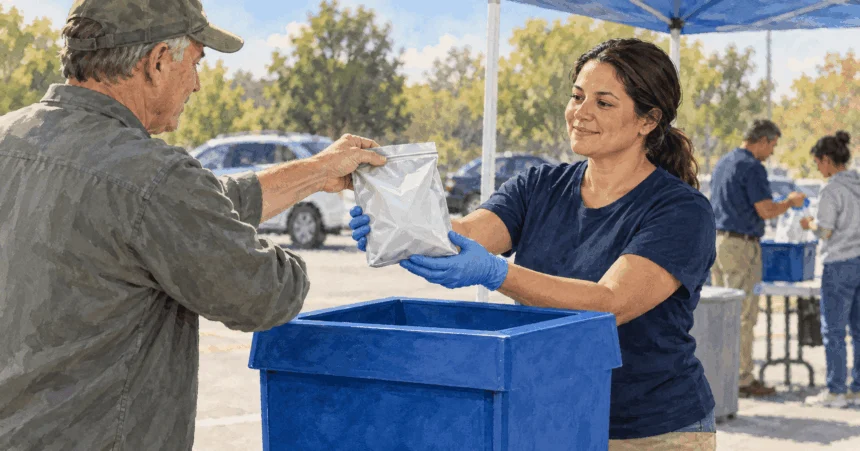
The National Prescription Drug Take Back Day is held twice yearly on the last Saturday of April and October. Standard operating hours for collection sites nationwide are 10:00 a.m. to 2:00 p.m. local time.
The DEA makes finding participating collection sites easy through its official online locator tool. This is the most reliable source for finding approved locations.
The tool allows searching by:
- ZIP code for targeted results
- City and State
- County and State
You can specify search radius of 10, 25, 50, or 100+ miles to broaden or narrow searches.
New collection sites are registered and added daily in weeks leading up to events. If you don’t find convenient locations initially, check the website again closer to event dates.
Preparing Your Medications
The process is designed to be simple, anonymous, and convenient.
Anonymity: The service is completely anonymous. No questions are asked, and you won’t be required to provide identification.
Packaging: You can leave medications in original containers. To protect privacy, remove or scratch out personally identifiable information (name, address, prescription number) from labels using permanent markers.
Consolidation: Some collection sites may encourage participants to empty pills and capsules into sealed plastic bags. This saves space in collection boxes and ensures safe volunteer handling. However, bringing medications in original bottles is also acceptable.
Liquids: Liquid medications like cough syrup should remain in original containers with caps tightly sealed to prevent leakage.
What You Can and Cannot Bring
Collection sites have specific guidelines based on safety and regulations.
| ✅ Accepted Items | ❌ Not Accepted Items |
|---|---|
| Prescription medications (controlled and non-controlled substances) | Needles, syringes, or sharps |
| Over-the-counter medications | Illicit drugs (marijuana, heroin, cocaine, etc.) |
| Medicated patches (fentanyl, nicotine) | Inhalers/aerosol cans |
| Medicated ointments, creams, lotions | Thermometers |
| Liquid medications (in sealed containers) | Hydrogen peroxide |
| Vitamins and dietary supplements | Bloody or infectious waste |
| Pet medications | Vaping devices with batteries |
Important: Vaping devices are accepted only if lithium-ion batteries are removed before drop-off.
Year-Round Disposal: Every Day is Take Back Day
While the National Prescription Drug Take Back Day is highly effective, the need for safe medication disposal exists year-round. The DEA and partners have significantly expanded year-round options, empowering the public to maintain safe medicine cabinets anytime.
Permanent Collection Sites
The DEA promotes the concept that “Every Day is Take Back Day,” shifting focus from event-based disposal to habitual, year-round safety. This initiative encourages using a growing network of permanent disposal sites.
The most convenient year-round option is the network of permanent drug disposal kiosks. The DEA authorizes thousands of locations nationwide to maintain secure, self-service drop-off boxes accessible during normal business hours.
These kiosks are typically located at:
- Retail pharmacies (CVS, Walgreens, independent pharmacies)
- Hospital and clinic pharmacies
- Law enforcement agencies (police departments, sheriff’s offices)
To find authorized collectors, the DEA provides a dedicated search tool separate from event-day locators. This tool allows searching by ZIP code or City/State to find the nearest permanent kiosk. A 2019 government report found over 70% of the U.S. population lived within five miles of permanent collection sites.
Mail-Back Programs
For individuals with mobility challenges or who live far from collection kiosks, mail-back programs offer secure and convenient solutions. These programs provide postage-paid, pre-addressed envelopes specifically designed for mailing medications to licensed disposal facilities.
These envelopes can often be purchased at retail pharmacies or online. In some cases, local health departments, community organizations, or pharmacies provide them free to the public. This method ensures medications, including controlled substances, are handled and destroyed in compliance with federal regulations.
At-Home Disposal: Last Resort
If take-back programs or mail-back envelopes aren’t accessible, the FDA and EPA provide specific instructions for disposing of most medications in household trash. This method should always be considered last resort due to environmental and diversion risks, but it’s preferable to flushing or leaving drugs unsecured.
Recommended steps:
- Remove: Take medicines out of original containers
- Mix: Combine drugs with unpalatable substances like used coffee grounds, dirt, or cat litter. Don’t crush pills or capsules
- Contain: Place mixture into sealable containers like zipper storage bags or empty cans with lids
- Discard: Throw sealed containers into household trash
- Protect Privacy: Scratch out or cover all personal information on empty pill bottles before recycling
Special Cases: Sharps and Inhalers
Since items like needles and inhalers aren’t accepted at Take Back Day events or most kiosks, knowing correct disposal procedures is crucial.
Sharps (Needles, Syringes, Lancets): Improper disposal can lead to accidental needlestick injuries and infectious disease spread. Sharps should never be thrown loosely into trash. Place them immediately after use into FDA-cleared sharps containers or heavy-duty, puncture-proof household containers like plastic laundry detergent bottles. Label containers “Sharps” or “Biohazard,” seal securely when full, and take to appropriate collection sites.
Inhalers: Pressurized canisters can be dangerous if punctured or incinerated. Disposal instructions vary, so read product labels and packaging for specific guidance and contact local trash and recycling facilities.
| Disposal Method | Best For | How It Works | Key Considerations |
|---|---|---|---|
| DEA Take Back Day | Large cleanouts | Twice-yearly national events with thousands of drop-off sites | Free, anonymous, highly secure; only available two days per year |
| Permanent Kiosks | Year-round convenience | Secure drop boxes at pharmacies, hospitals, police stations | Available during business hours; most accessible year-round option |
| Mail-Back Envelopes | Remote areas, mobility issues | Postage-paid envelopes to licensed facilities | Highly convenient and secure; may require purchase |
| At-Home Trash Disposal | No other options available | Mix with undesirable substances, seal, trash | Least preferred due to environmental/diversion risks |
The National Prescription Drug Take Back Day represents a critical tool in America’s fight against the prescription drug epidemic. By providing safe, convenient disposal options, the program addresses the crisis at its source – the home medicine cabinet.