Last updated 10 months ago. Our resources are updated regularly but please keep in mind that links, programs, policies, and contact information do change.
When a presidentially declared disaster strikes, the immediate aftermath is a time of confusion, fear, and urgent need. For immigrant families, particularly those with mixed immigration statuses, these challenges are compounded by uncertainty about their eligibility for federal help.
A central question arises: can an undocumented parent or guardian receive assistance from the Federal Emergency Management Agency (FEMA) for their children?
The answer is nuanced but clear: while undocumented adults are not eligible to receive financial disaster assistance for themselves, a critical pathway exists for them to apply for and receive this aid on behalf of their minor children who are U.S. citizens or “qualified aliens.”
This process is governed by a system that offers two distinct tiers of support. The first tier consists of immediate, non-monetary, life-sustaining aid available to every person in a disaster zone, regardless of immigration status. The second tier is FEMA’s main financial recovery program, the Individuals and Households Program (IHP), which has strict legal requirements for citizenship or immigration status but allows for applications from mixed-status households through an eligible child.
Two Tiers of Aid
In the immediate aftermath of a disaster, FEMA and its partner agencies operate on the primary mission of preserving life, health, and safety. To this end, certain forms of emergency assistance are made available to all survivors in a declared disaster area, without regard to their citizenship or immigration status.
Universal Emergency Assistance
Regardless of immigration status, all individuals affected by a major disaster may be eligible for short-term, non-monetary, in-kind emergency relief programs. This aid is designed to address immediate survival needs and includes:
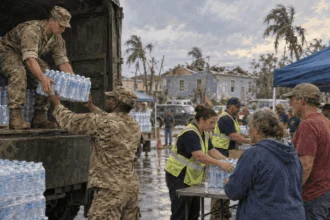
Emergency Food and Water: Distribution of essential supplies to sustain survivors.
Emergency Medical Care: Immediate medical attention for disaster-related injuries and search and rescue services.
Emergency Shelter: Access to safe, temporary congregate shelters to protect survivors from the elements.
Disaster Supplemental Nutrition Assistance Program (D-SNAP): Provides temporary food benefits for those affected by a disaster. Eligibility and application requirements for D-SNAP may be managed by the state government.
Support and Counseling Services
Beyond physical needs, the federal government also provides critical support services to help all survivors cope with the trauma and complexity of recovery. These services are available to everyone, including undocumented immigrants:
Crisis Counseling Assistance: Free and confidential counseling is available to help individuals and communities process the emotional and psychological trauma of a disaster.
Disaster Legal Services: In partnership with the American Bar Association, FEMA provides free legal assistance to low-income disaster survivors for issues such as insurance claims, landlord-tenant disputes, consumer fraud, and replacing lost legal documents.
Disaster Case Management: This service connects survivors with a case manager who helps them develop a personalized, long-term recovery plan and navigate the complex web of available resources.
The clear separation between this universal, non-monetary aid and the restricted financial aid is a deliberate policy design. It allows the government to fulfill its humanitarian obligation to protect the lives of all people within a disaster zone while adhering to the legal framework established by laws like the Personal Responsibility and Work Opportunity Reconciliation Act of 1996, which restricts access to many federal public benefits based on immigration status.
This system is designed to provide immediate, life-saving help broadly, but it reserves long-term financial recovery assistance for a legally defined group of residents.
Research shows that deep-seated fear of government agencies and immigration enforcement often prevents immigrant families from seeking any help at all, even the aid they are fully entitled to receive without question. Promoting awareness of these universal services is a critical first step in building trust and ensuring that the most vulnerable families receive the immediate care they need.
Financial Aid Through an Eligible Child
The primary source of financial assistance for disaster survivors is FEMA’s Individuals and Households Program (IHP). While federal law prohibits undocumented immigrants from receiving this aid directly, it provides a crucial exception for mixed-status families.
An undocumented parent or legal guardian can apply for IHP assistance on behalf of a minor child who meets the eligibility criteria and lives in the same household. The aid is legally directed to the eligible child but is intended to support the recovery of the entire household.
This provision is a pragmatic compromise, acknowledging the reality of mixed-status families and ensuring that U.S. citizen children are not left without support due to their parents’ immigration status.
Who is an “Eligible Child”?
For a household to qualify for IHP assistance, at least one member—in this case, a minor child under the age of 18 at the time of the disaster—must be a U.S. citizen, a non-citizen national, or a “qualified alien.” The specific definitions for these categories are strict and laid out in federal law.
| Category | Definition and Examples |
|---|---|
| U.S. Citizen | Anyone born in the 50 states, the District of Columbia, Puerto Rico, the U.S. Virgin Islands, Guam, or the Northern Mariana Islands; a person born outside the U.S. to at least one U.S. parent; or a naturalized citizen. |
| Non-Citizen National | A person born in an outlying possession of the U.S., such as American Samoa or Swain’s Island, on or after the date the U.S. acquired the possession, or a person whose parents are U.S. non-citizen nationals. |
| Qualified Alien | This category includes individuals with specific immigration statuses, such as: Legal Permanent Residents (“Green Card” holders), Asylees (individuals granted asylum) and Refugees, Aliens whose deportation or removal is being withheld, Victims of human trafficking (holding a “T” or “U” visa), Cuban/Haitian Entrants, Certain battered spouses, parents, or children with a pending or approved petition, Aliens paroled into the U.S. for at least one year for urgent humanitarian purposes. |
Ineligible Statuses
It is equally important to know which common statuses do not qualify an individual for IHP financial assistance. These include:
- Recipients of Deferred Action for Childhood Arrivals (DACA)
- Holders of Temporary Protected Status (TPS)
- Asylum applicants (those who have applied for but not yet been granted asylum)
- Holders of temporary non-immigrant visas, such as tourist, student, or temporary work visas (e.g., H-2A, H-2B)
The distinction between an “asylum applicant” (ineligible) and an “asylee” (eligible) is a crucial detail that illustrates the precarious position of many immigrants. Two individuals fleeing the same persecution may have vastly different access to disaster aid based solely on where they are in the multi-year backlog of the U.S. immigration system.
This demonstrates how disaster vulnerability can be directly tied to the pace and uncertainty of legal proceedings, creating inequitable outcomes even among people with similar humanitarian needs.
How to Apply on Behalf of Your Child
The application process for FEMA assistance can be daunting, especially for a family navigating a crisis. The specific requirement for a child to be the legal “applicant” is counterintuitive and can lead to errors that cause delays or denials.
Gather Your Documents
Having all necessary information ready before starting the application will make the process smoother. Prepare a file with the following:
For the Child (The Applicant):
- The child’s full legal name, date of birth, and Social Security Number (SSN). The child must have an SSN to apply. If the child is a U.S. citizen but does not yet have an SSN (e.g., a newborn), some legal aid organizations report that FEMA may be able to provide assistance in obtaining one. This is a critical point to inquire about if needed.
- Proof of the child’s status, such as a U.S. birth certificate.
For the Household (Information Provided by the Parent/Guardian):
- Contact Information: Your current phone number, current mailing address, and the address of the damaged home.
- Household Information: Your total annual household income before the disaster.
- Damage Information: A description of the disaster-caused damage and losses to your home and belongings.
- Insurance Information: Details of any insurance policies you hold (e.g., homeowners, renters, flood).
- Bank Information: If you wish to receive funds via direct deposit, you will need your bank’s name, account type, routing number, and account number.
The Application Process
There are three ways to apply for FEMA assistance:
Online: The most common method is through the official website at DisasterAssistance.gov.
By Phone: Call the FEMA Helpline at 1-800-621-3362. Help is available in many languages, and you can press 2 for Spanish. For those who are deaf, hard of hearing, or have a speech disability and use TTY, the number is 1-800-462-7585.
In Person: Visit a Disaster Recovery Center (DRC). You can find a nearby DRC using the locator on FEMA’s website or app.
When filling out the application, it is essential to list the eligible minor child as the “applicant” and the undocumented parent or guardian as the “co-applicant.”
The parent, as the co-applicant, will be required to sign a Declaration and Release form (FEMA Form 90-69B). This form is a sworn statement, made under penalty of perjury, attesting that the applicant (the child) is a U.S. citizen, non-citizen national, or qualified alien.
This signature authorizes FEMA to verify the child’s legal status, and only the child’s.
What Happens Next
After submitting the application, you will receive a nine-digit FEMA registration number. Keep this number in a safe place for all future communications with FEMA.
The next steps may include a home inspection to verify the damage you reported. FEMA may also request additional documents to verify your identity, that the damaged property was your primary residence (e.g., utility bills, lease), or, for homeowners, proof of ownership (e.g., deed, mortgage statements).
Once a decision is made, FEMA will send a letter explaining your eligibility, the amount of assistance granted, and the specific ways the funds can be used.
What Financial Help Can My Family Receive?
It is important to understand that FEMA’s Individuals and Households Program is not a substitute for insurance and is not designed to cover all losses from a disaster. The goal of the program is to meet essential needs, help make a home safe, sanitary, and functional, and provide a foundation to jump-start a household’s recovery.
The assistance is divided into two main categories: Housing Assistance and Other Needs Assistance (ONA).
| Category | Type of Aid | Description |
|---|---|---|
| Housing Assistance | Rental Assistance | Financial aid to rent temporary housing if the primary residence is uninhabitable. |
| Lodging Expense Reimbursement | Reimbursement for short-term stays in hotels or motels if displaced from the home. | |
| Home Repair/Replacement | Financial aid for homeowners to make essential repairs to their primary residence to make it safe and functional. In cases of total destruction, it may provide funds to help replace the home. | |
| Direct Temporary Housing | In certain disasters where rental properties are scarce, FEMA may provide a temporary housing unit, such as a mobile home or trailer. | |
| Hazard Mitigation | Funds to help eligible homeowners rebuild stronger to prevent damage from future disasters. | |
| Other Needs Assistance (ONA) | Personal Property | Financial aid to repair or replace essential household items like furniture, appliances, and computers, as well as tools and supplies needed for work or school. |
| Transportation | Financial aid to repair or replace a primary vehicle damaged by the disaster. | |
| Medical and Dental | Financial aid for disaster-caused injuries or illnesses, or to replace necessary medical equipment. | |
| Funeral Assistance | Financial aid to help with funeral or reburial expenses for a death caused by the disaster. | |
| Child Care Assistance | Reimbursement for new or increased child care expenses incurred as a direct result of the disaster. | |
| Moving and Storage | Financial aid to cover the cost of moving and storing personal property to prevent further damage while the home is being repaired. | |
| Serious Needs Assistance | An upfront payment to help households with urgent needs for essential items like food, water, first aid, and infant formula. |
A critical requirement for IHP is that FEMA cannot duplicate benefits provided by other sources. If a household has homeowners, renters, or flood insurance, they must file a claim with their insurance company first. FEMA can only provide assistance for necessary expenses and serious needs that are not covered by the insurance settlement.
A recent policy change has made accessing certain types of aid easier. For disasters declared after March 22, 2024, applicants no longer need to first apply for and be denied a loan from the U.S. Small Business Administration (SBA) to be considered for ONA grants for personal property and transportation.
This removes a significant bureaucratic hurdle that often delayed or prevented the most vulnerable households from receiving help for essential items like a vehicle or basic home furnishings.
Privacy and Immigration Concerns
For undocumented individuals, interacting with any government agency can be a source of intense fear and anxiety. The primary concerns often revolve around data privacy and the potential for negative immigration consequences.
Will FEMA Share My Information with ICE?
The answer, according to official policy, is no. FEMA has repeatedly stated that it does not proactively share applicant information with Immigration and Customs Enforcement (ICE) or other immigration enforcement agencies.
This policy is reinforced by federal privacy laws that restrict how government agencies can share personal data. When an undocumented parent applies as a co-applicant for their eligible child, FEMA’s verification process is focused solely on confirming the child’s eligibility. The agency will not require information about the parent’s immigration status.
While this policy is clear, the persistence of fear within immigrant communities points to a deep and systemic trust deficit. The official message is often not enough; it must be amplified by trusted community organizations to be truly effective.
Will Receiving FEMA Aid Make Me a “Public Charge”?
The answer is again no. Under current guidance from U.S. Citizenship and Immigration Services (USCIS), receiving emergency disaster relief from FEMA is not considered in a “public charge” inadmissibility determination.
The public charge rule is complex, but it generally focuses on an individual’s likelihood of becoming primarily dependent on the government for subsistence, as demonstrated by the long-term receipt of specific cash benefits (like Supplemental Security Income or Temporary Assistance for Needy Families) or long-term institutionalization at government expense.
One-time, non-cash, or limited-duration disaster assistance from FEMA does not fall into these categories.
Widespread confusion and fear surrounding the public charge rule, particularly after policy changes during the Trump administration, have had a “chilling effect,” deterring families from seeking help from programs that were never part of the rule to begin with.
It is crucial for families to understand that accepting FEMA aid to recover from a disaster will not jeopardize their future immigration prospects.
The Penalty of Perjury
While providing reassurance is important, it must be balanced with a clear understanding of legal obligations. The FEMA application is a legal document, and all information is provided under penalty of perjury.
This means that knowingly providing false information—such as misrepresenting a child’s citizenship status, fabricating damage, or concealing insurance payments—is a federal crime.
If discovered, it can lead to severe consequences, including being required to repay the aid, paying fines, and facing up to five years in prison. Honesty and accuracy on the application are paramount, both for a successful outcome and to avoid serious legal trouble.
Overcoming Barriers
Even with clear eligibility, mixed-status families often face significant practical barriers when trying to access aid. Studies show that immigrant families report difficulties understanding complex eligibility rules, providing the required documentation, and experiencing delays in receiving benefits.
Language access is another major hurdle, as applications and support materials may not be available in a family’s primary language. These administrative challenges can render an equitable policy ineffective if families cannot successfully navigate the process.
To overcome these barriers, families should consider the following strategies:
Seek Help from Trusted Organizations: Do not try to navigate the system alone. Local non-profits, faith-based groups, and community-based organizations often have staff or volunteers trained to help families with FEMA applications.
Consult an Immigration Expert: If there is any uncertainty about a household member’s immigration status and whether they qualify as a “qualified alien,” it is best to consult an immigration lawyer before applying. FEMA itself recommends this course of action.
Keep Meticulous Records: Always keep the 9-digit FEMA registration number provided after applying. Make copies of all documents submitted to FEMA and keep all receipts for how any financial aid is spent, as FEMA may audit the use of funds.
Resources for Families Who Do Not Qualify
For mixed-status families who do not have a U.S. citizen or qualified alien child or other adult in the household, financial assistance from FEMA’s IHP will not be an option. However, this does not mean that no help is available.
The U.S. disaster response system is a hybrid model that relies heavily on a robust non-profit sector to fill the gaps left by restrictive federal eligibility rules. These organizations often serve as a “safety net for the safety net.”
Voluntary and Charitable Organizations
Many non-governmental organizations (NGOs) and faith-based groups provide disaster assistance based solely on need, without regard to immigration status. Key organizations include:
American Red Cross: The Red Cross is a primary source of immediate disaster relief. It provides emergency shelter, food, water, and health services to all affected individuals. Immigration status is not a factor in receiving Red Cross assistance.
Other National and Local Organizations: Many other groups are active in disaster recovery and provide support to immigrant communities. These may include organizations like HIAS, the International Rescue Committee, and World Relief. It is also important to look for local immigrant and refugee rights coalitions that may mobilize to provide targeted support.
State and Local Government Programs
In some cases, state or local governments may use their own funds to establish disaster relief programs for residents who are ineligible for federal aid, including undocumented immigrants. After a disaster, it is advisable to check the websites of the state and local emergency management agencies for information on any such programs.
Even if a family knows they do not qualify for financial aid, it is still recommended to call the FEMA Helpline at 1-800-621-3362. The operators are trained to provide referrals to non-profit and other voluntary agencies that may be able to offer assistance, regardless of immigration status.
In the wake of a disaster, every available avenue for support should be explored.