Last updated 11 months ago. Our resources are updated regularly but please keep in mind that links, programs, policies, and contact information do change.
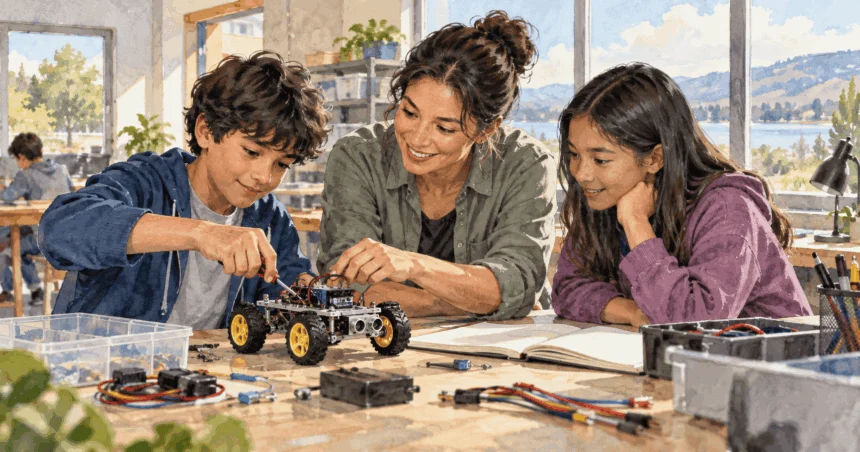
Every year, nearly 100,000 fifth-graders walk onto military bases across America for what looks like the ultimate science camp. They build rockets, program robots, and design space stations using professional software. They sit in fighter jet cockpits and watch cargo planes take off.
By the time they leave, many are dreaming of becoming engineers—and quite a few are thinking about military careers.
This is DoD STARBASE, the Pentagon’s youth outreach program. It’s federally funded, completely free for schools, and operates on military installations from California to Puerto Rico. The program has reached over 1.6 million students since 1993, making it one of the largest STEM education initiatives in the country.
STARBASE is part of a broader Pentagon strategy to secure America’s future technology workforce and build stronger ties between the military and local communities. Critics call it early recruitment. Supporters say it’s innovative education that changes kids’ lives.
From Michigan Base to National Program
The Selfridge Experiment
STARBASE began in 1989 when Barbara Koscak, a local educator, approached Brigadier General David T. Arendts at Selfridge Air National Guard Base in Michigan. She had an idea: what if kids could learn science and math in a real military environment, surrounded by actual aircraft and working with service members?
General Arendts said yes. Along with Lieutenant Colonel Richard “Rico” Racosky, an F-16 pilot, and Rick Simms, a university student, they created “Project STARS.” Racosky brought his own goal-setting program called dreams + action = Reality®, which became a core part of the curriculum.
The W.K. Kellogg Foundation provided the first grant in 1991. The inaugural program was supposed to serve 200 students but ended up reaching over 2,000. Nearly 70 military volunteers from Selfridge got involved, creating a model that combined hands-on science with personal development and drug prevention messages.
Going National
The success caught Washington’s attention quickly. In summer 1992, Michigan Senator Carl Levin presented the program to Congress. By fiscal year 1993, Congress had appropriated $2 million to the Air National Guard to expand STARBASE to seven states.
The original name stood for “Science and Technology Academies Reinforcing Basic Aviation and Space Exploration.” Today it’s simply STARBASE, reflecting a broader mission beyond aviation.
The program now operates under 10 U.S.C. § 2193b and is governed by Department of Defense Instruction 1025.07. Any organization wanting to use the “DoD STARBASE” name must follow these standards, even without direct DoD funding.
What Happens at STARBASE
The 25-Hour Experience
Each STARBASE program runs for exactly 25 hours, typically delivered as one full day per week for five weeks or as a five-day summer camp. A single classroom of students attends with their teacher, creating an intimate learning environment.
The program is free for schools, though they usually pay for transportation to the military base. Each academy has a certified teacher and teaching assistant, ensuring educational quality.
The STEAM Curriculum
While the Pentagon provides core frameworks and approved modules, each STARBASE academy customizes its curriculum based on local resources and educational standards.
Science: Students explore Newton’s Laws of Motion through hands-on experiments, learn Bernoulli’s principle to understand flight, investigate states of matter, build model rockets, and get introduced to nanotechnology. Everything involves real experiments, not textbook reading.
Technology: Kids work with tools often unavailable in regular classrooms. They build and program robots, experiment with 3D printing, learn basic coding, and use advanced flight simulators. The technology component shows how abstract concepts become practical tools.
Engineering & Art: The Engineering Design Process is central to STARBASE. Students identify problems, brainstorm solutions, build prototypes, test them, and refine their designs. A mandatory 3-hour block teaches 3D Computer-Aided Design (CAD) using professional software. Kids design space stations, all-terrain vehicles, or submarines, turning ideas into detailed digital models.
Mathematics: Rather than separate math lessons, mathematical concepts are woven throughout every activity. Students calculate rocket trajectories, use metric measurements for precise builds, apply geometry in CAD design, and analyze experimental data.
The curriculum deliberately creates excitement. Student testimonials consistently describe the experience as “unbelievable” and “not boring,” contrasting it with “boring textbooks.” This emotional impact is strategic—making STEM feel like an adventure rather than work.
Military Immersion
The military setting isn’t incidental. Service members from all ranks volunteer as role models and subject matter experts. They lead base tours, demonstrate how STEM applies to real military work, and share their career experiences.
The experiences vary by base type. At Air Force installations, students might explore F-18 fighter jet cockpits, tour massive KC-135 refueling aircraft, or watch takeoffs and landings. Army bases feature heavy equipment and specialized vehicles. Navy installations might include submarine tours or medical transport demonstrations.
This exposure serves dual purposes: it demystifies military careers and shows students the vast array of STEM jobs within the armed forces.
Beyond Fifth Grade
STARBASE Advanced Programs
Recognizing that fifth-grade interest needs nurturing, the Pentagon developed STARBASE Advanced for older students.
STARBASE 2.0 targets middle schoolers in grades 6-8 through after-school mentoring programs. Students tackle complex, long-term projects like FIRST LEGO League robotics competitions, advanced rocket launches, and sophisticated engineering challenges. STEM professionals from military and civilian communities serve as mentors.
STARBASE 3.0 continues the model for high schoolers with more career-oriented projects. These give students deeper insight into specific STEM fields while preparing them for college and careers.
The goal is for every STARBASE academy to eventually sponsor Advanced programs, creating a continuous STEM pipeline from elementary through high school.
Getting Into STARBASE
Who Can Participate
STARBASE is open to public and private schools, alternative education providers, and homeschooling groups. While primarily focused on fifth grade, some academies accept fourth or sixth graders with approval.
The program specifically targets students historically underrepresented in STEM fields and those from socioeconomically disadvantaged backgrounds. In 2023, 77% of participating schools were Title I-eligible, indicating high numbers of low-income students.
The Application Maze
There’s no national STARBASE application portal. Each academy handles its own enrollment, creating widely different processes across the country.
Kansas: Uses competitive applications submitted between January and spring for the following school year. Selection criteria include achieving a balanced rural/urban mix of schools. Non-selected schools go on waiting lists. Applications are available at kansasstarbase.org.
Florida: STARBASE Florida at Jacksonville’s 125th Fighter Wing restricts participation to pre-selected elementary schools within Duval County Public Schools. Only teachers from designated schools can register through starbaseflorida.org.
Michigan: Uses an open application process where qualifying teachers download forms from the state website, mail them in, and await contact if they meet criteria.
Alabama: STARBASE Maxwell provides a dedicated portal for homeschool families at starbasemaxwell.org.
Finding Your Local Academy
The official DoD STARBASE locations page lists dozens of academies across all 50 states and U.S. territories. Each academy’s contact information is provided, though application processes vary significantly.
STARBASE Locations Nationwide
| State | Academy Name / Location | Sponsoring Military Component | Website |
|---|---|---|---|
| AL | STARBASE Maxwell | Air Force | starbasemaxwell.org |
| AZ | STARBASE Arizona (Tucson) | Air National Guard | Contact: SB.Arizona@dodstarbase.org |
| AR | STARBASE Arkansas (Little Rock AFB) | Air National Guard | starbasear.org |
| CA | STARBASE Vandenberg | Space Force | Contact local base |
| CA | STARBASE Edwards (Edwards AFB) | Air Force | https://www.edwards.af.mil/ |
| CO | Peterson STARBASE | Space Force | starbasepeterson.com |
| CT | STARBASE Connecticut (Windsor Locks) | Air National Guard | starbase-ct.com |
| FL | STARBASE Patrick | Space Force | Contact local base |
| FL | STARBASE Florida (Jacksonville) | Air National Guard | starbaseflorida.org |
| GA | STARBASE Robins | Air Force Reserve | Contact local base |
| HI | STARBASE Hawaii (Keaau) | Air National Guard | Contact: SB.Hawaii@dodstarbase.org |
| ID | STARBASE Idaho (Boise) | Air National Guard | Contact: SB.Idaho@dodstarbase.org |
| IN | STARBASE Indiana (Fort Wayne) | Air National Guard | starbasein.org |
| KS | STARBASE Kansas (Multiple Locations) | Air National Guard | kansasstarbase.org |
| LA | Pelican State STARBASE (Pineville) | Air National Guard | pelicanstatestarbase.org |
| MD | STARBASE Maryland (Warfield ANGB) | Air National Guard | Contact local base |
| MA | STARBASE Hanscom (Hanscom AFB) | Air Force | starbasehanscom.live |
| MI | STARBASE One (Selfridge ANGB) | Air National Guard | starbaseone.org |
| MS | STARBASE Columbus (Columbus AFB) | Air Force | Contact: sb.columbus@dodstarbase.org |
| NM | STARBASE Holloman (Holloman AFB) | Air Force | starbaseholloman.org |
| NC | STARBASE Charlotte | Air National Guard | Contact: SB.Charlotte@dodstarbase.org |
| OH | STARBASE Wright-Patt | Air Force | Contact local base |
| OK | STARBASE Oklahoma (Multiple) | Air National Guard | Contact local base |
| OR | DoD STARBASE Oregon | Air National Guard | oregon.gov/omd/programs/starbase |
| SC | STARBASE Swamp Fox | Air National Guard | Contact local base |
| TX | STARBASE Goodfellow | Air Force | starbasegoodfellow.org |
| UT | STARBASE Hill (Hill AFB) | Air Force | starbasehill.org |
| VA | Winchester STARBASE Academy | Air National Guard | Contact local base |
| WI | STARBASE Wisconsin | Air National Guard | Contact local base |
This represents a sample of locations. Check the official DoD STARBASE website for a complete, current list.
Measuring Success and Impact
The Numbers Tell a Story
The Pentagon tracks STARBASE performance meticulously through annual reports. The data from fiscal years 2022 and 2023 reveals both the program’s scale and effectiveness.
In FY2023, STARBASE served 96,280 students. Since 1993, the program has reached over 1.6 million students total. The demographic data shows the program is meeting its diversity goals: 77% of participating schools were Title I-eligible, 62% of students were low-income, and 49% were female. The program served significant numbers of minority students, including 21% Black/African American and 25% Hispanic or Latino students.
Academic Gains
Students consistently leave STARBASE with measurably better STEM knowledge. The 2023 report found students answered 15% more questions correctly on post-program assessments compared to pre-program tests. The gains were especially strong in engineering (21% improvement) and the science of motion and force (19% increase).
Perhaps more important than knowledge gains are attitude shifts. The 2023 data showed statistically significant positive changes across 95% of attitudinal questions. The biggest improvements were in students’ confidence in their science abilities, understanding of what engineers do, and awareness of STEM career opportunities—including military jobs.
Teacher Impact
The program influences educators too. In 2023, 99.3% of teachers said they would recommend STARBASE to colleagues. After attending, 65% of first-time teachers reported being “Extremely Likely” or “Very Likely” to recommend military careers to students.
Student Voices
Student testimonials reveal the program’s emotional impact. One Louisiana student said, “Before I went to STARBASE, I felt like I wasn’t good at S.T.E.M., but when I was done I felt like a genius at it.” A South Dakota student highlighted the hands-on difference: “Normally, in class we just read books when we are learning about Science but not in STARBASE We actually get to touch stuff!”
Parent Perspectives
Parents frequently report profound changes in their children’s engagement and aspirations. A Texas parent shared: “This experience opened my son’s eyes to the possibilities of career choices for what he loves. He always said he didn’t want to go to college; however, all that has changed. When he got in my car this afternoon he was on fire to learn more and one day go to college and become an engineer!”
Independent Analysis and Criticism
RAND Corporation’s Assessment
In 2018, the RAND Corporation published a comprehensive analysis titled “DoD STARBASE: Improved Measures for Participation, Outreach, and Impact.” The research largely validated the program’s model, confirming that STARBASE effectively serves disadvantaged student populations.
RAND noted that some STARBASE sites operate in areas with lower-than-average trust in the military. In these locations, the researchers concluded, the program is well-positioned to “improve community relations and public perceptions of the military.”
The Recruitment Debate
The National Network Opposing the Militarization of Youth (NNOMY) offers a sharply critical perspective. In a 2024 article titled “DoD STARBASE: Early Grooming for Military Recruitment,” the organization argues that STARBASE is a “transparent effort to leverage public interest in STEM education while pushing a pro-military message to ten- and eleven-year-old kids.”
NNOMY cites several concerns:
- Targeting young, often socioeconomically vulnerable demographics
- Using pre- and post-program surveys that explicitly ask about military attitudes
- Strategic placement in “gap areas” lacking other military influence
The Effectiveness Paradox
These different perspectives reveal a fascinating tension. The outcomes the Pentagon celebrates as success are identical to those critics cite as problematic. DoD annual reports highlight positive shifts in student and teacher attitudes toward military careers as key achievements. NNOMY takes this exact data and frames it as “early grooming.”
The core debate isn’t whether STARBASE works—all sides agree it’s highly effective at changing attitudes. The question is whether this effectiveness represents beneficial community engagement or subtle influence campaigns targeting children.
STARBASE’s Strategic Role
National Security Investment
STARBASE isn’t just community outreach—it’s explicitly framed as a national security investment. The program’s official vision is to “develop a highly educated and skilled American workforce who can meet the advance technological requirements of the Department of Defense.”
STARBASE Maxwell’s website states that the DoD “seeks to foster strong relationships with future scientists and engineers” to “meet our own employment requirements” and “perpetuate our long-term security and prosperity.”
Industry Partnerships
Local academies often form direct partnerships with defense contractors. STARBASE Central Florida was established through a contract between the Navy’s Naval Air Warfare Center Training Systems Division and the National Center for Simulation, explicitly to build the future workforce for the region’s Modeling, Simulation & Training sector.
These connections demonstrate that STARBASE functions as a strategic response to what the Pentagon views as a national security vulnerability: potential decline of a domestic STEM workforce willing to work in defense.
The Broader STEM Landscape
Government Competition
STARBASE operates within a crowded field of federal STEM initiatives:
DoD STEM: The Pentagon’s umbrella initiative provides information on programs, internships, and scholarships at dodstem.us.
Air & Space STEM Outreach (DAFSTEM): The K-12 outreach arm for the Air Force and Space Force, available at dafstem.us.
NASA Opportunities: Offers challenges, virtual camps, internships, and online resources through their student portal.
Specialized Programs
Other agencies host targeted initiatives like Oak Ridge Institute for Science and Education STEM Academies for middle schoolers and the CDC’s Data Detectives Camp for rising 6th and 7th graders.
Private Sector Options
Non-governmental programs provide additional opportunities through organizations like YMCA STEM programs, franchise-based programs like Bricks for Kidz, and countless local robotics clubs, coding bootcamps, and science camps.
Understanding the Full Picture
STARBASE represents one of the most successful and well-funded STEM education programs in America. By any measurable standard—student engagement, knowledge gains, attitude shifts, teacher satisfaction—it works exceptionally well.
The program’s military setting provides resources and experiences unavailable in traditional classrooms. Students get hands-on access to advanced technology, professional mentorship, and real-world applications of scientific principles. For many participants, especially those from underserved communities, STARBASE opens doors to educational and career possibilities they might never have considered.
At the same time, STARBASE is explicitly designed to shape young people’s attitudes toward the military and STEM careers that serve national defense priorities. The Pentagon doesn’t hide this goal—it’s central to the program’s mission and funding justification.
Whether this dual purpose represents innovative public-private partnership or concerning influence targeting depends largely on one’s perspective on military recruitment, the role of defense spending in education, and the appropriateness of introducing career considerations to elementary school students.
What’s clear is that STARBASE has found a successful formula for engaging young minds in STEM learning while building stronger connections between military installations and local communities. For the nearly 100,000 students who participate each year, it’s often a transformative experience that shapes their academic interests and career aspirations in lasting ways.
For parents and educators considering STARBASE, the program offers genuine educational value through high-quality instruction, advanced resources, and unique learning opportunities. Understanding its broader strategic context helps informed decision-making about whether it aligns with individual educational goals and values.
The program’s continued growth and consistent positive outcomes suggest it will remain a significant presence in American STEM education for years to come, continuing to spark both enthusiasm from participants and debate from observers about its role in shaping the next generation of American scientists, engineers, and citizens.