Last updated 10 months ago. Our resources are updated regularly but please keep in mind that links, programs, policies, and contact information do change.
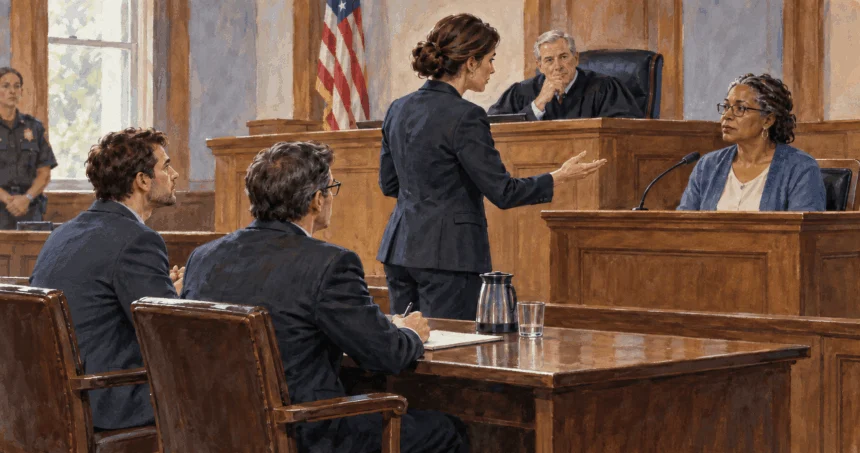
The right to look your accuser in the eye during a criminal trial isn’t just for courtroom drama. It’s one of the most fundamental protections in American law, guaranteed by the Sixth Amendment‘s Confrontation Clause.
This right emerged from centuries of abuse by tyrannical governments who convicted people based on secret accusations and paper evidence. Today, it ensures that criminal prosecutions happen in open court, where accusations can be tested through cross-examination rather than decided behind closed doors.
From its origins in a famous English treason trial to modern struggles with DNA evidence, child witnesses, and video testimony, the right to confrontation remains both vital and contested in American courtrooms.
Your Rights Under the Sixth Amendment
The Sixth Amendment serves as a charter of rights for anyone facing criminal prosecution. Ratified on December 15, 1791, as part of the Bill of Rights, it responded directly to abuses by the English crown.
The amendment states: “In all criminal prosecutions, the accused shall enjoy the right to a speedy and public trial, by an impartial jury of the State and district wherein the crime shall have been committed, which district shall have been previously ascertained by law, and to be informed of the nature and cause of the accusation; to be confronted with the witnesses against him; to have compulsory process for obtaining witnesses in his favor, and to have the Assistance of Counsel for his defence.”
The guarantee “to be confronted with the witnesses against him” is the Confrontation Clause. It works alongside other interconnected protections. The right to a public trial ensures confrontation happens in the open. The right to an impartial jury ensures neutral arbiters judge the confrontation.
Most importantly, the right to counsel drives the confrontation process. As the Supreme Court noted, the right to a lawyer affects a defendant’s ability to assert any other rights. Defense attorneys conduct cross-examinations, turning passive face-to-face meetings into active tests of evidence.
This right guarantees a specific procedure, not truthful testimony. It requires that testimony reliability be assessed in the “crucible of cross-examination” with the accused present.
Originally, these rights applied only to federal criminal cases. In 1965, Pointer v. Texas changed this. The Supreme Court ruled that the Confrontation Clause was so fundamental that it also applies to state prosecutions through the Fourteenth Amendment, making it a universal protection for all Americans.
The Story Behind the Right: Sir Walter Raleigh’s Trial
To understand why the Framers included confrontation rights in the Bill of Rights, you need to know about Sir Walter Raleigh’s infamous 1603 treason trial in England.
Before the Sixth Amendment, the English legal system was often inquisitorial, with judges actively investigating cases. A feared practice was “trial by affidavit,” where prosecutors built cases on ex parte statements—sworn testimony taken in secret from witnesses without the defendant present to challenge them.
The Confrontation Clause was created specifically to end this abusive practice.
Raleigh, a celebrated poet, soldier, and explorer who founded the Roanoke colony, was accused of plotting to overthrow King James I. The prosecution’s entire case rested on one piece of paper: a sworn “confession” extracted privately from Raleigh’s supposed co-conspirator, Lord Cobham.
At trial, Raleigh couldn’t see or question Cobham. He protested vehemently, demanding the court produce his accuser. In words that echo through legal history, he declared: “But it is strange to see how you press me still with my Lord Cobham, and yet will not produce him… let Cobham be here, let him speak it. Call my accuser before my face.”
The court refused. Raleigh was convicted based on this secret, untested paper evidence, even though reports suggested Cobham had recanted his confession.
The injustice of Raleigh’s trial became a rallying cry. Legal scholars and later the U.S. Supreme Court repeatedly pointed to this case as the “particular vice” that created the right of confrontation.
The core lesson wasn’t just that an accused should see a witness. The government must not prove its case using evidence gathered behind closed doors. The right fundamentally checks state power by forcing accusations into the open for adversarial testing.
This revulsion to secret accusations was so deeply ingrained in America’s founders that the Confrontation Clause was included in the Bill of Rights with little debate.
What Confrontation Really Means
The right to be “confronted” with a witness means much more than a passing glance. The Supreme Court has identified four essential elements that ensure evidence reliability:
Physical Presence: The basic right of a defendant to meet the witness face-to-face in the courtroom. This physical presence impresses upon witnesses the gravity of their accusations and prevents them from making false claims with detached impunity.
Testimony Under Oath: The witness must swear to tell the truth, subjecting them to perjury penalties. This solemn act reinforces the trial’s seriousness.
Cross-Examination: This is the right’s heart, described by the Court as the “greatest legal engine ever invented for the discovery of truth.” It allows defense teams to probe testimony, challenge memory, expose biases or motives to lie, and reveal inconsistencies.
Observation of Demeanor: The jury’s ability to watch witnesses testify is crucial for assessing credibility. A witness’s hesitation, confidence, body language, and tone can be as revealing as their words.
The Supreme Court’s first major interpretation came in the 1895 case Mattox v. United States. The Court confirmed that the clause’s “primary object” was preventing ex parte affidavits like the one used against Raleigh, while securing cross-examination benefits and jury observation of witness demeanor.
However, Mattox also established that the right isn’t absolute. The Court recognized that rigid adherence to the text could lead to absurd results. In Mattox, two witnesses who testified against the defendant at his first trial had died before his second trial. The defendant argued that admitting transcripts of their prior testimony would violate his confrontation rights.
The Court disagreed, stating that “general rules of law… must occasionally give way to considerations of public policy and the necessities of the case.” Letting a defendant go free simply because a witness died would carry “constitutional protection to an unwarrantable extent.”
The Court ruled that because the defendant had already been given a full opportunity to confront and cross-examine the witnesses at the first trial, the “substance” of his constitutional right was preserved.
This case established the foundational tension that continues shaping the law today: the conflict between the Constitution’s absolute-sounding language and practical justice administration necessities. It showed that the right is fundamentally about the opportunity for adversarial testing. Once that opportunity has been fairly provided, the system can accommodate practical realities like witness death.
The Modern Revolution: Crawford v. Washington
For decades, Mattox was interpreted through a flexible but often confusing lens. In 1980, Ohio v. Roberts established a standard governing for nearly a quarter-century. Under Roberts, an out-of-court statement from an unavailable witness could be used if it had “adequate ‘indicia of reliability.'” This meant the statement either fell under a “firmly rooted hearsay exception” or showed other “particularized guarantees of trustworthiness.”
This gave judges significant discretion to decide which out-of-court statements were reliable enough for admission.
This framework was shattered in 2004 by the landmark Crawford v. Washington decision. In a majority opinion by Justice Antonin Scalia, the Court declared the Roberts reliability test an unconstitutional departure from the Sixth Amendment’s original meaning.
The Court argued that the Confrontation Clause doesn’t empower judges to gauge evidence reliability; it commands a specific procedure for testing that reliability—confrontation. Justice Scalia wrote: “Dispensing with confrontation because testimony is obviously reliable is akin to dispensing with jury trial because a defendant is obviously guilty. This is not what the Sixth Amendment prescribes.”
Crawford swept away the Roberts test and replaced it with a seemingly more rigid standard. The pivotal question is no longer “Is the statement reliable?” but rather, “Is the statement testimonial?”
The distinction is critical:
If an out-of-court statement is non-testimonial, the Confrontation Clause has no say. Its admissibility is governed solely by state and federal rules of evidence, such as hearsay rule exceptions.
If a statement is testimonial, it cannot be admitted unless the person who made the statement is unavailable to testify at trial, AND the defendant had a prior opportunity to cross-examine them.
The Crawford court declined to provide a single, comprehensive definition of “testimonial,” but it gave clear examples of what falls into the “core class”: “prior testimony at a preliminary hearing, before a grand jury, or at a former trial; and to police interrogations.”
A statement is testimonial if it’s made under circumstances where an objective person would reasonably believe it would be used later at trial.
| Generally Testimonial (Confrontation Clause Applies) | Generally Non-Testimonial (Confrontation Clause Does Not Apply) |
|---|---|
| Statements made during police interrogation where the primary purpose is establishing past events for future prosecution | Statements made to police during ongoing emergencies, such as frantic 911 calls reporting crimes in progress |
| Formal affidavits and certified forensic lab reports created specifically for trial use, such as drug analyses or DNA reports | Business records created for routine administration of entity affairs, not for prosecution purposes |
| Prior testimony given in grand juries, preliminary hearings, or former trials | Spontaneous or “excited utterances” made to friends, family, or bystanders shortly after startling events |
| Formal statements or confessions made to law enforcement after receiving Miranda warnings | Statements made by very young children to non-law enforcement figures like teachers, where the primary purpose is seeking protection or medical help |
When Face-to-Face Isn’t Required
Even under Crawford’s stricter regime, the right to physically confront witnesses in court isn’t absolute. The Supreme Court has recognized several narrow exceptions, each reflecting a difficult balance between defendant rights and other compelling societal interests.
Child Witnesses and Remote Testimony
Perhaps the most debated exception involves child abuse victim testimony. In the 1990 case Maryland v. Craig, the Supreme Court confronted a wrenching scenario: can a child who would be traumatized by testifying in front of their alleged abuser testify from a separate room via closed-circuit television?
In a narrow 5-4 decision, the Court said yes, but only under very specific conditions.
The Court held that while the Confrontation Clause reflects a strong “preference” for face-to-face confrontation, this preference must sometimes yield to an “important public policy,” such as protecting a child’s psychological well-being.
The exception isn’t automatic. A judge must hold a hearing and make a case-specific finding that this particular child would suffer “serious emotional distress” if forced to testify in the defendant’s presence, and that this distress would prevent the child from reasonably communicating.
Even with this accommodation, other confrontation elements must remain intact: the child must be under oath, subject to full cross-examination, and their demeanor must be visible to the judge, jury, and defendant on the monitor.
The Craig decision creates a fascinating legal puzzle after Crawford. Craig is based on balancing interests—defendant rights versus public policy—a methodology Crawford seemed to reject in favor of rigid procedural rules. Nonetheless, the Supreme Court has allowed Craig to remain good law, creating a unique carve-out for child witnesses that exists in tension with the Court’s modern jurisprudence.
This precedent gained new relevance during the COVID-19 pandemic, as courts relied on Craig to justify broader use of remote video testimony for various witnesses.
Forfeiture by Wrongdoing
A second major exception is rooted in the equitable principle that no one should profit from their own wrongdoing. The “forfeiture by wrongdoing” doctrine holds that if a defendant intentionally procures a witness’s absence—for example, by threatening, intimidating, or even killing them—the defendant forfeits their constitutional right to confront that witness.
The Supreme Court first articulated this principle in the 1878 case Reynolds v. United States, stating that the Constitution “does not guarantee an accused person against the legitimate consequences of his own wrongful acts.” If a defendant “voluntarily keeps the witnesses away, he cannot insist on his privilege” of confrontation.
The key element is intent. The prosecution must prove, typically by “preponderance of the evidence,” that the defendant acted with the specific purpose of preventing the witness from testifying.
This doctrine is critically important in modern prosecutions for domestic violence and human trafficking, where witness intimidation is pervasive. It allows prosecutors to introduce a victim’s prior testimonial statements (such as detailed accounts given to police) even if the victim is later too frightened to appear in court or has been harmed by the defendant.
Other Historical Exceptions
Two other exceptions have deep common law roots:
Dying Declarations: The law has long recognized an exception for statements made by witnesses who believe their death is imminent. The rationale, accepted by courts for centuries, is that a person on the verge of death has the strongest possible motive to tell the truth. The Crawford court acknowledged this exception’s unique historical pedigree.
Unavailable Witness with Prior Cross-Examination: As established in Mattox and reaffirmed in Crawford, the Confrontation Clause is satisfied if a witness who is now genuinely unavailable (due to death, illness, etc.) previously testified under oath and was subject to full and fair cross-examination by the same defendant.
Modern Challenges: Technology and Science
The core principles of confrontation, forged in an era of quill pens and town criers, face unprecedented challenges in the 21st century. Technology is the primary force pushing at this ancient right’s boundaries, forcing courts to decide how a right to face a human accuser applies to data, algorithms, and virtual courtrooms.
Forensic Evidence
A major area of contention is forensic evidence. Following Crawford, the Supreme Court ruled in Melendez-Diaz v. Massachusetts that a certified lab report—such as one identifying a substance as cocaine—is a testimonial statement.
This means prosecutors cannot simply submit the report as evidence; they must produce the analyst who conducted the test for cross-examination.
This decision has had massive impact, giving defense teams a powerful tool to challenge forensic science methodology and reliability, but also placing significant logistical and financial burdens on underfunded state crime labs.
Courts have generally held that bringing in a “surrogate” witness—a lab supervisor who reviewed the report but didn’t perform the analysis—is not sufficient to satisfy the defendant’s right to confront the actual analyst who made the crucial certification.
Even more complex issues arise with “black box” evidence generated by sophisticated software. When a conviction relies on data from a gunshot detection system like ShotSpotter or a complex DNA mixture analysis program like STRmix, who is the “witness” the defendant gets to confront? Is it the police officer who uses the system, the programmer who wrote the code, or the algorithm itself?
This is a legal frontier where the right to confrontation collides with modern technology’s opaque nature.
Domestic Violence Prosecution
The Crawford decision also radically altered domestic violence prosecution. For years, many jurisdictions relied on “evidence-based prosecution,” using a victim’s frantic 911 call or initial statements to responding officers to secure convictions, even if the victim later refused to cooperate out of fear or reconciliation.
By classifying many of these statements—particularly those taken in formal, non-emergency settings—as testimonial, Crawford made them inadmissible without the victim’s live testimony.
While a 911 call made during an ongoing emergency is still generally non-testimonial, a formal statement given at the station an hour later is not. This has forced major strategic re-evaluation of how these sensitive cases are brought to trial.
Virtual Testimony
The future of testimony itself is in question. The widespread use of two-way video conferencing during the COVID-19 pandemic accelerated a debate that had been simmering for years: can a virtual confrontation satisfy the Sixth Amendment?
Unlike the one-way system in Craig, two-way video allows witnesses and defendants to see each other. Federal and state courts are split on whether this is a constitutionally adequate substitute for physical presence.
Courts that permit it have developed detailed checklists to ensure fairness, verifying that:
- Technology is working properly
- The jury can observe the witness’s full demeanor
- The witness is not being coached off-screen
- The defendant has a private line of communication with their attorney
This ongoing struggle to adapt a right designed for a physical courtroom to a virtual world demonstrates the enduring challenge of making our oldest legal principles relevant and effective in an ever-changing society.
The right to confront witnesses remains as vital today as it was in Sir Walter Raleigh’s time. While technology and modern prosecution techniques create new challenges, the fundamental principle endures: in America, the government cannot convict you based on secret accusations. Your accusers must face you in open court, where their testimony can be tested, challenged, and weighed by a jury of your peers.