Last updated 9 months ago. Our resources are updated regularly but please keep in mind that links, programs, policies, and contact information do change.
- The Tanker’s Journey and Flag Change
- The Statelessness Argument
- Domestic Law vs. International Maritime Law
- Historical Precedent: Civil War and Spanish-American War
- Russian and Chinese Responses
- British Support and Strategic Considerations
- Operation Southern Spear and Control of Venezuelan Oil
- Implications for Maritime Commerce
- Legal Proceedings and Future Seizures
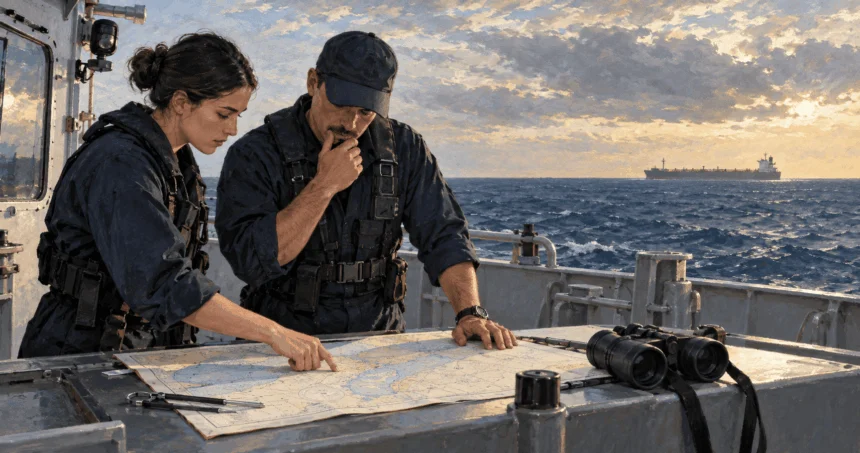
On January 7, 2026, U.S. Coast Guard personnel boarded a Russian-flagged oil tanker in the North Atlantic, about 220 miles south of Iceland, and seized it. The vessel—recently renamed Marinera after sailing for months as the Bella 1—was empty of cargo. It had never reached Venezuela to load the oil it was banned from carrying under U.S. law. A Russian submarine had been escorting it. The boarding happened anyway.
The United States claimed authority to seize a merchant vessel flying another major power’s flag, in international waters, based on a legal argument that says ships lose protection when they change countries mid-journey. Whether that theory holds up under international maritime law is now the subject of sharp disagreement among legal scholars, diplomatic protests from Moscow and Beijing, and concern among shipping industry executives who worry that the rules governing who can seize what, where, are becoming unclear.
Can the United States legally seize foreign vessels on the high seas when those vessels aren’t engaged in piracy, slavery, or drug trafficking—the traditional exceptions to the rule that ships are protected by their country of registration once they leave territorial waters?
The answer appears to be: sometimes, if you’re willing to stretch the definition of “stateless” far enough, and if you have the naval power to make it stick.
The Tanker’s Journey and Flag Change
The journey to seizure began in the Persian Gulf in August 2025, when the ship—then called the Bella 1—loaded Iranian crude oil. The ship, a Very Large Crude Carrier capable of moving two million barrels, had a history that sanctions enforcement officials describe as “suspicious.”
It turned off its tracking system frequently, a telltale sign of vessels conducting ship-to-ship transfers designed to obscure cargo origins. The U.S. Treasury had sanctioned it in 2024 as part of what American officials call the “shadow fleet”—about 1,000 old tankers Russia, Iran, and Venezuela use to secretly move oil.
The ship was heading toward Venezuela when, in mid-December 2025, the Trump administration announced what it termed a “blockade” of sanctioned tankers.
On December 15, as U.S. forces approached, the Bella 1 reversed course and headed north into the Atlantic.
U.S. forces tracked the ship using satellite imagery and naval surveillance as it zigzagged northward, apparently trying to reach either a port or waters where American forces might hesitate to act.
Then, on December 30, the crew painted a flag on the hull. The ship’s name changed to Marinera. Russia’s maritime registry added it to their rolls. A company called Burevestmarin, registered six months earlier in the Ryazan region, became the listed owner.
Russia dispatched naval assets—including a submarine and surface vessels—to escort the tanker. By every traditional understanding of maritime law, a ship flying a recognized flag, properly registered, and escorted by that flag state’s warships, enjoys the protection of that nation’s sovereignty on the high seas.
International maritime law states that ships “shall be subject to [the flag state’s] exclusive jurisdiction on the high seas.”
The U.S. boarded it anyway. Personnel from the cutter Munro, supported by Navy helicopters, secured the ship while the escort withdrew without intervening. The 28-member crew—17 Ukrainians, six Georgians, three Indians, and two from Russia—was detained. The tanker, still empty, was taken into U.S. custody.
The Statelessness Argument
International maritime law allows warships to board foreign ships in five specific situations: piracy, slave trade, unauthorized broadcasting, drug trafficking, and ships with no country.
White House Press Secretary Karoline Leavitt said the vessel had no country because it changed registration while being chased. The ship changed flags while being actively pursued by U.S. forces, and American officials argue this mid-voyage switch, without what they characterize as a “genuine” transfer of ownership, rendered the registration legally void. No valid flag means no protection from its country of registration.
Some maritime law experts find this argument defensible within existing frameworks. Dr. Pierre Thévenin, a researcher at the Stockholm International Peace Research Institute, explained that flag changes at sea without legitimate ownership transfers can be void under international law, leaving ships technically stateless.
The Lowy Institute, an Australian think tank specializing in naval affairs, concluded the boarding was “likely lawful” because the ship was “not lawfully registered” when U.S. forces acted—the registration process may not have been complete, and the timing suggested tactical maneuvering rather than genuine business activity.
But this interpretation requires accepting that the United States gets to decide whether another country’s ship registration is “genuine.” Russia insists the ownership transfer to Burevestmarin was legitimate, that the registry change followed proper procedures, and that the ship was therefore a properly flagged merchant ship deserving of protection.
Foreign Minister Sergey Lavrov called the seizure “a gross violation of fundamental principles and norms” of maritime law.
The factual dispute centers on Burevestmarin. The company was registered only six months before acquiring the tanker, and the acquisition occurred while U.S. forces were actively pursuing the ship.
Was this a genuine business transaction or a paper transfer designed solely to provide protection from seizure? That question has no clear precedent in international maritime law, and the answer determines whether the U.S. acted lawfully or committed what Russia characterizes as piracy.
Domestic Law vs. International Maritime Law
The U.S. law that allows this comes from 1977 and lets the president ban trade during emergencies. President Trump, like his predecessor, has used this law to impose sanctions on Venezuelan oil, effectively blocking transactions involving Venezuelan crude.
When a ship engages in sanctioned activity—loading, transporting, or attempting to sell Venezuelan oil—it potentially becomes subject to civil forfeiture under federal asset forfeiture statutes.
The problem is that the law doesn’t clearly say whether the president can seize foreign ships at sea without permission from their country. The statute applies to “property” subject to U.S. jurisdiction, but international maritime law has always held that ships on the high seas fall under the exclusive jurisdiction of their country of registration.
These two laws contradict each other, and resolving it requires finding an exception in international maritime law.
This exception was meant for abandoned ships or ships whose countries no longer exist. It was not designed to address ships that change flags during enforcement actions, and applying it in this context represents a significant expansion of the doctrine.
Jennifer Parker, a naval studies expert at the Lowy Institute, noted that treating ships that change countries while being chased as stateless could let any powerful country seize ships that change registry at an inconvenient time, even if the new registration is technically complete.
The U.S. has a counterargument rooted in international law, which states that international law allows ships to change their country registration if there’s a real change in ownership but adds that a ship can only be protected by one country at a time.
This language suggests ships flying multiple flags simultaneously, or changing flags in rapid succession, forfeit protection under any flag. The flag change occurred while U.S. forces were actively pursuing it with a federal court warrant already issued. American officials treat this sequence as a transparent attempt to use flag-switching as a tactical maneuver to evade lawful enforcement, not as a legitimate business transaction.
Which side is right depends on factual questions that haven’t been decided in court: Was the ownership transfer to Burevestmarin genuine or merely a paper transaction? Was the registry change complete and formally valid when the boarding occurred? Did the timing indicate genuine business activity or transparent evasion?
These questions will likely take years of litigation to resolve, assuming Russia chooses to challenge the seizure in U.S. courts.
Historical Precedent: Civil War and Spanish-American War
The seizure has historical precedent, but nothing recent like this. During the Civil War, the Navy seized ships trading with the South, and the Supreme Court said this was legal, saying the president could seize ships during wartime even without Congress formally declaring war.
In the 1898 Spanish-American War, the Supreme Court again affirmed that cargo seized from Spanish-owned ships was lawfully captured because a state of war existed.
These cases said the U.S. can seize foreign ships during wartime if a court approves it. The current seizure occurs during peacetime and is ostensibly justified by sanctions enforcement rather than traditional prize authority.
During the 1990-1991 Gulf War, the U.S. boarded an Iraqi ship carrying tea from Sri Lanka pursuant to a U.N. embargo, but this happened with the ship’s country’s permission or because the ship clearly had no country.
The seizure represents something closer to the aggressive posture of prize law, applied in peacetime against a major power’s properly flagged ship.
The Trump administration has said this seizure follows the same aggressive approach used in past wars. The Center for Strategic and International Studies noted that “the U.S. Navy has a history of seizing ships during wartime” and that the current administration has signaled this will be “the start of continued seizures” as part of a broader strategy.
Russian and Chinese Responses
Russia’s response has been sharp and unambiguous. Foreign Minister Lavrov called the seizure a violation of fundamental maritime law principles, and Russia’s foreign ministry issued a statement questioning whether this was about law enforcement or about the U.S. controlling Venezuela’s oil.
The ministry rejected what it called “neo-colonialist tendencies” and demanded humane treatment of the detained crew members.
China joined the criticism. A Foreign Ministry spokesperson condemned the “unilateral sanctions and vessel confiscations” as lacking U.N. authorization and warned that such actions “disregard maritime norms and infringe on the sovereignty of states.”
China operates its own shadow fleet and has been expanding its naval presence globally—if the U.S. establishes precedent for aggressive high-seas seizures based on domestic sanctions law, China may eventually apply similar logic to its own enforcement operations.
British Support and Strategic Considerations
British involvement in the operation has exposed tensions within the traditional Western alliance. British Defense Secretary John Healey justified the seizure as lawful and aligned with international maritime law, arguing the ship was “part of Russia and Iran working together to break sanctions, which fuels terrorism and conflict from the Middle East to Ukraine.”
According to Andrew Gawthorpe, a senior fellow at the Foreign Policy Centre in London, the U.K. likely supported the operation to maintain good relations with Trump not because of the strength of the case but because supporting the U.S. operation would “buy some goodwill with Trump on other issues, such as Ukraine.”
Operation Southern Spear and Control of Venezuelan Oil
The seizure was one of four ships seized by U.S. forces in a matter of weeks—the Skipper and Centuries in December 2025, then the Marinera and M Sophia in January 2026.
These seizures are part of Operation Southern Spear, the Trump administration’s campaign to cut off Venezuela’s oil sales using military force and seizing oil money.
Energy Secretary Chris Wright said the U.S. will control Venezuelan oil sales and keep the money in U.S. bank accounts until the administration determines Venezuela is “ready” to receive them. Secretary of State Marco Rubio told reporters that Venezuela’s interim authorities understand “the only way they can move oil and generate revenue and not have economic collapse is if they cooperate and work with the United States.”
This goes beyond normal sanctions, which punish rule-breaking and discourage it in the future. This is the U.S. seizing Venezuela’s oil money to force its government to cooperate.
Implications for Maritime Commerce
The shadow fleet—about 1,000 ships—operates secretly to avoid enforcement. These old ships register in countries with loose rules, turn off tracking systems, and transfer cargo at sea to hide where it comes from. Many are associated with environmental hazards, labor violations, and corruption.
From one perspective, aggressively seizing these ships serves legitimate purposes beyond sanctions.
But the vessel was empty when seized. It had never successfully completed its intended transaction. It was taken into U.S. custody based on past behavior and suspected intent, not on any actual violation committed while registered as a ship.
If ships can be seized because they might break sanctions someday or broke them in the past, then maritime commerce has entered a much more unstable era.
Ships need insurance and financing, which companies won’t provide if the rules keep changing. Owners and insurers need to know that ships won’t be arbitrarily seized by every nation whose policies they might be suspected of violating.
If major naval powers start seizing ships based on their own laws and suspicions—without clear authority—it could destroy the system that has kept global trade stable.
Legal Proceedings and Future Seizures
The U.S. is holding the Marinera while it tries to legally take ownership of it, a process where the U.S. government tries to prove it can keep the ship.
Russia could sue in U.S. courts and argue the ship was properly registered under law, the statelessness argument was wrong, and the seizure violated international law.
Other nations are watching to see if the U.S. argument is accepted as valid and whether there are consequences for aggressive high-seas seizures. If the U.S. wins, other countries could start seizing ships based on their own laws too, creating a situation where any powerful country could seize ships it thinks are breaking its rules.
The Trump administration has signaled this is the beginning of more seizures. CSIS analysis suggests this is the beginning of more seizures as the administration targets the western hemisphere.
The U.S. case rests on four arguments: international law allows boarding stateless ships, ships lose protection if they change flags while being chased, the flag change wasn’t real, and U.S. law lets the president seize the ship. Each argument is weak on its own, but together they’re being used to create a new rule.
The case against the seizure is that ships should be protected by their flag country: that a ship flying a recognized flag and properly registered must be protected from seizure by other countries, except in cases of piracy, slavery, drug trafficking, or similar crimes. If that principle weakens, maritime commerce becomes unpredictable.
The real question is whether the U.S. military can enforce its laws on the high seas against other countries’ ships. The U.S. has the military power to seize ships at sea. Whether it has the right to do so—especially against ships from major powers like Russia—may take years of court battles and negotiations to determine.
For now, the ship sits in U.S. custody with its crew detained.
International maritime law is based on countries agreeing to follow the same rules. The seizure is a test case for whether the U.S. will use its military power to rewrite those rules.
Our articles make government information more accessible. Please consult a qualified professional for financial, legal, or health advice specific to your circumstances.