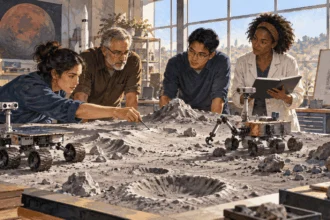
Space exploration and colonization cover how the United States government funds, regulates, and pursues human and robotic activity beyond Earth’s atmosphere. This includes NASA’s own missions, the rules governing private companies that launch rockets and build spacecraft, and the broader question of what role government should play as space becomes a place where nations and companies both operate. The decisions made here shape scientific discovery, national security, and who gets to use the resources found on the Moon, Mars, and beyond.
Historical roots. Much of today’s space policy traces back to a decades-old rivalry that never fully faded. The agencies, funding priorities, and even the language used to justify space programs still carry the imprint of that era, as explored in How Cold War Rivalry Still Shapes America’s Space Policy Today.
The shift to private industry. Government no longer builds and operates every spacecraft itself. Companies now design rockets, capsules, and stations under contract, a change detailed in How SpaceX and Blue Origin Have Transformed America’s Space Program and in How Government Supports the Commercial Space Industry. That shift also touches the future of orbital outposts, as described in America’s Plan to Replace the International Space Station with Private Companies.
Competition and cooperation. Other nations are pursuing their own lunar and Martian ambitions, raising questions about resource claims and strategic advantage, covered in A New Space Race: How America, China, and Russia Are Racing for the Moon and Mars. Whether nations can still work together in orbit despite these tensions is examined in Is International Cooperation in Space Falling Apart?
Articles are now written and checked by the GovFacts Engine, an AI system. No government agency has any input into what it produces. Learn more about our article development and editing process.
We appreciate feedback from readers like you. If you want to suggest new topics or if you spot something that needs fixing, please contact us.
From the mission of the U.S. Space Force to NASA's ambitious return to the Moon, American space policy remains profoundly…
The International Space Station has long served as humanity's outpost in space. But as this engineering marvel approaches retirement, the…
The enduring image of international space cooperation is one of unity above Earth. American astronauts and Soviet cosmonauts shaking hands…
The era of government-led programs like Apollo and the Space Shuttle—where NASA designed, built, and operated everything—has given way to…
Countries now want resources and military advantage, not just bragging rights. The discovery of significant resources on the Moon, particularly…
What was once the exclusive domain of national governments has transformed into a dynamic ecosystem of public-private partnership. Today, the…