- pop.psu.edu2 links
Last updated 9 months ago. Our resources are updated regularly but please keep in mind that links, programs, policies, and contact information do change.
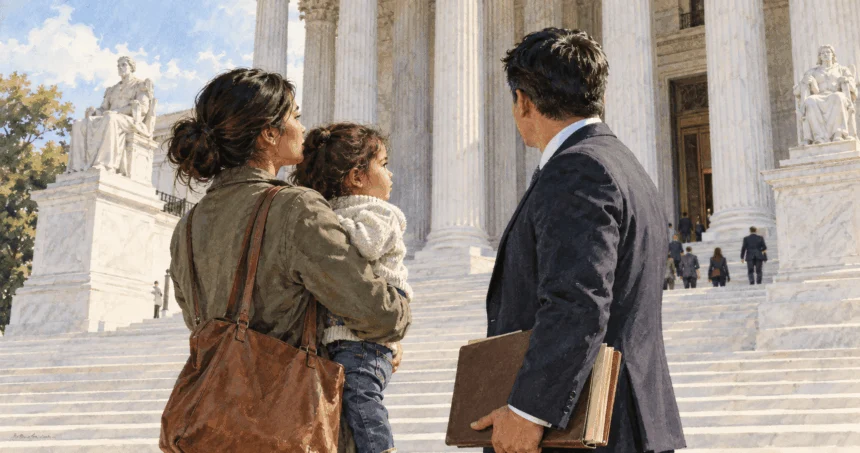
The Supreme Court is preparing to decide whether millions of children born on American soil will be citizens of the country they were born in. The case, expected to be decided by July 2026, challenges a principle that has stood uninterrupted for 157 years: if you’re born in America, you’re American.
On January 20, 2025, hours after his second inauguration, President Trump signed an executive order attempting to end automatic citizenship for children born to undocumented immigrants and parents on temporary visas. Multiple federal courts blocked the order before it could take effect. Now the Supreme Court will decide whether the Fourteenth Amendment’s guarantee of birthright citizenship survives—or whether the president can rewrite constitutional law through executive action.
- Current Birthright Citizenship System
- Historical Origins: Overturning Dred Scott
- What Trump’s Executive Order Does
- Who Loses Citizenship: The Scope
- Path to the Supreme Court
- The Legal Arguments
- Three Possible Outcomes
- What This Means for Your Family Right Now
- Birthright Citizenship Globally
- Alternative Pathways to Citizenship
- Timeline to Decision
- What This Reveals About America
About 255,000 babies are born each year to undocumented mothers. Another 4 million children have been born to parents on temporary visas. If the Court sides with Trump, these children and millions more in the future would be born in America but denied American citizenship—creating what researchers project could become 1.7 million stateless people by 2075, people who belong to no country at all.
Current Birthright Citizenship System
A baby born in a hospital anywhere in the United States becomes an American citizen at birth. No applications. No proof of parents’ immigration status. The hospital files paperwork, the state issues a birth certificate, and that document serves as proof of citizenship.
This applies to nearly everyone born on U.S. soil: children of citizens, permanent residents, tourists, students, temporary workers, and undocumented immigrants. The only exceptions are narrow and specific—children born to foreign diplomats with immunity and children born to enemy soldiers during active hostile occupation.
The constitutional foundation is the opening sentence of the Fourteenth Amendment, ratified in 1868: “All persons born or naturalized in the United States, and subject to the jurisdiction thereof, are citizens of the United States.” That phrase—”subject to the jurisdiction thereof”—has become the battleground. For 157 years, courts interpreted it to mean everyone physically present in the U.S. who must follow U.S. law. The Trump administration argues it means something else.
The Supreme Court confirmed the broad interpretation in 1898 in United States v. Wong Kim Ark. Wong Kim Ark was born in San Francisco to Chinese parents who couldn’t become citizens under the Chinese Exclusion Act. When he traveled to China and tried to return, immigration officials denied him entry, claiming he wasn’t a citizen. The Supreme Court disagreed, ruling 6-2 that birth on U.S. soil made him a citizen regardless of his parents’ status.
That precedent has governed for 127 years.
Historical Origins: Overturning Dred Scott
The Fourteenth Amendment was forged in the aftermath of slavery to correct one of the Supreme Court’s most shameful decisions.
In 1857, Dred Scott v. Sandford ruled that Black people—enslaved or free—could never be American citizens. Chief Justice Roger Taney wrote that Black people were “not included, and were not intended to be included” in the Constitution. They had no rights, no legal status, no claim to citizenship in the country where they were born.
The Civil War ended slavery in 1865, but it didn’t resolve the citizenship question for four million formerly enslaved people. Congress and the states decided this couldn’t be left to politics or state whims. On July 9, 1868, they ratified the Fourteenth Amendment, constitutionalizing birthright citizenship. Anyone born in the United States—especially the formerly enslaved and their children—automatically had citizenship.
Historians recognize the Citizenship Clause as specifically designed to overturn Dred Scott and ensure no American could ever again be denied citizenship based on race or parentage. For 157 years, that principle held. Children of immigrants from Italy, Ireland, China, Mexico, everywhere—automatically American by birth. Their parents might have struggled with immigration status, but their American-born children were unambiguously citizens.
What Trump’s Executive Order Does
Executive Order 14160, titled “Protecting the Meaning and Value of American Citizenship,” attempts to unravel 157 years of constitutional law through presidential directive.
The order declares that children born after February 19, 2025, would not automatically be citizens if their mother was either unlawfully present or on a temporary visa (tourist, student, work visa) and their father was not a U.S. citizen or lawful permanent resident. Both conditions must apply—the order uses “and,” not “or.”
The order doesn’t try to change the law directly—presidents can’t do that. Instead, it directs federal agencies to stop issuing citizenship documentation for children in these categories. The Secretary of State, Attorney General, Secretary of Homeland Security, and Social Security Commissioner were told to withhold passports, Social Security numbers, and federal recognition of citizenship. A child born in a U.S. hospital would have a birth certificate from the state, but the federal government wouldn’t recognize it as proof of citizenship.
Administration lawyers argue that “subject to the jurisdiction thereof” doesn’t include children whose parents are temporarily present or here unlawfully. These children retain citizenship claims to their parents’ home countries, the argument goes, so they’re not under exclusive U.S. jurisdiction.
Before the February 19, 2025 implementation date, federal judges issued preliminary injunctions blocking it. Courts found the order likely violated both the Fourteenth Amendment and federal statutes protecting citizenship rights. The order has remained blocked.
Who Loses Citizenship: The Scope
Approximately 255,000 babies are born annually to undocumented immigrant mothers in the United States. Under the executive order, none would automatically gain citizenship.
About 4 million children have been born to parents on temporary visas. This includes children born to international graduate students pursuing PhDs at American universities, H-1B visa holders working in tech, medicine, and research, tourists who unexpectedly went into labor during a U.S. vacation, and people on student visas, cultural exchange programs, and temporary work assignments.
The Migration Policy Institute projects that by 2075, there could be 1.7 million people living in the United States who were born here to parents who were themselves born here, yet would lack legal status because their parents lacked it. This would create a multi-generational underclass of Americans-by-birth who are not citizens—a situation that hasn’t existed since before the Civil War.
Children born in America to undocumented parents from countries that only grant citizenship through parentage could end up citizens of nowhere. They couldn’t get a U.S. passport. They couldn’t get a passport from their parents’ home country either. They would be legally invisible—unable to travel, unable to access most social services, without any government to turn to for protection.
If you need a passport to travel but can’t get one because you’re not recognized as a citizen, you’re trapped. If you later want to leave, you need a passport from your parents’ home country, but that country might not issue one to someone born abroad.
Path to the Supreme Court
Legal challenges began within days of Trump signing the order. On January 23, 2025—three days later—a federal judge in Washington State issued a temporary restraining order. Within weeks, judges in Maryland, Massachusetts, and other states issued preliminary injunctions blocking enforcement nationwide.
The Trump administration appealed, arguing lower courts lacked authority to block executive orders nationwide. But courts disagreed, finding the order likely violated the Constitution and federal law.
In June 2025, the Supreme Court heard arguments about whether lower courts could issue such broad injunctions—a procedural question with massive implications. On June 27, 2025, the Court ruled in Trump v. CASA that while federal courts might not have authority to issue universal injunctions applying nationwide, they could protect specific plaintiffs and support class-action lawsuits.
Within days, a new class-action lawsuit was filed on behalf of babies affected by the order. In July 2025, a federal judge granted a preliminary injunction protecting that entire class. The order remained blocked.
By December 2025, the Supreme Court agreed to hear the case directly. Now called Trump v. Barbara, the case will receive oral arguments in spring 2026, with a decision expected by late June or early July 2026.
The Legal Arguments
The case hinges on 13 words: “All persons born or naturalized in the United States, and subject to the jurisdiction thereof.”
The Trump administration argues that “subject to the jurisdiction thereof” excludes certain categories—specifically those temporarily present or unlawfully present. Administration lawyers point to the amendment’s 1868 context, arguing it was written to cover formerly enslaved people, not children of temporary visitors or undocumented immigrants who never intended to make America their permanent home.
They cite historical statements from Reconstruction-era lawmakers who expressed concerns about the amendment’s breadth. If children born to foreign diplomats are excluded because they’re not “subject to jurisdiction,” perhaps children of all temporary visitors could be excluded too.
The administration also notes that most developed democracies don’t grant automatic birthright citizenship to all children born on their soil. France, Germany, the United Kingdom, Australia, and New Zealand all require at least one parent to be a citizen or permanent resident. Only about 30 countries worldwide grant unrestricted birthright citizenship.
Challengers argue the plain language is clear: “All persons” means all persons. No exceptions except those the Constitution explicitly creates—diplomats and enemy soldiers during wartime.
They point to Wong Kim Ark, which specifically addressed children born to non-citizen parents. The Court ruled in 1898 that the amendment grants citizenship regardless of parents’ immigration status, as long as they’re subject to U.S. law. Congress has never tried to change this in 127 years. If lawmakers believed the law was wrong, they had the power to amend it. They never did.
Challengers argue “subject to the jurisdiction thereof” means you must follow U.S. law and can be prosecuted under it. Tourists must follow traffic laws. Undocumented immigrants face criminal prosecution and immigration enforcement. Students must comply with regulations. Everyone in the U.S.—except diplomats—is subject to American jurisdiction.
They emphasize the Fourteenth Amendment’s original purpose: ensuring no class of people born in America could be denied citizenship based on their parents’ status. That was the whole point of overturning Dred Scott. Creating a new class of American-born non-citizens based on parents’ immigration status would contradict that fundamental purpose.
If the order were upheld, every parent getting a birth certificate would need to prove immigration status. This could lead to immigration enforcement actions at hospitals. It would disproportionately affect people of color, as officials might rely on appearance, accent, or language rather than careful documentation.
Three Possible Outcomes
If the Court upholds birthright citizenship as currently understood, nothing changes. Children born in the United States continue to be automatic citizens regardless of parents’ status. The executive order is struck down. The 157-year principle remains law. This would affirm what lower courts found: the Constitution’s plain language protects birthright citizenship, Supreme Court precedent from 1898 remains valid, and presidents cannot unilaterally reinterpret constitutional rights through executive order.
If the Court sides with Trump and agrees that “subject to the jurisdiction” excludes children born to undocumented immigrants and temporary visa holders, the impact would be revolutionary. The executive order could take effect. Children born after that date to parents in those categories would not automatically be citizens.
This would represent the most significant change to citizenship law in 157 years. Hospitals would need to determine and document parental immigration status at birth. Federal agencies would need new procedures to track and deny citizenship claims. Families would raise children in America who aren’t American citizens. Statelessness would become reality for some children. Access to federal benefits and services would become complicated. The decision would set a precedent about presidential power—that presidents can fundamentally reinterpret the Constitution through executive action.
The Court could issue a narrower ruling. It might allow restrictions on children born to undocumented immigrants but protect children born to parents on legal temporary visas. Or it might uphold birthright citizenship but limit it in some unarticulated way.
What This Means for Your Family Right Now
If you give birth in the United States before the Supreme Court issues its decision—expected by late June or early July 2026—your child will be born a U.S. citizen. That’s current law. Your child will get a birth certificate recognizing citizenship. You can apply for a Social Security number. Eventually, you can get a U.S. passport.
This applies even if you’re undocumented or on a temporary visa.
If the Supreme Court rules against birthright citizenship and the executive order takes effect, the cutoff would likely be whenever the order becomes enforceable—probably sometime after the June/July decision. If you’re pregnant and expecting to deliver before that ruling, your child’s citizenship is secure. If you’re expecting to deliver after the ruling, you’d be in uncertain territory.
If you recently had a baby in the U.S., your child’s citizenship is not in jeopardy. Documents already issued—birth certificates already received, Social Security numbers already granted—won’t be retroactively revoked. The executive order only applies to children born after February 19, 2025.
If you’re undocumented and had a child born in the U.S. in 2024 or early 2025, your child is an American citizen with a birth certificate proving it. Your child’s citizenship doesn’t depend on whether you later become a citizen or permanent resident.
If the executive order takes effect, proving your child’s citizenship might become more complicated. You might face questions about your own immigration status when trying to get your child’s passport or access certain services. Advocacy groups worry the order could lead to immigration enforcement actions in hospitals and government offices.
Keep your child’s birth certificate in a safe place. Obtain certified copies from your state’s vital records office (these cost $15-30 in most states). Consider consulting with an immigration attorney about your family’s situation. Monitor updates on the Supreme Court case at reliable sources like SCOTUSblog.com or ACLU.org.
If you’re in the U.S. on any type of visa—H-1B work visa, F-1 student visa, tourist visa—and had a child born here, that child is currently a U.S. citizen. Your child has all the rights of any other American citizen.
If the Supreme Court upholds the executive order, future children born to visa holders would not automatically be citizens. You’d need to determine whether your child could claim citizenship through your home country or through some other legal pathway.
Birthright Citizenship Globally
About 30 countries worldwide grant unrestricted birthright citizenship—any child born there becomes a citizen automatically, regardless of parents’ status. These include Canada, Mexico, and many Latin American countries.
Many countries use “jus sanguinis” (citizenship by blood), where citizenship passes through parents, not birthplace. Germany, the United Kingdom, France, Italy, and most of Europe use this system or a combination. In these countries, a child born to non-citizen parents is typically not automatically a citizen.
The United Kingdom ended unlimited birthright citizenship in 1983. France did so in 1993. Ireland, the last EU country with unrestricted birthright citizenship, eliminated it in 2005 through a referendum after concerns about “birth tourism.” Australia and New Zealand also restricted their birthright citizenship laws.
In a global context, ending unrestricted birthright citizenship isn’t unprecedented. But America’s 157-year commitment to it, based on the Fourteenth Amendment, is historically significant and tied directly to America’s post-Civil War commitment to racial equality.
Alternative Pathways to Citizenship
If birthright citizenship were eliminated, other pathways would remain, though they’re far more complicated.
Citizenship through parents: If at least one parent is a U.S. citizen, a child can acquire citizenship at birth or shortly after, even if born abroad. If a child is born in the U.S. but denied birthright citizenship, they might still acquire citizenship through a citizen parent through a process called “derivation.”
Naturalization: When children reach adulthood, they can apply to become citizens through naturalization. This requires continuous lawful residence in the U.S., passing an English test and civics exam, demonstrating good moral character, and taking an oath. It typically takes three to five years of permanent resident status before someone can naturalize.
Special immigrant categories: Some people qualify for citizenship through special programs—refugees, asylees, trafficking victims, military service members. These pathways are limited and require meeting specific criteria.
Citizenship by marriage: Marrying a U.S. citizen can lead to citizenship, though this requires meeting many requirements and can take years.
These alternatives exist, but they’re far more complicated and slower than birthright citizenship. A child born in Texas to undocumented parents couldn’t simply become a citizen—they’d have to wait until adulthood, somehow establish lawful permanent residence, and then apply for naturalization years later. For practical purposes, if birthright citizenship were eliminated, many U.S.-born children of non-citizens would be stuck without a clear path to citizenship for many years.
Timeline to Decision
The Supreme Court announced its decision to hear the case in December 2025. Oral arguments are expected in spring 2026, likely March or April. During oral arguments, lawyers for both sides will present their positions to the justices, who will ask probing questions.
After oral arguments, the justices deliberate. The Supreme Court typically issues decisions in the term when cases are argued. Since this case is being argued in spring 2026, expect a decision by late June or early July 2026.
When the decision comes, it will be a written opinion explaining the Court’s reasoning. If it’s a close decision—5-4 or 6-3—there will be dissenting opinions explaining why other justices disagreed. These opinions matter because they affect how lower courts interpret the ruling and provide guidance for future cases.
Reliable sources to follow include SCOTUSblog.com, a specialized site covering Supreme Court cases with expert analysis; ACLU.org, a civil rights organization actively challenging the order; USCIS.gov for official government immigration updates; and major newspapers like the New York Times, Washington Post, and Wall Street Journal.
What This Reveals About America
This Supreme Court case raises profound questions about what America is and who belongs here.
Birthright citizenship has been law for 157 years because Americans decided, after the Civil War, that birth on American soil should confer citizenship. It was a rejection of the idea that government could create permanent classes of people—people born here but not citizens—based on their parents’ status.
Immigration policy and citizenship policy don’t always move easily together. The law has always recognized that immigrating to America is a process, and not everyone present is necessarily immigrating permanently or legally. So how do we balance that with the principle of birthright citizenship?
The Supreme Court’s answer will affect how Americans think about belonging, rights, and who is “American.” It will signal whether constitutional rights can be easily reinterpreted by presidents or whether they’re fixed principles. It will shape which children grow up with full rights and which grow up as citizens-in-waiting or non-citizens.
For millions of Americans—especially those born to immigrant parents—this case is about whether America remains a country where birth confers the rights of citizenship, or whether America becomes a place where you can be born here and still be an outsider, a non-citizen in the only country you know.
The Supreme Court will answer that question sometime before July 2026.