Last updated 11 months ago. Our resources are updated regularly but please keep in mind that links, programs, policies, and contact information do change.
The U.S. military is betting everything on a radical transformation that could either save American dominance or create the world’s most expensive vulnerability.
What JADC2 Really Means
The Pentagon calls it a “once-in-a-generation modernization.” Military leaders describe it as the future of warfare itself. Joint All-Domain Command and Control—JADC2, pronounced “jad-see-too”—represents the most ambitious military technology project since the Manhattan Project.
- What JADC2 Really Means
- From Military Silos to Unified Networks
- The Uber Model for Military Operations
- From Joint to Combined Operations
- Why JADC2 Matters Now
- The Technology Behind the Vision
- How Each Military Branch Contributes
- Comparing Service Initiatives
- Major Implementation Challenges
- Implementation Timeline and Current Progress
- Ethical Questions About AI in Warfare
- The Verdict: Revolution or Expensive Mistake?
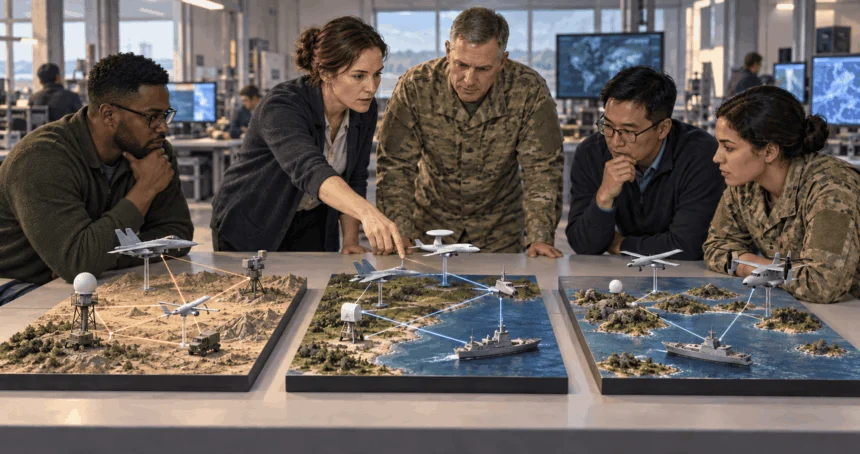
JADC2 isn’t a new weapon or piece of equipment. It’s a complete reimagining of how America fights wars. The concept aims to connect every sensor, platform, and soldier from all five military branches into a single, AI-powered network that spans land, sea, air, space, and cyberspace.
Think of it as creating a military nervous system where a satellite detecting a threat in the Pacific can instantly coordinate with an Army missile battery in Europe and a Navy destroyer in the Atlantic—all without human intervention slowing down the process.
The stakes couldn’t be higher. As China and Russia develop weapons specifically designed to exploit America’s military weaknesses, the Pentagon believes JADC2 is the only way to maintain superiority in future conflicts.
From Military Silos to Unified Networks
The Problem with Stovepipes
For decades, America’s military branches built their command systems in isolation. The Army developed networks that couldn’t talk to Navy systems. Air Force communications remained separate from Marine Corps operations. Military officials call these “stovepipes”—powerful but isolated systems that create dangerous gaps.
This fragmentation has plagued American forces from Grenada to the Gulf War. Soldiers have died because an Air Force pilot couldn’t instantly share target data with a Navy ship’s defensive systems. Critical information gets trapped in bureaucratic relay races when seconds matter most.
The Government Accountability Office has repeatedly flagged these interoperability failures as a national security risk. Each service optimized its own capabilities while ignoring the larger picture.
Breaking Down the Walls
JADC2 attacks this problem head-on by creating what military planners call a “common operating picture.” Every commander, from a platoon leader in Afghanistan to an admiral in the Pacific, would see the same real-time battlefield information.
The system follows a simple three-step process: sense, make sense, and act. Sensors across all domains continuously collect data. Artificial intelligence analyzes this information to identify threats and opportunities. Human commanders then direct responses with unprecedented speed and precision.
The Department of Defense strategy document describes this as moving from platform-centric to data-centric warfare. Information becomes the central organizing principle rather than individual weapons systems.
The Uber Model for Military Operations
Pentagon officials frequently explain JADC2 using the Uber analogy. When someone requests a ride, Uber’s algorithm instantly evaluates multiple variables—location, available drivers, traffic patterns, vehicle capacity—to find the optimal match and dispatch a car.
JADC2 would work similarly on the battlefield. When any sensor detects a target, the AI system would automatically determine the best “shooter” to engage it. This could be the nearest missile battery, the most strategically positioned fighter jet, or even a cyber weapon, depending on factors like range, ammunition availability, and rules of engagement.
The goal is automating this “sensor-to-shooter” process at machine speed. What currently takes hours or days would happen in minutes or seconds. During recent Army experiments, artificial intelligence named FIRESTORM has demonstrated kill chains that take mere seconds from target detection to weapon engagement.
This speed advantage could prove decisive against adversaries like China, whose military doctrine focuses on overwhelming American command systems before they can effectively respond.
From Joint to Combined Operations
Adding Allied Partners
The Pentagon recently updated JADC2 to CJADC2—Combined Joint All-Domain Command and Control. The “Combined” designation formally acknowledges that future conflicts will require allied participation.
This expansion reflects strategic reality. The National Defense Strategy identifies alliances as America’s critical advantage over competitors like China and Russia. But integrating allied systems creates enormous technical and security challenges.
Current efforts include the Mission Partner Environment and the Secret and Below Releasable Environment (SABRE), which aim to create frameworks for sharing classified data across different national systems. The challenge involves maintaining security while enabling real-time collaboration.
The Five Eyes Alliance
The Navy’s Project Overmatch recently achieved a historic milestone by signing an agreement with the Five Eyes intelligence alliance—Australia, Canada, New Zealand, the UK, and the US. This allows allied personnel to embed directly with development teams to ensure interoperability from the ground up.
The agreement represents a fundamental shift from trying to “bolt on” allied compatibility after systems are built to designing it into the architecture from the beginning.
Why JADC2 Matters Now
The China Challenge
The driving force behind JADC2’s urgency is the shift from counter-terrorism to great power competition. The 2018 National Defense Strategy officially pivoted American military focus toward China and Russia as near-peer adversaries.
These nations have studied American military operations for decades and developed sophisticated strategies to counter U.S. advantages. China’s approach, called “systems destruction warfare,” specifically targets American command and control networks.
Both China and Russia employ anti-access/area-denial (A2/AD) strategies using long-range missiles, advanced air defenses, and cyber weapons to prevent American forces from operating freely in key regions like the Indo-Pacific or Eastern Europe.
Eroding Military Advantage
Defense leaders acknowledge that America’s post-Cold War military dominance has eroded. In some areas, U.S. forces are now outranged and outgunned by adversary weapons systems.
The Air Force’s assessment notes that traditional American advantages in platform superiority no longer guarantee victory. Future conflicts will be won by whichever side can process information faster and coordinate responses more effectively.
JADC2 represents an attempt to regain competitive advantage through information superiority rather than platform superiority. The concept echoes the British success in the Battle of Britain, where radar networks and coordinated fighter response overcame German numerical superiority.
Information Advantage as Strategic Priority
The Pentagon’s strategy emphasizes achieving “information advantage”—the ability to see, understand, and act on information faster than opponents. This concept treats information itself as a weapon system.
Military strategists point to the “OODA Loop”—Observe, Orient, Decide, Act—developed by Colonel John Boyd. The theory suggests that whichever side can cycle through this loop faster gains decisive advantage by operating inside the opponent’s decision timeline.
JADC2 aims to compress this loop using artificial intelligence and automation. By presenting adversaries with multiple, complex threats faster than they can respond, the system would overwhelm their command structures and lead to paralysis.
The Technology Behind the Vision
Artificial Intelligence as the Brain
AI and machine learning form JADC2’s cognitive core. Modern military operations generate enormous data volumes that human analysts cannot process quickly enough for real-time decision-making.
The Defense Department mandate requires becoming an “AI-enabled force” by 2025, with JADC2 as the primary driver.
AI systems will perform several critical functions:
Automated Data Fusion: Algorithms will combine fragmented datasets from radar tracks, satellite imagery, signals intelligence, and cyber feeds to create unified battlefield pictures.
Predictive Threat Detection: Machine learning models will recognize patterns and anomalies that indicate emerging threats, providing early warning capabilities.
Decision Support: AI will analyze tactical situations, run thousands of simulations, and recommend optimal responses ranked by success probability and risk level.
Target Recognition: Automated systems will process sensor data to identify and classify potential targets, reducing targeting timelines from hours to seconds.
Cloud and Edge Computing
Cloud computing provides the backbone for JADC2’s massive data processing requirements. The Pentagon’s Joint Warfighting Cloud Capability contract represents a multi-billion dollar investment in scalable infrastructure.
However, cloud-only approaches create vulnerabilities. Communication delays between battlefield sensors and remote data centers—called latency—can be too slow for real-time operations. These links are also vulnerable to jamming or destruction.
Edge computing solves this problem by bringing processing power directly to the battlefield. Ruggedized servers in vehicles, aircraft, and even wearable soldier devices can process data locally, ensuring operations continue even when broader network connections are severed.
This hybrid architecture must intelligently manage data flow between central enterprise clouds and distributed tactical systems based on bandwidth availability, mission priority, and threat levels.
Advanced Networking Infrastructure
JADC2 requires creating a military “Internet of Things” with multiple overlapping network layers:
5G and Wireless Technologies: High-speed, low-latency connectivity links soldiers, vehicles, drones, and sensors on the battlefield while enabling mobile command posts that are harder to target.
Mobile Ad-Hoc Networks: Self-forming mesh networks where every node can receive, transmit, and relay data. If one component is destroyed, the network automatically reroutes through other nodes.
Space Transport Layer: The Space Development Agency is building a constellation of hundreds of small satellites in low-Earth orbit to provide global, persistent communications—the ultimate backbone connecting forces worldwide.
How Each Military Branch Contributes
Army Project Convergence
The Army leads Project Convergence, described as a “campaign of learning” that advances JADC2 through large-scale live-fire experiments and demonstrations.
Project Convergence focuses on integrating long-range precision fires with assets from other domains to support Multi-Domain Operations doctrine. Recent experiments have demonstrated sensor-to-shooter timelines measured in seconds rather than hours.
These exercises also test interoperability with international partners, including the UK and Australia, in scenarios focused on potential Indo-Pacific conflicts. The Army’s approach emphasizes practical validation over theoretical development.
Navy Project Overmatch
Project Overmatch represents the Navy and Marine Corps’ highly classified contribution to JADC2. The program supports Distributed Maritime Operations doctrine, which envisions fleets of manned and unmanned vessels operating across vast distances as coordinated units.
Key capabilities include delivering software updates to ships at sea, similar to smartphone updates, allowing rapid adaptation to new threats. The Navy is also eliminating proprietary network standards that prevent communication with other services.
Recent developments focus on creating robust digital ecosystems that can connect widely distributed naval forces while maintaining security and reliability.
Air Force Advanced Battle Management System
The Air Force and Space Force contribute through the Advanced Battle Management System (ABMS), often described as the foundation for a military internet of things.
ABMS is a “system of systems” including new hardware, software, digital infrastructure, and operational concepts. Early efforts outfit KC-46 tanker aircraft with communications pods that act as airborne gateways, translating and relaying data between advanced fighters and other force elements.
The program also develops cross-domain solutions allowing users to access data from multiple security levels on single devices—a critical capability for joint operations.
Space Force and the National Defense Space Architecture
The Space Force enables the entire JADC2 enterprise through the National Defense Space Architecture, built by the Space Development Agency.
Unlike traditional large, expensive satellites, this “proliferated” constellation uses hundreds of smaller, more affordable satellites in low-Earth orbit with two main components:
Transport Layer: A mesh network of cross-linked satellites providing resilient, low-latency communications across the globe.
Tracking Layer: Satellites with infrared sensors designed to detect and track advanced threats like hypersonic missiles.
Comparing Service Initiatives
| Initiative | Lead Service(s) | Primary Focus | Key Approach | JADC2 Contribution |
|---|---|---|---|---|
| Project Convergence | U.S. Army | Multi-Domain Operations | Live-fire experiments and demonstrations | Sensor-to-shooter validation for long-range fires |
| Project Overmatch | Navy/Marine Corps | Distributed Maritime Operations | Secretive network architecture development | Resilient naval command and control |
| Advanced Battle Management System | Air Force/Space Force | Military Internet of Things | Digital infrastructure and gateway technologies | Air and space connectivity backbone |
This service-led approach creates both opportunities and risks. Each branch can leverage domain expertise to develop tailored solutions, but parallel efforts risk creating new incompatible systems—perpetuating the original problem JADC2 was meant to solve.
Air Force officials warn that service efforts are “not aligned,” while the Government Accountability Office notes that the Air Force set ABMS requirements three years before the overarching JADC2 strategy was approved.
Major Implementation Challenges
Technical Hurdles
Interoperability Remains the Biggest Problem: True interoperability requires more than sending messages between systems—receiving systems must understand and use data seamlessly. Services currently use different messaging formats, data standards, and security protocols that prevent this integration.
During one recent experiment, Navy and Army systems couldn’t fully exchange messages due to software incompatibilities. Without common data standards and open architectures, JADC2 risks becoming a collection of well-connected but still-incompatible systems.
Cybersecurity Creates Unprecedented Attack Surface: A vast, interconnected network linking every sensor and shooter creates an enormous target for adversaries. JADC2 will face sophisticated cyberattacks and electronic warfare aimed at disrupting, degrading, or deceiving the network.
The Pentagon’s answer is implementing “Zero Trust” security across the enterprise by 2027. This framework operates on “never trust, always verify” principles, requiring continuous authentication and validation for all users and devices.
JADC2 creates a strategic paradox where its greatest strength—total connectivity—becomes its greatest weakness. Adversaries could theoretically achieve systemic effects by successfully attacking the network itself rather than defeating forces platform by platform.
Bureaucratic and Cultural Obstacles
Funding and Oversight Problems: JADC2 lacks a single, dedicated budget line item despite being a multi-billion dollar undertaking. Funding spreads across hundreds of different programs, making congressional oversight and progress tracking difficult.
Some analysts note that JADC2’s funding appears modest relative to its ambitions, creating a risky reliance on many small programs to produce large, integrated outcomes.
Acquisition Process Limitations: The Pentagon’s traditional acquisition system, designed for buying large platforms over decades, is poorly suited for software-centric capabilities requiring continuous updates.
Promising technologies like the DARPA-developed STITCHES program risk falling through bureaucratic cracks between research funding and long-term sustainment programs.
Cultural Resistance: Services have historically prioritized their own requirements and resist sharing data or ceding control. This requires shifting from “data ownership” to “data stewardship” where information becomes an enterprise asset.
Over-classification often prevents data sharing with those who need it, both within the U.S. military and with allied partners.
Strategic Criticisms
Some strategists offer fundamental critiques of JADC2’s technology-focused approach. They argue the concept’s emphasis on achieving “information advantage” through perfectly networked forces doubles down on an American way of war that adversaries are already designed to counter.
China’s military doctrine focuses on “systems destruction warfare” aimed at disintegrating opponent C4ISR networks. Critics contend JADC2’s pursuit of a single, all-encompassing network makes it a more centralized and vulnerable target.
These analysts advocate for true decentralization and operational resilience, empowering tactical commanders to make decisions with “minimum necessary data” rather than relying on potentially fragile super-networks.
Implementation Timeline and Current Progress
From Strategy to Action
Following the 2021 unclassified JADC2 strategy release, Deputy Secretary Kathleen Hicks signed the classified Implementation Plan on March 15, 2022. This document provides the roadmap moving from broad concept to concrete action with specific milestones, assigned responsibilities, and resource requirements.
Implementation focuses on delivering “minimum viable capabilities” that can be tested, refined, and scaled. In February 2024, the Pentagon announced delivery of the first CJADC2 capability combining software, data integration, and operational concepts.
A key focus area is U.S. Indo-Pacific Command, where legislation directs the Pentagon to deploy and demonstrate joint data integration layer prototypes and establish timelines for initial operational capability.
Transforming Military Operations
Successful JADC2 implementation will represent historic transformation from platform-centric to data-centric military forces. It will enable convergence of kinetic and non-kinetic effects from all domains, allowing commanders to orchestrate complex webs of actions presenting adversaries with multiple, simultaneous challenges.
This transformation will enable new operational concepts like Distributed Maritime Operations, where forces are more disaggregated but remain lethal through network connections. Future command posts may become small, mobile units rather than large, vulnerable fixed locations.
The network itself becomes a primary weapon system. Force lethality will be measured by network speed, resilience, and intelligence rather than individual platform power.
Ethical Questions About AI in Warfare
The Automation Dilemma
JADC2’s drive for speed pushes the military directly into complex debates about artificial intelligence in lethal decision-making. The concept of AI-accelerated “kill chains” raises profound questions about Lethal Autonomous Weapon Systems.
The JADC2 concept puts humans “on the loop” rather than “in the loop,” meaning autonomy levels in lethal decisions will be determined by software code and programmed rules of engagement. This operationalizes previously theoretical debates about autonomous weapons.
Key Ethical Concerns
Meaningful Human Control: How can the military ensure humans retain sufficient authority over lethal force use when decisions happen at machine speed?
Laws of War Compliance: Can AI systems be reliably programmed to follow complex, context-dependent principles like distinction between combatants and civilians and proportionality in attacks?
Automation Bias: Studies show humans, especially under stress, tend to over-trust automated system recommendations. This could lead commanders to approve AI-recommended strikes without proper scrutiny.
Lowering War Thresholds: Some analysts worry that autonomous systems reducing perceived human costs could make war decisions politically easier, potentially increasing global instability.
These challenges create practical problems as some leading commercial AI companies express reluctance to partner with the Pentagon, potentially limiting access to cutting-edge technology.
The Verdict: Revolution or Expensive Mistake?
JADC2 represents either the future of American military dominance or the most expensive technology gamble in Pentagon history. The concept’s success depends on overcoming unprecedented technical, bureaucratic, and strategic challenges while navigating complex ethical terrain.
The initiative’s ambitious timeline—achieving AI-enabled force status by 2025—creates enormous pressure for rapid progress despite systemic obstacles. Whether JADC2 delivers on its transformative promises or becomes another costly military technology failure will determine America’s military competitiveness for decades to come.
Early demonstrations show promise, but critics warn that focusing on technological solutions may miss fundamental questions about future warfare’s nature. The debate continues as billions of dollars and national security hang in the balance.
The coming years will test whether America can truly transform its military culture and technology infrastructure quickly enough to maintain advantages over adversaries who have spent decades preparing to exploit current weaknesses. JADC2’s ultimate success or failure will write the next chapter in military history.