Last updated 10 months ago. Our resources are updated regularly but please keep in mind that links, programs, policies, and contact information do change.
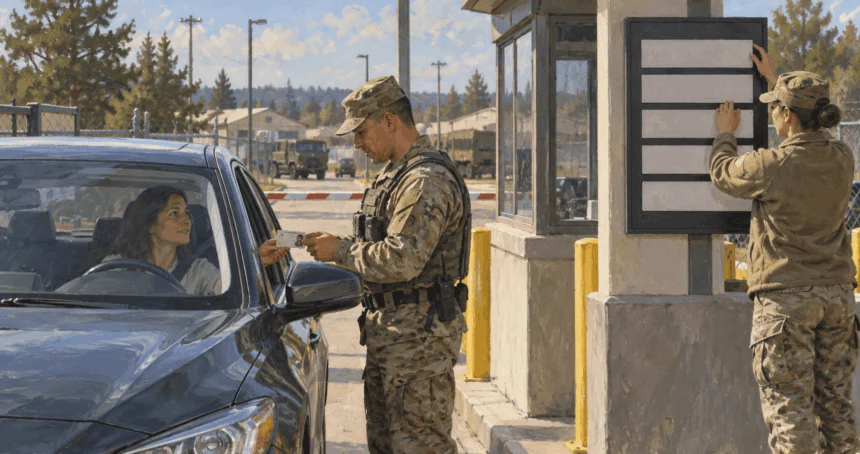
Drive past any U.S. military base and you’ll see them: small signs displaying colors or letters like “BRAVO” or “CHARLIE.” Most people ignore these cryptic markers, but they represent one of the most important security systems protecting American military personnel worldwide.
These signs display the current Force Protection Condition—FPCON—a standardized threat level that can determine whether you spend five minutes or five hours getting through the gate, whether base schools stay open, and whether thousands of military families hunker down in their homes during an emergency.
The system operates on five escalating levels, from NORMAL (routine security) to DELTA (imminent attack). Since September 11, 2001, no U.S. military installation has operated below BRAVO, meaning every American base worldwide maintains heightened security as the new normal.
What FPCON Actually Is
The Force Protection Condition system serves as the military’s standardized framework for identifying, preventing, and responding to terrorist threats against U.S. personnel, families, and facilities worldwide.
Think of it as a threat thermometer that triggers specific, mandatory security responses. When commanders change the FPCON level, they’re not making arbitrary decisions—they’re invoking pre-defined, legally sanctioned security measures mandated by DoD instructions.
The Strategic Framework
The Department of Defense aligns each FPCON level with a specific defensive strategy using the memorable formula: “Deter, Detect, Delay, Deny, Defend.”
FPCON NORMAL: Deter potential threats through routine security FPCON ALPHA: Detect signs of possible threats through increased vigilance
FPCON BRAVO: Delay adversaries’ ability to execute plans FPCON CHARLIE: Deny terrorists opportunities to carry out attacks FPCON DELTA: Defend against imminent or ongoing attacks
This framework helps everyone from gate guards to base commanders understand the purpose behind the security measures they implement.
A Brief History
The current FPCON system replaced an older, inconsistent framework called THREATCON in June 2001—just months before the 9/11 attacks that would permanently alter how it’s used.
The previous system varied significantly between military branches and locations, creating confusion and security gaps. FPCON standardized responses across the entire Department of Defense and avoided confusion with threat systems used by other agencies like the State Department.
The push for better security frameworks gained urgency after tragedies like the 1996 Khobar Towers bombing in Saudi Arabia, which killed 19 U.S. service members and highlighted vulnerabilities that standardized systems like FPCON aim to address.
The Five Threat Levels Explained
Each FPCON level represents a distinct security posture with specific protective measures. The levels are progressive—each one includes all measures from lower levels plus additional restrictions.
FPCON NORMAL: Routine Security
Threat Level: General global threat of possible terrorist activity exists, but no specific, credible threat against particular locations or people.
What It Means: This is the minimum baseline condition for all DoD installations. While life appears routine, foundational security measures are always active.
What You’ll See:
- Basic access control at installation gates
- Random vehicle and personnel searches
- Security forces securing unused buildings
- Mandatory annual antiterrorism training for all personnel
Impact on Daily Life: Minimal. Normal operations continue with baseline security procedures that most people barely notice.
FPCON ALPHA: Increased General Threat
Threat Level: Increased general threat of possible terrorist activity, but nature and extent unpredictable. Intelligence may indicate hostile group activity without specific targets or methods identified.
What It Means: Focus shifts from deterrence to active detection of suspicious activity. Measures must be sustainable indefinitely without major operational disruption.
What You’ll See:
- Installation leaders inform all personnel and families of heightened threat
- More frequent and thorough random security checks
- Increased coordination with local law enforcement
- Some installations implement “FPCON ALPHA+” with 100% ID checks
Impact on Daily Life: Noticeable but manageable. Slightly longer wait times at gates, more visible security presence, heightened awareness messages.
FPCON BRAVO: The New Normal
Threat Level: Increased or more predictable threat of terrorist activity. Intelligence provides some warning about preferred attack methods or general target regions, but without precise targets.
What It Means: This has been the minimum baseline for all U.S. installations since September 11, 2001. The “new normal” that fundamentally changed military life.
What You’ll See:
- Thorough inspection of large vehicles for explosives
- Parking areas and trash containers moved away from critical buildings
- More frequent visible security patrols with armed guards
- Mail and package screening
- Random Antiterrorism Measures creating unpredictable security checks
Impact on Daily Life: Noticeable security presence and procedures. Longer gate waits during peak hours, visible standoff distances around buildings, more stringent vehicle inspections.
The Permanent Shift: The fact that BRAVO became the baseline after 9/11 represents a permanent recalibration of acceptable risk. What was once considered heightened security is now routine, with lasting effects on military budgets, base architecture, and family stress levels.
FPCON CHARLIE: Attack is Likely
Threat Level: An incident has occurred in the area, or intelligence indicates terrorist action against specific targets or personnel is likely. The threat is no longer general—it’s targeted and probable.
What It Means: Significant escalation that will cause hardship and disrupt routine activities. This level creates a formidable, restrictive security environment designed to deny terrorists any opportunity to attack.
What You’ll See:
- Mandatory 100% ID checks for every person entering
- Some installation gates closed entirely
- Significant traffic delays and long lines
- Additional heavily armed security forces
- Curtailment plans activated—non-essential personnel ordered to leave or stay away
- All personal items inspected before entry
- Large gatherings postponed or cancelled
- Children escorted directly to and from on-base schools
Impact on Daily Life: Major disruption. Long commutes due to gate closures and 100% ID checks. Many civilian employees and contractors restricted from base. Family activities curtailed. Heightened stress and anxiety throughout the community.
FPCON DELTA: Attack Imminent or Occurring
Threat Level: Terrorist attack has just occurred in the immediate area, or intelligence indicates an imminent attack against specific locations or people. Direct, immediate threat requiring urgent response.
What It Means: Near-complete installation lockdown. All normal activity halts. Typically declared as localized condition not intended for more than a few days.
What You’ll See:
- All installation gates closed
- Access limited to mission-essential personnel and emergency responders only
- Personnel ordered to shelter in place in nearest secure building
- All routine base services shut down (commissary, exchange, clinics, recreation)
- All flights grounded except authorized security or medical responses
- Mass notification system (“Giant Voice”) activated with audible warnings
Impact on Daily Life: Complete disruption. No one enters or leaves the installation. Families in base housing shelter at home. Off-base families cannot access the installation. All normal life stops until the threat passes.
Who Makes the Call?
FPCON decisions follow a structured command process balancing threat intelligence with operational readiness. The authority operates as a “one-way ratchet”—local commanders can raise levels quickly but cannot lower them below regional minimums.
Regional Authority: Combatant Commanders
Ultimate authority for setting minimum FPCON levels rests with unified Combatant Commanders responsible for large geographic regions.
U.S. Northern Command (USNORTHCOM): Sets baseline FPCON for the continental United States, Alaska, Canada, and Mexico. Established in 2002 with the primary mission of homeland defense.
Other Commands: U.S. European Command, Indo-Pacific Command, and other combatant commands set FPCON levels for all U.S. bases in their theaters of operation.
Local Authority: Installation Commanders
Installation commanders have significant authority and responsibility within their areas:
Can Raise Levels: Local commanders can unilaterally elevate FPCON for their installation based on specific threats or suspicious activity.
Cannot Lower Levels: Commanders cannot reduce FPCON below the baseline set by their regional combatant commander.
One-Way Ratchet: This asymmetrical structure prioritizes risk aversion. The system trusts local commanders to react quickly to increasing threats but requires higher-level approval to lower security postures.
The Intelligence Engine
FPCON changes are intelligence-driven, requiring commanders to use “all available threat intelligence” for informed decisions.
Sources: Intelligence flows from national organizations like the Defense Intelligence Agency and NSA, plus service-specific units like Air Force Office of Special Investigations and Naval Criminal Investigative Service.
Local Analysis: Installation-level Threat Working Groups meet quarterly to develop terrorism threat assessments specific to their location. Antiterrorism Working Groups meet semi-annually to oversee overall security programs.
Continuous Process: These groups provide commanders with structured, ongoing analysis necessary for timely and appropriate FPCON decisions.
Real-World Impact on Daily Life
FPCON changes, particularly at higher levels, create profound effects on everyone associated with military installations.
At the Gates
The most immediate impact is on installation access. FPCON CHARLIE and DELTA create traffic nightmares:
100% ID Checks: Every single person must show identification, creating massive backups extending well beyond base perimeters.
Gate Closures: Some entrances close entirely, funneling all traffic through limited, heavily controlled entry points.
Vehicle Searches: Thorough inspections of vehicles can turn a five-minute commute into hours-long ordeals.
Restricted Access: Visitors, vendors, and most contractors find access severely limited or denied, disrupting supply chains and services.
For Employees: Mission-Essential Status
During FPCON CHARLIE or DELTA, every DoD employee and contractor must know whether they’re classified as “mission-essential” or “non-essential.”
Non-Essential Personnel: Directed to stay home or immediately leave the installation to reduce potential casualty numbers and clear areas for security forces.
Mission-Essential Personnel: Required to report for duty in high-threat environments, often with significant personal risk.
Supervisor Responsibility: Every employee must confirm their status with supervisors, creating anxiety and confusion during already stressful situations.
For Military Families
Elevated FPCONs can bring family life to a standstill:
Service Disruptions: Access to base schools, childcare centers, medical clinics, commissary, and exchange facilities becomes curtailed or completely cut off.
Shelter in Place: During FPCON DELTA, families in base housing must stay in their homes while off-base families cannot access the installation.
Children’s Safety: Schools may implement special procedures, including parent escorts for children traveling to and from school.
Emergency Preparedness: The DoD constantly advises military families to maintain comprehensive emergency plans and well-stocked emergency kits with 2-3 days of supplies for potential lockdowns.
Community Relations
The DoD acknowledges the high cost of security measures in its own guidance:
FPCON BRAVO: “May affect operational capability and military-civil relationships with local authorities” FPCON CHARLIE: “May create hardship and affect the activities of the unit and its personnel”
This reveals the constant tension commanders face between security needs and operational, financial, and social costs.
The Post-9/11 Reality
The permanent shift to FPCON BRAVO as baseline has created lasting changes:
Infrastructure: Mandatory standoff distances for new construction, altered base architecture Budgets: Ongoing costs for enhanced security measures Psychology: Normalized state of heightened alert affecting military families’ daily stress levels Operations: Routine procedures designed around higher threat assumptions
FPCON vs. Civilian Alert Systems
Military families often confuse FPCON with the Department of Homeland Security’s public alert system. While both address terrorism threats, they serve different purposes and audiences.
The National Terrorism Advisory System (NTAS)
The Department of Homeland Security replaced the familiar color-coded Homeland Security Advisory System with NTAS in 2011. This system informs the American public about terrorist threats rather than directing specific actions.
NTAS Bulletins: Describe current developments or general trends regarding terrorist threats (informational).
NTAS Alerts: Warn of specific, credible threats, divided into Elevated (credible threat exists) and Imminent (threat is credible, specific, and impending).
Sunset Provision: Unlike FPCON levels that remain active indefinitely, NTAS alerts expire on specific dates unless updated.
Key Differences
The fundamental difference is function:
FPCON: Prescriptive system directing mandatory security actions and protective measures that DoD components must take.
NTAS: Descriptive system informing and advising the public about threats and recommending precautionary steps.
Independent Operation: The systems often operate independently. A military installation might elevate to FPCON CHARLIE based on a local threat while no national NTAS alert exists, or vice versa.
FPCON vs. NTAS Comparison
| Feature | FPCON System | NTAS System |
|---|---|---|
| Agency | Department of Defense | Department of Homeland Security |
| Audience | Military personnel, DoD civilians, contractors, families | American public, first responders, agencies |
| Purpose | Mandatory security actions at military facilities | Information and recommendations for public |
| Application | DoD installations worldwide | U.S. homeland |
| Structure | Five progressive levels always in effect | Two advisory types issued only when needed |
| Example | Installation commander raises FPCON to CHARLIE due to specific threat, closing gates | DHS issues bulletin about new terrorist tactics overseas |
Your Role in Force Protection
The DoD’s security strategy recognizes that protection is a shared responsibility requiring vigilance from everyone in the military community.
See Something, Say Something
Security forces cannot be everywhere. The entire community serves as eyes and ears for installation protection through active threat reporting.
What to Watch For:
Surveillance: People recording activities, taking notes, drawing diagrams, or using binoculars near sensitive facilities.
Information Gathering: Attempts to gain information about security procedures, operational schedules, or personnel numbers through conversations, phone calls, or online inquiries.
Security Testing: Anyone testing security responses by approaching checkpoints and turning away, or trying to talk their way into restricted areas.
Suspicious Supplies: People attempting to acquire military uniforms, official identification, or emergency vehicles.
Dry Runs: Individuals or groups practicing actions or appearing out of place for their surroundings.
Reporting Channels:
- Local law enforcement or installation security forces (immediate threats)
- Army’s iSALUTE Suspicious Activity Report program
- DHS See Something, Say Something campaign
Personal Protection and Preparedness
Operations Security (OPSEC): Be mindful of what you discuss in public and online. Never share sensitive military information like deployment dates, troop movements, or security details on social media or in unsecured conversations.
Family Emergency Planning: Maintain comprehensive emergency plans and well-stocked emergency kits with supplies for potential base lockdowns during FPCON DELTA.
Official Guidance: The DoD’s “Antiterrorism Personal Protection Guide” provides detailed advice on home security, safe travel practices, and personal protection for military families.
Finding Current FPCON Levels
At Installation Gates: Every military installation must post current FPCON levels at all entrance gates.
Official Websites: Many installations display current FPCON prominently on their homepage, like Fort Gregg-Adams.
Mass Notification Systems: Installations use Alert! systems and official social media pages to communicate FPCON changes to their communities.
Mobile Apps: Some installations provide mobile apps with current status updates and emergency notifications.
Living with FPCON
For military families, understanding FPCON isn’t just about security—it’s about managing daily life in an environment where threat levels can change rapidly.
Practical Preparation
Emergency Kits: Maintain supplies for 2-3 days including non-perishable food, water, medications, baby formula, diapers, and other necessities.
Communication Plans: Establish family communication procedures for when base access is restricted or phone systems are overwhelmed.
Alternative Arrangements: Develop backup plans for childcare, medical appointments, and essential services that might be disrupted during elevated FPCON levels.
Documentation: Keep important documents accessible and copies stored securely both on and off base.
Managing Stress and Uncertainty
Stay Informed: Follow official channels for FPCON updates rather than relying on rumors or social media speculation.
Maintain Routines: When possible, stick to normal routines and activities to reduce anxiety, especially for children.
Community Support: Lean on military community networks and family readiness groups for mutual support during stressful periods.
Professional Help: Utilize military family support services if FPCON-related stress significantly impacts daily functioning.
Teaching Children
Age-Appropriate Explanations: Help children understand security measures without creating excessive fear.
Emergency Procedures: Teach children what to do during lockdowns or when separated from parents during FPCON changes.
Normalizing Security: Help children understand that visible security measures are protective, not threatening.
The Bigger Picture
The FPCON system represents more than colored signs at military gates—it’s a visible manifestation of how the September 11 attacks permanently altered American military life.
The New Normal
The decision to make FPCON BRAVO the baseline for all U.S. installations represents a fundamental shift in risk tolerance. What was once considered heightened security became routine, institutionalizing a state of elevated alert that has lasted over two decades.
This change affects:
Military Budgets: Billions in ongoing security costs Base Design: Mandatory standoff distances and hardened construction Family Life: Normalized security procedures and stress Community Relations: Changed interactions between military installations and surrounding civilian communities
Balancing Security and Mission
The FPCON system embodies the constant tension between protection and operation. Higher security levels provide better protection but at significant costs:
Operational Costs: Reduced efficiency, delayed missions, increased personnel requirements Economic Impact: Disrupted supply chains, limited civilian access, reduced local business Social Costs: Family stress, community isolation, decreased quality of life Strategic Risk: Potential mission degradation from excessive security focus
Looking Forward
As threats evolve, so too must the FPCON system. Future considerations include:
Cyber Threats: Integrating digital security with physical protection measures Evolving Tactics: Adapting to new terrorist methods and technologies Community Resilience: Building stronger partnerships with local communities Technology Integration: Using advanced systems for more efficient security
The signs at military gates will continue displaying FPCON levels, but their meaning extends far beyond simple threat indicators. They represent a security framework that touches every aspect of military community life, from morning commutes to family emergency planning to national defense strategy.
Understanding FPCON helps military families navigate this complex environment while contributing to the shared responsibility of protecting those who serve our nation. Whether you’re driving past a base as a curious civilian or living through your first FPCON CHARLIE as a new military spouse, these signs represent a commitment to security that defines modern military life.
The system isn’t perfect, and the costs are real. But for the millions of Americans who depend on military installations for their livelihoods, security, and way of life, FPCON provides a structured approach to managing an uncertain world. Those colored signs at the gate may seem cryptic to outsiders, but for the military community, they’re an essential part of daily life—a reminder that security is everyone’s responsibility and that protecting our defenders requires constant vigilance.