- ftc.gov2 links
- aboutamazon.com2 links
- fool.com
Last updated 4 months ago. Our resources are updated regularly but please keep in mind that links, programs, policies, and contact information do change.
Amazon dominates American commerce. The retail giant controls more than a third of all online sales, operates the world’s largest cloud computing platform, and employs over a million workers across the United States.
This enormous scale has attracted intense scrutiny from federal regulators. The Federal Trade Commission is pursuing a landmark antitrust lawsuit. Labor agencies are investigating warehouse safety conditions. Privacy watchdogs have fined the company for mishandling children’s data.
The regulatory battle spans three major areas: whether Amazon stifles competition, how it treats workers, and what it does with customer data. Each front represents a different challenge to the company’s business model.
In This Article
So What?
• Consumer effects: Choices about regulating Amazon will influence prices, selection, speed of delivery, and data privacy for millions of shoppers.
• Impact on workers: Labor reforms or increased unionization could improve conditions and benefits but might also change job structures or availability in fulfillment and delivery networks.
• Market and economic outcomes: Antitrust action could reshape competition in e-commerce and cloud services, affecting rivals, small businesses, and incentives for innovation.
• Policy precedent: How regulators handle Amazon may set templates for oversight of other tech giants like Google, Meta, and Apple.
• International influence: U.S. regulatory decisions could help shape global norms for competition, labor rights, and data privacy in the tech sector.
Amazon’s Massive Scale
E-commerce Dominance
Amazon commands 37.6% of the US online retail market, generating an estimated $447.4 billion in e-commerce revenue in 2024. Its closest competitor, Walmart, holds just 6.4% of the market. Apple follows at 3.6% and eBay at 3%.
Some analysts predict Amazon’s share will exceed 40% soon. In specific categories, the company’s dominance is even starker. Amazon controls an estimated 65% of the Books & Media market and 42% of Consumer Electronics.
Amazon Prime drives much of this success. The subscription service has over 181 million subscribers in the US and 250 million worldwide. This represents a significant portion of America’s 273 million e-commerce users. Prime and other subscription services generated $44.3 billion in global revenue for Amazon in 2024.
Beyond Retail
Amazon Web Services (AWS) dominates cloud computing with a 31-32% share of the global market. The cloud infrastructure market reached $330 billion in 2024. Microsoft Azure holds 21-23% and Google Cloud has 12%. AWS brought in $107.5 billion in revenue last year.
The company has quietly built the third-largest digital advertising business globally, behind only Google and Meta. Amazon’s advertising revenue hit $56.22 billion in 2024 and could exceed $67 billion soon.
Amazon’s entertainment arm competes directly with Netflix. Prime Video has 290 million users globally. The company has sold over 100 million Alexa-powered devices like the Echo smart speaker.
The Integrated Ecosystem
These different businesses create a powerful cycle. The retail platform generates massive consumer data about what people search for, buy, and consider buying. This data makes Amazon’s advertising platform extremely effective, attracting billions in ad revenue from sellers.
The vast logistics network and customer base make Fulfillment by Amazon nearly essential for sellers who want Prime shipping eligibility. High-margin businesses like AWS ($107.5 billion in revenue) and advertising ($56.2 billion) subsidize the low-margin retail business.
This allows Amazon to invest in lower prices and faster shipping, which strengthens its e-commerce dominance and attracts more Prime members. The cycle repeats, making it difficult for companies to compete with Amazon in any single area.
| Sector | Amazon’s Market Share | Closest Competitor | Competitor’s Share |
|---|---|---|---|
| US E-commerce | 37.6% | Walmart | 6.4% |
| Cloud Infrastructure (Global) | 31-32% | Microsoft Azure | 21-23% |
| Digital Advertising (Global) | 3rd Largest Player | Google / Meta | Dominant |
Economic Impact Claims
Amazon claims its investments have contributed over $1 trillion to US GDP since 2010. The company says it supports nearly 5 million jobs nationwide, including over 2 million indirect jobs in construction, logistics, and professional services.
More than 60% of sales in Amazon’s store come from independent sellers. These sellers employ over 1.8 million people in the US to support their Amazon-related operations, according to the company’s small business empowerment report.
Critics point to Amazon’s public subsidies. Good Jobs First reports that state and local governments have awarded Amazon over $4.7 billion in taxpayer-funded incentives for warehouses and data centers. These subsidies often divert public money from schools and infrastructure, critics argue.
The Antitrust Case
FTC’s Landmark Lawsuit
In September 2023, the Federal Trade Commission filed a sweeping antitrust lawsuit against Amazon. Seventeen state attorneys general joined the case. The trial is scheduled for October 2026.
The government alleges Amazon uses “interlocking anticompetitive and unfair strategies to illegally maintain its monopoly power.” The FTC defines two markets where Amazon allegedly abuses its dominance: the “online superstore market” for shoppers and the “market for online marketplace services” for sellers.
The FTC argues Amazon violates the law through “exclusionary conduct that prevents current competitors from growing and new competitors from emerging.”
Specific Allegations
Anti-Discounting Measures: Amazon allegedly punishes sellers who offer lower prices on competing websites. If Amazon’s pricing bots detect a lower price elsewhere, the company can bury that seller’s product in search results or remove them from the “Buy Box.”
An estimated 98% of sales occur through the Buy Box, making this placement crucial for sellers. Regulators argue this creates incentives that artificially inflate prices across the internet, as sellers must keep prices high on all channels to avoid Amazon penalties.
Fulfillment Requirements: The FTC alleges Amazon coerces sellers into using its costly Fulfillment by Amazon (FBA) service. Amazon conditions Prime eligibility on FBA usage, making it expensive for sellers to use alternative fulfillment providers or sell on other platforms.
Combined fees for FBA, advertising, and other required services force many sellers to pay close to 50% of their total revenues to Amazon, according to the FTC.
Seller Data Misuse: Lawmakers and regulators have investigated claims that Amazon uses non-public data from third-party sellers to develop competing private-label products. The claims under investigation hold that Amazon identifies best-selling items, accesses proprietary sales and inventory data, and then launches similar “Amazon Basics” products at lower prices.
Amazon has internal policies prohibiting this practice, but company executives, including former CEO Jeff Bezos, could not guarantee to Congress that violations never occurred.
Project Nessie: The FTC’s complaint described a pricing algorithm called “Project Nessie.” According to the complaint, this algorithm predicted whether competitors would follow Amazon’s price increases, and when Nessie determined other retailers would likely match a price hike, Amazon would raise prices and keep them elevated.
The FTC claims this practice generated over $1 billion in excess profits at consumers’ expense.
Amazon’s Defense
Amazon argues the FTC’s case is misguided and would harm consumers and small businesses. The company contends the government’s market definition is “artificially narrow” and ignores fierce competition from the entire retail sector, including Walmart and Target.
When viewed as part of the total US retail market, Amazon’s share is much smaller. Amazon maintains its actions are pro-competitive and designed to enhance customer experience through lower prices, wider selection, and convenient services like Prime and FBA.
The Phoenix Center found that Amazon’s prices are about 3.5% lower than main rivals on average, challenging the FTC’s claim that its practices lead to higher prices.
Labor Practices Under Scrutiny
OSHA Safety Violations
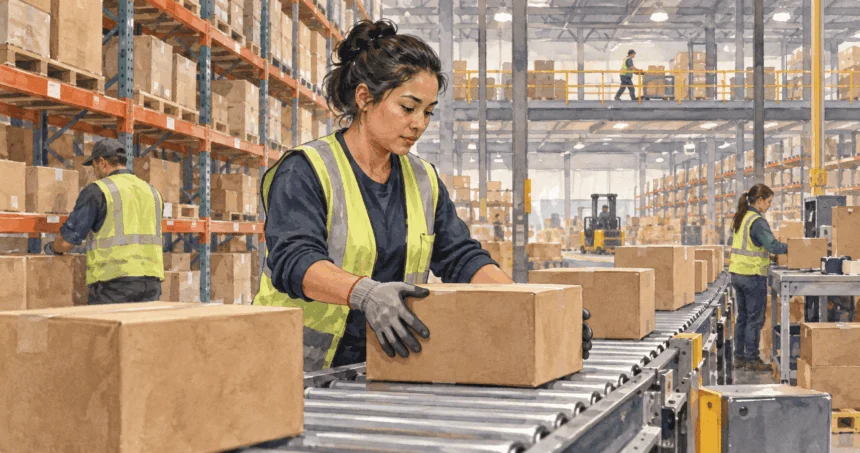
The Occupational Safety and Health Administration has conducted extensive investigations into Amazon facilities. These inspections resulted in numerous citations at warehouses in Colorado, Idaho, New York, Florida, and Illinois.
OSHA consistently finds that Amazon’s work processes expose employees to high risks of ergonomic hazards and musculoskeletal disorders like lower back injuries and carpal tunnel syndrome. Investigators directly link these injuries to core warehouse demands: high-frequency package lifting, heavy weights, awkward postures, and long hours needed to meet productivity quotas.
OSHA has stated that “Amazon’s operating methods are creating hazardous work conditions” and its “work processes were designed for speed but not safety.” Data shows injury rates at Amazon warehouses significantly exceed the general warehousing industry average.
In December 2024, Amazon reached a corporate-wide settlement with OSHA requiring comprehensive ergonomic risk assessments, enhanced safety training, and continued federal oversight.
The Algorithmic Boss
Amazon uses sophisticated surveillance systems to manage its workforce. This algorithmic boss tracks employee productivity in minute detail and real-time. Workers’ handheld scanners measure metrics like “Time off Task,” automatically flagging unscheduled inactivity periods.
Constant monitoring creates pressure to maintain rapid pace, which can lead workers to rush through tasks unsafely or avoid necessary rest breaks.
An international survey by UNI Global Union found over half of Amazon workers felt monitoring negatively impacted their physical (51%) and mental (57%) health. Many described feeling treated like a “robot” or “slave.”
France’s data protection authority fined Amazon €32 million in January 2024 for an employee monitoring system deemed “excessively intrusive” under GDPR.
Union Organizing
These conditions have fueled union organizing efforts. Despite Amazon’s active opposition to unionization, workers at the JFK8 fulfillment center in Staten Island voted to form the Amazon Labor Union (ALU) in April 2022. This became the first and only NLRB-recognized union at a US Amazon facility.
Amazon filed numerous objections to the election, alleging the ALU and NLRB regional office improperly influenced the vote. After lengthy review, an NLRB regional director overruled all objections and officially certified the union victory in January 2023.
NLRB officials have since accused Amazon of violating federal labor law through retaliation against union activists, firing of organizers, and refusal to bargain in good faith with the ALU.
The Speed-Safety Tension
The regulatory scrutiny reveals a direct link between Amazon’s consumer value proposition—fast, efficient delivery—and workplace conditions drawing government intervention. The operational model ensuring Prime packages arrive in two days or less is the same model OSHA and NLRB are investigating.
To achieve unparalleled delivery speeds at massive scale, Amazon engineers fulfillment centers around maximum productivity. This requires high-speed work, repetitive motions, and technology to constantly monitor performance and minimize downtime. OSHA investigators have linked these operational imperatives to high musculoskeletal injury rates.
Any regulatory action forcing changes to warehouse processes for safety could impact productivity. Productivity slowdowns could affect delivery speeds and operational costs, fundamental elements of Amazon Prime that millions value.
Amazon maintains it aims to be “the benchmark of safety excellence” and points to data showing its Lost Time Incident Rate improved 65% over five years. The company invested $2.2 billion in 2024 to increase average starting wages for fulfillment and transportation employees to over $22 per hour, with total average compensation exceeding $29 per hour including benefits.
Data Privacy Violations
The All-Knowing Store
Amazon’s business model runs on big data. Every click, search, and purchase is collected and analyzed to create a “360-degree view” of each user for personalized shopping experiences. The company’s recommendation engine, responsible for as much as 35% of total sales, results directly from this data collection.
Data collection extends into homes through Alexa-enabled devices like Echo speakers. These devices “always listen” for wake words. Once activated, they record voice commands and transmit them to Amazon’s cloud servers for processing and storage.
Children’s Privacy
In May 2023, the FTC and Department of Justice charged Amazon with violating the Children’s Online Privacy Protection Act (COPPA). The government alleged that Amazon retained children’s voice recordings and geolocation data indefinitely, even after parents requested deletion.
The FTC alleged Amazon “sacrificed privacy for profits,” using unlawfully retained voice data to train and improve the Alexa algorithm. Children’s speech patterns differ from adults’, making this data valuable.
Amazon agreed to pay a $25 million civil penalty and was court-ordered to overhaul data deletion practices, delete inactive child accounts, and stop using such data for algorithm development.
Ring Security
Amazon’s Ring subsidiary faced separate FTC action. The FTC alleged that Ring failed to implement basic cybersecurity protections and that these lapses enabled security breaches allowing hackers to control customers’ cameras. In one case, according to the FTC, a Ring employee spied on female customers for months.
Ring agreed to pay a $5.8 million settlement.
Privacy advocates like the Electronic Frontier Foundation have criticized Ring’s role in creating a vast, privately-owned surveillance network. The EFF warns about Ring’s past partnerships with thousands of police departments, arguing these arrangements facilitated warrantless police access to video footage and threatened privacy.
Following public pressure, Ring ended its formal police partnership program. However, the EFF warns the company is exploring new integrations that could again facilitate law enforcement access to camera footage.
Expanding Definition of Harm
Regulatory actions against Amazon’s data practices signal how government agencies are redefining “harm” in the digital age. Concern extends beyond direct financial injury to intangible and societal harms: erosion of personal privacy, chilling of free expression, and commercial exploitation of children’s data.
The FTC’s COPPA lawsuit took the position that using children’s data to train algorithms, even if it improves products, is unlawful when it prioritizes profit over legally protected privacy rights. The EFF’s Ring critique focuses on societal harm from pervasive surveillance infrastructure that can monitor public spaces and protests.
This broader harm definition challenges data-driven business models fundamental to Big Tech. It signals regulators’ increasing willingness to intervene in core data collection and algorithmic training processes driving products and profits.
Amazon states its commitment to privacy, asserting it has “built privacy into services from the ground up” and never sells individual customers’ personal data. The company points to its Privacy Notice and customer controls like the Alexa Privacy Hub for reviewing and deleting voice recordings.
Amazon highlights physical safeguards like microphone-off buttons and built-in camera shutters on Echo devices as evidence of privacy-by-design philosophy.
Regulatory Options
Multiple federal agencies are investigating Amazon across different areas:
| Agency | Full Name | Core Mission | Amazon Focus |
|---|---|---|---|
| FTC | Federal Trade Commission | Protect consumers and promote competition | Antitrust, consumer protection, data privacy |
| DOJ | Department of Justice | Enforce federal laws and ensure public safety | Antitrust partnership with FTC |
| OSHA | Occupational Safety and Health Administration | Ensure safe working conditions | Warehouse safety, ergonomic hazards |
| NLRB | National Labor Relations Board | Protect workers’ rights to organize | Union elections, unfair labor practices |
| SEC | Securities and Exchange Commission | Protect investors and maintain fair markets | Business practice disclosures |
Enforcement vs New Laws
One approach involves regulators using existing authority more forcefully. The FTC’s antitrust lawsuit builds on the Sherman Act of 1890 and Federal Trade Commission Act of 1914. Proponents argue these laws are flexible enough for modern digital markets and require renewed enforcement will rather than new legislation.
Many lawmakers and policy experts argue digital platforms’ unique nature requires new, tailored legislation. The bipartisan American Innovation and Choice Online Act (AICOA) would designate dominant online platforms as “covered platforms” and prohibit specific discriminatory conduct.
Key provisions would make it illegal for platforms like Amazon to “self-preference” their own products over competitors’ or use non-public business user data to develop competing products. The act would mandate interoperability with competing services, making market entry easier for new players.
Supporters believe AICOA would create clear rules fostering competition. Opponents, including Amazon, argue it would stifle innovation, degrade services like Prime, and compromise security and privacy.
The Breakup Option
The most controversial regulatory option is structural separation of Amazon’s businesses—”breaking up” the company. A 2020 House Judiciary Committee majority staff report argued this is the only way to resolve fundamental conflicts of interest in Amazon’s business model.
One proposal would separate Amazon’s retail marketplace from its first-party retail operations and private-label brands. This would force Amazon to choose between being the platform’s neutral operator or a seller on it.
Another proposal involves spinning off AWS into a completely independent company. This would prevent Amazon from using massive cloud computing profits to cross-subsidize its retail arm.
Breakup critics warn of severe negative consequences. They argue such radical intervention punishes success and would harm consumers by dismantling the integrated ecosystem making Amazon Prime possible. The convenience of fast, free shipping bundled with video streaming and other perks results directly from synergies between Amazon’s retail, logistics, and technology divisions.
Technical complexity would be staggering. Uncoupling AWS, which provides foundational cloud infrastructure for many Amazon services and millions of external businesses, would be unprecedented and potentially disruptive.
Economic Philosophy Battle
The debate over regulating Amazon represents a larger battle over US antitrust law’s future and economic philosophy. This conflict pits the long-reigning “consumer welfare standard” against a resurgent “Neo-Brandeisian” movement.
For four decades, US antitrust enforcement has followed the consumer welfare standard, primarily asking whether company actions harm consumers, typically through higher prices. From this perspective, Amazon often appears successful. Defenders argue the company consistently delivers lower prices, greater selection, and unparalleled convenience—direct consumer benefits.
A new school of thought, championed by figures like FTC Chair Lina Khan, argues this standard is dangerously narrow and ill-suited for the platform economy. In her influential 2017 paper “Amazon’s Antitrust Paradox,” Khan argued companies like Amazon can inflict deep, lasting harm on competitive landscapes by driving out rivals, squeezing suppliers, and stifling innovation while offering low consumer prices short-term.
This Neo-Brandeisian view, named for early 20th-century Supreme Court Justice Louis Brandeis, contends antitrust law should protect market structure itself from concentrated corporate power’s corrosive effects, not just shield consumers from high prices.
The FTC’s current Amazon lawsuit represents the most significant real-world application of this new philosophy. Its focus is on “exclusionary conduct,” power over sellers, and structural conflicts embedded in Amazon’s business model rather than consumer prices.
Various regulatory options represent different answers to this fundamental philosophical question. A “lighter touch” approach would reaffirm the traditional consumer welfare standard. AICOA passage would represent legislative decision to create new platform-era rules. Full structural breakup would express the ultimate Neo-Brandeisian view that market structure, not just short-term prices, is antitrust law’s primary concern.
This debate’s outcome will set powerful precedent for how the US government regulates all dominant technology companies in the 21st century.